
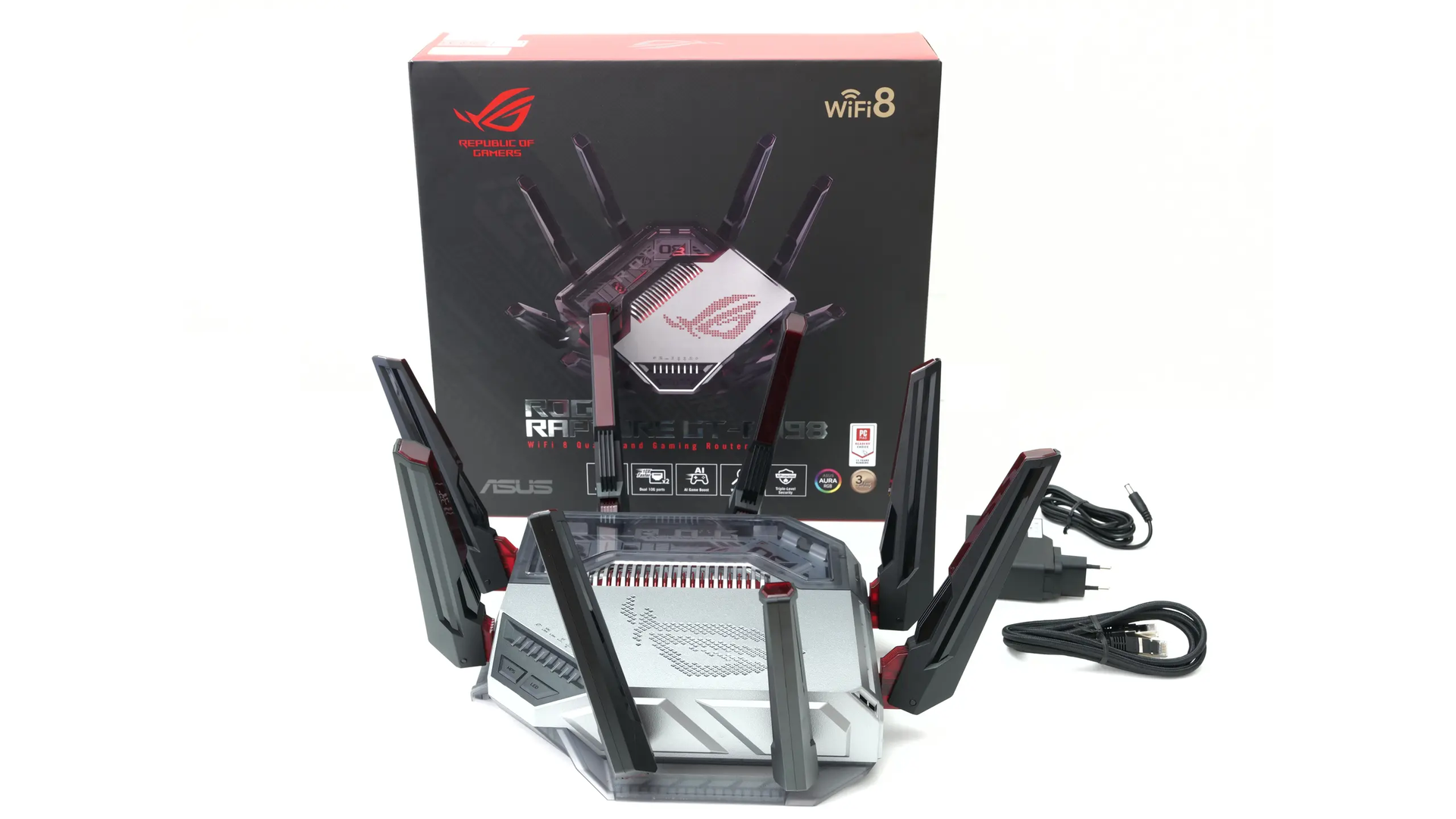
Asus has beaten every other manufacturer to market with the ROG Rapture GT-BN98, the world's first commercially available Wi-Fi 8 gaming router.
It's a bold flagship release for a wireless standard that isn't even finalized yet — and with zero Wi-Fi 8 client devices currently on sale, reviewers had to get creative just to test what it can actually do. I dug into three in-depth reviews to see whether it's worth buying now.
What reviews say
Build quality drew consistent praise. It's "extremely well constructed with very good attention to detail," said Blacktubi, while Guru3D leaned into the router's dramatic looks, joking that unboxing it feels like "a small alien spacecraft has crash-landed on the desk."
YouTuber Landpet was blunt about the performance side, calling it flat-out "an absolute beast of a router."
On paper, the GT-BN98's theoretical link rates are identical to its Wi-Fi 7 predecessor, the GT-BE98 — Blacktubi pointed out the headline numbers "are the exact same." But real-world range and throughput told a different story.
Design
Hiding it would be counterproductive, since the antennas require space to be positioned correctly and the chassis benefits from unobstructed airflow
Guru 3DThe chassis is large by any standard. It measures roughly 35cm by 35cm and weighs over 2kg. It needs "a proper, dedicated spot" rather than a small shelf, and ruling out wall mounting altogether given the size.
The antennas dominate the look, adjustable around the perimeter and giving the router an almost insect-like silhouette when fully extended. The top panel mixes a metallic finish with geometric detailing and translucent panels, plus the expected Aura RGB lighting.
Build quality feels solid throughout — no flex, clean panel fit, antenna arms that hold their position. Front-edge LEDs give a quick status read without opening the app.
Thermally, this Asus router added a thicker aluminum top plate and an upgraded heatsink layer for passive cooling. Stress testing turned up no signs of throttling.
Design & ports
Inside is a 2.6GHz quad-core processor and 2GB of RAM, running a quad-band radio setup — 2.4GHz, dual 5GHz bands, and a single 6GHz band — for a combined theoretical throughput of 25,000Mbps.
A North America-only "Pro" variant swaps the second 5GHz band for an extra 6GHz band on the UNII-8 spectrum, which isn't approved for use in most other regions.
For wired gear, there are two 10GbE ports (one general-purpose, one dedicated gaming port), four 2.5GbE ports, and a single gigabit port, with up to six LAN ports active depending on configuration. USB 3.2 Gen1 and USB 2.0 round things out for network storage or 4G/5G backup internet.
Performance
This is officially the fastest wireless backhaul router that I've tested, which is insane
LandpetReal-world speed testing — done entirely with Wi-Fi 7 client devices, since Wi-Fi 8 hardware doesn't exist yet — found wired and wireless backhaul holding up strongly even at 100 feet away
Over a wired 10G connection, speeds matched his 5 Gbps ISP plan exactly in both directions. On Wi-Fi, internet speeds hit 4.1 Gbps down and 2 Gbps up.
Local network testing — where speed isn't capped by the ISP — pushed even higher: 4.6 Gbps down and 4.2 Gbps up over wireless backhaul between two mesh units, with wired backhaul close behind at 4.5 Gbps down and 4.2 Gbps up.
Range held up well too. At 20ft, speeds stayed around 4 Gbps down; at 50ft outdoors, 2.7 Gbps down; and even at 100ft, it still managed 1.92 Gbps down, though upload dropped sharply to 718 Mbps.
A more controlled comparison, pairing two GT-BN98 units against two GT-BE98 units, found "significantly higher" throughput at long range with the newer hardware.
The more surprising finding: those gains aren't limited to future Wi-Fi 8 gear. Testing with an existing Wi-Fi 7 MacBook still measured "more than 10% higher average throughput" on the GT-BN98 versus the older Wi-Fi router — evidence that upgraded radio components benefit today's devices too, even without any Wi-Fi 8 features actually switched on.
Firmware
The ASUSWRT 6.0 was singled out as a real step up, with the interface "noticeably more modern and much more responsive" than Asus's decade-old firmware.
The headline addition is the new Adaptive QoE engine, which "smartly allocates network resources to balance gaming, streaming, and daily tasks," replacing the older Adaptive QoS system.
Security also got an upgrade via the revamped AiProtection suite, which was called "genuinely impressive" for including network-level ad and tracker blocking at no extra cost.
The new Wi-Fi Insight tool also correctly flagged interference from a Zigbee smart home devices on the 2.4GHz band, a decent addition which impressively “works as intended”.
Price
Pricing is still rolling out region by region ahead of the router's wider October 2026 launch.
The flagship GT-BN98 Pro is currently the only model on sale, listed on ASUS's Canadian eStore at CA$1,299.99.
A US launch price of around $899 has been floated by early previews but isn't yet official.
The standard GT-BN98 (non-Pro) has also been priced at €960 in Europe, though North American pricing for that specific model hasn't been confirmed yet.
Given the router is shipping ahead of Wi-Fi 8's official IEEE finalization — not expected until 2028 — buyers are paying an early-adopter premium on top of already-flagship router pricing.
Who should buy it
This is a router for enthusiasts buying ahead of the curve, not something you need for Wi-Fi 8 today — compatible client devices aren't expected until 2027 at the earliest.
Still, the benefits aren't purely theoretical: better range, backhaul speed, and firmware improvements apply right now, even to existing Wi-Fi 7 devices.
Verdict
The good
- Meaningfully better range and throughput, even on older Wi-Fi 7 devices
- Premium build quality with no thermal throttling under load
- Adaptive QoE and free-included ad/tracker blocking are genuine upgrades
The bad
- No Wi-Fi 8 client devices exist yet to fully prove the standard
- Large footprint requires dedicated desk space
- High price tag
The verdict
Worth it if you want the best router hardware available today and don't mind future-proofing ahead of the Wi-Fi 8 ecosystem. Hold off if you're not running multi-gig internet or don't need flagship-level range right now.
Swipe to scroll horizontally
Spec |
Detail |
|
Wi-Fi standard |
Wi-Fi 8 (802.11bn) |
Row 1 - Cell 2 |
Bands |
Quad-band: 2.4GHz, dual 5GHz, single 6GHz |
Row 2 - Cell 2 |
Max theoretical throughput |
25,000 Mbps combined |
Row 3 - Cell 2 |
Channel bandwidth |
Up to 320MHz, 4096-QAM |
Row 4 - Cell 2 |
Processor |
2.6GHz quad-core |
Row 5 - Cell 2 |
Memory |
2GB RAM |
Row 6 - Cell 2 |
Wired ports |
2x 10GbE, 4x 2.5GbE, 1x Gigabit |
Row 7 - Cell 2 |
USB |
1x USB 3.2 Gen1, 1x USB 2.0 |
Row 8 - Cell 2 |
Backup connectivity |
4G/5G cellular backup WAN |
Row 9 - Cell 2 |
Key software |
Adaptive QoE, WiFi Insight, AiMesh, Guest Network Pro, AiProtection, GTNet game acceleration |
Row 10 - Cell 2 |
Guest networks |
Up to 5 SSIDs via Guest Network Pro |
Row 11 - Cell 2 |
Dimensions/weight |
~35cm x 35cm, 2kg+ |
Row 12 - Cell 2 |

Follow TechRadar on Google News and add us as a preferred source to get our expert news, reviews, and opinion in your feeds.






 English (US) ·