
 3 weeks ago
35
3 weeks ago
35
For decades, scholars have been warning us about the dangers of nostalgia as a political tool. But scholars be damned, I’m having a lot of fun playing The Witcher 3 in 2026, and I’m not ashamed of it. The pleasure of rediscovering this classic also made me appreciate even more the excellent job that developer CD Projekt Red did in adapting Andrzej Sapkowski’s fantasy world in a way that is respectful and faithful, even if not entirely accurate to the source material.
CD Projekt Red released The Witcher 3: Wild Hunt — Remastered on Sept. 29, a free (on most platforms) update to the classic 2015 RPG that brings massive improvements to the game’s graphics, plus some much-needed fixes to gameplay elements. It’s no surprise, then, that Geralt’s most famous adventure is suddenly the highest-rated game of 2026 (well, on a technicality).
One quest in Blood and Wine shows how much CD Projekt Red cares about The Witcher
 CD Projekt Red/Warner Bros. Interactive Entertainment
I chose to start my latest foray into The Witcher 3 with the largest of its two expansions, Blood and Wine, which sends Geralt to the France-inspired nation of Toussaint. No matter how strong the pull of nostalgia is, this is not 2016, and I’m no longer a youngster with a lot of free time on my hands to play the game’s 200-ish-hour main campaign. Also, I realized I kind of skimmed through Blood and Wine the first time I played it, and that’s a mistake I wanted to rectify.
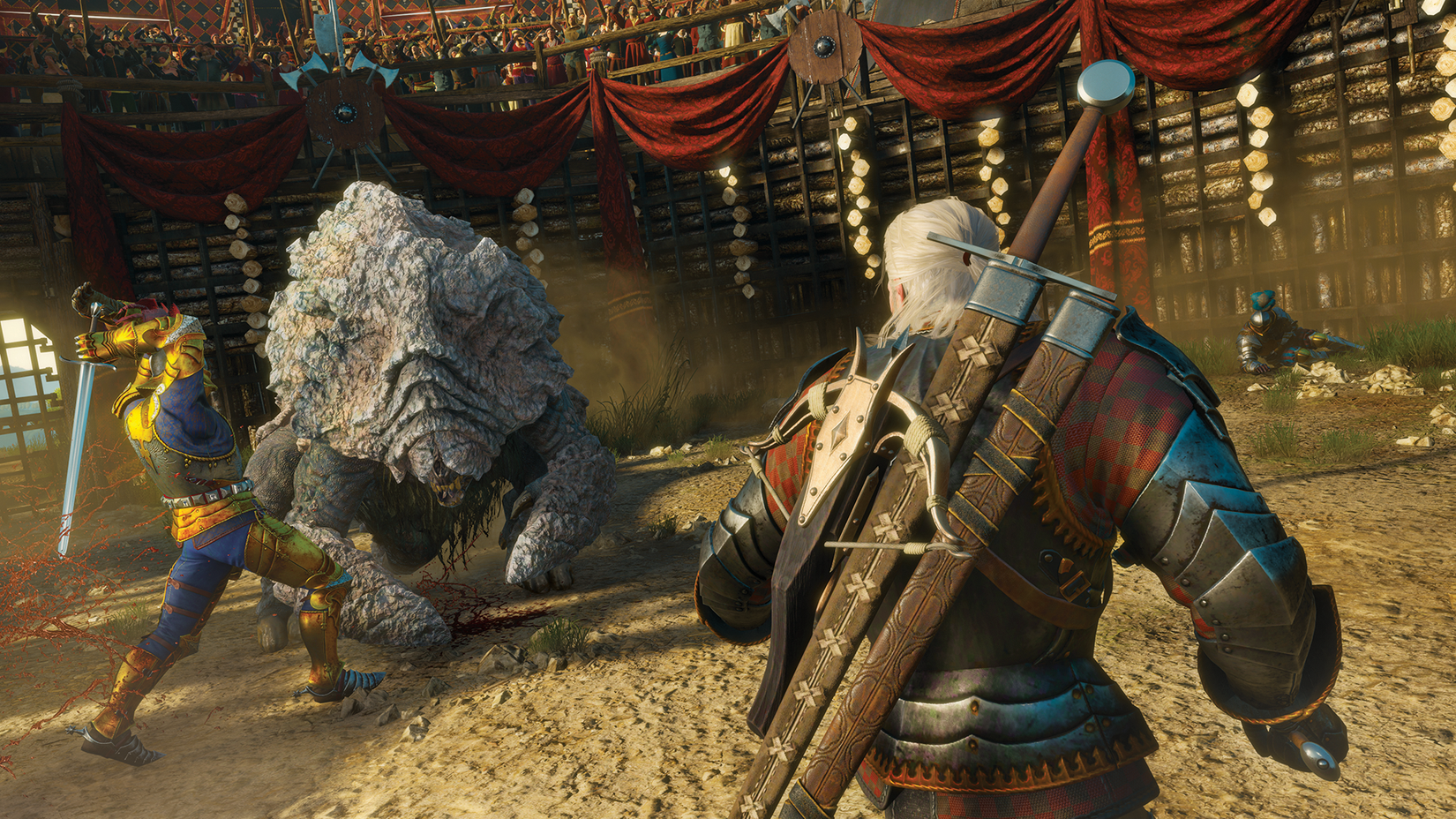
“The Warble of a Smitten Knight” is one of the first side quests you encounter in the expansion. Shortly after arriving in Touissant, Geralt meets young knight Guillaume de Launfale, who is trying to prove his love for fair maiden Vivienne by putting his body on the path of rampaging monsters. Guillaume noticed something odd about Vivienne and suspects she’s affected by a curse. Conveniently, a Witcher shows up at the right time to fix this mess.
However, Geralt will have to go the extra mile to fulfill this contract. The only way to get close to Vivienne is to take Guillaume’s place in the ongoing chivalric tournament. The quest itself is textbook The Witcher 3: the characters are colorful, the story is apparently simple but hides interesting twists, and the player has to make an important choice at the end that could have unexpectedly tragic consequences. It’s also a great example of how much CD Projekt Red cares about the source material that inspired the games.
When signing up for the tournament, Geralt will be asked to choose which of his two knightly titles he wants to use, Geralt of Rivia or Sir Ravix of Fourhorn. This may surprise fans who have only played the games. In fact, the White Wolf was knighted by Queen Meve of Lyria and Rivia for his heroic deeds during the Battle for the Bridge, as seen in Baptism of Fire, the third novel in the Witcher Saga. Funnily, this is also where the name “Geralt of Rivia” comes from: Geralt had previously used it as a made-up moniker, but after his knighting, it stuck with him.
Sir Ravix of Fourhorn is an even deeper cut. To get the reference, fans would have to go back to the very beginning of Geralt’s literary saga: the book The Last Wish, the first short story collection in The Witcher series. In the story “A Question of Price,” Geralt is invited by Queen Calanthe of Cintra to attend the betrothal celebration for her daughter Pavetta, under the alias of “Sir Ravix.” This is more than a cool Easter egg: Pavetta’s daughter is none other than Ciri. In “A Question of Price,” Geralt invokes the famous Law of Surprise that sets up his long-lasting relationship with Ciri, and by extension, the events of The Witcher 3.
 Image: CD Projekt Red
More characters from the books can be met during the quest, such as Prince Anséis and Arthur Tailles. That’s nothing new for fans of The Witcher games. From the first title in the series, CD Projekt Red showed great understanding and respect for the source material, along with a knack for using it to weave a compelling new story that rarely openly contradicts Sapkowski’s writing (and when it happens, it’s usually to bring back some characters, like Regis, who returns in Blood and Wine after dying in the books).
In a time of endless remakes and recycling of established IPs, more people should look at CD Projekt Red as an example, including the producers of the dreadful Netflix series The Witcher — but it’s too late for that.
What is their secret? Why are the Witcher games beloved by fans of the books as well? First, there’s a matter of shared cultural understanding. CD Projekt Red is a Polish studio, and Sapkowski is a Polish writer whose fantasy works are imbued with Polish and Slavic culture. It may sound obvious, but a shared cultural background helps people working on an existing IP see it as more than a way to make money. There’s less risk of someone “actively disliking or even mocking the source material," as Beau DeMayo, who was a writer for the first two seasons of Netflix’s The Witcher, said about the show’s writing room. (This claim was disputed by the producers, but it was indirectly corroborated by Henry Cavill, who often cited his wish “to tell the Witcher story properly” as one of the reasons he left the show.)
 Photo: Netflix
It’s true that Andrzej Sapkowski himself doesn’t see the games as part of his canon or a perfect adaptation of his world and characters, accusing them of taking minor elements of his works, such as Witcher schools, and blowing them out of proportion. Still, this is exactly why The Witcher games stand out: They don’t try to adapt the source material; they expand it.
All the Witcher games take place after the conclusion of the book series. This was a brave choice by CD Projekt Red. It insulated the games from direct comparison with the books and prevented the internet from filling up with endless lists detailing the ways they diverted from the source material. It gave the developers much more creative freedom, but it came with a big burden: Would they be able to craft a story that could at least be compared with Sapkowski’s decades of work? Just looking at The Witcher 3, a game that has been mostly praised for its story, that is still considered a masterpiece a decade after it came out, and that sold over 65 million copies, I think the answer is yes.
By crafting a different story from the source material, the games still didn’t escape comparison with the books, but that was limited to two aspects: the world and the characters. As for the latter, the RPG nature of the games means Geralt will inevitably feel different from his depiction in the books, depending on the choices players make. With the large supporting cast, CD Projekt Red has achieved various degrees of faithfulness to the books, but there have never been any egregious offenses. For example, it’s safe to say that Vesemir’s depiction in the games is a lot less rage-inducing than his appearance in the Netflix show, where he tries to forcibly inject Ciri with a mutagen substance.
 Photo: Jay Maidment/Netflix
In terms of depicting the world of The Witcher, CD Projekt Red really knocked it out of the park, and the shared cultural roots mentioned earlier are a big reason. Sapkowski’s fantasy world draws many elements from Eastern European folklore and the region's history, especially from the Middle Ages. It’s a dangerous world fraught with supernatural perils, but the darkness often comes from humans and their actions: war and discrimination are major themes and plot elements throughout the novels. Still, there is also whimsy and bittersweet humor, representing a duality that is often present in fairy tales and folk stories. The games preserve that duality effectively, adding a metatextual element coming from the nature of an open-world RPG.
Going back to “The Warble of a Smitten Knight” as an example, one of the two possible choices at the end leads to a truly tragic ending for some of the characters involved. However, throughout the quest you’ll also have to endure a herald who puts every announcement in annoying rhymes, or get into fisticuffs with a begrudging knight during a banquet.
 Image: New Line Cinema
A meaningful comparison can be made between the Witcher games and The Lord of the Rings movie trilogy. It’s not accurate to Tolkien’s works, but the movies’ faithfulness to the world depicted in the books and to the “spirit” of the source material led millions of fans to fall in love with them. Many of these fans discovered Tolkien’s works after watching their adaptation into another medium, as has been the case with Sapkowski’s The Witcher series.
On the other end of the spectrum, you have The Rings of Power and Netflix’s The Witcher, whose many sins go beyond a lack of accuracy to their source material, and beyond the scope of this article, too. Still, The Witcher 3’s second life in 2026 could be a useful lesson on not just how to make great games, but also how to handle an IP in a respectful manner that also creates a new, valuable addition to a beloved cultural property.





 English (US) ·