
CBS
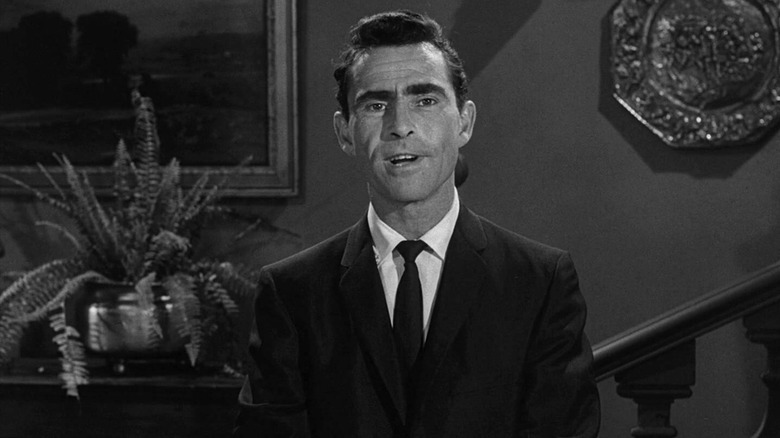
After the success of "The Twilight Zone" in the late 1950s and early '60s, creator Rod Serling became something of a celebrity on the lecture circuit. As such, one can easily find insightful older interviews where he comments on the then modern state of television, society itself, or exciting trends he saw in the sci-fi genre. For example, in one interview in 1970, Serling expressed his frustrations with "Star Trek: The Original Series." In a separate interview recorded in 1968, he was similarly critical towards noncommittal TV documentaries and talked about his outrage at institutionalized racism. Indeed, by appearing on camera in ”The Twilight Zone," he was able to cement his status as not just as a writer but also as a full-bore TV personality.
In May of 1971, Serling gave a lecture at UCLA and talked about his career, the craft of writing, the history (and cancellation) of "The Twilight Zone," and the over-commercialization of then modern TV. In an amusing aside, he even discussed watching Henry Kostur's 1953 Biblical epic "The Robe" on television and becoming confused. "There is a certain somber quality to the story of the crucifixion," he noted, "and the first time this thing is on the air, every 11 minutes, I don't have any idea who's being crucified, Christ or Arthur Godfrey. Because Arthur Godfrey is on the screen condescendingly patting some little kid's head, selling some s*** called Axion." Remember those Axion commercials?
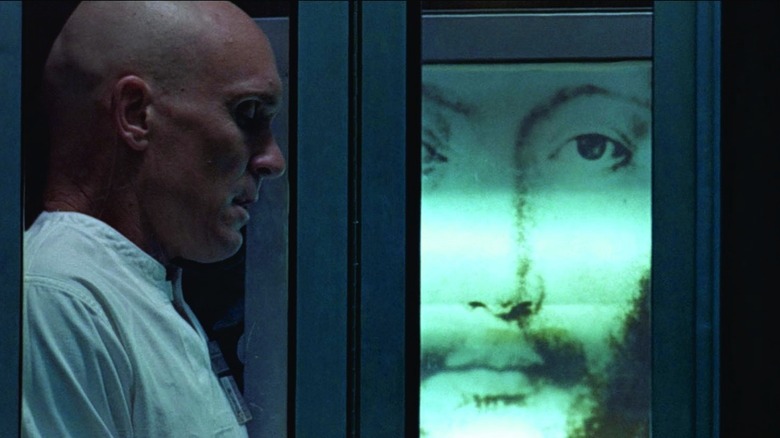
During his UCLA appearance, Serling was asked why science fiction seemed to be flagging in popularity. "Star Trek," the interviewer points out, was the last good sci-fi show, and it had gone off the air two years earlier. Serling countered that sci-fi was doing fine, as proven by the success of director George Lucas' then new film "THX 1138."
Rod Serling saw THX 1138 as a sign that sci-fi was thriving
American Zoetrope
The UCLA crowd gave a round of applause at the mention of "Star Trek," which was, at the time, only just being discovered by a mainstream audience in reruns. And while the interviewer used the failure of "Star Trek" as a bellwether for where sci-fi stood in the popular imagination, Serling corrected him by saying that "Star Trek" elicited an enthusiastic response from many folks. He added that "Star Trek" had only been canceled because it was too expensive to make, stating:
"'Star Trek' did not die on the vine due to any lack of popular reaction. It died from an economic case of [being] overweight. It was too damned expensive to do and derive a profit. And if you recall the show, it was beautifully, beautifully produced each week with an awful lot of hardware and a large cast. And the economics of television dictated that it leave by virtue of that."
Sci-fi, Serling argued, needn't present itself as some sort of beleaguered fringe genre with no support or a category of films that is only beloved by a tiny niche audience. In Serling's mind, sci-fi was always big.
Serling named two recent sci-fi films that could refute that sentiment. For one, director Stanley Kubrick's (ostensibly confusing) "2001: A Space Odyssey" was a box office smash in 1968. But more recently, Serling pointed to the success of "THX 1138" as a positive sign. Amusingly, Serling couldn't quite recall the title of the movie, and he could only remember director George Lucas as "some kid who went to UCLA." Lucas had, in fact, attended the University of Southern California, not UCLA, but Serling's mix-up is rather amusing since those schools have long been rivals in the college sports scene.
Rod Serling never got to see the Star Wars phenomenon
American Zoetrope
Rod Serling's passing comment on "THX 1138" was as follows:
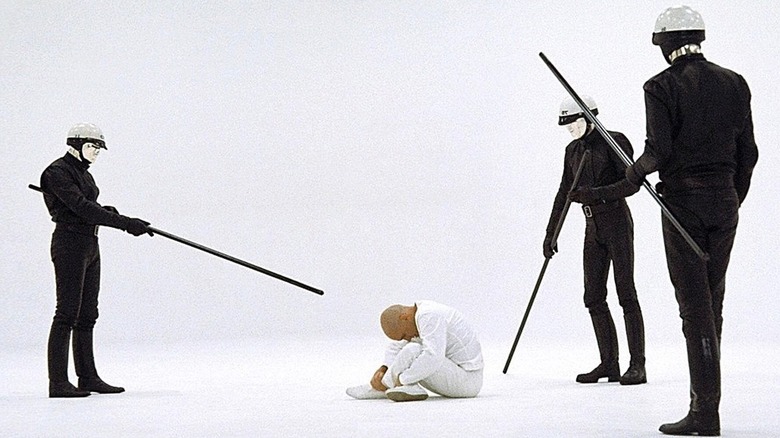
"This old saw, of science fiction appealing only to a small coterie of intellectuals (or non-intellectuals, whatever the case may be) is simply phony. Because '2001' — case in point — is one of the big grossers that Metro released. This rather obscure film, shot by a kid, I think, who originally went to UCLA. 'THX?' 'THX Something Something Something.' [...] Big, big box office smash! Very, very successful film. So, this business of science fiction appealing to a minute group is simply phony."
"THX 1138" was only really a commercial hit thanks to its low budget, but it was well received by critics and it's now regarded as something of a cult classic. George Lucas would, of course, go on to direct the 1973 nostalgia piece "American Graffiti" in 1973 before releasing "Star Wars: Episode IV — A New Hope" in 1977. The latter, a high-octane sci-fi visual effects-heavy bonanza, became ... well, you know what it became.
So, yeah, Lucas may be a household name now, but at one point in history, he was little more than "some kid from UCLA" to someone like Serling. One can also credit Serling for staying on top of his pop sci-fi entertainment, as "THX 1138" was brand new when he commented on it. He couldn't have even predicted that the "kid" he had mentioned would revolutionize science fiction some years later. Sadly, though, Serling died in 1975 at the age of 50, so we can only speculate as to what he would've made of "Star Wars" in general.







 English (US) ·