
 Image via HBO

Published Mar 12, 2026, 9:00 PM EDT
Carly Lane is an Atlanta-based writer and critic who has been with Collider in some form or fashion since 2021. She considers herself a television nerd, diehard romance/sci-fi/fantasy reader, and nascent horror lover. Her fondness of books is only eclipsed by the towering TBR that her shelves can't possibly contain.
She is the author of A REGENCY GUIDE TO MODERN LIFE: 1800s ADVICE ON 21ST CENTURY LOVE, FRIENDS, FUN AND MORE, published through DK Books (an imprint of Penguin Random House) and currently available wherever books are sold.
Sign in to your Collider account
Editor's note: The below interview contains spoilers for The Pitt Season 2 Episode 10.
As Noah Wyle and R. Scott Gemmill's hit HBO medical drama The Pitt nears the final third of Season 2, the current Fourth of July shift for the doctors and nurses of the fictional Pittsburgh Trauma Medical Center is only getting more intense. Now that the hospital has been forced to take its network offline to avoid a potential cyberattack, rising temperatures have also led to heightened stress, and the show's latest episode doesn't waste any time revealing how overwhelming the pressure can become.
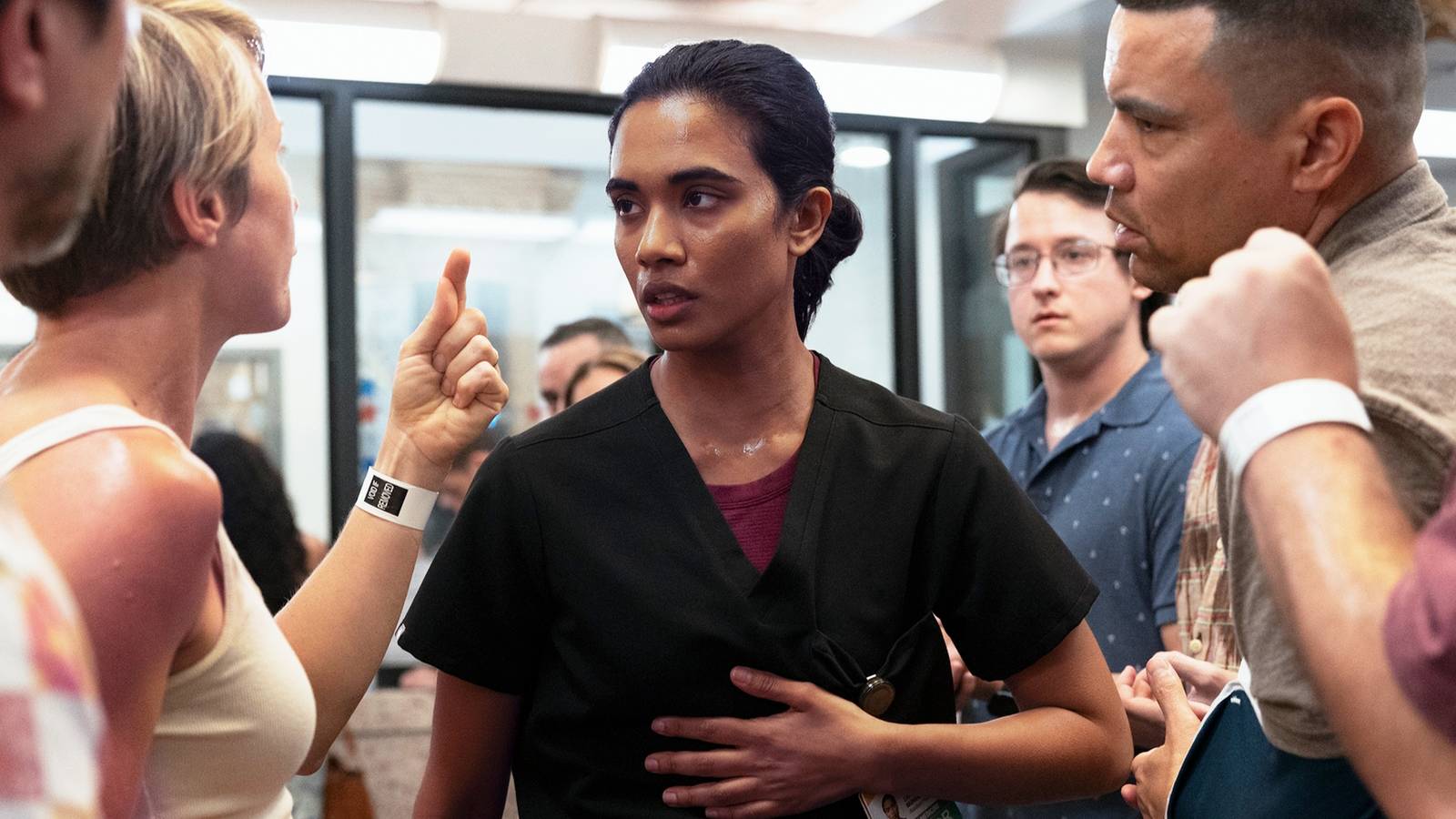
The season's latest hour, "4:00 P.M.," directed by Damian Marcano and written by Simran Baidwan, sees Dr. Samira Mohan (Supriya Ganesh) dealing with what turns out to be a panic attack, but there's little time for anyone to take a break — or for Dr. Robby (Wyle) to offer any real sympathy. Ahead of the episode's premiere, Collider had the opportunity to speak with Ganesh about Mohan's most pivotal moments in Episode 10, why having an intimacy coordinator on set for Mohan's panic attack sequence was essential, how that Episode 7 moment with Dr. Jack Abbot (Shawn Hatosy) — and Robby's non-apology for his harsh words — informs Mohan's decision to ask Abbot for a letter of recommendation instead, and more.
COLLIDER: As far as Mohan's panic attack is concerned, we see how slowly it builds up to that sort of crescendo moment when, by the time she's out in the waiting room, everything is just at its most overwhelming. Did you all try shoot it as sequentially as possible so that you, as the actor, were really able to go through the steps of building up to that moment?
SUPRIYA GANESH: Totally. Everything we do is filmed sequentially. Because of one location situation, something wasn't totally in sequence. There was one point where we just filmed something backwards where we hadn't... I forget the exact sequence of things, but there was one bit where I essentially had information about where I would end up as opposed to where I would start. It was just because of what location was available at what time, what made sense for production, but almost everything was sequentially shot.
We were getting ready to speak today, and then I saw the meme that was going around on X about you giving yourself food poisoning, and then you chimed in on it, which is really funny. But it did get me thinking about the amount of physicality that's involved in a sequence like this. Does the body always know the difference between acting and the real thing? Was there ever a period where you actually felt that overwhelmed in the moment, or was it a mind-over-matter situation?
GANESH: Yeah, it was incredibly draining. What really, in many ways, almost sent me over the edge was the breathing, because the breathing during a panic attack is really specific. I did a lot of research; even though I have my own experiences with it, everyone experiences a panic attack very differently. I wanted to make sure I was also incorporating things that other people experience, so I know that I'm not having a panic attack. A big thing for me was making sure my hands were clenching and unclenching several times, because that's not something I've experienced when I've had a panic attack, but that's something that a lot of other people have experienced. I think that was important for me to do, just that reminder of, "Oh, this isn't actually happening. This isn't what it feels like for me." But the breath, especially, there were points where I was like, "I'm going to hyperventilate. I need to be more careful."
Every patient who's in an extreme situation gets an intimacy coordinator on our show, so I got an intimacy coordinator for being a patient as Dr. Mohan. One thing I told her was just, "Hey, I need to know when the camera's actually rolling or when the director's deciding to roll the camera here, because if I'm doing this too long in the lead-up to it, I'm going to pass out." That was definitely helpful, to have someone in my corner in those moments.
Supriya Ganesh Reveals What Dr. Mohan's Biggest Takeaway Is From Robby's Harsh Words
"She's shocked by the intensity of it, but Robby's consistently hot and cold with her."
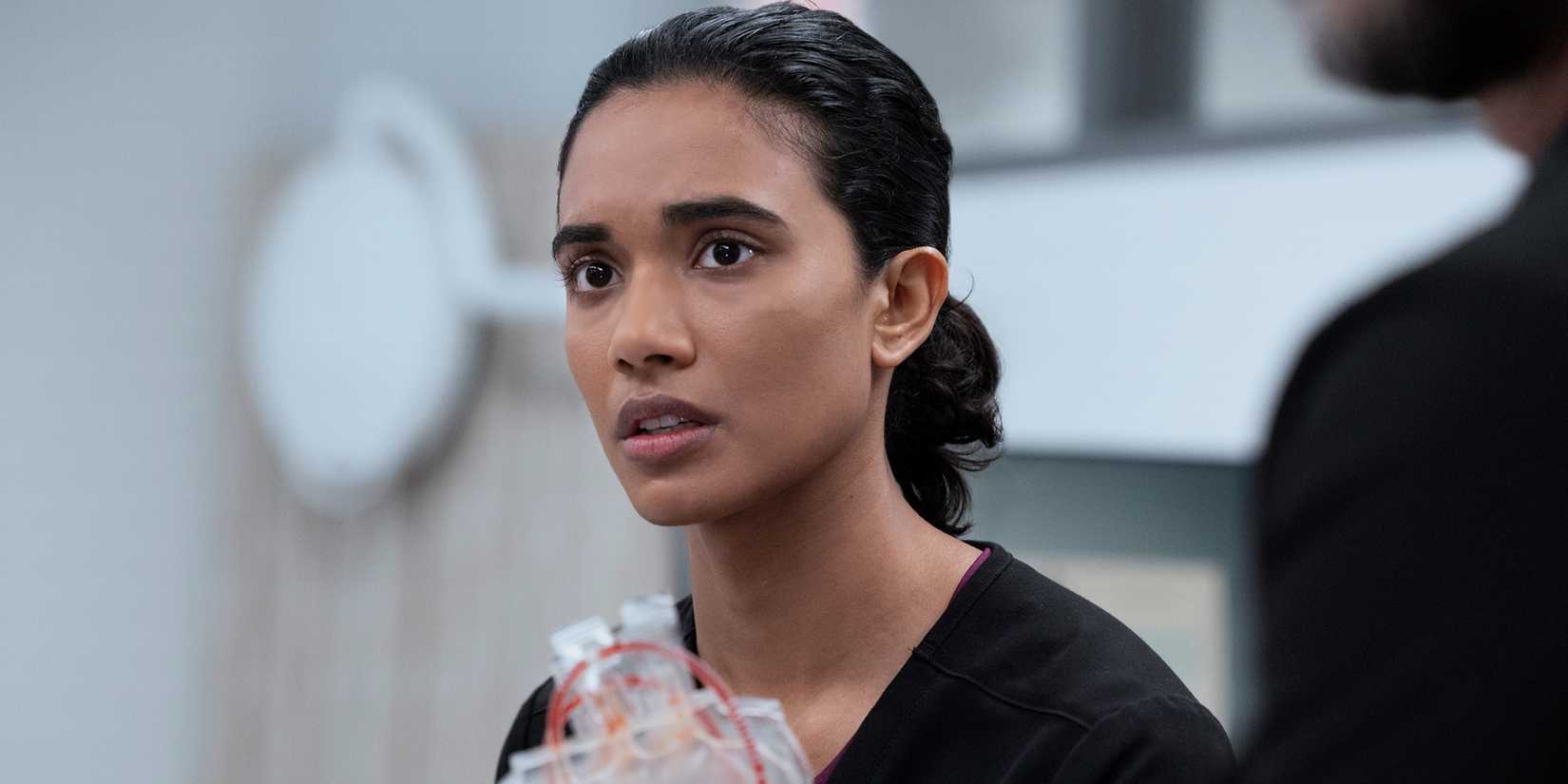 Image via HBO
Even the continuation of that sequence, with Joy bringing Mohan into a patient room, Langdon gets involved, and then Langdon realizes they need to bring Robby in. As we've seen so far this season, Robby is in a state already, and it feels like he gets pulled in at the worst possible time, and he's not very sympathetic to what Mohan is going through. Despite him delivering it in the harshest possible terms, is there anything about his reaction that clarifies anything for Mohan or allows her to understand where this intense reaction is coming from?
GANESH: Totally. When he names it as a panic attack, that's definitely the first time that she's really considering it. I think subconsciously, she knows. I think Langdon definitely knows. I haven't seen the cut, but something that Patrick [Ball] and I improvised was him breathing with me, where he's telling me to calm down. That's something that was totally improvised, because we were filming this bit, and we kind of were like, "Wait, she is calmer," in between now and when Robby shows up. That was really great. So I think it's something that a lot of people in the room know. Robby's the first one to name it, and Samira only realizes in that moment that's what it is.
Even though there are signs, I think the biggest sign is [that] they didn't cut her shirt off. That was something that we definitely discussed as a team, if that made sense for the doctors to do. Because any other patient having some sort of myocardial situation, we're cutting the shirt off to put an EKG lead on. But I think the conclusion was that Langdon's getting the sense that this is more psychological than physical. Or, it is a physical reaction, but it is more of a panic attack than a heart attack. And yeah, it's something that other people can catch onto, but she doesn't really know until Robby says it.

Related
‘The Pitt’s Shawn Hatosy Explains What Abbot and Robby’s Episode 9 Conversation Really Means
Hatosy also reveals why he was "nervous" to make his directorial debut on 'The Pitt' and the truth behind last week's Mohan/Abbot scene.
They leave things on not great terms, at least until the end of the episode, because he does circle back to check on her, and it's a little frosty at first. What's great is that she's willing to call him out on his behavior, and he's willing to own up to it at the same time. Do you think that there's any possibility of that interaction lingering over the shift, or do you feel like, from Mohan's perspective, she just wants to drop it and move on at this point?
GANESH: Yes, he does apologize, but it's not really the ideal apology. He's kind of like, "I'm sorry, but also pull yourself up by your bootstraps and get your shit together." It's one of those things. I don't think, as Mo, I really felt held by that apology. But I think she's not surprised. She's shocked by the intensity of it, but Robby's consistently hot and cold with her. It's a very paternal type of dynamic where you're not sure whether it's going to be a good day or bad day, especially with that type of fraught relationship. For her, she just wants to continue to impress him and feel... especially because she's looking for a place at PTMC next year, and she's a little like, "Okay, should I ask him for a recommendation?" She just wants to be on good terms with him, so she isn't really picking at him in the same way as he does in the following hours. I definitely think she's hoping she can get back on his good side.
Supriya Ganesh Explains How Mohan's Panic Attack Changes Things in 'The Pitt' Season 2
"She's someone who's really hard on herself..."
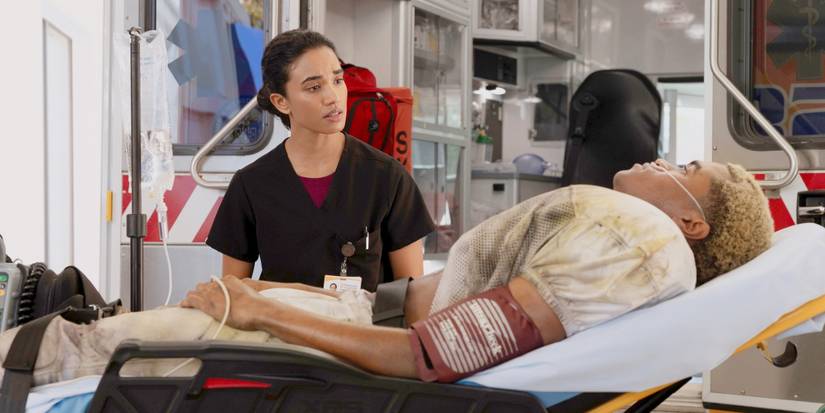 Image via HBO Max
You've already touched on it in that moment, when he tells her, "Stop feeling sorry for yourself, focus on your patients." When we've talked before about the character, she does feel very patient-focused as far as her approach to medicine, but maybe she's been getting sidetracked by other things, like the constant calls from her mom. Do you feel like Mohan has internalized anything about not wanting to let herself get to this point again?
GANESH: She's someone who's really hard on herself, so I don't even think she recognizes what Robby did was bad or potentially even a traumatic moment for her until after the fact. Because the entire time she's trying to go like, "No, I'm okay. I'm sorry. I'm okay." I think that she's aware of how many people are in the room and whether that tone was appropriate. There's a version of what he's saying that she's probably saying to herself, like there's a patient she isn't able to treat because of this. I definitely think there are gears turning of like, "Okay, what do I need to do to manage this so that it doesn't affect my work like this again?" But that's also just not how mental health works. You can't really predict that you're going to have a panic attack. What if this is something she's predisposed to? I think it's a complicated question that is worth exploring.
Collider Exclusive · TV Medicine Quiz
Which Fictional Hospital
Would You Work Best In?
The Pitt · ER · Grey's Anatomy · House · Scrubs
Five hospitals. Five completely different ways medicine goes sideways on television — brutal, chaotic, romantic, brilliant, and ridiculous. Only one of them is the ward your instincts were built for. Ten questions will figure out exactly where you belong.
🚨The Pitt
🏥ER
💉Grey's Anatomy
🔬House
🩺Scrubs
FIND YOUR HOSPITAL →
01
A critical patient comes through the door. What's your first instinct? Medicine under pressure reveals who you actually are.
AStay completely present — block everything else out and work through it step by step, right now. BTriage fast and delegate — get the right people on the right problems immediately. CTrust my gut and move — I work best when I stop overthinking and just act. DAsk the question everyone else is ignoring — what's the thing that doesn't fit? ETake a breath, make a joke to cut the tension, and then get to work — panic helps no one.
NEXT QUESTION →
02
Why did you go into medicine in the first place? The honest answer says more about you than the one you'd give in an interview.
ABecause I wanted to be where it matters most — right at the edge, when someone's life is actually on the line. BBecause I wanted to help people — genuinely, one patient at a time, in a system that makes it hard. CBecause I was drawn to the intensity of it — the stakes, the drama, the feeling of being fully alive. DBecause medicine is the most interesting puzzle there is — and I needed a problem worth solving. EBecause I wanted to make a difference — and also, honestly, I didn't know what else to do with my life.
NEXT QUESTION →
03
What do you actually want from the people you work with? Who you want beside you under pressure is who you are.
ACompetence and calm — I need people who don't fall apart when things get bad. BTrust and reliability — I want to know that when I pass something off, it's handled. CConnection — I want colleagues who become family, even if that gets complicated. DIntelligence and the willingness to be challenged — I have no interest in people who just agree with me. EFriendship — people I actually like spending twelve hours a day with, because those hours are going to happen either way.
NEXT QUESTION →
04
How do you actually perform under extreme pressure? The worst shifts reveal things about you that the good ones never will.
AI narrow in — everything irrelevant falls away and I become completely focused on what's in front of me. BI lead — pressure is when I'm at my most useful, keeping everyone else on track while managing my own fear. CI feel it fully and work through it — I don't pretend the fear isn't there, I just don't let it win. DI get sharper — high stakes are clarifying. This is exactly the environment I think best in. EI hold it together in the moment and fall apart slightly afterwards — which I've made my peace with.
NEXT QUESTION →
05
You lose a patient you fought hard to save. How do you carry it? Every doctor who's worked a long shift has had to answer this question.
AI carry it. All of it. I don't look for ways to put it down — that weight is part of doing this work honestly. BI process it and move — you have to, or the next patient suffers for the one you just lost. CI feel it deeply and lean on the people around me — I don't think you're supposed to handle that alone. DI go back over every decision — not to punish myself, but because I need to understand what I missed. EI grieve it genuinely, find some way to laugh about something unrelated, and try to be kind to myself — imperfectly.
NEXT QUESTION →
06
How would your colleagues describe the way you work? Your reputation on the floor is usually more accurate than your self-image.
AIntense and completely present — no small talk during a shift, but exactly who you want there. BSteady and dependable — not the flashiest in the room but never the one who drops something. CPassionate and occasionally chaotic — brilliant on the hard cases, prone to drama everywhere else. DBrilliant and difficult — right more often than anyone else, and everyone knows it, including me. EWarm and self-deprecating — not the most intimidating presence, but genuinely good at this and easy to like.
NEXT QUESTION →
07
How do you feel about hospital protocol and procedure? Every institution has rules. What you do with them is a choice.
AProtocol is the floor, not the ceiling — I follow it until the patient needs something it can't provide. BI respect it — the system is broken in places, but the structure is there for a reason and I work within it. CI follow it until my instincts tell me not to — and my instincts are usually right, even when they cause problems. DRules are for people who haven't thought hard enough about when to break them. EI try to follow it and mostly do — with a few memorable exceptions that still come up in meetings.
NEXT QUESTION →
08
What kind of medical work do you find most compelling? What draws your attention when you walk through those doors matters.
AEmergency and trauma — I want to see everything, handle anything, and never know what's coming next. BGeneral emergency medicine — breadth over depth, keeping the whole machine running under impossible conditions. CSurgery — I want to be in the room where the most consequential thing happening is happening right now. DDiagnostics — the cases no one else can solve, the symptoms that don't add up, the answer hiding underneath everything. EWhatever needs doing — I'm a generalist at heart and I find something interesting in almost every patient.
NEXT QUESTION →
09
What does this job cost you personally? Nobody works in medicine without paying a price. What's yours?
AEverything outside these walls — I've given this job my full attention and the rest of my life has gone around it. BMy idealism, mostly — I came in believing the system could be fixed and I've made a complicated peace with that. CStability — my personal life has been as chaotic as the OR, and that's not entirely a coincidence. DMy relationships — I am not easy to know, and the people who've tried to would probably agree. EMy sense of gravity — I use humour as a coping mechanism, which not everyone appreciates in a hospital.
NEXT QUESTION →
10
At the end of a long shift, what keeps you coming back? The answer to this question is the most honest thing about you.
AThe fact that it's real — that nothing else I could be doing would matter this much, right now, today. BThe patients — individual human beings who needed something and got it because I was there. CThe people I work with — I have walked through impossible things with these people and I'd do it again. DThe next unsolved case — there's always another puzzle, and I'm not done yet. EBecause despite everything — the exhaustion, the loss, the absurdity — I actually love this job.
REVEAL MY HOSPITAL →
Your Assignment Has Been Made You Belong In…
Your answers have pointed to one fictional hospital above all others. This is the ward your instincts, your temperament, and your particular brand of dysfunction were built for.
The Pitt
You are built for the most unsparing version of emergency medicine television has ever shown. The Pitt doesn't romanticise the work — it puts you inside a single fifteen-hour shift and doesn't let you look away. You are someone who needs their work to be real, who finds meaning not in the drama surrounding medicine but in medicine itself, and who has made peace with the fact that this job will take from you constantly and give back in ways that are harder to name. You don't need the chaos to be aestheticised. You need it to be honest. Pittsburgh Trauma Medical Center is exactly that — and you would not want to be anywhere else.
ER
You are the person who keeps the whole floor running — not the most brilliant in the room, but possibly the most essential. County General is built on the shoulders of people who show up, do the work, absorb the losses, and come back the next day without requiring the job to be anything other than what it is. You care deeply about patients as individual human beings, you believe in the system even when it fails you, and you understand that emergency medicine at its core is about holding the line between order and chaos for just long enough. ER is television about endurance, and you have it.
Grey's Anatomy
You came to medicine with your whole self — your ambition, your emotions, your relationships, your history — and you have never quite managed to leave any of it at the door. Grey Sloan is a hospital where the personal and the professional are permanently, chaotically entangled, and where that entanglement produces both the greatest disasters and the most remarkable saves. You are someone who feels things fully, who forms deep attachments to the people you work with, and who understands that the most extraordinary medicine often happens at the intersection of clinical skill and profound human connection. It's messy here. You would not have it any other way.
House
You are drawn to the problem above everything else. Not the patient as a person — though you are capable of caring, even if you'd deny it — but the case as a puzzle, the symptom that doesn't fit, the diagnosis hiding underneath the obvious one. Princeton-Plainsboro is a hospital that exists to house one extraordinary, impossible mind, and everyone around that mind is there because they are smart enough and stubborn enough to keep up. You work best when the stakes are highest, when the standard answer is wrong, and when the only way forward is to think harder than everyone else in the room. That is exactly what you would do here.
Scrubs
You understand that medicine is tragic and absurd in almost equal measure, and that the only sane response is to hold both of those things at the same time. Sacred Heart is a hospital where the laughter and the grief are genuinely inseparable — where a terrible joke can get you through a terrible moment, and where the most ridiculous people are also, on their best days, remarkably good doctors. You are warm, self-aware, and funnier than most people in your field. You lean on the people around you and you let them lean back. Scrubs is a show about learning to become someone worthy of the job — and you are still very much in the middle of that process, which is exactly right.
↻ RETAKE THE QUIZ
You mentioned Mohan wanting a letter of recommendation from Robby, and there is a moment in this episode where she mentions she was hoping to circle up with Abbot to ask him for one. Her decision about what kind of specialty she wants to pursue has been hovering over her storyline this season. Do you feel like she's any closer to deciding what she wants to do than before, or is this question going to continue even heading into Season 3?
GANESH: If she starts the day with that question, it's very likely she's going to end the day with that question. If we wanted to push things along like that, things wouldn't be interesting. So I definitely think that she's asking for the recommendation because she would like to stay, but I don't know if that's something that initially gets resolved.
I previously spoke with Shawn [Hatosy] about that scene between Abbot and Mohan, but I was curious about your perspective on this, because I was really interested in how both characters come out of that interaction. Abbot's offer to handle Orlando's supplies, that sort of gesture, does that change Mohan's view of him at all?
GANESH: I think it's just a moment of great support that she doesn't really get that often. There's a reason why, when she's asking Dana if Abbot's still around because she wanted to ask him about a recommendation letter, she's talking about him and not Robby. Because she feels very seen by him in that moment. There's a lot of people who would laugh at her for having that instinct or think it's silly, so the fact that he didn't do that and wanted to help her follow through on supporting this patient, it's really special to her.
New episodes of The Pitt Season 2 premiere Thursdays on HBO Max.








 English (US) ·