The PC gaming ray tracing obsession began with the first RTX 20 graphics cards released on this day in 2018 — the GeForce RTX 2080 and 2080 Ti led the charge, but games were thin on the ground
3 hours ago
4
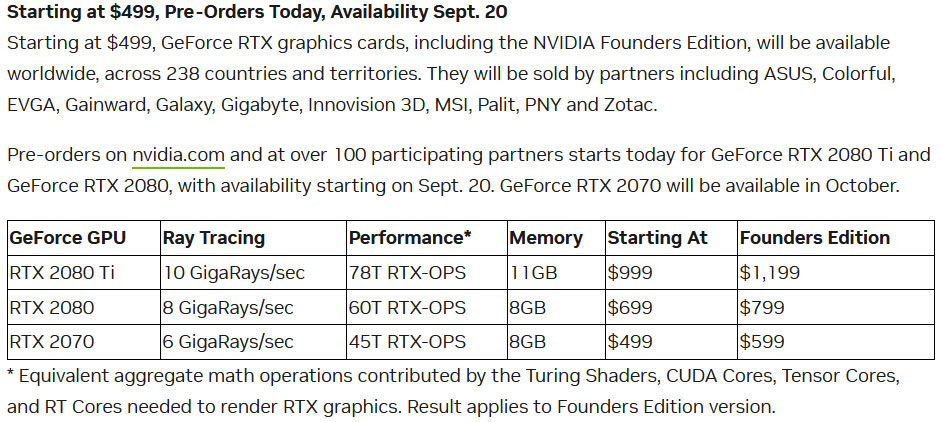
Nvidia’s Turing GPUs became available to enthusiasts for the first time on this day eight years ago. This wasn’t just another accelerated GPU generation, though, at least according to Nvidia. The GeForce 20 series pioneered a “20 years in the making” ability to deliver hybrid graphics enhanced by real-time ray tracing. Nvidia made this new technology available at the high-end first, via the GeForce RTX 2080 and RTX 2080 Ti (review links). The more mainstream RTX 2070 wouldn’t become available until October.
In a blog post a month ahead of the release day, Nvidia CEO Jensen Huang didn't hold back in heralding the arrival of Turning for PC gaming graphics. “Turing opens up a new golden age of gaming, with realism only possible with ray tracing, which most people thought was still a decade away.” He went on to claim that “Once you see an RTX game, you can’t go back.”
Despite Huang’s boasts we can look back and confidently say that many gamers still don’t care about ray tracing. Nor do they wish to endure the performance impact even the latest generation mainstream graphics cards from Nvidia (and AMD, and Intel) still suffer from when this feature is turned on. Moreover, at the time of launch back in 2018, and for quite a few months onwards, there was little in the way of content that made the new RTX 20 series' distinguishing feature seem worthwhile. Early in-game showcases that garnered a lot of pixel peeping and chin rubbing included Battlefield V, Metro Exodus, and Shadow of the Tomb Raider.
Our review of the RTX 2080 Founders Edition noted that this new second-fastest Turing architecture card managed to outpace the legendary GTX 1080 Ti. However, we grumbled about it being $100 more expensive than the former flagship. During this era, Nvidia Founders Editions were actually more expensive than the base models from AIBs. Thus the RTX 2080 FE had an MSRP of $799, but you might have been able to pick up an Asus, Colorful, EVGA, Gainward, Galaxy, Gigabyte, Inno3D, MSI, Palit, PNY, or Zotac for $699.
Our review of the GeForce RTX 2080 Ti flagship was more positive, despite the conclusion that the “$1200 price tag is out of reach for most gamers.” The 71% uplift in price wasn’t really worth it for the ~26% faster performance vs the GTX 1080 Ti. It was also about 20% faster in gaming than the pro Titan V, though.
Our review of the RTX 2080 Ti was 14 pages long, but here’s a direct link to some gaming benchmarks featuring the likes of Tom Clancy’s Ghost Recon, The Witcher 3, and World of Warcraft: Battle for Azeroth. During gaming, this new consumer flagship would typically consume about 280W.
Eight years later, we can say that realtime ray tracing has indeed proved popular. Even consoles and mobile games now use and boast of this visual tech, and probably couldn’t ignore it without getting sidelined. But adoption has been slow, and it has taken yet more layers of technology, such as DLSS for the green team, to make ray tracing at all accessible for budget / mainstream gamers, even in 2026.
Get Tom's Hardware's best news and in-depth reviews, straight to your inbox.
Do you still rock a Turing GPU in 2026? If you do, or are just curious about how well an 8-year-old card would do in 2026, I'm sorry to say that Turing has slipped off the end of our famous graphics card hierarchy. However, the following generation RTX 3070 at $499 offered very similar performance to the prior-gen $1,199 flagship. Those were the days (except that the cryptomining craze happened).
Mark Tyson is a news editor at Tom's Hardware. He enjoys covering the full breadth of PC tech; from business and semiconductor design to products approaching the edge of reason.
The PC gaming ray tracing obsession began with the first RTX 20 graphics cards released on this day in 2018 — the GeForce RTX 2080 and 2080 Ti led the charge, but games were thin on the ground

 3 hours ago
4
3 hours ago
4









 English (US) ·