
 Custom image by Kyle Gratton

Published May 24, 2026, 11:30 AM EDT
Kyle Gratton is an editor and writer based out of Kansas City. He received a bachelor's degree, dual majoring in English and History with a minor in Film and Media Studies, and has been a senior staff writer and reviewer for Screen Rant's Gaming section since 2021, with roles in editorial, and various freelance projects.
A terminal Midwesterner who graduated from the University of Kansas, Kyle also has knowledge and interest in literature, film, film adaptions of literature, and history.
Find Kyle on Bluesky: kwg.bsky.social
and Letterboxd: KyleG5
Sign in to your ScreenRant account
Traditional sequels are rare in The Legend of Zelda. Nintendo's iconic series is most commonly an anthology, where concrete narrative connections between games are often left as afterthoughts. There wasn't even a comprehensive Zelda timeline until 2011, compiled in the Hyrule Historia companion book around the time Skyward Sword came out, and it happened to arrive shortly after the series' only trilogy was completed.
There are quite a few technical sequels in the long-running series, ranging from arguably the most direct Zelda sequel ever, Tears of the Kingdom, to only tangentially related sequels like Twilight Princess, which features the apparition of Ocarina of Time's Link as the Hero's Shade. But three games managed to pull together a single continuous storyline, anchored by a once-controversial character redesign, Toon Link.
The Wind Waker Began A Toon Link Zelda Trilogy

The Legend of Zelda: The Wind Waker is now one of the series' most beloved entries, but it was divisive back in 2002 ahead of its worldwide release. It was the first 3D game to change art styles after Majora's Mask largely reused assets from Ocarina of Time, and Link's new cel-shaded, cartoonish look was not very popular among fans who hoped the series would continue in a more mature direction.
The Wind Waker was so contentious (not just because of its art style; the open-world sailing had detractors as well) that Nintendo attempted a course correction with the next 3D Zelda game, Twilight Princess, scrapping a direct Wind Waker sequel for the Game Boy Advance in the process. Toon Link's reputation would be rehabilitated through The Wind Waker sequels that actually saw the light of day though, and has become a popular version of Link in part because of his inclusion in the Super Smash Bros. series from Brawl forward.
The Minish Cap should also not be overlooked as an instrumental appearance for Toon Link. It has grown to be seen as one of the best 2D Zelda games, and a bona fide Game Boy Advance classic.
There are two key narrative elements laid down by The Wind Waker that are instrumental to the Toon Link Zelda trilogy. First is the flooding of Hyrule, which effectively topples the kingdom, a necessary measure after a hero failed to rise against Ganondorf's return. The other is The Wind Waker's incarnation of Princess Zelda, known as Tetra, who eventually comes to reestablish Hyrule Kingdom.
Phantom Hourglass Is A Direct Sequel To The Wind Waker
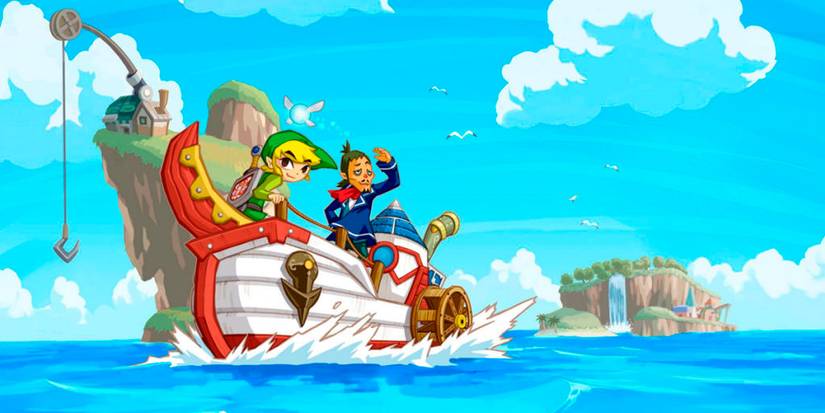
Funnily enough, getting the Hyrule royal family back on the throne is not addressed in the slightest by The Wind Waker's follow-up, The Legend of Zelda: Phantom Hourglass. Released four years later (if we're going by The Wind Waker's worldwide release in 2003), Phantom Hourglass landed on the Nintendo DS.
Phantom Hourglass is, in the grand scheme of the Zelda chronology, admittedly inconsequential. The Wind Waker's finale makes a concerted effort to show the drowning of Hyrule Castle, which was preserved under the Great Sea, frozen in time until Link arrives and pulls the Master Sword from its pedestal. It's a heavily symbolic event, wiping away the last vestiges of the kingdom as Ganondorf is finally slain.
It would have been an odd turn to undo that and have Hyrule's edifice immediately restored by Tetra, so Phantom Hourglass instead takes players to a neighboring sea known as the World of the Ocean King... which may or may not be some sort of parallel dream world. Regardless, The Wind Waker's Link and Tetra return in a story set shortly after, barely being more connected than the duologies that preceded it: The Legend of Zelda and Zelda 2, A Link to the Past and Link's Awakening, Ocarina of Time and Majora's Mask, and Oracle of Ages and Oracle of Seasons (these last two are so indirect that their timeline placement is interchangeable).
Spirit Tracks Completes Zelda's Toon Link Trilogy

Toon Link's trilogy is often overlooked because the third game, The Legend of Zelda: Spirit Tracks, takes place a whole century after its predecessor. This arguably makes it a more distant sequel than a lot of the aforementioned follow-ups, but it only takes place as a direct result of Tetra's actions post-Phantom Hourglass. After her sojourn to the World of the Ocean King, Tetra and her pirate crew discover a new continent and establish the kingdom of New Hyrule.
Spirit Tracks released just two years after Phantom Hourglass on the 3DS, and broadly received the same amount of praise, but both games are often forgotten in the series' long history; the mainline 3D home console entries tend to stand out the most. Spirit Tracks is a canonical anomaly because it shows the only other Hyrule known to be established after the original kingdom of the same name. Most games gloss over each depiction of Hyrule being different, even if they're canonically the same realm.
Others take place outside Hyrule, and it's so far unclear how Breath of the Wild and Tears of the Kingdom's Hyrule fits with the others, since its founding is different. This 100-year gap between Phantom Hourglass and Spirit Tracks is often used to discredit the idea that they're part of a trilogy with The Wind Waker, but these are the only three games in the timeline's Adult Era, and they have far more tangible connections than a lot of other games have to each other.
In retrospect, Toon Link has had a tremendous impact on the Zelda series at large. After a controversial introduction, Toon Link leads the only trilogy in the series, makes regular guest appearances in other franchises, and Zelda's art style has bent back toward cel-shading with BOTW and TOTK. Spirit Tracks remains the only game set in New Hyrule, and it may stay that way if Nintendo continues to avoid the Adult Era timeline branch.
After two massive open-world games, it would seem that a sequel to TOTK is not on the way, meaning another Zelda trilogy may not happen any time soon. Echoes of Wisdom is essentially self-contained, though Grezzo developing a direct sequel next could be a great way to continue Princess Zelda's new stint as protagonist. For now, the oft-forgotten trilogy of The Wind Waker, Phantom Hourglass, and Spirit Tracks will remain The Legend of Zelda's only.
Created by Shigeru Miyamoto, Takashi Tezuka
First Game The Legend of Zelda
Movie(s) The Legend of Zelda (Live-Action)
TV Show(s) The Legend of Zelda
The Legend of Zelda franchise follows the adventures of Link, an elf-like Hylian, and Princess Zelda as they protect the land of Hyrule from the evil warlord-turned-demon king Ganon. The series is known for its mix of action, adventure, and puzzle-solving elements, often revolving around the collection of the Triforce, a powerful relic left by the goddesses who created Hyrule.





 English (US) ·