
 4 weeks ago
32
4 weeks ago
32
There's a particular kind of cognitive dissonance that happens when you spend months researching dynamic range charts, reading MTF curves, and comparing autofocus systems, only to find yourself genuinely excited about a plastic camera with a 1.6-megapixel sensor that hangs from your keychain. I've spent years writing about camera technology for this site, dissecting the differences between sensors and explaining why certain lenses outperform others. And yet, some of the most enjoyable photography I've done recently has been with cameras that would make any spec-sheet enthusiast wince.
This isn't a contradiction. It's a phenomenon I've started calling the "fun camera" effect, and based on the sales numbers of cameras like the Pentax 17, the Fujifilm X half, and the absurdly popular Kodak Charmera, I'm clearly not alone in experiencing it.
What Exactly Is a "Fun Camera"?
The fun camera isn't your backup body. It's not the second camera you bring to a wedding in case your main rig fails. It's something entirely different: a deliberate step sideways (or backwards) from your primary system, chosen specifically because of its limitations rather than despite them. These are cameras that would be completely unacceptable as your only tool. Fixed lenses with no zoom. Tiny sensors. No autofocus, or autofocus so primitive it might as well not exist. Manual film advance. Delayed image review. Resolution so low it makes your smartphone look like a medium format digital back. And yet people are buying them in droves, often paying premium prices for the privilege of shooting with inferior technology.

The current market is flooded with options that fit this description. On the film side, you have the Pentax 17, which launched in mid-2024 as the first new film camera from a major manufacturer in nearly two decades. It's a half-frame camera, meaning it shoots two vertical images on each standard 35mm frame, effectively doubling your exposures per roll while halving your resolution. It costs $500. For considerably less money, around $50, you can pick up a Kodak Ektar H35, which does essentially the same thing with a plastic lens and zero manual controls. On the digital side, Fujifilm released the X half in 2025, an $850 camera with a 1-inch sensor oriented vertically that includes a "Film Camera Mode" preventing you from reviewing images until you've finished your virtual roll. The Flashback ONE35 takes this concept further by making you wait 24 hours to see your photos, simulating the experience of dropping film at a lab. And then there's the Kodak Charmera, a $30 keychain camera with specs that would have been mediocre in 2003, which sold out within hours of launch and now commands scalper prices of four times retail.
The Weight of Capability
To understand why these cameras resonate so deeply, you have to understand what it feels like to shoot with modern professional equipment. I don't mean the physical weight, though that's certainly a factor. I mean the psychological weight. When you're carrying a camera body that costs several thousand dollars paired with glass worth even more, there's an implicit pressure to justify that investment with every frame. You find yourself thinking about whether a scene is "worth" photographing. You start pre-editing in your head before you've even pressed the shutter. You review images obsessively on the back screen, chimping after every shot to verify sharpness at 100% magnification. The capability of modern cameras is genuinely miraculous, but that capability comes with expectations, both external and internal, that can slowly drain the spontaneity from photography.
The gear acquisition cycle makes this worse. Every new camera promises better performance, which creates an implicit hierarchy where older or simpler equipment becomes "lesser." You start seeing your images through the lens of what they could have been if only you'd had faster autofocus, cleaner high ISO, or more resolution to crop into. The endless pursuit of technical perfection becomes a treadmill, and somewhere along the way, you forget that the point was never to produce the sharpest possible rendering of a parking lot. The point was to make pictures that meant something to you.
Freedom Through Limitation
This is where the fun camera earns its name. When you pick up a Kodak Ektar H35 with its fixed-focus plastic lens and single shutter speed of 1/100th of a second, there's nothing to optimize. You can't pixel-peep a half-frame film negative. You can't review your shot immediately and decide it wasn't sharp enough. You point the camera at something interesting, press the button, and advance the film. That's it. The creative decisions collapse down to two questions: what do I want to photograph, and do I want flash or not? Everything else is out of your hands.
The half-frame format adds another dimension to this. Because the Pentax 17, Fujifilm X half, and Ektar H35 shoot vertical images by default (the film moves horizontally, so each half-frame ends up in portrait orientation), you're forced to see differently. You get 72 shots per roll instead of 36, which changes your relationship with each frame. Some photographers use this to create intentional diptychs, pairing images that work together as a sequence. Others just appreciate that the format encourages experimentation without the usual cost penalty. Either way, you're thinking about photography differently than you would with your main camera, and that shift in perspective often produces more interesting work than technical perfection ever could.
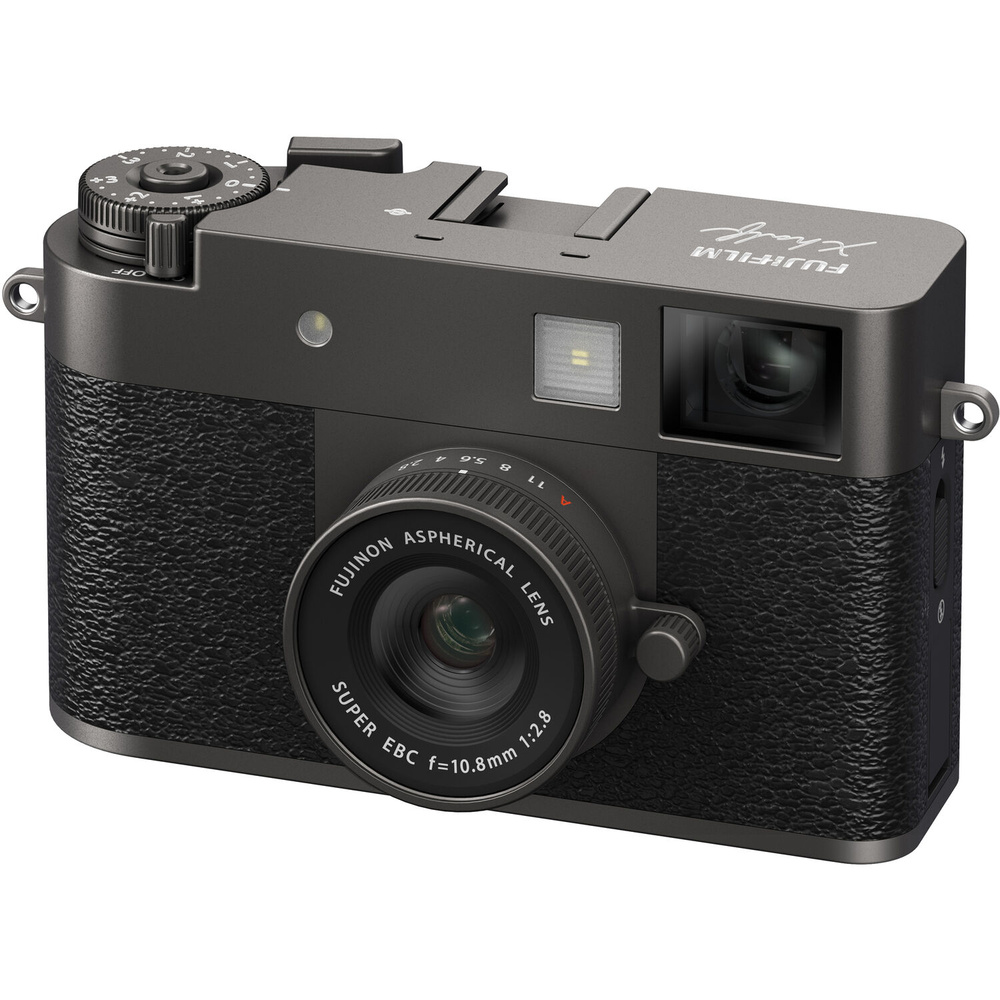
The Fujifilm X half takes this philosophy digital while maintaining the friction. Its Film Camera Mode is genuinely clever: you select a film simulation, choose a roll length of 36, 54, or 72 frames, and then you're committed. You can't change settings. You can't review images. You shoot your roll, then "develop" it through the companion app. It's artificial limitation, sure, but the experience is surprisingly effective at recreating the mindset of shooting film without the ongoing cost of processing. The Flashback ONE35 goes even further with its mandatory 24-hour development wait (though they've since added an optional instant mode for those who can't handle the anticipation). These cameras understand something important: sometimes the best feature is the absence of features.
Tactile Nostalgia
As a 90s kid who grew up with disposable cameras for family vacations and waiting anxiously for doubles from the grocery store photo counter, there's something wonderfully emotional about using these cameras. The X half has a "film" advance lever that serves no mechanical purpose other than to feel good. The Kodak Charmera is designed to look exactly like the Kodak Fling from 1987, right down to replacing the film speed rating with "1987" on one of its color variants. These aren't just cameras; they're time machines dressed up as photography equipment.
There's real power in that tactile connection. Modern cameras are designed for efficiency, which means they've largely eliminated the physical rituals that used to define photography. You don't wind film. You don't cock shutters. You don't even need to bring the camera to your eye anymore with rear-screen live view. All of that friction has been engineered away in pursuit of speed and convenience, and most of the time that's genuinely better. But friction can also be pleasurable. The click of the Ektar H35's wind wheel, the snap of a mechanical shutter, the weight of a camera that requires your active participation rather than just accepting your input: these things matter in ways that don't show up on specification sheets.
Aesthetic Imperfection
The images these cameras produce are, by most technical standards, flawed. The Charmera shoots 1.6-megapixel files that look like they came from a 1999 webcam. The Ektar H35's plastic lens is soft, especially at the edges. Half-frame negatives show more grain when enlarged because you're working with less real estate. The Flashback ONE35's film simulations add artifacts and color shifts that no serious photographer would tolerate from professional equipment. But that's the point. These "flaws" create aesthetic character that pristine digital perfection simply cannot replicate.
 There's a reason Instagram filters exist, and it's not because people want their phone photos to be more technically accurate. We've collectively decided that certain kinds of imperfection are beautiful: the grain of pushed film, the halation around highlights, the limited color palette of old photographic processes. The fun camera gives you these qualities natively, without requiring post-processing fakery. When you shoot with an Ektar H35 loaded with Kodak Gold, you get actual film grain on actual celluloid. When the Charmera clips your highlights into oblivion, that's not a simulation. The imperfection is authentic in a way that filters can only approximate.
More importantly, these limitations push you toward subjects and compositions you'd never attempt with your main camera. You start photographing things simply because they seem fun, without worrying about whether the result will be "good enough." The pressure evaporates. You shoot the weird shadow on the sidewalk. You photograph your lunch. You take pictures of your friends making stupid faces at a party without stressing about focus accuracy or motion blur. And sometimes, against all technical odds, you end up with images that actually capture something your expensive equipment consistently misses: genuine, unguarded moments of real life.
The GAS Question
I'd be lying if I said there wasn't at least some element of gear acquisition syndrome at play here. Photographers are notorious collectors, and the fun camera market feeds directly into that impulse. The Charmera is sold in blind boxes specifically to encourage multiple purchases. The Ektar H35 comes in five colors. Vintage digicams have become legitimate collectibles, with certain early-2000s point-and-shoots commanding prices that would have seemed insane five years ago. It's worth being honest with yourself about whether you're buying a creative tool or just filling a void with another purchase.
The test I use is simple: does the camera change how you photograph, or does it just change what you own? A fun camera that lives in your bag and actually gets used is serving its purpose. A fun camera that sits on a shelf after the initial novelty wears off was just another object you bought to feel something. The best way to avoid the second outcome is to set real constraints: commit to shooting a roll a month on your Ektar, or bring only the Charmera on your next vacation instead of your mirrorless kit. The limitation only works if you actually submit to it.
Remembering Why You Started
At its core, the fun camera phenomenon is about reconnecting with the basic pleasure of making pictures. Not capturing images. Not creating content. Making pictures, the way you did when you first picked up a camera and everything felt new and possible. The technical knowledge you've accumulated since then is valuable, but it can also become a cage. Sometimes you need a tool simple enough that your expertise becomes irrelevant, leaving you with nothing but your eye and your instincts. If you're looking to rebuild that foundation or help someone else discover it for the first time, Fstoppers' Photography 101 tutorial is an excellent resource for stripping away the complexity and focusing on what actually matters.
Your fun camera might be a Pentax 17 or a thrift store point-and-shoot you grabbed for $8. It might be a Fujifilm X half or a disposable Kodak from the drugstore checkout aisle. The specific equipment matters less than the mindset shift it enables. Find something that makes you forget about sharpness and dynamic range. Find something that makes you want to photograph things just to see what happens. Find something that reminds you photography was supposed to be fun. That's worth more than any spec sheet improvement.





![20 Years Later, One of the Best Sitcoms of the 21st Century Returns With Hilarious First Look [Exclusive]](https://static0.colliderimages.com/wordpress/wp-content/uploads/2026/02/malcolm-in-the-middle-life-s-still-unfair-feature.jpg?w=1600&h=900&fit=crop)

 English (US) ·