
 4 hours ago
6
4 hours ago
6

Photographers routinely talk about four digital camera formats: medium format, full-frame, APS-C, and Micro Four Thirds. While there are technically two different medium-format image sensor sizes, and APS-C can mean slightly different things to various manufacturers, those are the “big four,” and they encompass basically every modern interchangeable-lens digital camera. But what about APS-H? That was definitely a digital camera format, so where did it go?
As photographer, YouTube creator, and scandalous lens maker Tom Calton explains in a new YouTube Short seen below, APS-H digital cameras have all but disappeared.
As Calton says, the common and popular APS-C image format owes its legacy to APS film formats. APS, which stands for Advanced Photo System, is a film format that hit the market in the mid-1990s, not long before the digital photography revolution.
Various film manufacturers, including Eastman Kodak, Fujifilm, Agfa, and Konica, made APS film. It was not the first consumer-oriented film format that aimed to displace 35mm’s dominance, but it was arguably the last. APS film formats were smaller than full frame, which meant the promise of smaller cameras and lenses, not unlike the promise that APS-C digital cameras have made throughout the 21st century.
Kodak’s APS dreams began as “Project Orion” in the 1980s, and in the early 1990s, Kodak and its partners, Fujifilm, Minolta, and Nikon, announced a collaborative new film camera system. Testing began in 1994, production started the following year, and consumers could start buying APS film in 1996.
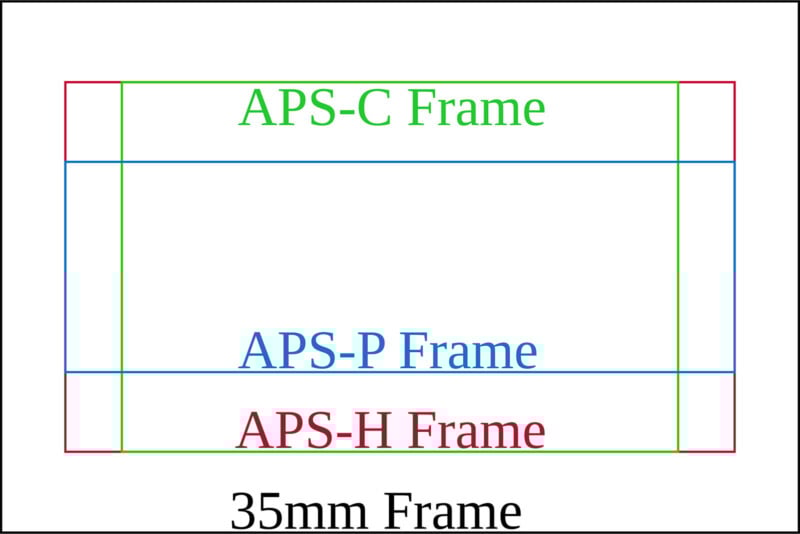 APS film formats | Credit: nytpu. Licensed via CC BY-SA 4.0
APS comprised three different frame sizes. There was APS-P, APS-C, and the subject of today’s trip down memory lane, APS-H. APS-P, or APS Panoramic, had a 3:1 aspect ratio and measured 30.2 by 9.5 millimeters. APS-C, Classic, delivered the expected 3:2 aspect ratio in a smaller-than-35mm format of 25.1 by 16.7 millimeters, down from the 36 by 24 millimeters of a standard 35mm film frame. Finally, there was APS-H, where the H stood for “High Definition.” This film had a 16:9 aspect ratio and was 30.2 by 16.7 millimeters, not much smaller than 35mm. It had a 1.25 crop factor, while APS-C had a 1.44 times crop.
When digital image sensors entered the mainstream, manufacturers adopted the same terminology as for film, but the precise image area dimensions changed slightly. The first digital cameras did not have full-frame (35mm format) image sensors. They were all “crop” sensors, technically.
For example, the Nikon D1 featured a 2.7-megapixel “DX” CCD image sensor measuring 23.7 by 15.6 millimeters, the same size as Nikon’s APS-C cameras today but smaller than the APS-C film format. Canon’s first DSLR, the D30, launched in 2000 and sported a 3.1-megapixel APS-C image sensor, albeit one with a different size than Nikon’s DX-format sensor. The D30’s sensor was 22.7 by 15.1 millimeters, which is negligibly larger than the APS-C sensor Canon uses in its modern mirrorless cameras, which is 22.3 by 14.9 millimeters.
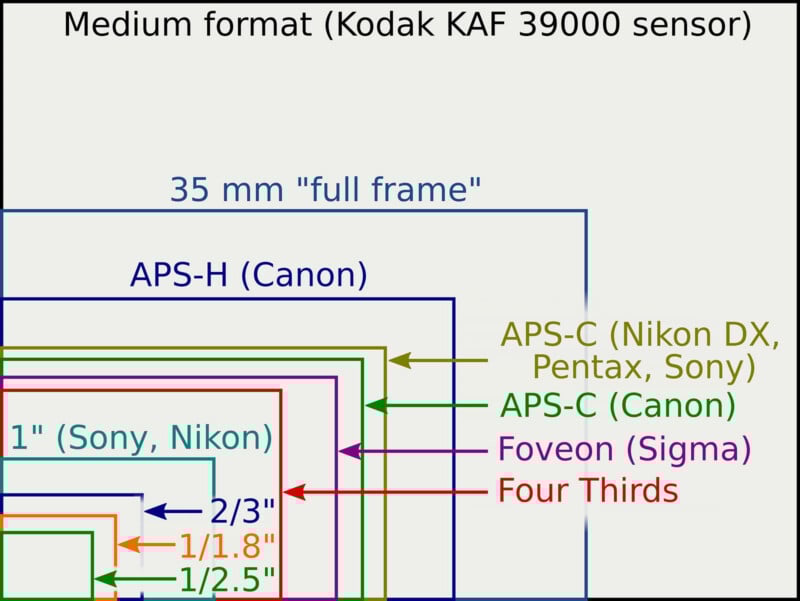 Digital image sensor formats | Credit: Moxfyre, licensed via CC BY-SA 3.0
Canon’s first in-house professional DSLR, 2001’s EOS-1D, ushered in the era of larger image sensors. This groundbreaking camera sported a 28.7 by 19.1-millimeter APS-H CCD image sensor with a whopping 4.15 megapixels. Much like APS-C digital image sensors, Canon’s APS-H sensor was smaller than the APS-H film format introduced in the 1990s, but not by that much. Rather than a 1.25x crop factor, the EOS-1D had a 1.3x crop factor.
There is little doubt that Canon’s adoption of the APS-H digital sensor can be traced back to its collaboration with Kodak, which bore the fruit of a few digital cameras in the late 1990s, including the Canon EOS D6000 and the Canon EOS DCS 1.
Canon continued to utilize the APS-H format for some of its flagship professional DSLRs for years afterward, releasing its very last APS-H camera, the EOS-1D Mark IV, in 2009.
 Canon EOS-1D Mark IV
That was the end of the road for mainstream APS-H digital cameras, but APS-H wasn’t quite done yet.
APS-H has been used in some more niche digital cameras over the years, like the oft-maligned Leica M8, Leica’s first digital rangefinder that arrived in 2006, and its slightly upgraded sibling, the M8.2, in 2008.
More recently, Sigma’s last Foveon camera to date used an APS-H image sensor. The odd Sigma sd Quattro H announced in 2016 featured a 26.6 by 17.9 millimeter 26-megapixel sensor. This was, and remains, the largest Sigma Foveon sensor ever made, although Sigma says it is still working on its full-frame Foveon sensor project.
 Sigma sd Quattro H
And that is it. Aside from a 250-megapixel APS-H CMOS image sensor Canon showed off in 2024, which is only for industrial applications, the format has all but vanished.
Most camera manufacturers never bothered with the format at all, and those who did, like Canon, ultimately chose to focus on full-frame and APS-C instead. It makes sense, as APS-H gets close enough to full frame that it makes little sense to make lenses specifically for it, and the space savings are relatively small. Nonetheless, APS-H was an interesting format that had its supporters, and it’s worth revisiting it now and then.
Image credits: Header photo courtesy of Canon







 English (US) ·