
 3 weeks ago
39
3 weeks ago
39
How do you make a documentary about artificial intelligence without it becoming out of date by the time the movie comes out? While Daniel Roher‘s film “The AI Doc: or How I Became an Apocaloptimist” does aim to be a definitive portrait of what generative AI is now and where it will go, the filmmaker is more concerned with what he can actually control.
The film, which opens Friday, March 27 from Focus Features, grapples with Roher’s apprehension about bringing a child, now two years old, into a world that will be governed by AI and what he can do to prepare his son for an AI-driven future. His film’s subtitle about being an “Apocaloptimist,” a portmanteau for apocalypse and optimist, recognizes that there’s no right answer about how AI will shape the future. It’s not entirely a utopian teaching tool, nor is it going to take over and replace all of humanity (probably), but it’s also both.


The movie doesn’t get too invested in the specifics of how generative AI will impact Hollywood, but perhaps more than any other industry, it’s harder to find people in entertainment who are even-keeled and don’t view gen-AI’s impact as either the future of movies or the end of artistry. That’s why we wanted to have a frank conversation with Roher about generative AI and it’s impact on films.
Who better to temper people’s expectations or talk them off the ledge than the documentarian behind the definitive AI doc?
The following interview has been edited and condensed for clarity and length.
IndieWire: You get a lot of whiplash watching this film. It goes from people singing the utopian praises of AI to the next minute hearing it’s apocalyptic and horrible. Is that how you felt conducting these interviews?
Daniel Roher: Yeah, that intellectual oscillation that you’re speaking to was very true to my own experience and how it felt to make the movie and live with and experience the topic. It was really hard to wrap my own head around as I was making the film. I would talk to one person and be like, “OK, maybe this isn’t gonna be so bad. Maybe it’s gonna be good.” And then I talked to another person, and I’d be like, “Oh, fuck.”
This film was an exercise of, how do you process the fact that you’re talking to the smartest people in the world who are telling you one thing, and then you’re talking to the other group of the smartest people in the world, and they’re telling you the polar opposite, and they’re both right? That’s a really hard thing to reconcile, and it’s gonna be hard for a lot of people to reconcile, but ultimately, that’s what an apocaloptimist is. It’s someone who refuses the binary of, this is going to be the apocalypse or we have every reason to be optimistic. It’s someone who instead says, “No, it’s going to be both at the same time.” So what agency do we all have in our lives to bend this towards one direction?
The movie is beautifully animated. Did you ever consider using AI in this film as a means of experimenting with it and commenting on it?
Not really, and I think that’s just a function of the fact that when you get a bunch of artists together and we’re tasked with making this movie, we’re not particularly interested in AI-generated animation, because we like to make animation. We love to draw. We love to make stuff. We like to do stop motion. So it’s like, why? Why would we need it? But it’s never a discussion and never seemed like something that was sensical, sensible to the movie or to our creative approach.
Have you played around with AI tools for videos or animation? What have you found or discovered? Clearly you didn’t see it as a means to help some facets of your process?
There’s technology out there that you could see it as impressive, you could see it as frightening. It’s sort of both at the same time. It’s empowering and it’s disempowering both at the same time. It’s got extraordinary promise and represents peril for many. What I’m driving at is that these are just tools. And tools are not inherently good or bad. They’re almost both depending on who uses them and who yields them. The problem is, this is just the most powerful tool that’s ever been devised. But I’m not afraid of using AI to enhance and empower my creative endeavors; I’m afraid of AI replacing my creative endeavors. And that’s what people need to be focused on and thinking about.
If you’re going to use AI in your own workflow and your own creative enterprise, ask yourself the basic question, how does this empower me, versus how might this replace me? And if you start seeing it through that lens, hopefully people might have the critical thinking capacity in their own experience to determine what works for them and what doesn’t.
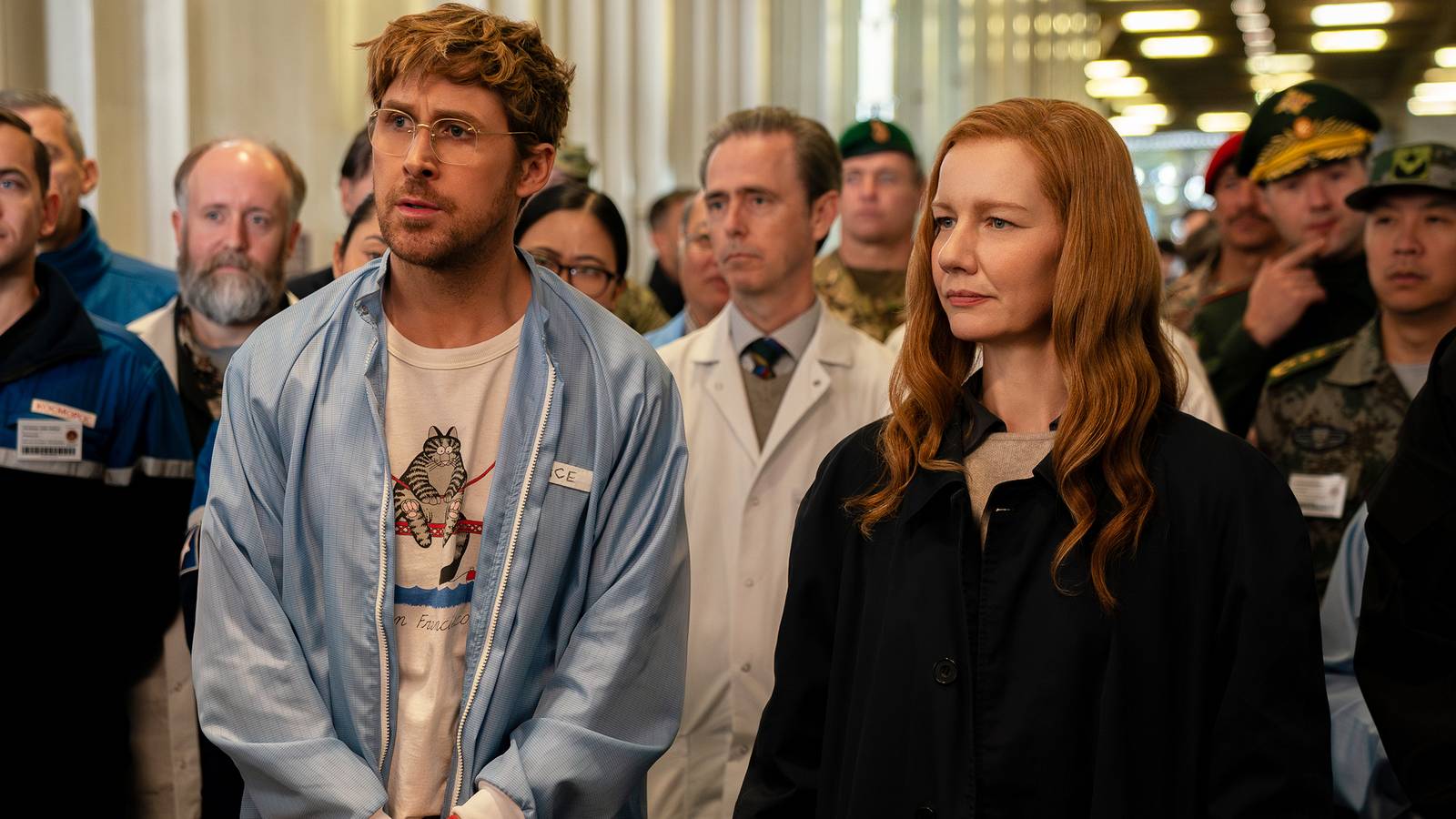
 ‘The AI Doc: Or How I Became an Apocaloptimist‘Courtesy of Focus Features. © 2025 All Rights Reserved.
In the same way that the film suggests that it’s not so simple to just say that AI is good or bad, it’s the same for movies. But if you had to make one bold proclamation about what AI is going to do to movies and entertainment, are you able to or is it just not that simple?
My bold proclamation would be, don’t listen to people who make bold proclamations. People don’t know what the future is, and we have agency over our own lives and how we use this technology.
This is not a satisfying answer, but what I can say with certainty is that we will experience profound change in every industry, the film industry, like we will every other human industry. It’s a little bit trickier when it comes to art, artists, filmmakers, storytellers, and writers, because what are those vocations and occupations and crafts other than expressions of humanity, soul, experience, and chronicles of what it is to exist? It’s harder to palette for me machines replacing those people.
So I don’t know what’s going to happen. I don’t have a crystal ball. All I know for myself is what I’d like to see in the future, and the ways in which I hope AI is integrated in the ways in which I hope the world says, “You know what, we don’t really need AI for that. That’s not super necessary. That’s not something we’re interested in.” But I only have agency over myself. I try and just exercise the power that I have however I can.
Why do you think people in entertainment are so loud and vehement about anything AI, that it’s the worst thing ever for the industry? Are people in this industry more worked up and louder about this than you’ve seen compared to other industries?
Perhaps. To answer your first question about why are people more vocal here, I think people are scared. I think it’s very natural to feel scared in the face of this. I’m scared. If you’re not scared, you’re not paying attention.
Perhaps filmmakers and storytellers, it’s a little easier to imagine at this point on the technological food chain those people being eliminated, those vocations being eliminated, those creative pursuits and jobs being eliminated. You’re already seeing job losses in the creative spheres. But I think that, give it a second and all of a sudden, every blue collar worker who thinks that they’re immune from job loss because of work in a physical job. “A robot’s not gonna be able to fucking weld that gate together, get a clog out of that drain.” It’s just a matter of time. For creative people, this is just on the vanguard and is front and center.
Is part of it because of the way these AI slop videos are pushed out to people online? Every video from Seedance is captioned with something like “Hollywood is cooked.” What do you make of the general discourse and the way in which people actually consume AI content today?
The first thing is to identify the basic reality of, this stuff’s here. It’s coming. It’s already here. That just is the reality. So then the question becomes, what agency do we have, and what do we want it for, not want it for? What are the common sense precautions we can take to protect the world from the worst use cases of technology? So, for example, I would say, if something is generated by AI, the tech companies should be legally liable to make sure there is a baked-in watermark so people know that they’re looking at a generated image. I think that’s very important, just on the surface of protecting objective reality as we know it.
But beyond that, sometimes you close your eyes and you imagine, it seems very old fashioned to spend $75 million getting movie stars and going out with hundreds of people to shoot a movie when you can have a computer do it like that. Like, where is the economy there? And that’s frightening for people, and I understand that.
But at the end of the day, I personally am not interested in stories that were written by computers. I’m not interested in films that were directed by computers. What I’m interested in is art that comes from a human experience and emotionality, and computers can’t do that.
I’m not just speaking for myself. None of my friends are interested in that either. So it’s really just a question of, collectively, what do people want? If the vast majority of people are like, “Yeah, who cares, we’ll just watch AI-generated movies,” I think that’s really sad. All I can do is focus on why I create and who I am, and the value and virtue of what I have to offer in a world that devalues everything.
 ‘The AI Doc: Or How I Became an Apocaloptimist’Courtesy of Focus Features. © 2025 All Rights Reserved.
Are we going to get to a middle ground where there’s some acceptable normalcy in the use of AI? You alluded to the fact that people are already being replaced, but will we get to a middle ground where it’s not fully AI-generated movies but has some more practical use cases in VFX and post-production? It feels like some people just don’t want to hear about it in any shape or form.
I can only offer what seems to be a sensible approach, from my perspective and my own opinion on the matter, which is the following, how does the technology empower a human artist versus how does the technology replace a human artist? If we’re talking about VFX artists who’s going to have to spend 12 hours painting out an Evian bottle that was left in frame, that’s fucking annoying. That person’s overworked and has so much stuff to do and has to work on the renders and the this and the that and is busy. There’s a plugin that can just neutralize that. I think that’s great, and that’s empowering, and that’s helpful. But it’s a different story if it’s just that person doesn’t have a job and some prompt engineer types a prompt into a machine and it just makes the visual effect, or it makes the explosion.
That’s what I encourage people to think about replacing artists versus empowering them. As it pertains to the film industry, that should be the focus. I’m not someone who’s like, don’t use AI. I think that’s an absurd position to take. I’m someone who’s more like, yeah, fine, use AI, explore these tools, use all these fancy new generators, learn how they work, experience them, and just think critically about what do you want to use them for? How will they empower you?
As it pertains to VFX, they’ve been using AI plugins for years for VFX artists. This is not new. So it’s really going to be, will studios green light $50 million movies when they can spend $5 million making a movie on a computer? I don’t have the answer to that yet. But the first AI-generated feature film will come out, what, this year? In the next couple of months? It’ll be very interesting when people watch that movie and it’s like, “Oh, fuck. This is well-directed.” I don’t know if that’ll happen. We’ll have to see.
Matthew McConaughey in a recent conversation with Timotheé Chalamet said that he believes one day a synthetic actor could win an Oscar. Is that something you believe can happen?
Matthew and I talked about this. [Editor’s note: Roher is currently working on a fictional feature film starring McConaughey.] We had a discussion about it, and the question I posed to him is, (A) I don’t think that’s a given, and (B) Do we want that? Do we want that to be in the world? He was challenging me and being like, are you just holding on to the nostalgia of what was and the past and not looking at the future? Well, no, I mean, it’s just a question of the role and value of artists. And we ended up having a philosophical, very robust philosophical discussion.
But what is the value of an artist? What is the value of an actor? What is the value of a storyteller or a playwright or this or that? An AI has not lived. An AI has not experienced the world. AI has not been born, and AI has not sat alone in a crib at night crying waiting for its parents to come in. An AI has not gone to school and been bullied, and AI has not scraped its knee, and AI has not gotten sick, and AI has not had its heart broken. These are uniquely human functions.
What is an actor other than someone who’s putting their lived experience into a role for the sake of enlightenment, entertainment, fun, empowerment, and education? That’s what actors do. I’m not interested in any computer actor, and that was my point, I don’t treat it like it’s a given.
Matthew has has been very proactive about trademarking his likeness and trademarking his voice and “Alright, alright, alright.” I think that’s totally fine. If that’s empowering for you, then do that. But again, I personally always come back to this place of how does the technology empower us versus how might the technology replace us?
The discussion we’re having and the laws surrounding these types of issues are lagging far behind the technology itself. So it’s a very good question, who should own your digital likeness? That is a question that matters, but the actual law is a 17th or 18th century legislative mechanism that moves very slowly. The technology is a magical 25th century that’s crash-landed into the 21st century that we’re all grappling with.
 Tilly Norwood, a creation of AI studio Xicoia
You do some good journalism at the end getting some interviews with Sam Altman, Dario Amodei, and Demis Hassabis (Mark Zuckerberg and Elon Musk did not participate in the film). How do they think about Hollywood? Do they want to have a place in it? Are they people with taste who want to engage with art? Or does it scare you that these five dudes could dictate the future of Hollywood?
These five dudes are going to be dictating everything if we let them. Hollywood is just one small component of the global pie. These people are sitting on the precipice of the greatest technology ever created that has no parallel. There’s no precedent. There’s nothing like this that’s ever happened before, and Hollywood, in the grand scheme, is but a small footnote in the gargantuan magnitude of what’s coming. I care about it like you do because we both work in the industry, and we both care about films, and we love films. But at the end of the day, what’s at stake is humanity itself and what it means to be human, what it means to exist, and we’re staring down the barrel at an empowerment crisis.
You know what happens when there’s 50 percent unemployment, where people don’t have a reason to get up in the morning, when people’s livelihoods are gone and it’s an epidemic of, “What the fuck do I do today?” Imagine what happens when we have mass unemployment and disaffected young people, an erosion of objective reality, and you can’t believe what you see, and you’ve been lied to, and the collective story that has bound us together for 400 years as Americans is no longer true, or as human beings is no longer true? You don’t have to squint your eyes too much to see how that could be scary and dangerous and violent.
The tech companies are responsible here, but individuals are responsible here. We have agency over all governments. If there’s 50 percent unemployment in a red district or 50 percent unemployment in a blue district, that’s bad. That’s a bipartisan issue. It’s just about good people pragmatically trying to nudge this asteroid that’s heading towards us just enough so it doesn’t hit us directly. It just sort of passes us by, because there’s no stopping it. But we do have a capacity to slow it down and decide the future we all want to live in.
I don’t believe that’s a corny trope. For people who watch the movie and are like, “What a fucking eye roll. Really? Collective action? Like, what is that going to do?” My response is 1) Fuck you, and 2) Don’t be such a cynical asshole. That’s what I would have said before I made it. Now I’m standing on the other side having exercised the power I have in the universe as a filmmaker to make this movie, to make something that’s successful, that’s accessible, so people can have some kind of a first date, philosophically and spiritually with this technology.
The reality is the arc of the moral universe is long, but it does bend towards justice. I fundamentally believe that even in the face of this dark regression that we’re living through right now, it is but a blip, and it’s temporary, and there will be a reset. I have to believe that.
What do you think about Netflix buying Ben Affleck’s AI company?
How is Netflix going to use AI? That’s what I want to understand critically, and what Netflix should have a very clear, coherent policy about. Because if Netflix is a company that is going to start making generated movies and disempower artists, then I won’t make movies for Netflix. I am currently employed by Netflix. It’s worth mentioning that. But the point is not just specific to Netflix.
All the studios, how are you using this technology? How do you think about it? Ethically, philosophically, who at your company is creating an action plan for the future, and what is in that action plan? What values do you believe in? These are all the questions that everyone has to be thinking about and answering.
“The AI Doc: Or How I Became an Apocaloptimist” opens in theaters from Focus Features on Friday, March 27.


 English (US) ·