
 13 hours ago
8
13 hours ago
8
Can it be Mini LED without a FALD backlight?
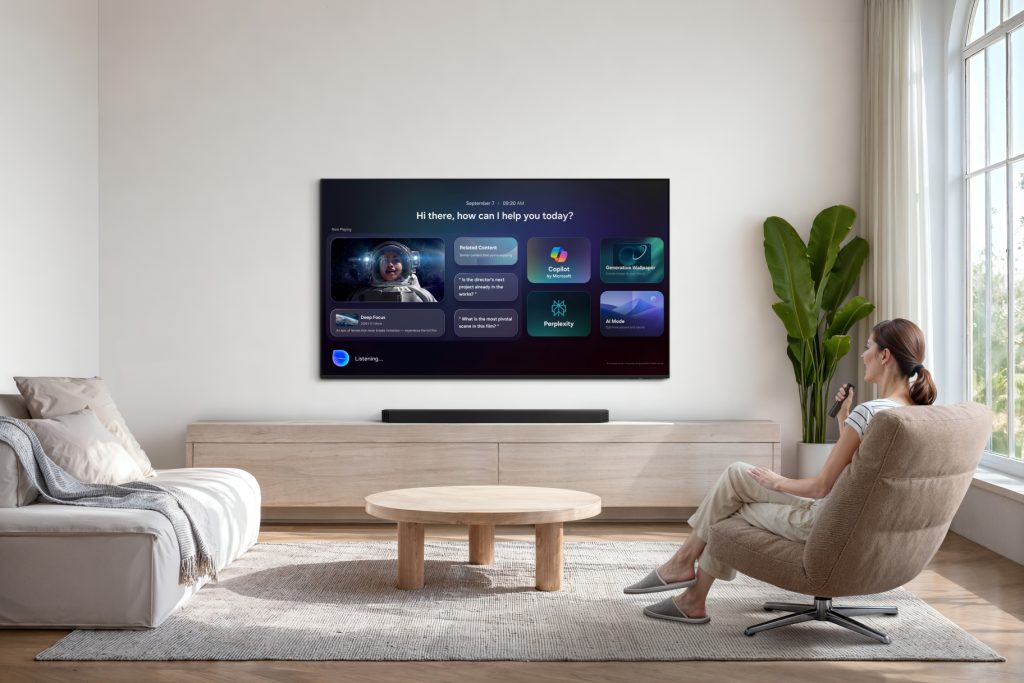
A marketing image for Samsung's M-series TVs. Credit: Samsung
A marketing image for Samsung's M-series TVs. Credit: Samsung
What makes a display a Mini LED display?
It’s a question that sounds like it should have a simple answer. But it’s now at the center of a lawsuit between two of the biggest names in TVs, with TCL accusing its longtime competitor Samsung of falsely advertising budget LCD-LED TVs as Mini LED sets.
TCL may have a point. Samsung’s M-series TVs, which range from $300 for a 43-inch model to $2,300 for a 100-inch model, do raise some legitimate questions about what should qualify as Mini LED. More broadly, though, the dispute highlights a problem for shoppers: Without agreed-upon standards for what “Mini LED” actually means, manufacturers have plenty of room to define the technology for themselves.
TCL accuses Samsung of Mini LED “fraud”
In a lawsuit (PDF) filed in the US District Court for the Central District of California in late August, TCL accused Samsung of resorting to “fraud” to compete with TCL’s QM-series of Mini LED TVs. Samsung’s M70H, M80H, and M90H are “merely recycled… pre-existing, low-end, standard LED televisions, [which are Samsung’s entry-level] Crystal UHD line… re-labelled… as ‘Mini LED,’” TCL’s suit says.
“Samsung’s M Models contain none of the technological advancements associated with Mini LED technology, including [full array local dimming],” the complaint reads.
Samsung didn’t respond to questions I sent about specific claims in TCL’s lawsuit. Instead, a spokesperson shared a statement noting that it intends to vigorously defend against the lawsuit.
The FALD debate
TCL argues that M-series TVs don’t have backlights capable of true full array local dimming, or FALD, the most advanced type of backlighting technology available in LCD-LED displays.
A FALD backlight uses dozens to thousands of small LEDs, or Mini LEDs, grouped into different zones, each with individually controllable brightness levels. This helps boost contrast, which is critical for image quality and essential for delivering quality HDR on an LCD-LED display.
According to a specification line titled “Micro Dimming” on the M-series TVs’ product pages, the devices use “Supreme Mini LED Dimming.” The spec sheets (PDF) available for download from those pages include a tiny footnote that clarifies: “Supreme Mini LED Dimming is Software-based (not full-array hardware-based) technology.”
Samsung also uses the term “Supreme Mini LED Dimming” on product pages for its Neo QLED TVs, which TCL accepts as true Mini LED TVs. The Neo QLED spec sheets don’t include the footnote, though.
Software-based dimming without individually addressable LED zones differs from the FALD technology described above. With software-based dimming, a TV typically analyzes each frame of a video, breaking it into different zones and determining each zone’s ideal brightness level. Using that information, the display modifies the frame’s brightness to boost perceived contrast. Critically, though, the display’s brightness level remains uniform across the panel, unlike in a display using a FALD backlight.
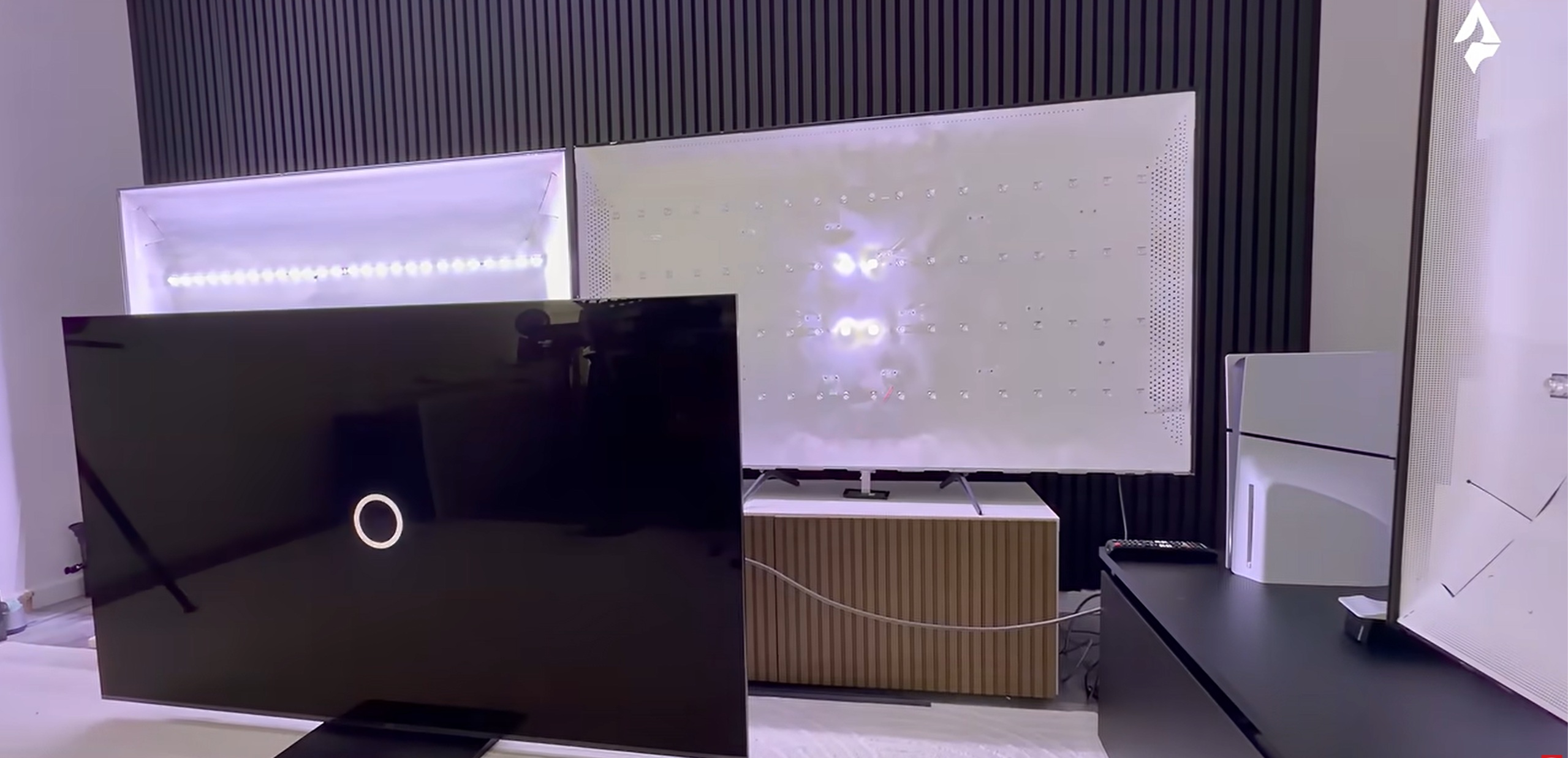
In this shot from AP Tech’s video, you can see the differences between how the backlights of the M80H (left) and TCL (right) manage the image shown on the TV in front.
Credit: AP Tech/YouTube
In this shot from AP Tech’s video, you can see the differences between how the backlights of the M80H (left) and TCL (right) manage the image shown on the TV in front. Credit: AP Tech/YouTube
Software-based dimming was more common on TVs from the 2010s, such as TCL’s P6-series and LG’s UH8500-series. But even then, software-based dimming paled in comparison to FALD, as Reviewed noted in 2016.
Software-based dimming “will never be as effective as a well-designed, hardware-based local dimming solution, especially in scenes that are more susceptible to blooming artifacts,” Guillaume Chansin, associate director of displays and XR at Counterpoint Research, told me.
“However, the software plays an important role to get the most out of the hardware, with some brands able to achieve comparable image quality with fewer LEDs or dimming zones,” he said.
Because displays that support software-based dimming work differently from those that use a backlight with individually addressable LED zones, they’re not what people typically think of when describing “FALD.”
Eric Virey, principal displays analyst at Yole Intelligence, considers FALD a hardware feature first and foremost. It requires a “2D array of LEDs uniformly distributed across the entire area of the display,” along with a good algorithm to help reduce blooming, he said, adding, “To me, a ‘software-based’ Mini LED dimming just doesn’t make any sense if you don’t have that full, 2D-array of LEDs or Mini LEDs in the backlight.”
An LED display with FALD should have better contrast than an equally specced display without it. But experts I spoke with took things further, suggesting that a display shouldn’t be considered Mini LED if it doesn’t support FALD.
“I think that is broadly agreed across the industry that FALD is a key and mandatory feature in Mini LED backlights,” Virey told me via email.
Bob O’Brien, Counterpoint’s research director, also equates Mini LED with FALD.
“Mini LED was originally introduced as an improved FALD technology, with more dimming zones. So among those in the industry, it has always been assumed that a Mini LED TV has FALD capability,” he told me.
Even Samsung’s own website describing Mini LED suggests that local dimming is essential. “Mini LED is an advanced backlighting display technology that uses tiny LEDs, smaller than standard ones, for more precise backlight control through local dimming zones—a technique where backlight zones are controlled independently,” it says.
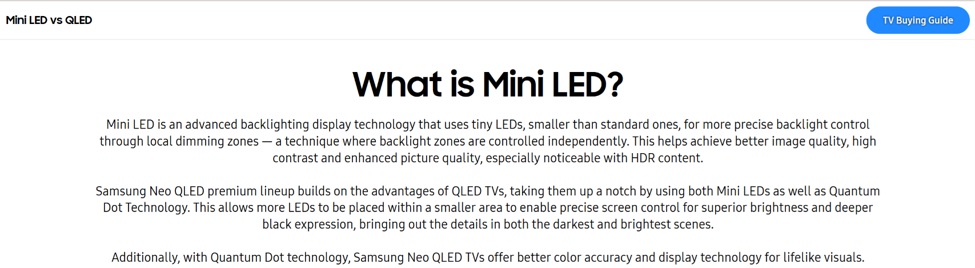
A screenshot from Samsung’s website explaining Mini LED.
A screenshot from Samsung’s website explaining Mini LED. Credit: Samsung
In its complaint against Samsung, TCL says it disassembled an M70H and M80H, both Samsung sets, and confirmed they can’t perform local dimming because they lack the necessary LED control chip and circuitry and use the same processor as Samsung’s entry-level Crystal TVs.
How mini should Mini LEDs be?
Although FALD support is key to TCL’s argument, a more obvious question might be whether M-series TVs use actual Mini LEDs. Again, though, there’s no industry-wide rule for what makes an LED “mini.”
I’ve seen Mini LEDs referred to in various size ranges over the years, including 50-300 µm (0.05-0.3 mm), 100-200 µm (0.1-0.2 mm), 100-300 µm, and “typically below 200 µm.”
TCL’s lawsuit claims that Mini LEDs “are generally .1 mm to .3 mm” and that the LEDs in Samsung’s M-series TVs are 0.5 mm. I’ve been unable to find a reputable source that refers to an LED as large as 0.5 mm as a Mini LED. I have even seen LEDs measuring more than 0.2 mm or 3 mm be considered a traditional LED in some cases.
TCL further alleges that M-series TVs have a few dozen LEDs, while some Mini LED displays have thousands. Those LEDs aren’t arranged in an array on a panel; instead, they’re “arranged on two aluminum strips,” the filing says.
A teardown video from YouTube channel AP Tech also shows an M-series TV’s backlight consisting of two rows of LEDs.
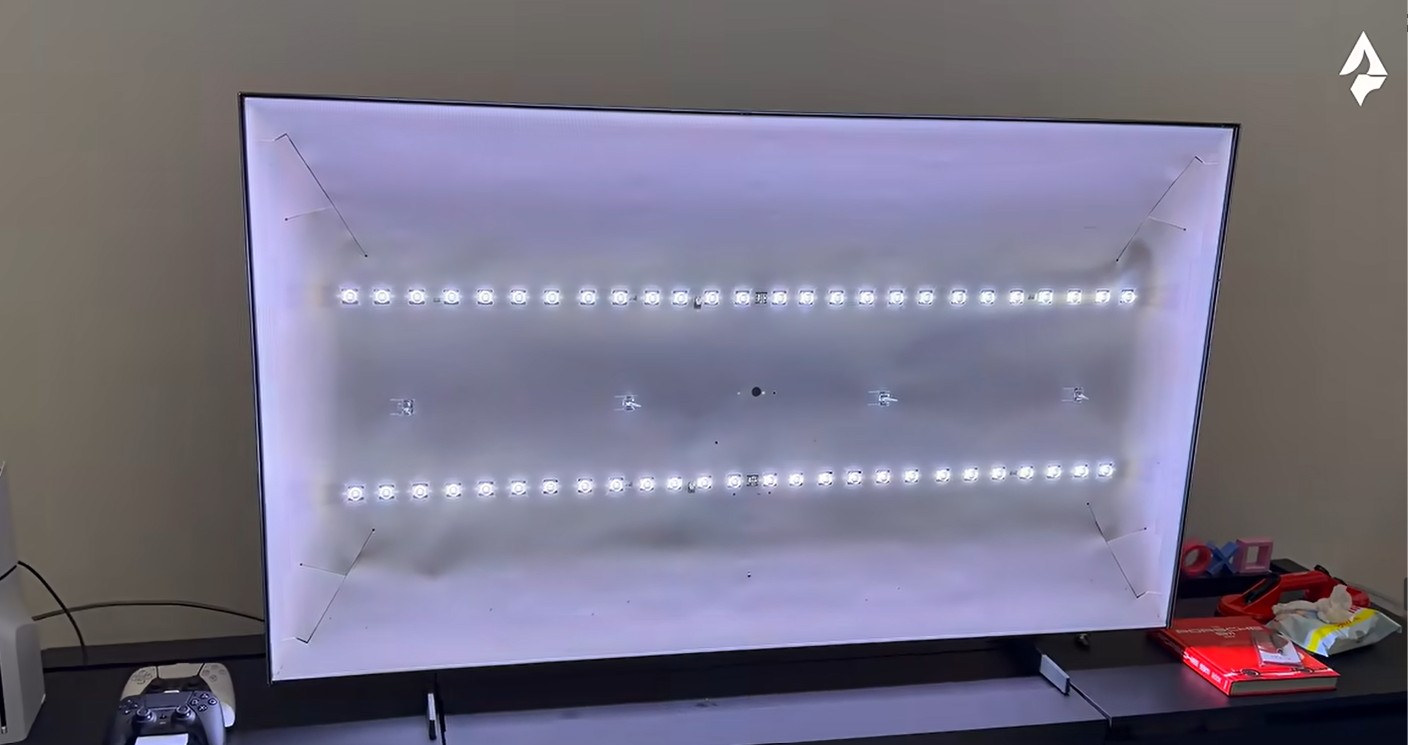
The M80H’s backlight has two rows of LEDs.
The M80H’s backlight has two rows of LEDs. Credit: AP Tech/YouTube
The industry hasn’t established standards for how many LED zones or Mini LEDs a display needs to qualify as Mini LED. That can leave shoppers confused about what they’re actually buying. It also creates a gray area where manufacturers can set their own standards.
“There are no organizations with authority to make and enforce such standards. TV brands have historically exploited the lack of clear standards to be more creative in their marketing,” O’Brien said.
“I think that [TCL’s] claims are legitimate and raise some important question[s] for the entire industry, which lacks a clear definition of what a Mini LED display is,” Virey told me.
The problem can be seen elsewhere in the display panel industry with technologies like QLED.
The industry could try to create standards, but Virey thinks it would lead to “an endless race.”
“Each time there are new technologies, new marketing terms are invented and can easily be abused,” he said.
M-series performance
While enthusiasts may delight in digging into the complex underpinnings of backlight technology, most people just care about performance. So how are Samsung’s M-series TVs?
There aren’t many reviews. RTINGS found that the M80H had “low” contrast (6,440:1, according to the review site’s testing) that makes “dark scenes look washed out in a dark room.” Regarding HDR performance, RTINGs said, “Content mastered at 600 or 1,000 nits, which is most HDR content, cuts off rapidly at the TV’s peak brightness. This lets the TV get as bright as it can, but there’s less gradation in bright parts of the scene, so highlights can seem to blend together.”
By comparison, Samsung’s $1,200 Mini LED Neo QLED QN80H, which uses individually addressable dimming zones, reached a contrast of 80,000:1 after calibration, according to RTINGs. That translated into visible improvements during actual use. RTINGs reported that the QN80H “looks good in a dark room thanks to its high contrast ratio and great black uniformity, making it a good choice for a home theater room.”
The AP Tech video below shows how an M-series TV and one with FALD handle dimming differently.
TCL’s budget QM6K ($550 MSRP as of this writing), meanwhile, reached a contrast ratio of 118:059:1 after RTINGs’ calibration. But even this set falters in areas where you might expect Mini LED to shine. Its HDR performance, for example, is reportedly lacking.
“Visually, the TV doesn’t impress, although its black levels are quite good due to its impressive contrast and good black uniformity. Unfortunately, there’s more haloing around bright highlights than you’d like, but it’s alright. Its HDR brightness is mediocre at best, so the TV doesn’t provide an impactful HDR experience overall,” RTING’s review says.
Mini LED muddied
TCL has an obvious stake in challenging Samsung’s marketing. The companies are longtime rivals, and casting doubt on Samsung’s claims could help TCL sell more TVs. But the underlying question is still worth asking: What should consumers expect when a TV is marketed as Mini LED?
I’d argue that a TV with slightly smaller LEDs than average but without local dimming shouldn’t be considered Mini LED with local dimming. The important distinction isn’t simply the size of the LEDs; it’s how they’re used to deliver improved contrast and HDR performance.
But even that definition has limits, as small LEDs and local dimming zones aren’t enough to guarantee good performance. TCL’s own budget line of Mini LED TVs can disappoint in areas where the technology should have an advantage, such as HDR support. And compared with Samsung’s more expensive Mini LED TVs, the M-series has worse HDR performance and black levels and is harder to use in a dark room, according to RTINGs’ testing.
That leaves shoppers in an awkward position. Terms like “Mini LED” or “QLED” are now used liberally, but they don’t always tell you how a TV will perform. Manufacturers often fail to disclose basic details, like the size of the LEDs, the number of dimming zones, or accurate contrast and brightness measurements.
For shoppers, then, it’s important to remember that comparative pricing and independent testing are ultimately much more useful than a label on a box.

Scharon is a Senior Technology Reporter at Ars Technica writing news, reviews, and analysis on consumer gadgets and services. She's been reporting on technology for over 10 years, with bylines at Tom’s Hardware, Channelnomics, and CRN UK.








 English (US) ·