
Miramax Films
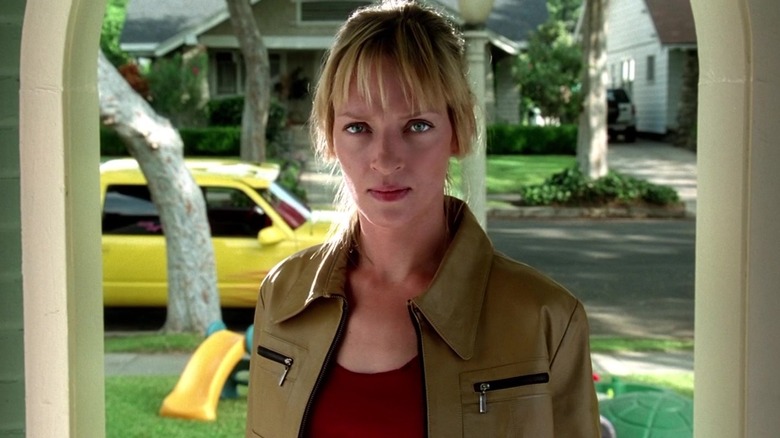
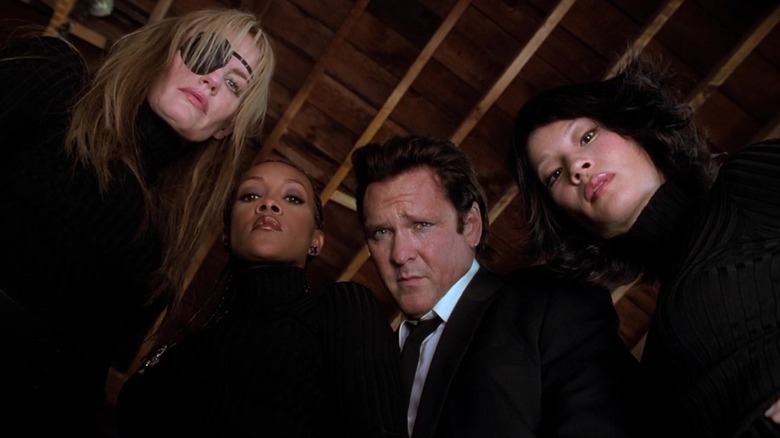
Although filmmakers continued to make action movies after the release of Quentin Tarantino's "Kill Bill" in 2003, they really didn't need to. With both parts edited together, "Kill Bill" ran an overwhelming 253 minutes, packing in every action scene, action character, and action movie plot trope in one gigantic remixed orgy of 1970s movie references. Tarantino is notoriously fond of martial arts cinema, violence, and revenge stories, and "Kill Bill" attempted to synthesize all his favorite movies into one. The stylish results were exhilarating, and "Kill Bill" became a giant hit. The first part, released in October of 2003, made over $180 million. The second part, released the following April, made over $153 million. The first part likely did better at the box office because it had more action scenes, including a prolonged sword fight wherein the Bride (Uma Thurman) murders dozens of people.
The film was so successful that Tarantino has, perhaps oddly, largely stayed within the realm of revenge ever since. The director started to use movie violence as a means to obtain a kind of vicarious revenge against real-life crimes. His 2007 film "Death Proof" (released as half of the two-for-one movie "Grindhouse") was about women getting revenge on a male serial killer. "Inglourious Basterds" depicted Jewish characters murdering Adolf Hitler and other powerful Nazis during World War II. "Django Unchained," of course, was about a Black gunslinger taking revenge on white slave owners in 1860s America.
Not everyone was impressed with "Kill Bill," however. Indeed, Stephen King, authoring a guest column for EW in 2007, actively disliked "Kill Bill," feeling that the film was "full of itself." King had no patience for Tarantino's in-jokes, inspirations, and movie references. At the end of the day, for King, it was just dull.
Stephen King felt that Kill Bill was dull
Miramax Films
In his column, Stephen King was parsing out, in a critical way, the difference between movies that mattered and movies that didn't. His baseline example was a pair of Francis Ford Coppola movies, "Dementia 13" (1963) and "The Godfather Part III" (1990). King wrote that the former was actually more important than the latter, as "Dementia 13" had "heart, soul, and the crazy enthusiasm of youth," while "Godfather III" was "the work of a talented man who has either used all his talent up or is saving what's left for another day." Ouch.
In 2003, King saw two movies that he thought were both worthy of attention, one because it was great, and the other because it was, to use his term, "blah." The great film was Clint Eastwood's crime drama "Mystic River," a film that he felt successfully built characters in order to tell its story. "Kill Bill" was the "blah" film because, as mentioned, he felt it was terribly dull. He even threw shade on a few of his least favorite movies to describe "Kill Bill," writing that the film "isn't a benchmark of awfulness like 'Mars Attacks!' or 'Mommie Dearest'; it's just dully full of itself." (Personally, I felt more of a sting at his dismissal of "Mars Attacks!")
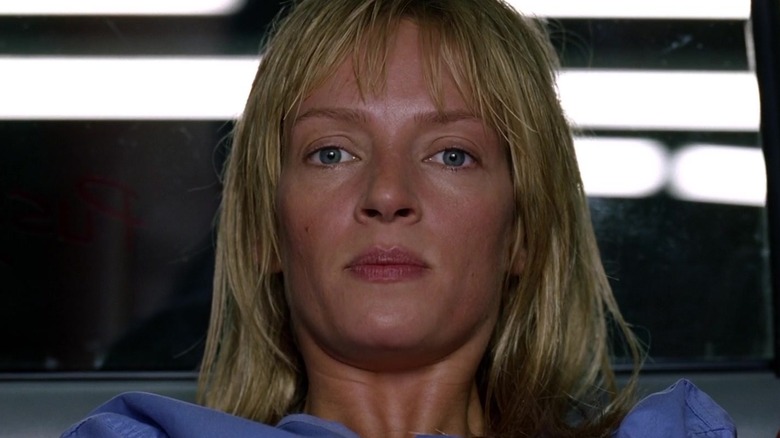
King did note that at least the film's violence was spectacular and that it was "choreographed like an Esther Williams swim routine." But he disliked that Uma Thurman's character wasn't given a name, making her an archetype. She's not so much a relatable human being as, in King's view, "a label." And then, by the end of the first half, there's not even a notable conclusion.
To Stephen King, Kill Bill wasn't so much a story as a Quentin Tarantino reference party
Miramax Films
To that effect, King wrote:
"There's not even an ending you can hang your hat on; we're just told to stay tuned for more — more karate kicks and throws, more falsetto birdy-sounding battle cries. It's certainly well made, and the story garners some of our interest as it goes along, but dull is still dull, isn't it? All I'm doing here is trying to focus the feelings of vague dissatisfaction you're apt to experience leaving this movie, the sense that you came to be entertained and instead found yourself warming your hands at the bonfire of Quentin Tarantino's vanities."
King concluded, perhaps inaccurately, that more people would remember "Mystic River" than they would "Kill Bill." He wrote that it "isn't a bad movie; it's just a tepid one. Ten years from now, you'll be hard put to remember what it was about or who was in it."
In terms of DVD revenue, midnight screenings, and general cultural penetration, however, "Kill Bill" has actually lingered in the pop consciousness far better than Clint Eastwood's film. "Mystic River" was nominated for six Academy Awards, including Best Picture and Best Director, and won Oscars for Best Actor and Best Supporting Actor (for Sean Penn and Tim Robbins). Kevin Bacon also gave a great performance and famously only required one directorial note. "Kill Bill," meanwhile, has been parodied in other movies, and adored by film bros; you can be damn sure some kids still have "Kill Bill" posters in their dorm rooms to this day.
I'm willing to bet none of them have "Mystic River" posters. If you do, good work. Stephen King would approve.







 English (US) ·