
 3 weeks ago
46
3 weeks ago
46
Meteoric, a startup by two engineers from the University of Cambridge and backed by Y Combinator, plans to build drones that will autonomously fly inside low- and mid-altitude clouds near solar farms to dissipate them and help keep power production in optimum conditions. According to Mete Karslioglu, Meteoric’s CEO, these drones will mechanically alter the water droplets inside clouds that cover solar farms, reducing their reflectivity and increasing the amount of sunlight that hits the panels below.
“Low and mid-level overcast clouds cut incoming sunlight by 73–82% while they’re overhead. We recover that without building new infrastructure,” Karslioglu wrote in their Y Combinator post. “Fleets of 10s-100s of autonomous drones that fly into low and mid-altitude clouds (1–5 km) over a solar farm and alter the water droplets that form them without using any chemicals. This reduces their reflectivity and brings back measurable amounts of sunlight to the panels below. Our cloud-loss model shows that this process can increase annual generation from existing assets by 10-30% across major U.S. grid regions, worth ~$5,000-28,000/MW, without building any new infrastructure.” They also added, “Our ultimate goal is to reduce the intensity of severe storms and hurricanes.”
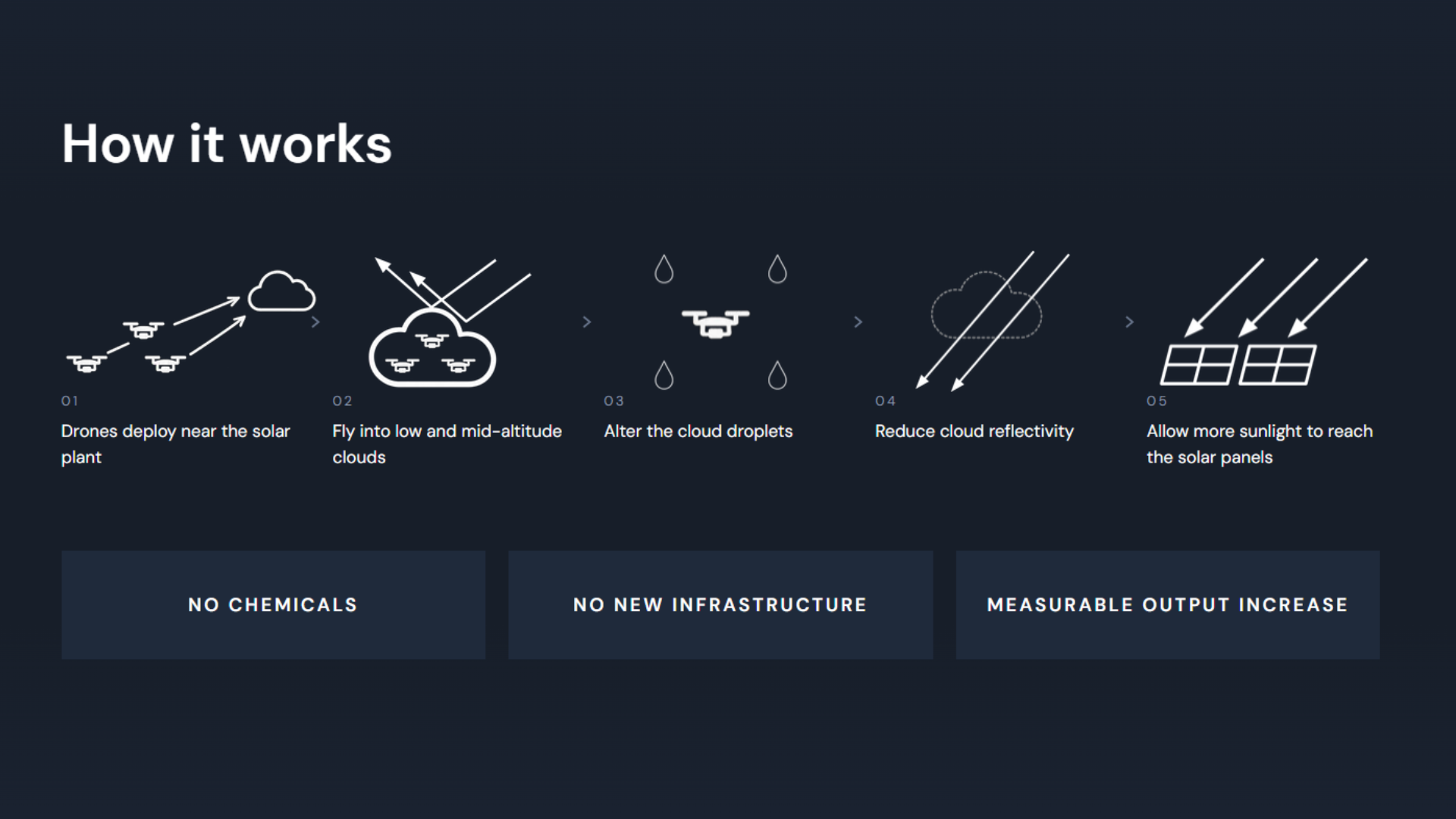
It’s unclear what method the startup will use to help dissipate clouds, but it claims to have a working prototype that dissipated an artificial cloud by 13% in cloud-chamber tests. Techniques to dissipate fog and low clouds already exist, like dispersing solid or liquid carbon dioxide inside them to make the floating water droplets grow bigger and encourage them to fall from the sky, or through mechanical mixing, such as flying a helicopter through saturated air in order to mix them with drier air and make it easier for the water vapor to evaporate. However, Meteoric said that these methods are expensive, with aircraft operations costing $2,000 per hour or more. On the other hand, its electric drones would only cost $30 to $60 an hour, making its operations significantly cheaper.
This is a unique approach to one of the biggest problems of solar power, where changing weather patterns and the day/night cycle greatly reduce their output. Other institutions, both startups and tech giants, are also looking for ways to solve this. For example, Reflect Orbital proposes launching an orbital mirror to reflect sunlight in various areas to extend daylight, while Meta plans to put solar collecting satellites in geosynchronous orbit and then beam the sunlight to collectors on the ground below.
Now, the startup’s premise looks promising for localized applications, like solar plant deployments. However, its dream of scaling up to impact storms and hurricanes raises some questions. The World Meteorological Organization says that the amounts of energy involved in weather systems are so massive that it’s impossible to alter or eliminate severe weather phenomena. “Weather modification technologies that claim to achieve such large-scale or dramatic effects do not have a sound scientific basis and should be treated with suspicion,” the group said. There’s also the concern that modifying weather conditions, even locally, might have unintended consequences on the local ecosystem. Nevertheless, Meteoric’s plan to increase solar output by cutting cloud cover might be interesting for solar operators looking to maximize the production of their plants.

Follow Tom's Hardware on Google News, or add us as a preferred source, to get our latest news, analysis, & reviews in your feeds.








 English (US) ·