
 Image via Dimension Films

Published May 3, 2026, 5:23 PM EDT
Jeremy has more than 2500 published articles on Collider to his name, and has been writing for the site since February 2022. He's an omnivore when it comes to his movie-watching diet, so will gladly watch and write about almost anything, from old Godzilla films to gangster flicks to samurai movies to classic musicals to the French New Wave to the MCU... well, maybe not the Disney+ shows.
His favorite directors include Martin Scorsese, Sergio Leone, Akira Kurosawa, Quentin Tarantino, Werner Herzog, John Woo, Bob Fosse, Fritz Lang, Guillermo del Toro, and Yoji Yamada. He's also very proud of the fact that he's seen every single Nicolas Cage movie released before 2022, even though doing so often felt like a tremendous waste of time. He's plagued by the question of whether or not The Room is genuinely terrible or some kind of accidental masterpiece, and has been for more than 12 years (and a similar number of viewings).
When he's not writing lists - and the occasional feature article - for Collider, he also likes to upload film reviews to his Letterboxd profile (username: Jeremy Urquhart) and Instagram account.
He has achieved his 2025 goal of reading all 13,467 novels written by Stephen King, and plans to spend the next year or two getting through the author's 82,756 short stories and 105,433 novellas.
Sign in to your Collider account
You do need more than one hand to count the Stephen King stories out there that haven’t yet been adapted to film or television, but not that many more than one. He’s been writing reliably creepy stories for more than half a century at this point, and it only took a couple of years before the adaptations started coming (well, they start coming, then they don’t stop coming). The first novel was Carrie, and it was first adapted by Brian De Palma in 1976. It’s worth bringing up because there have been subsequent adaptations of Carrie, including one that’s still upcoming, at the time of writing, helmed by Mike Flanagan. And Flanagan is kind of Hollywood’s Stephen King guy, at the moment. He’s directed some properly challenging adaptations to date, including Gerald’s Game and The Life of Chuck, all the while being ambitious with his Doctor Sleep adaptation, which has to work as a sequel to King’s The Shining (as Doctor Sleep, the novel, is) and a sequel to Stanley Kubrick’s (quite different) The Shining.
Flanagan’s been celebrated for bringing King to the big screen on these three occasions, especially with each adaptation being challenging in its own right. And he’s not slowing down with the whole King thing, because there’s Carrie, as mentioned before (which is a miniseries, rather than a film), then an adaptation of The Mist, and he still apparently might get around to adapting The Dark Tower properly one day, too. He’s on track to become the most prolific when it comes to adapting King, but as for being the best at adapting King? Frank Darabont still stands in the way of that title, because no filmmaker has made the stories of Stephen King work quite as well on screen as Darabont, and his three adaptations – The Shawshank Redemption, The Green Mile, and The Mist – all speak to that.
The Stephen King Adaptations Frank Darabont Has Directed to Date
Technically, Frank Darabont’s first Stephen King adaptation was a short film based on “The Woman in the Room,” which is a short story by King featured in the collection Night Shift. Short story, and short film, so only worth mentioning here because it wasn’t really a work of horror, and so it might've suggested, early on, that Darabont wasn’t necessarily as interested in King’s horror stories as most. Take The Shawshank Redemption, which has disturbing moments, but really isn’t close to a work of horror, since it’s a prison drama. And it was based on a Stephen King novella called "Rita Hayworth and Shawshank Redemption," which was one of King’s earliest non-horror works, and one of his best. Hell, it’s one of his best stories regardless of genre.
You probably don’t need much more by way of commentary for The Shawshank Redemption, since its legacy and reputation are so immense at this stage. Darabont went bigger five years later by directing The Green Mile, which was another prison story of King’s, but one with a little more by way of fantastical/supernatural elements, albeit without being full-on horror. Also, the source material was longer, and so the movie was fittingly a good deal longer than The Shawshank Redemption, too, but The Green Mile manages to feel intimate because it’s set on death row, and it goes to some truly dark territory while also being unafraid to get sentimental. Dark territory is all you get with Darabont’s third King adaptation, The Mist, which takes the novella of the same name and proves faithful for a while, with its story about people being trapped in a supermarket while unspeakable monsters lurk outside (and hey, there are a few monstrous people inside, too)… but then it reaches its ending, and then things switch gears. Call it an unfaithful ending, if you want, but it packs more of a punch.
How Frank Darabont Understood, and Sometimes Improved, the Source Material He Adapted
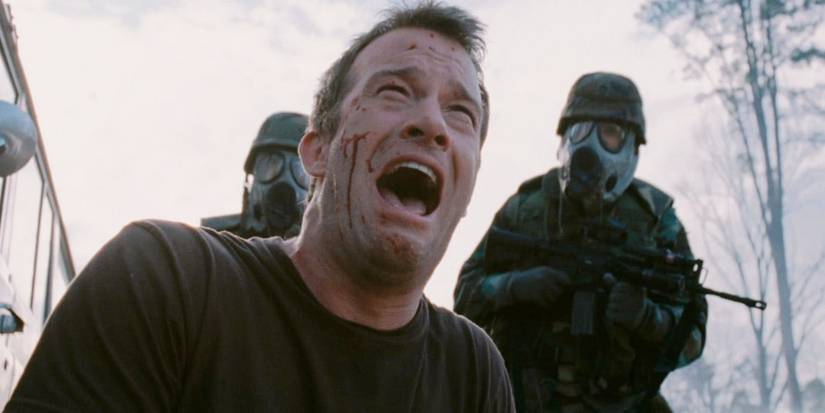 Image via Dimension Films
That ending, when it comes to The Mist, is perhaps one of the easiest things to point out if you want to argue that Darabont’s the best of the filmmakers who've ever tackled Stephen King. He kept what worked about the original story, but then figured out a more brutal and memorable way to end it, and the change was one that the author himself supported. It’s a more obvious change than any made to The Shawshank Redemption, but there is a certain ambiguity to the way the novella ends compared to the movie, which is sort of comparable to The Mist originally having an ambiguous ending on paper, but a more hard-hitting one on screen. With The Shawshank Redemption, it comes down to the very last scene taking place just after the novella ends, but it really does work so much better, and feels fitting considering all that came before.
There's a crowd-pleasing drama, a magical realist epic, and a cosmic horror story all ideally adapted, one after the other.
The Green Mile is the most faithful to the text, technically, but this works because it feels the most complete of the bunch (it is a novel, versus the novellas that are "Rita Hayworth and Shawshank Redemption" and "The Mist"), so it demonstrates that Darabont isn't interested in shaking things up just for the hell of it. It’s a little more streamlined, compared to the book, which was a bit more episodic owing to it originally being released in serial form, but the core of the story is well-maintained. So, there’s a crowd-pleasing drama, a magical realist epic, and a cosmic horror story all ideally adapted, one after the other. Even if you can argue that two are prison stories, they're very different sorts of prison stories, and a different approach was needed for one over the other. You can’t call it a trilogy, but this trio of movies is phenomenal, and they're easily Darabont’s three greatest works as a director, too.
Who Else Really Understands How to Make Stephen King Adaptations Work?
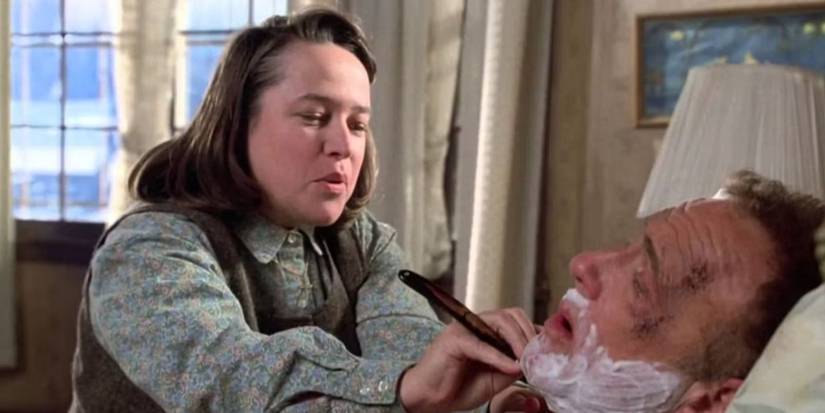 Image via Columbia Pictures
Going through the rest of Darabont’s body of work can be deflating. Other than adapting King, he’s not done a ton, and he’s also had some misfortune with the projects he has tackled (like The Majestic flopping, being taken off The Walking Dead as showrunner very early on, and having his series Mob City canceled after only one season). He most recently worked as a director for a couple of episodes of Stranger Things, which was always very Stephen King-inspired, but he’s otherwise been quiet. So, since The Mist (2007), others have continued to adapt Stephen King in their own ways, including Mike Flanagan, as mentioned before. Him apparently directing his own spin on The Mist is bold, though, considering how great Darabont’s version already is.
As for other directors who've stood out when adapting Stephen King, a (very) honorable mention has to go to Rob Reiner, who directed both Stand by Me (based on “The Body”) and Misery. In terms of quantity, the only director who, at the time of writing, trumps Darabont and Flanagan is Mick Garris, who directed the TV movie Desperation, Riding the Bullet, and Sleepwalkers (the last of those being written for the screen by King himself), and then counting miniseries, he was also the director behind all the episodes of The Stand (1994) and The Shining (1997). Those projects generally haven’t been as polished as Darabont’s and Flanagan’s, but for lower-budgeted affairs, they’ve mostly worked. And, in time, Mike Flanagan could well stand as the greatest director associated with King adaptations. It’s a crown Darabont holds for now, but maybe not forever. With Flanagan, he doesn’t seem like he’s going to be slowing down anytime soon, and if he can nail something as beloved and strange as The Dark Tower, then King’s constant readers will be over the M-O-O-N. That spells “Watch out, Frank Darabont.”

The Mist
Release Date November 21, 2007
Runtime 126 minutes
Director Frank Darabont
Writers Frank Darabont




 English (US) ·