
 Image via New Line Cinema
Published May 29, 2026, 8:11 PM EDT
Julio is a Senior Author for Collider. He studied History and International Relations at university, but found his calling in cultural journalism. When he isn't writing, Julio also teaches English at a nearby school. He has lived in São Paulo most of his life, where he covers CCXP and other big events. Having loved movies, music, and TV from an early age, he prides himself in knowing every minute detail about the things he loves. When he is older, he dreams of owning a movie theater in a small countryside town.
Sign in to your Collider account
Sometimes, movie titles can deceive us. There are many reasons why this may happen, but most times it's just about narrative needs, especially if the movie is an adaptation of another work. That's the case in The Lord of the Rings: The Two Towers, although the movie makes pretty clear what exactly its two titular towers are. As Saruman (Christopher Lee) himself says, they are his tower in Isengard, Orthanc, and Sauron's tower in Mordor, Barad-dûr. Despite his striking speech declaring "the union of the two towers," however, those are not the two towers author J.R.R. Tolkien originally chose.
Tolkien left a huge amount of records and material documenting the process of writing The Lord of the Rings, including countless notes and letters to his editors. That's where the evidence comes from: Orthanc is correct, but Tolkien didn't consider Barad-dûr as the other tower. He was often divided about this issue, because he didn't like the title The Two Towers, and accepted it only because his editors thought it would be best. So, then, the question of which towers those were arose, and, although the books don't explicitly say it, Tolkien himself did.
In the Books, ‘The Two Towers’ Are Actually Orthanc and Minas Morgul, not Barad-dûr
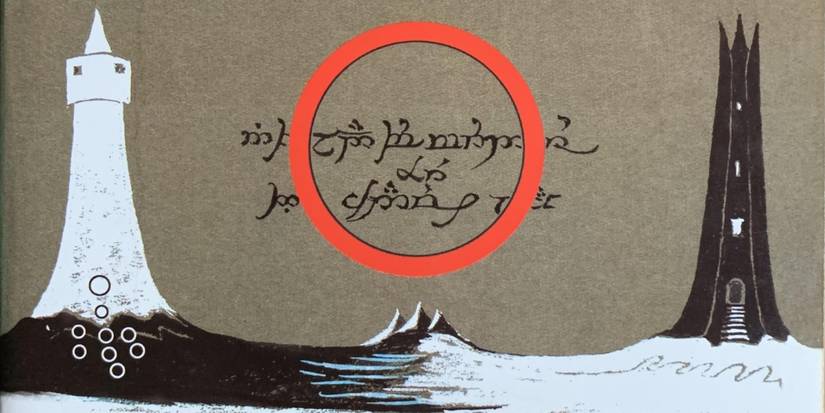 Image via Allen & Unwin
Besides being among the greatest writers of the past century, Tolkien was also a talented illustrator, having designed the covers for the original release of The Lord of the Rings books. On the dust jacket for The Two Towers, he made it clear that the title refers to Orthanc and Minas Morgul with a gorgeous illustration. It features a white tower with the symbols of a moon and nine rings to the left, and a dark tower with a star and a white hand to the right. The latter is obviously Orthanc, with Saruman’s white hand sigil. But the white tower is Minas Morgul, and Tolkien included the appropriate symbols to clarify it.
Minas Morgul is the Nazgûl headquarters, a pale-white city structured around a main tower in the darkness of the Morgul Vale. There are nine Nazgûl, and each was once a man turned into a wraith wearing their respective Rings of Power. Minas Morgul was also originally a fortress of Gondor until it was taken by the Nazgûl, and its original name was Minas Ithil, which translates to "Tower of the Moon." So, Tolkien's design on The Two Towers dust jacket is a dead giveaway: a white tower under the Moon where nine rings are can only be Minas Morgul; no other tower in Middle-earth fits this description.
Confirmation from Tolkien himself came around that same time, in February 1954. On a note added at the end of one of the final drafts of The Fellowship of the Ring, he wrote [sic]: “The second part is called THE TWO TOWERS, since the events recounted in it are dominated by ORTHANC, the citadel of Saruman, and the fortress of MINAS MORGUL that guards the secret entrance to Mordor.” At that moment in the story in the books, Frodo (Elijah Wood) and Sam (Sean Astin) are entering Mordor through the Morgul Vale. The staircase sequence, the fight against Shelob, and the breakout from Cirith Ungol all take place in The Two Towers, and are geographically connected to Minas Morgul.
J.R.R. Tolkien Also Briefly Considered the Tower of Cirith Ungol as Another Possibility
Because of how the books had to be structured upon release, Tolkien wasn't happy with the title The Two Towers, and was himself uncertain about what towers should be referenced to in the title. Orthanc was the most obvious choice for the first one, but, for the other, there were many contenders, including Minas Morgul, Cirith Ungol, Barad-dûr, and even Minas Tirith. Most readers believe that the second tower should be Cirith Ungol, actually, as that's where most of Frodo and Sam's action takes place, and Tolkien himself briefly considered this same thought.
In his letters to his editor, Rayner Unwin, Tolkien briefly acknowledged Cirith Ungol as the second tower. First, in Letter 140, he wrote that perhaps it could "be left ambiguous" what the towers were, leaving it to the reader to decide: "It might refer to Isengard and Barad-dûr, or to Minas Tirith and B [sic]; or Isengard and Cirith Ungol.” Shortly after, however, in Letter 143, he wrote that “It must, if there is any real reference in it to Vol. II, refer to Orthanc and the Tower of Cirith Ungol," but also admitted that, "since there is so much made of the basic opposition of the Dark Tower and Minas Tirith, that seems very misleading."
His reference to "Vol. 2" is key here, as The Lord of the Rings actually comprises six books organized into three volumes: The Fellowship of the Ring is Vol. 1, The Two Towers is Vol. 2, and The Return of the King is Vol. 3. The two books in Vol. 2 tell completely separate stories, however, and Tolkien himself called them "widely divergent" in Letter 140, but the title of the volume needed to provide some connective tissue between them and present them as part of the same overarching story, and The Two Towers was the best Tolkien could come up with at the time. Still, when the books were released, the towers on the cover were Orthanc and Minas Morgul, making those the official two towers.
Peter Jackson Had To Redefine the Two Towers To Fit the Film Trilogy
Image via Allen & UnwinRegardless of Tolkien's choices for the original books, however, it's still completely understandable why Peter Jackson would pick Orthanc and Barad-dûr for his film trilogy. They couldn't strictly follow the book's structure in The Two Towers, otherwise it would result in an even longer movie, where Frodo and Sam's segments would be much bigger than the rest of the Fellowship. Their entrance into Mordor was then allocated in The Return of the King, which, in turn, left The Two Towers without every one of Tolkien's choices for the second tower — except Barad-dûr. He did consider it briefly, but he knew that all the other options had a much stronger case.
For the movies, though, Barad-dûr fits like an iron-clad Orc gauntlet. Even in The Return of the King, Minas Morgul and Cirith Ungol are featured only briefly, and, without them, The Two Towers still needed another tower to go with Orthanc. There is simply no other tower featured in the movie adaptation — not even the Hornburg at Helm's Deep could be considered a proper tower — and Saruman's newly-formed alliance with Sauron prompted the obvious choice of Barad-dûr. It may not have been Tolkien's top choice, but, given the differences between written and visual media, this change had to be made for the sake of the narrative, as changing the original title is simply unthinkable.
Collider Exclusive · Middle-earth Quiz
Which Lord of the Rings
Character Are You?
One Quiz · Ten Questions · Your Fate Revealed
The road goes ever on. From the green hills of the Shire to the fires of Mount Doom, every soul in Middle-earth carries a destiny. Ten questions stand between you and the truth of who you are. Answer honestly — the One Ring has a way of revealing what we most want to hide.
💍Frodo
🌿Samwise
👑Aragorn
🔥Gandalf
🏹Legolas
⚒️Gimli
👁️Sauron
🪨Gollum
BEGIN YOUR QUEST →
01
You are handed a responsibility that could destroy you. What do you do? The weight of the world falls on unlikely shoulders.
AAccept it. Someone has to, and running changes nothing. BStay by the side of whoever carries it. They shouldn't go alone. CStep forward and lead. This is exactly what I was made for. DIt's mine now. I won't let anyone else have it.
NEXT QUESTION →
02
Your closest companion is heading into terrible danger. You: True loyalty is revealed not in comfort, but in crisis.
AFollow them without hesitation. I'd rather die beside them than live without them. BRally others and forge a plan to help — strength in numbers. COffer wisdom and guidance. My counsel may save them where swords cannot. DLet them go. Only the strong survive, and sentiment is a weakness.
NEXT QUESTION →
03
Enormous power is within your reach. Your instinct is: Power corrupts — but only those who reach for it.
ADestroy it. Nothing good comes from power this absolute. BUse it to protect those I love — just this once. CWield it wisely. I have the will and the knowledge to do good with it. DSeize it. I have waited long enough. It belongs to me.
NEXT QUESTION →
04
What does "home" mean to you? Where we long to return reveals who we truly are.
AA simple, peaceful place — green hills, good food, no adventure required. BWherever the people I love are. Home is a feeling, not a place. CA kingdom I must earn before I can truly claim it as mine. DI lost it long ago. That loss is what drives everything I do.
NEXT QUESTION →
05
When a battle is upon you, your approach is: War reveals what we are made of — whether we like it or not.
ASurvive by any means. I'm not a fighter — but I'll do what I must. BFight for the person beside me, not for glory or honour. CLead the charge. Nothing inspires an army like a king at the front. DStrike from range, fast and precise — never let them get close.
NEXT QUESTION →
06
Someone comes to you for advice in their darkest hour. You: Wisdom is not knowing all the answers — it's knowing which questions to ask.
AListen, then offer honest encouragement. Sometimes people just need belief. BGive them practical help — words are fine, but action is better. CSpeak carefully. I have seen much, and I know what counsel can cost. DTell them what they want to hear. Trust is a tool like any other.
NEXT QUESTION →
07
How do you see yourself, honestly? Self-knowledge is the most dangerous kind.
ASmall and ordinary — but perhaps that's exactly why I was chosen. BDefined entirely by who I serve and love. I am nothing without them. CForged by hardship into something the world has not yet fully seen. DDiminished from what I once was — and consumed by the need to reclaim it.
NEXT QUESTION →
08
Which of these best describes your relationship with the natural world? Middle-earth speaks to those who know how to listen.
AI find peace in it — forests, rivers, open skies. Nature restores me. BI prefer the earth underfoot — stone, mines, solid and real things. CI have watched the world change for longer than most can comprehend. DNature offers hiding places, cold water, raw fish. That's enough for me.
NEXT QUESTION →
09
You encounter a wretched, pitiable creature who has done terrible things. You: How we treat the fallen reveals the height of our character.
AShow mercy. Even the most broken souls deserve a chance at redemption. BPity them — but never trust them. They made their choices. CSee them as a tool. Their knowledge or skills may still serve a purpose. DDestroy them before they can cause more harm. Mercy is a luxury we cannot afford.
NEXT QUESTION →
10
When the quest is over and the songs are sung, what do you hope they say about you? In the end, we are all just stories.
AThat an ordinary person did an extraordinary thing — and came home. BThat I never abandoned the person who needed me most. CThat I was worthy of the crown — and everything it demanded. DNothing. I don't need songs. I needed it, and now it's gone.
REVEAL MY FATE →
The Fellowship Has Spoken Your Place in Middle-earth
The scores below reveal your true character. Your highest number is your match. Even a tie tells a story — the Fellowship was never made of simple people.
💍 Frodo
🌿 Samwise
👑 Aragorn
🔥 Gandalf
🏹 Legolas
⚒️ Gimli
👁️ Sauron
🪨 Gollum
You carry something heavy — and you carry it alone, even when you don't have to. You were not born for greatness, and that is precisely why greatness chose you. Your courage is not the roaring, sword-swinging kind; it is quiet, stubborn, and terrifying in its refusal to quit. The Ring weighs on you more than anyone can see, and still you walk toward the fire. That is not weakness. That is the rarest kind of strength there is.
You are, without question, the best of them. Not the most powerful, not the most celebrated — but the most essential. Your loyalty is not a trait; it is a force of nature. You would carry the person you love up the slopes of Mount Doom if it came to that, and we both know you'd do it without being asked. The world needs more people like you, and the world is lucky it has even one.
You were born to lead, and you have spent years running from it. The crown is yours by right, but you know better than anyone that right means nothing without the will and the worthiness to back it up. You are tempered by loss, shaped by long roads, and defined by a code of honour you hold to even when no one is watching. When you finally step forward, the world shifts. Because it was always waiting for you.
You have seen more than you let on, and you say less than you know — which is exactly as it should be. You are a catalyst: you do not fight the battles yourself, you ignite the people who can. Your wisdom comes not from books but from an age of watching what happens when it is ignored. You arrive precisely when you mean to, and your presence alone changes what is possible. A wizard is never late.
Graceful, perceptive, and almost preternaturally calm under pressure — you see things others miss and act before others react. You do not need to make a scene to be remarkable; your presence speaks for itself. You are loyal to those you choose to stand beside, and that choice is not made lightly. You have lived long enough to know that the most beautiful things in this world are also the most fragile, and that is why you fight to protect them.
You are loud, proud, and absolutely formidable — and beneath all of that is one of the most fiercely loyal hearts in Middle-earth. You don't do anything by half measures. Your friendships are forged like iron, your grudges run as deep as mines, and your courage in battle is the kind that makes legends. You came into this fellowship suspicious of everyone and ended it willing to die for an elf. That is not a small thing. That is everything.
You think in centuries and act in absolutes. Order, dominion, control — not because you are cruel by nature, but because you have decided that the world left to itself always falls apart, and you are the only one with the vision and the will to hold it together. You were not always this. Something was lost, or taken, or betrayed, and the version of you that stands now is the answer to that wound. The tragedy is that you're not entirely wrong — just entirely too far gone to course-correct.
You are a study in contradiction — pitiable and dangerous, cunning and broken, capable of both cruelty and something that once resembled love. You are defined by loss: of innocence, of self, of the one thing that gave your existence meaning. Two voices war inside you constantly, and the tragedy is that the better one sometimes wins, just not often enough, and never at the right moment. You are a warning, yes — but also a mirror. We are all a little Gollum, given the right ring and enough time.
↻ RETAKE THE QUIZ
The strike of brilliance on the film's part is having Saruman reference "the union of the two towers" in a montage showing both Orthanc and Barad-dûr to leave no room for disputes concerning the film trilogy. This is one of many ways Jackson's trilogy stands on its own, almost as something separate from the original books. While people may speculate about what the two towers are in the books, in the movies it's clear from the start, with no room for debate. The debating and researching is one of the best and most fun aspects of being a fan of Tolkien's work, though, so readers will still often argue about what they think the two towers really are, but now we know Tolkien's own thoughts on the matter.
The Lord of the Rings: The Two Towers is available to stream on HBO Max.


 English (US) ·