
 4 hours ago
20
Peter Farrelly’s new film I Play Rocky is about the underdog-with-heart story of how a great boxing movie got made against the odds with its plucky young untried screenwriter allowed to star. So here is a reissue of that 1976 film for its 50th anniversary. It’s a forthright, rousingly idealistic film, wholesome in its essential patriotism, and which unselfconsciously shrugs off the boxing-movie’s gloomy generic inheritance, throwing away its grim traditional baggage of tragedy, cynicism and loss. It also doubles as a love letter to Philadelphia, the cradle of American democracy.
Its writer and insurgent star Sylvester Stallone created the role of Rocky Balboa, a punchy heavyweight fighter just turned 30, making peanuts slugging it out with bums and reduced to collecting debts for the Philly mob; this is an indignity which infuriates his grizzled old trainer and former mentor Mickey (Burgess Meredith) who once saw greatness in Rocky and is disgusted to see him selling out. Rocky is moreover entirely oblivious to national preparations to celebrate the 1976 bicentennial. (Boxing is for this anniversary what country music was in Robert Altman’s Nashville, only without the disorientation and pessimism.)
Our hero is poignantly in love with Adrianna, or Adrian (Talia Shire), an almost cartoonishly nerdy woman in the neighbourhood who serves behind the counter in a pet shop; she lives with her shlubby protective brother Paulie (Burt Young), a meat packer who hates his job and his life. (A photo in their shared home shows a younger, slimmer man in Navy uniform.) Paulie is always trying to set Rocky up with his sister, wanting a brother-in-law relationship with this tough guy so he too can work for Rocky’s wiseguy employer Gazzo (Joe Spinell). Stallone shows how intensely irritated he is by Paulie’s naive demands on this subject, not merely because of Paulie’s manifest lack of qualifications for this violent job, but because he hates that he is having to do it himself.
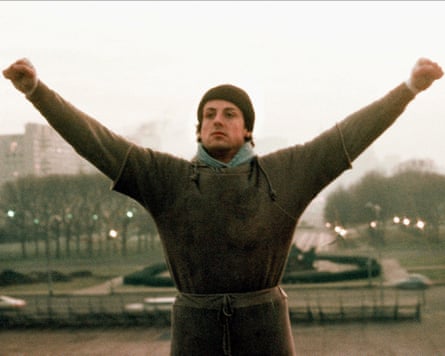
Having thoroughly established this situation, screenwriter Stallone unveils his second act with an exhilarating flourish. World champ Apollo Creed (an easy, breezy Carl Weathers) is in town to defend his heavyweight title and he and his retinue are appalled when the scheduled challenger has to pull out with an injury. So Creed decides to turn his fight into a story of the American dream-come-true: he will fight a local Philly boxer and picks our Rocky because he likes his nickname, the “Italian Stallion”. He and his crew figure this will be an amusing pastime, in which he will charitably give some local no-hoper a moment in the ring before putting him on the canvas. But tough, canny, big-hearted Rocky has other ideas: up at four every morning for roadwork, too puffed to get up those steps of the Philadelphia Museum of Art at first … but determined to make it.
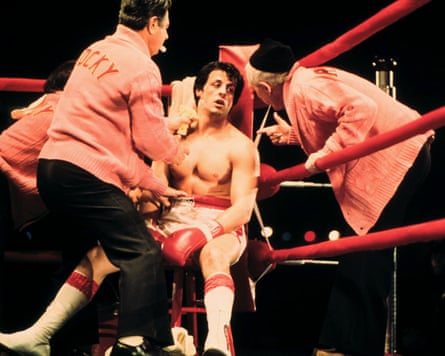
As Rocky, Stallone is clearly a very big strong man, and very convincing in the ring – although not buff with the razor-sharp defined musculature that would now be considered indispensable. (Oddly, there is no “weigh in” scene with him and Apollo.) In many ways, Rocky is about hero-worship of the great heavyweight champ Rocky Marciano, whose image is repeatedly invoked in this movie, and also about an Italian-American’s gallant, non-bigoted rearguard action against the inexorable dominance of African-American fighters. (Real-life champion Joe Frazier gets a walkon here.)
Rocky thoughtfully tells Adrian how tough boxing is, how loaded it is against fighters like him, and how it is almost designed to turn boxers into wrecks. When a movie audience hears that Rocky has been promised $150,000 as his share of the purse, they must wince with anticipation at the betrayal that is surely coming. He’s going to get cheated of that fortune … isn’t he? Similarly, when the loathsome Gazzo gives Rocky $500 for training expenses, we wince again. Rocky is now in debt to this gangster. Gazzo is going to demand some sort of quid quo pro. Will Rocky be asked to take a dive?
The answer in both cases, by a kind of miracle, is no. (Or at least we can assume that the answer to the first is no, and definitely no to the second.) Rocky is a film that appears to remember the melancholy destiny of Brando in On the Waterfront and also the ugly racial contest in something like The Great White Hope, which starred James Earl Jones as the Jim Crow-era black boxer Jack Johnson. But it turns despair on its head.
Stallone’s film was produced by Hollywood titans Irwin Winkler and Robert Chartoff who, four years later, were behind Martin Scorsese’s Raging Bull, a boxing movie that of course restored the darkness and the agony to the boxing genre in monochrome. But you can see similarities: Adrian’s first, extended, uncomfortable visit to Rocky’s room is not unlike Vickie LaMotta first coming to Jake’s house. And the very notion of the boxer just wanting to stay upright, absorb the punches and go the distance is very like the secular ordeal of De Niro’s self-pitying martyr LaMotta. (Actually, Rocky has one very gruesome detail not in Raging Bull: when towards the bout’s end, Rocky actually gets his cornerman to take the tape off his eyebrow, to reopen the cut so his eye will gorily reopen as well and he can see what he is doing.)
The resemblance ends there. Rocky wins a moral victory against Creed, who isn’t such a bad guy, of course, but with real faults. Before the fight, we see him discussing business opportunities in Canada, because of tax advantages. Canada? During the bicenntenial? That sort of existential disloyalty to Uncle Sam was never going to go unpunished. At the end we see that Rocky has succeeded in knocking his opponent down once and in securing the love of a good woman. And it’s a story that director John G Avildsen tells with great simplicity, often at a walking pace, mostly without stirring music on the soundtrack, except of course for those road running sequences. It has an enduring kind of innocence.





 English (US) ·