
 5 hours ago
8
5 hours ago
8
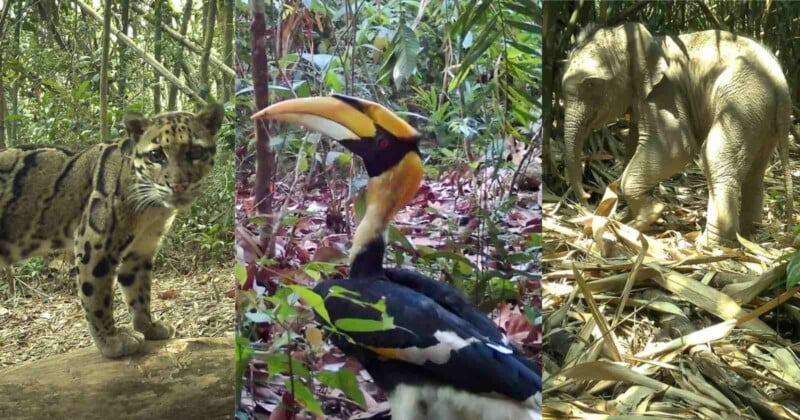 Some of the incredible species captured in the Annamite Mountains | Photo credit: Fauna & Flora.
A wide-ranging camera trap survey in the largely unexplored “Amazon of Asia” has captured rare images of endangered and elusive animals.
A camera trap survey conducted throughout 2025 has provided new insight into the biodiversity of the Annamite Mountains, recording a wide range of threatened and rarely seen species across forests spanning Laos, Vietnam, and northeastern Cambodia. The images highlight the ecological significance of one of Southeast Asia’s most important forest landscapes, which stretches about 683 miles.
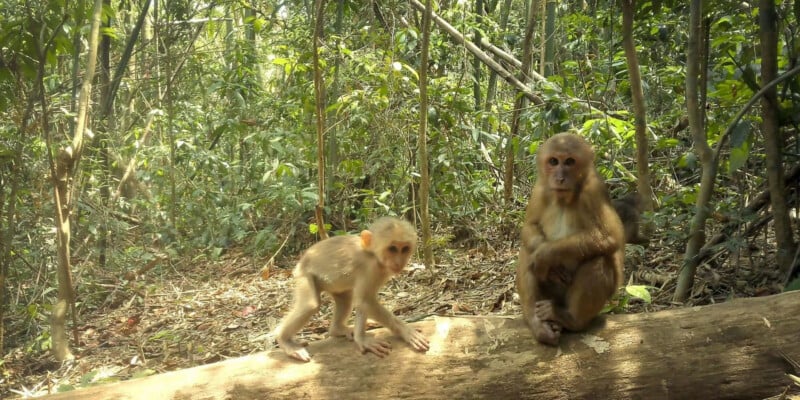 A mother and baby stump-tailed macaques perch on a fallen tree. | Photo credit: Fauna & Flora.
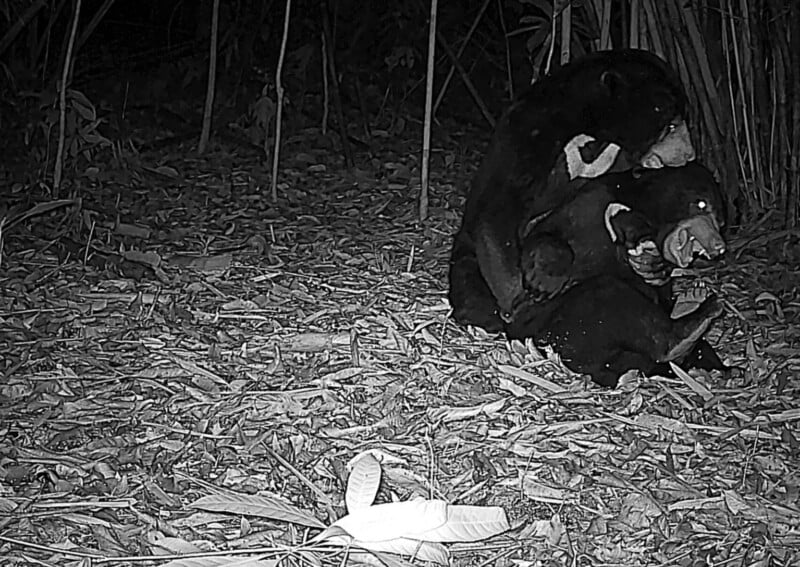 Named for their distinctive orange-yellow chest patch, these play-fighting sun bears have poor eyesight and hearing, but a powerful sense of smell. Their claws are strong enough to rip open a concrete-hard termite mound or excavate a bees’ nest. | Photo credit: Fauna & Flora.
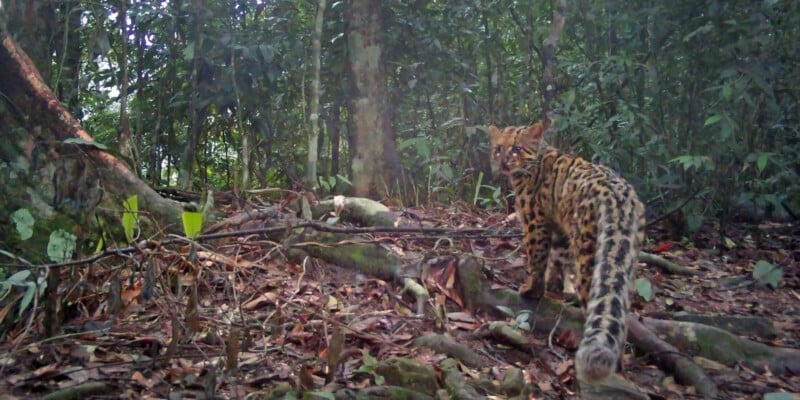 Named for their exquisitely patterned coats, marbled cats are expert tree climbers. | Photo credit: Fauna & Flora.
The survey was led by Fauna & Flora’s Cambodia program in partnership with the Ministry of Environment of Cambodia and the provincial environment department in Ratanakiri, with support from local Indigenous communities. Residents helped identify camera locations, transport equipment, and retrieve memory cards from remote parts of the protected area.
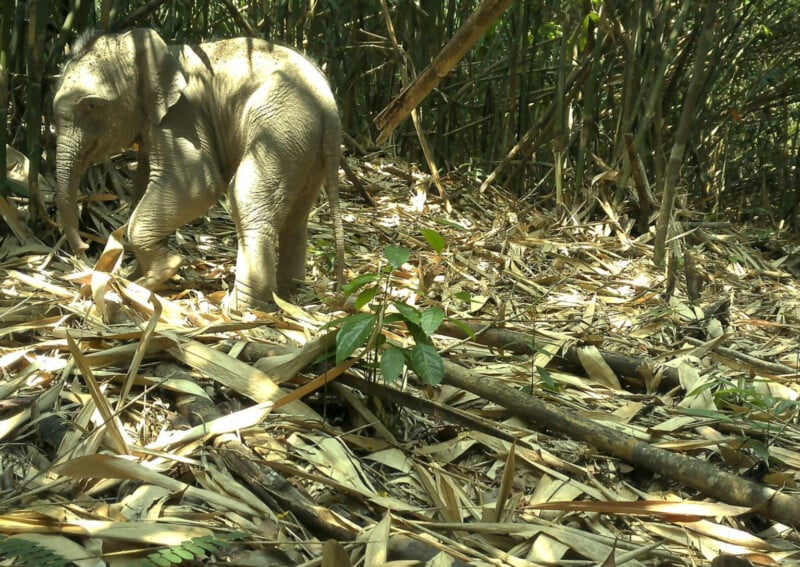 A camera-trap image of two Asian Elephants moving through forest in the Annamite Mountains. | Photo credit: Fauna & Flora.
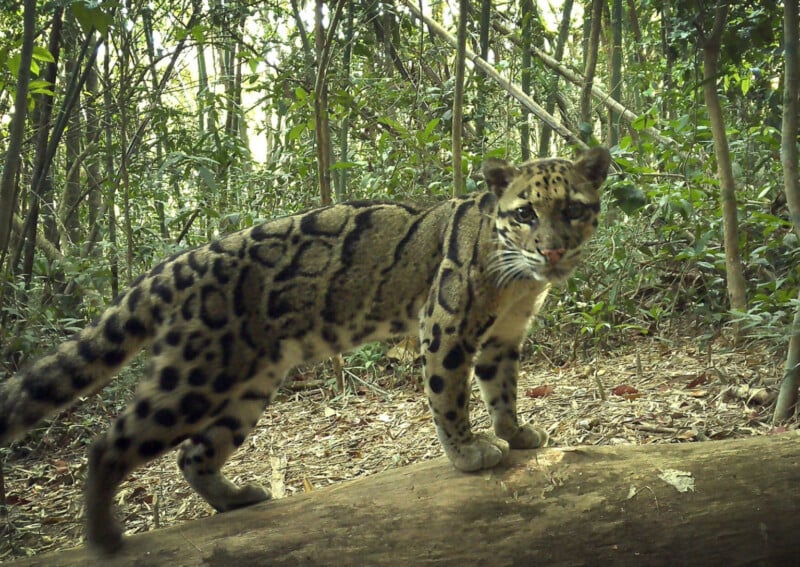 A clouded leopard was photographed. The beautiful markings on their coat make clouded leopards a prime target for the illegal wildlife trade. | Photo credit: Fauna & Flora.
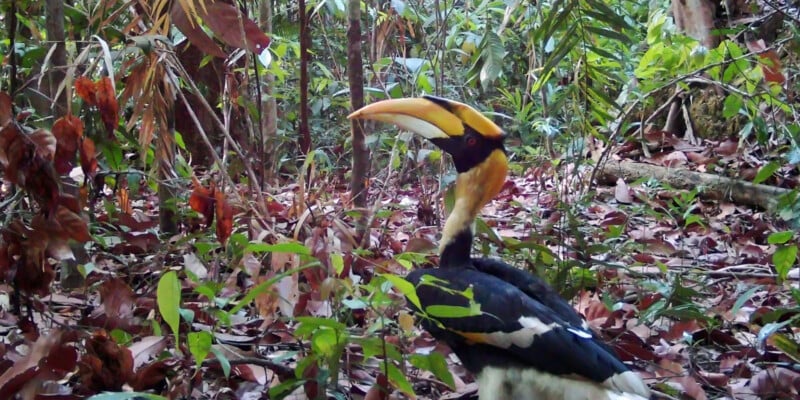 A great hornbill. | Photo credit: Fauna & Flora.
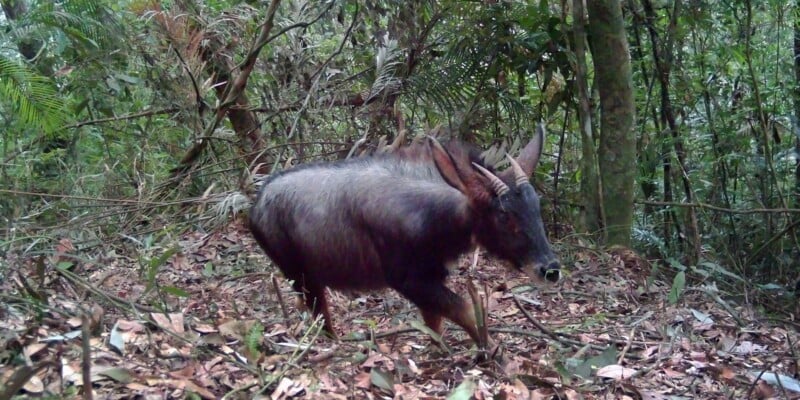 Looking like a cross between goat and antelope, the shy, elusive serow is a medium-sized mammal that favours rocky, forested hillsides. | Photo credit: Fauna & Flora.
The camera traps recorded a wide variety of wildlife, including Asian elephants, dholes, clouded leopards, marbled cats,stump-tailed macaques, and grey peacock-pheasants. Footage showed two sun bears interacting playfully, a species recognizable by the orange-yellow marking on its chest. The cameras also captured images of the Annamite striped rabbit, an endangered species named after the mountain range. Experts say it has only rarely been photographed and was not known to science until 1996. Among the bird species recorded was the great hornbill, whose presence is considered a sign of a healthy forest ecosystem.
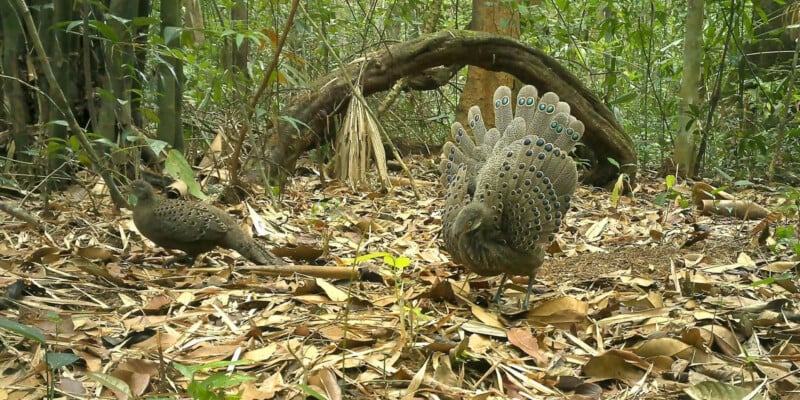 A male peacock-pheasant attempts to impress watching females by flaunting his iridescent ocelli (eyespots) and strutting his stuff on the dance floor he has created among the forest leaf litter. | Photo credit: Fauna & Flora.
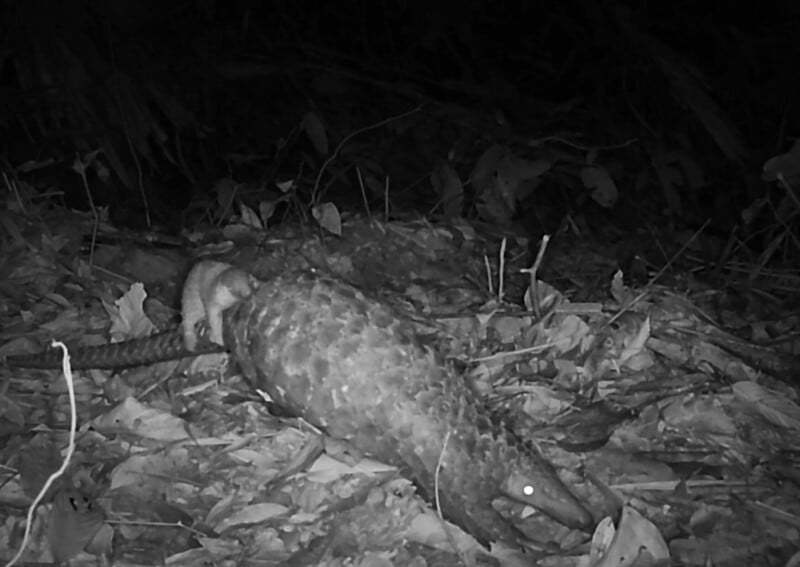 Sunda pagolin are photographed here. Affectionately known as pangopups, baby pangolins hitch a ride on their mum’s tail. The critically endangered Sunda pangolin, pictured here, is one of eight species of pangolin. These scaly anteaters are the world’s most trafficked mammal, targeted for their meat and scales. | Photo credit: Fauna & Flora.
“The Annamites mountain range is alive with a host of incredible creatures, each playing a critical role in maintaining the forest ecosystems that are vital to the health of our planet,” Gareth Goldthorpe, Senior Technical Adviser, Asia-Pacific at Fauna & Flora, says in a statement. “This camera-trap data allows us to discover some of the Annamites’ rarest species, while also understanding more about their behavior, preferred topography, and their interactions with human settlements.”
Fauna & Flora has worked in the Annamites since the 1990s to help protect the region’s forests. According to the organization, data from the long-term camera-trap survey shows that key threats to wildlife include habitat encroachment and fragmentation, as well as widespread snaring, which can rapidly deplete animal populations even in otherwise intact forests.
Previously, PetaPixel reported on a first-of-its-kind camera survey on a remote Tasmanian island which captured images of species seldom seen by humans.
Image credits: All photos by Fauna & Flora







 English (US) ·