

Published Jul 11, 2026, 9:00 AM EDT
Craig began contributing to Screen Rant in 2016 and has been ranting ever since, mostly to himself in a darkened room. After previously writing for various outlets, Craig's focus turned to TV and film, where a steady upbringing of science fiction and comic books finally became useful. Craig has previously been published by sites such as Den of Geek.
Craig is an approved critic on Rotten Tomatoes.
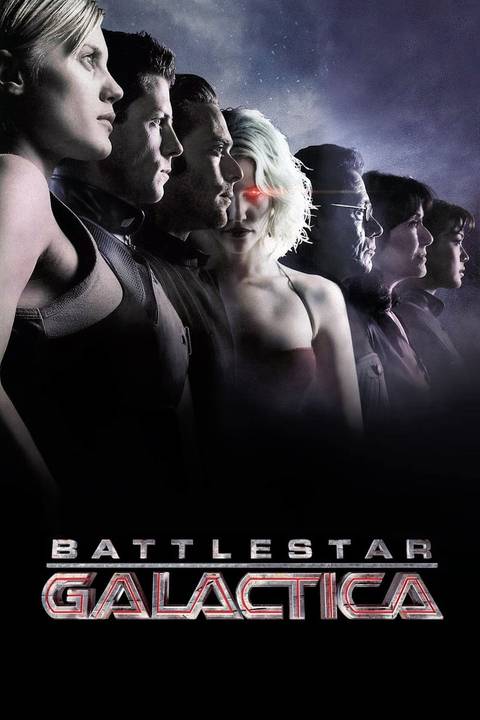
Battlestar Galactica is unquestionably one of the best space operas of all time, but it's also one of the biggest. Incorporating multiple human colonies, fallen civilizations, a race of sentient cyborgs, and literal gods, the Ronald D. Moore remake delves into both the scientific and the mystical to deliver a story of great scope and even greater scale. The fact that Battlestar Galactica ends with the survivors settling on Earth, then a flashforward thousands of years into the future shows our real-world present, only underlines the story's lofty ambition.
Few sci-fi shows share as much in common with Battlestar Galactica as The Expanse. Both series keep their fictional universes within a vague sphere of reality, and both eschew the Star Trek/Wars notion of alien races lurking around every corner. Military command chains, philosophical debates, and unknowable deities are just a few of the other parallels between the Battlestar Galactica reboot and the live-action adaptation of James S.A. Corey's book series.
As space operas go, both Battlestar Galactica and The Expanse sit on the more epic end of the spectrum. One could even argue that Battlestar Galactica is the 'bigger' of the two. The Galactica hops between star systems with relative ease, but galactic travel only becomes possible midway through The Expanse after the Ring Gates open. In terms of each show's fictional timeline, however, it's Battlestar Galactica that ends up looking smaller than its rival.
Like Battlestar Galactica's four-season run, The Expanse's six seasons cover a brief period of a few years. Also like Battlestar Galactica, The Expanse's lore and mythology stretch back eons, with events from millennia ago paying off in each show's present day. The similarities are abundant, but one key factor makes The Expanse feel larger in scale: the linear nature of its timeline.
In Battlestar Galactica, the same cycle is repeating over and over again across time. A civilization rises, develops sentient AI, gets destroyed by its own creation, then the pattern repeats. The characters of Battlestar Galactica are simply playing out one of these endless cycles, and while it's never explicitly revealed how long the wheel has been turning, it's a very, very long time.
The Expanse has an ancient civilization too: the mysterious Protomolecule builders, who existed thousands of years prior to the show's events. They were wiped out by exo-galactic entities dwelling inside the Ring Gates, who appear to be even more ancient than their victims. The story then picks up in Holden's era, where the remnants of the Protomolecule species are discovered, and the Ring Entities reawaken as a result.
Battlestar Galactica, then, is a series of closed loops repeating the same thing over and over. The Expanse is a linear chronology of cause and effect happening in sequence. Even if the first Cylons are just as old as the Ring Entities, The Expanse feels larger purely by virtue of being one long line of history.
Battlestar Galactica's Spiritualism Doesn't Make It The 'Bigger' Show

A viewer might argue that Battlestar Galactica's spiritual side gives it a sense of the grandiose that The Expanse cannot match. The mystery over what "God" truly means, the prophetic visions, Starbuck's resurrection (and possibility of being an angel) all give the 2000s series a remit that seems to reach far beyond The Expanse's pure science. Does that divine element not make Battlestar Galactica inherently bigger as a series?
Not necessarily. Looking closer, The Expanse does exactly the same thing, albeit with a more empirical slant. The Ring Entities are also referred to as "Dark Gods," the Protomolecule can trigger visions that border on prophetic, and on Laconia, the blue stuff is even used to bring the deceased back to life. It's the same thing, but whereas Battlestar Galactica asks, "Is this science or spirituality?" The Expanse says, "Nope, it's definitely science."
Release Date 2004 - 2009-00-00
Showrunner Ronald D. Moore
Directors Wayne Rose, Michael Nankin, Rod Hardy, Sergio Mimica-Gezzan, Edward James Olmos, Robert M. Young, Jeff Woolnough, Félix Enríquez Alcalá, Jonas Pate, Allan Kroeker, Anthony Hemingway, Jean de Segonzac, Marita Grabiak, James Head, Paul A. Edwards, Gwyneth Horder-Payton, Brad Turner, Ronald D. Moore, Bill Eagles
Writers Carla Robinson, Michael Taylor, Bradley Thompson, David Weddle, Jane Espenson, Mark Verheiden, Michael Angeli, Anne Cofell Saunders, Jeff Vlaming, Michael Rymer, Dawn Prestwich, Nicole Yorkin, Seamus Kevin Fahey
-

Edward James Olmos
William Adama
-

Mary McDonnell
Laura Roslin







 English (US) ·