
 3 weeks ago
43
3 weeks ago
43
A retro video gaming devotee has showcased Lara Croft adventuring in and among ancient tombs on a humble ESP32-P4 microcontroller. This highly affordable device (available as a sub-$25 dev board) packs a pair of 32-bit 400 MHz RISC cores and delivers a slick, playable 1,024 x 600 pixel experience for TheAlexKid777, yet consumes roughly 1 watt at peak. It is good to see someone having video-gaming fun with cheap, power-sipping new tech in 2026.
Go deeper with TH Premium: GPUs
Testing the power of ESP32-P4. Tomb Raider 1 port @EspressifSystems - YouTube
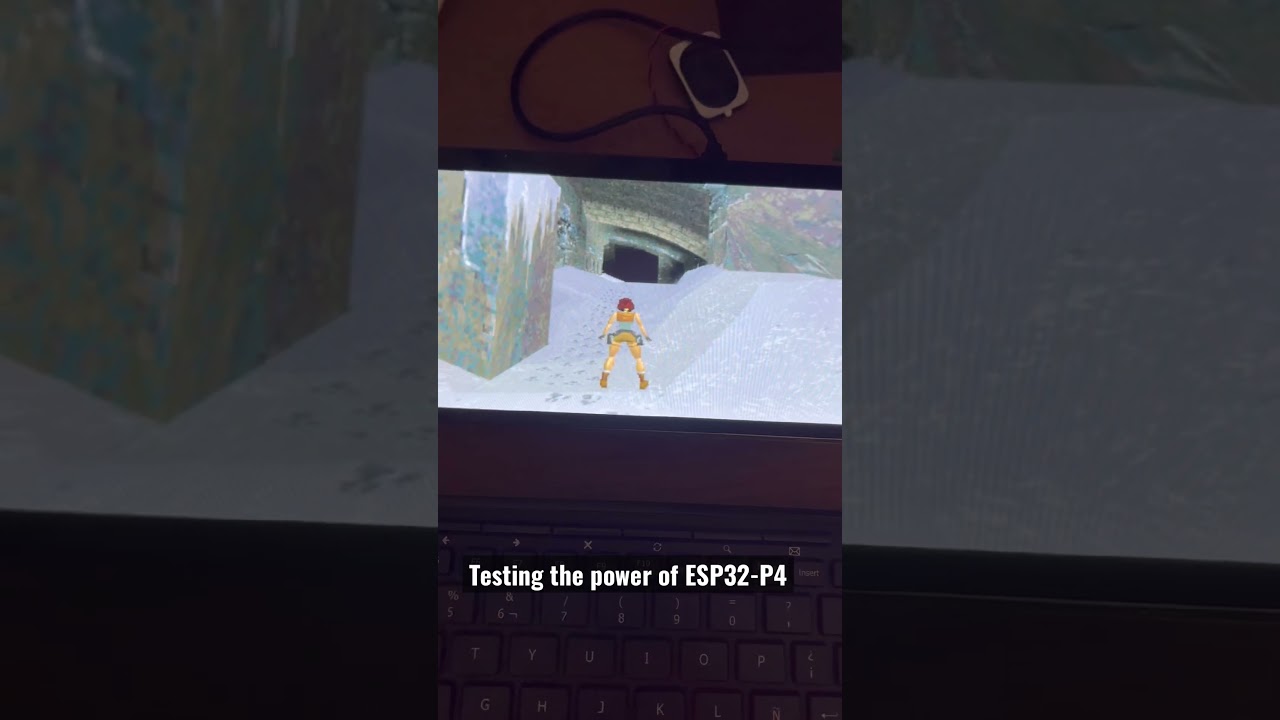
When it launched in the mid-90s, Tomb Raider quickly became a classic by successfully capturing the add-a-third-dimension-to-all-games-and-IPs trend while delivering an eminently enjoyable adventure game. Not all games were better because they were in 3D rather than 2D. Far from it. Now the compute power required to run a title like OpenLara doesn’t require an expensive and power-hungry game console - a cheap dev board that typically consumes milliwatts is capable enough today.
But the high-efficiency low-wattage gaming feat described above is just half the story. The other phenomenon demonstrated here is the beefing up of commonly available microcontrollers. Developers no longer need to be extremely resource thrifty when coding for these humble devices. They now pack plenty of horsepower to spare.
In the case of Espressif’s ESP32-P4, there is “a dual-core RISC-V CPU featuring AI instruction extensions, an advanced memory subsystem, and integrated high-speed peripherals,” the maker highlights. There’s also up to 64MB PSRAM, 768KB SRAM, an FPU, DSP, ISP, 55 programmable GPIOs, and more. It sounds almost like an original Tomb Raider era dream.
In TheAlexKid777’s demo, this hardware is attached to the back of what looks like a 7- or 8-inch LCD. It runs OpenLara at 320 x 240 pixels, which is PPA hardware scaled to 1,024 x 600 pixels. The game also features stereo audio pumped through the dev board’s ES8311 codec, and it's controlled via a connected USB keyboard.
We’ve previously reported on various ESP32 family microcontrollers being used to: power a retro Mac emulator, host a tiny ad-blocking dongle, and even run a 28.9 million parameter LLM. Some of these projects use far cheaper ESP32 microcontrollers, too, starting at $5.

Follow Tom's Hardware on Google News, or add us as a preferred source, to get our latest news, analysis, & reviews in your feeds.





 English (US) ·