
 1 hour ago
3
1 hour ago
3
GlobalFoundries and TSMC have entered into a five-year manufacturing agreement valued at $2 billion under which GlobalFoundries will produce silicon interposers for TSMC's CoWoS advanced packaging technology. The arrangement will establish a U.S.-based manufacturing source for these components, which will enable TSMC's clients to brand their products as completely made and packaged in America. Volume production is scheduled to ramp up in the first half of 2028.
"By providing manufacturing service using GF's trusted U.S. manufacturing footprint, we are creating a secure, scalable source of essential advanced-packaging elements that will help customers accelerate innovation and strengthen the semiconductor supply chain," said Ed Kaste, senior vice president of CMOS Business at GlobalFoundries.
GF and TSMC team up
Under the agreement, GlobalFoundries will expand manufacturing capacity at its fabrication facility in Malta, NY, to produce silicon interposers used in TSMC's CoWoS-S packaging ecosystem. Such interposers are custom pieces of silicon that provide high-density connections between logic chiplets and high-bandwidth memory (HBM) stacks and enable the creation of complex multi-die processors for artificial intelligence (AI) and high-performance computing (HPC) applications. The companies have not disclosed the production capacity to be installed, but the agreement provides a framework for additional expansion depending on demand.
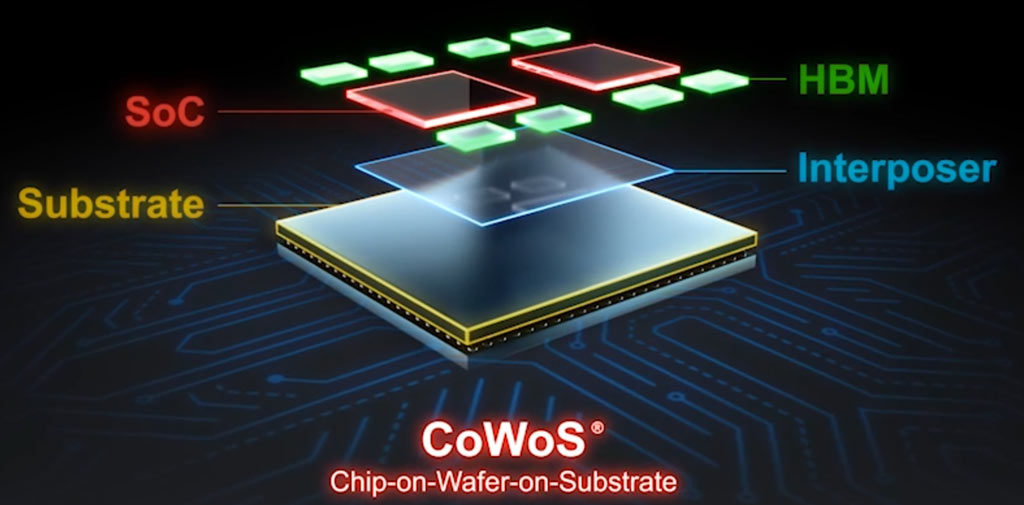
Silicon interposers used for TSMC's CoWoS-S packaging technology are customized for particular processor designs, as their configurations depend on the number, dimensions, and placement of logic chiplets and HBM stacks, as well as the interconnections between them.
In addition, interposers must meet the power-delivery requirements of specific processors, including power distribution networks and embedded deep trench capacitors (DTC), and their designs must account for signal integrity, power integrity, and thermal characteristics. Furthermore, large interposers may exceed the maximum lithographic reticle size and therefore require stitching, so it remains to be seen how well GlobalFoundries will stitch such interposers for extra-large system-in-packages (SiPs).
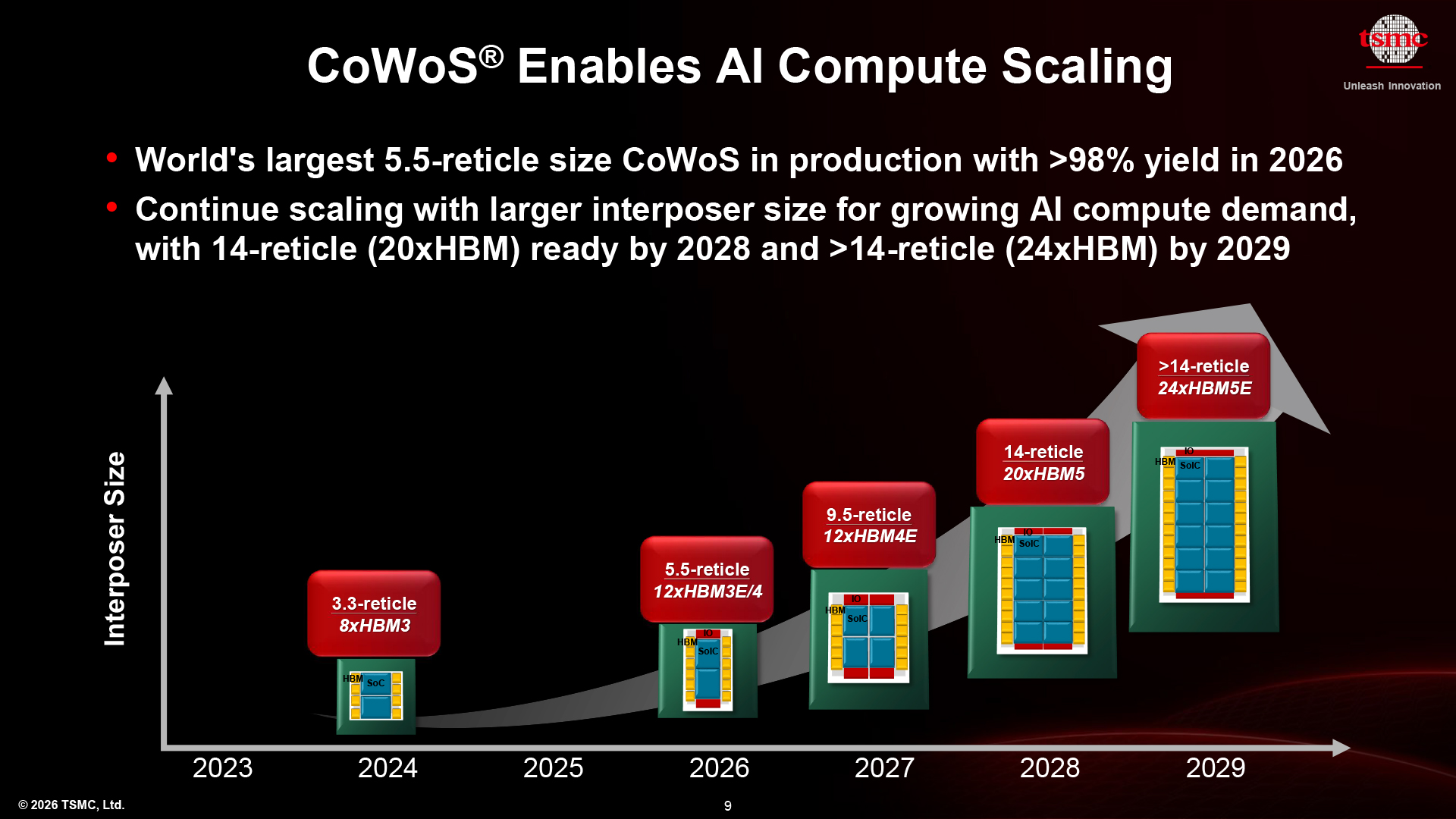
While certain manufacturing processes and structural elements can be standardized, the resulting interposers are generally application-specific. GlobalFoundries will not be a TSMC supplier, but a subcontractor that will manufacture multiple customer-specific interposer designs rather than standardized components that require close cooperation with TSMC. Specifically, GlobalFoundries will need to ensure compatibility between its design rules, manufacturing processes, and qualification procedures so that interposers produced by GF can be used in TSMC's CoWoS packaging flows. It remains to be seen how the companies will handle ownership and protection of intellectual property, as interposer layouts may incorporate technologies and production methods specific to TSMC and its customers.
By transferring some interposer production to GlobalFoundries, TSMC could free up some of its own manufacturing resources and increase availability of components required for advanced packaging.
Get Tom's Hardware's best news and in-depth reviews, straight to your inbox.
Manufacturing silicon interposers is only one part of the CoWoS-S production process. The technology also requires attaching logic chiplets and HBM stacks to interposers using high-precision bonding equipment, assembling the resulting structures onto organic substrates, and then performing electrical testing. These operations require dedicated manufacturing capacity, which the agreement between the two companies does not address.
Becoming a part of TSMC's CoWoS ecosystem
Following its exit from development of leading-edge process technologies in 2018 and consequent inability to produce leading-edge AI and HPC accelerators, GlobalFoundries is now becoming a part of TSMC's advanced packaging supply chain in the U.S. that will supply custom components for AI and HPC processors.
For GlobalFoundries, the agreement represents an opportunity to participate in the manufacturing of advanced AI processors without producing their leading-edge logic dies. Although the company abandoned the development of leading-edge process technologies eight years ago, its manufacturing capabilities remain suitable for producing certain components used in sophisticated multi-chip packages, including CoWoS-S interposers. It remains to be seen though whether it can also participate in TSMC's CoWoS-L supply chain.
The agreement with GlobalFoundries is particularly important considering TSMC's plans to establish advanced packaging operations in Arizona. The company intends to introduce CoWoS and 3D-IC packaging capabilities in the state before 2029 and has signed a 10-year agreement with Amkor Technology, which is building an advanced packaging facility in Peoria, Arizona, that is scheduled to begin production in early 2028.
As GlobalFoundries ramps up interposer production in New York in the first half of 2028, TSMC could potentially establish a largely domestic CoWoS supply chain that comprises logic dies manufactured in Arizona, silicon interposers produced in New York, and advanced packaging and testing performed by TSMC and/or Amkor in Arizona. For a while, HBM stacks would still have to be sourced from memory manufacturers in Asia, though both Micron and SK hynix intend to bring HBM assembly facilities to the U.S. already this decade, so it is safe to say that the U.S. will have a vertically integrated supply chain for production of advanced AI processors by 2029 – 2030.
There is a catch, though, as GloFo and TSMC have not disclosed how CoWoS assembly operations will be divided between TSMC and Amkor, or whether GlobalFoundries' interposers will be used in Arizona at all. Yet, GF's wording about a trusted U.S. manufacturing footprint strongly implies that its interposers will be primarily aimed at SiPs fabricated entirely in the U.S. Meanwhile, expanding interposer production alone will not increase the number of finished AI processors unless sufficient chip-on-wafer assembly and testing capacity is available.
Some things remain unclear
The initial agreement covers five years and establishes a mechanism for further capacity additions. However, the companies have not disclosed the planned manufacturing volumes, capital expenditures associated with the expansion, or the breakdown of the $2 billion agreement. Furthermore, we yet have to find out how GF's manufacturing capabilities are aligned with CoWoS-S' advancements.

Follow Tom's Hardware on Google News, or add us as a preferred source, to get our latest news, analysis, & reviews in your feeds.





 English (US) ·