Pi calculation world record shattered at 314 trillion digits with a four-month run on a single server — StorageReview retakes the crown, thanks to storage bandwidth
3 weeks ago
17
(Image credit: StorageReview)
The competition to calculate digits of Pi was initially an informal pursuit but grew more serious over time. Our server-oriented colleagues at StorageReview have proven that storage performance can make or break a Pi run, setting their latest record at a whopping 314 million digits with a single server that ran for four months.
Calculating Pi quickly became a way to benchmark the floating-point performance of CPUs. As the calculations grew ever larger, however, the task became more complicated, as RAM, I/O architectures, and storage systems came into play. That's a point StorageReview clearly illustrated by achieving a record with a single 2U server over a four-month calculation run.
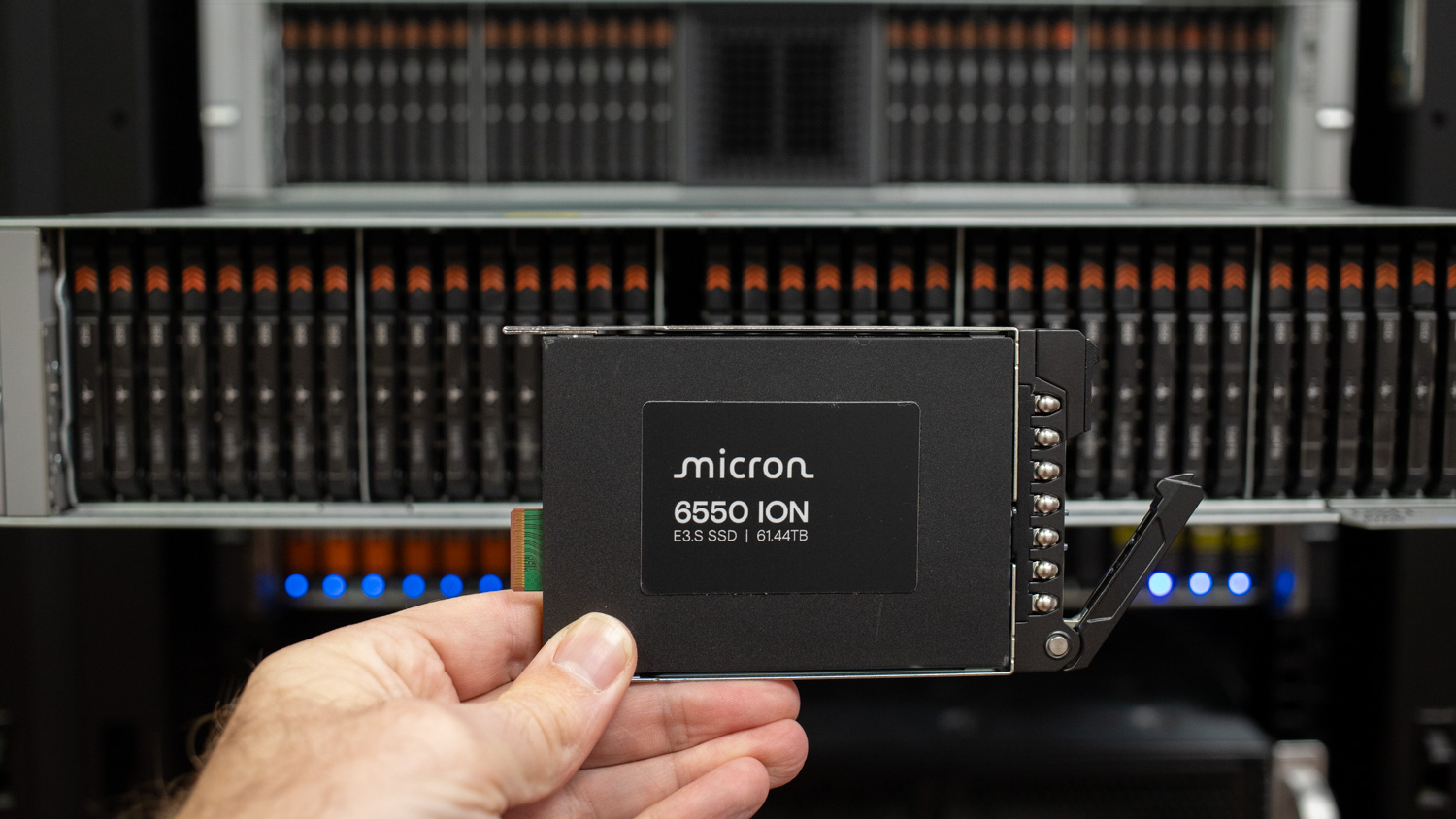
The said machine is a Dell PowerEdge R7725 unit fitted with two AMD Epyc 192-core chips, for a total of 384 cores, along with 1.5 TB of DDR5 memory, an amount that could probably buy a small country at today's prices. The storage array is where this setup shines, though, with 2.5 petabytes of storage thanks to a 40-drive array of Micron 6550 Ion SSDs at 61.44 TB each.
It's long been the case that calculating Pi to such long extents requires a significant amount of bytes to store intermediate computations. After all, you're dealing with factors that are trillions of digits long. Past approaches, such as Google's 100-trillion record in 2022, used cloud server instances, and Linus Media Group and Kioxia's 300-trillion-digit run earlier this year used a Weka cluster with shared storage. But StorageReview opted to prove a point by using plain ol' simple fast local SSDs.
It's worth noting that one key factor enabling the 314-trillion-digit run is that, unlike the previous generation, the 17th-generation Dell servers used don't have a PCIe switch in their storage backplane; instead, they use a direct connection to the CPUs' PCIe lanes. With 40 bays, that works out to 2 to 4 lanes per SSD, but that still worked out to a meaty 280 GB/s of read/write performance, much higher figures than StorageReview's own past experiments.
There were additional relevant optimizations as well. The team tweaked the machine's scratch array for the patterns generated by the y-cruncher software at large digit counts. It also changed the server's standard air-cooling configuration to a CoolIT AHx10 setup, resulting in higher steady-state load clocks for the Epyc chips.
The power consumption was only 1,600W, a high number on its own but actually a pretty impressive figure as far as efficiency is concerned. Last but not least, the OS was changed from Windows Server to Ubuntu 24.04.2, a simple switch that resulted in better I/O performance on its own. We can't help but wonder if using the latest Windows Server release with native NVMe support would have been comparable. If you're curious about more details, go ahead and read the entirety of StorageReview's write-up.
Get Tom's Hardware's best news and in-depth reviews, straight to your inbox.
Bruno Ferreira is a contributing writer for Tom's Hardware. He has decades of experience with PC hardware and assorted sundries, alongside a career as a developer. He's obsessed with detail and has a tendency to ramble on the topics he loves. When not doing that, he's usually playing games, or at live music shows and festivals.
Pi calculation world record shattered at 314 trillion digits with a four-month run on a single server — StorageReview retakes the crown, thanks to storage bandwidth

 3 weeks ago
17
3 weeks ago
17





 English (US) ·