
 3 weeks ago
30
3 weeks ago
30
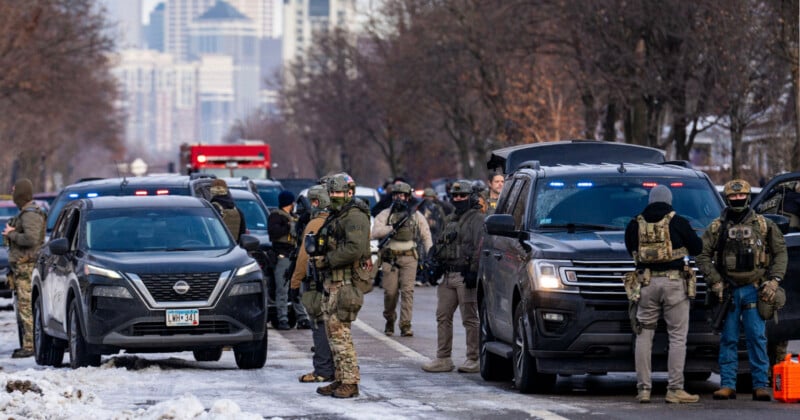 Federal agents in Minneapolis on January 8. | Photo by Chad Davis
A Minnesota photojournalist is challenging a nationwide temporary flight restriction banning drone flights within 3,000 feet of Department of Homeland Security assets.
Minnesota Reformer reports that drone photographer Rob Levine is challenging the temporary flight restriction, known as a TFR, which was put in place on January 16, 2026, essentially creating a nationwide, moving no-fly zone around DHS buildings and vehicles, including unmarked ICE cars.
“You have no way of knowing in advance before you fire up the drone whether you are within a prohibited distance of, say, an unmarked car that ICE is using for immigration enforcement,” Grayson Clary tells Minnesota Reformer. Clary is a staff attorney at the Reporters Committee for Freedom of the Press, which is representing Levine in the case.
The January 16 ban came during Operation Metro Surge, an operation led by ICE and the Customs and Border Protection (CBP) with the goal of apprehending undocumented immigrants in Minnesota. The TFR means that drones are not allowed to fly within 3,000 feet laterally and 1,000 feet vertically of not just DHS assets, but also Department of Defense and Department of Energy assets. The ban is scheduled to remain in place until October 29, 2027.
“Our members are finding it impossible to comply with the order — even when photographing stories with drones that are unrelated to these agencies,” National Press Photographers Association (NPPA) President Alex Garcia said in a press release on January 28. “A moving, effectively invisible TFR, applying to unmarked or rented vehicles creates a constantly shifting restricted airspace that journalists have no practical way to identify or avoid.”
Minnesota Reformer notes that, as well as the NPPA, The New York Times and The Washington Post both sent a letter to the FAA protesting the TFR, arguing it violates the First and Fifth Amendments of the U.S. Constitution.
Levine has previously tested a TFR issued by the FAA: in 2016, at the Standing Rock protests in North Dakota, the FAA denied his flight request only to reverse course and grant him a three-day waiver, which made him the only photographer with aerial access. Levine says that after seeing the TFR in Minnesota, he was worried he could be manhandled by agents.
“Seeing how these federal agents treated constitutional observers, I was truly worried that going out and flying,” Levine tells DroneXL. “I could get arrested, have my drone destroyed, and be roughed up, like they did to so many of those constitutional observers.”
The lawsuit can be read here.



 English (US) ·