
 2 hours ago
3
2 hours ago
3
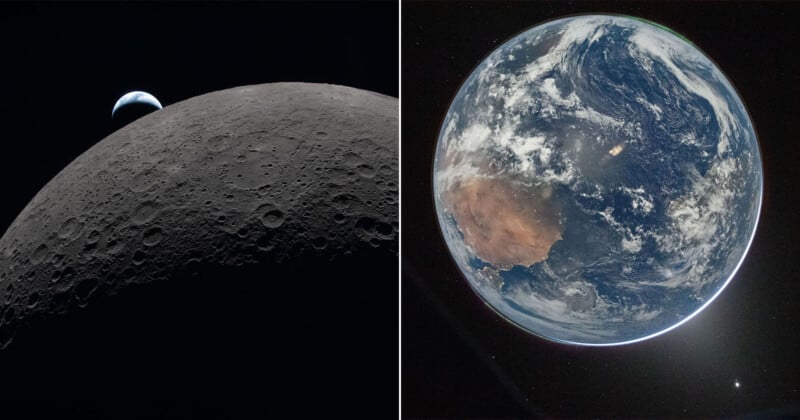
NASA’s Artemis II mission ushered in a new era of space exploration and inspired billions at a time when hope is so sorely needed. The successful mission, more than 50 years after people last orbited the Moon, honored Apollo’s rich legacy while charting an all-new path for the future. The four astronauts aboard Artemis II’s Orion spacecraft captured many exceptional photos on their journey, and these are our favorites.
Jaron Schneider
I like perspective. As much as I enjoy the wide, sweeping shots of our Moon and Earth set against each other (and I do very, very much enjoy those), my favorite photos remind me that there were people there.
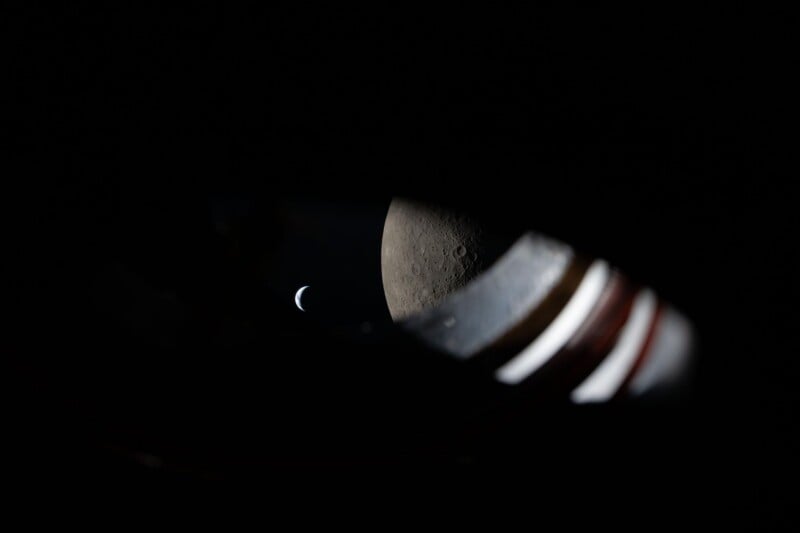 “A Room With a View” | A view from the window of the Orion spacecraft approximately 9 minutes before Earthset during the Artemis II lunar flyby on April 6, 2026.
These photos have context. We have seen stunningly beautiful photos of space before, and even some photos of the side of the Moon that faces away from our view down here on Earth. What we haven’t seen is human finger press a “normal” camera’s shutter in order to get that view. To me, Artemis II is soul-fulfilling because of that human element.
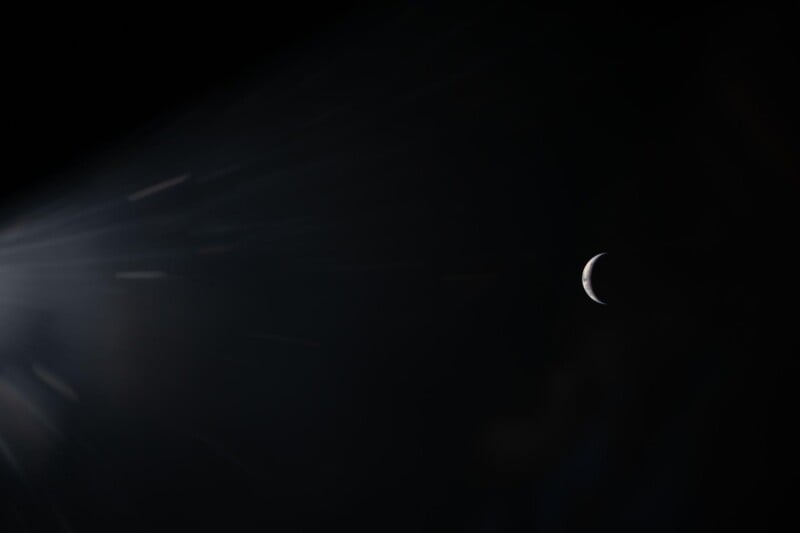 “A Crescent Earth” | An illuminated sliver of Earth set against the blackness of space is seen through the window of the Orion spacecraft in this photograph from the Artemis II crew on the third day of their journey to the Moon.
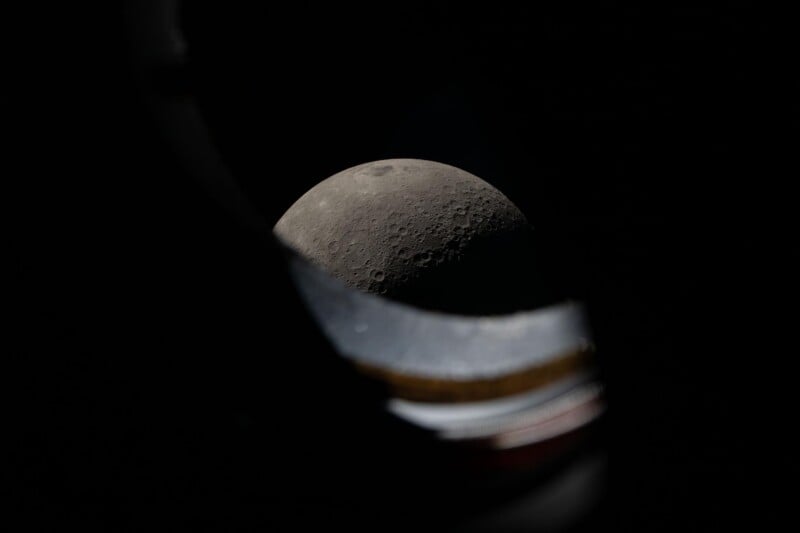 “Still Life” | The Moon seen peeking above the window sill of the Orion spacecraft during the Artemis II lunar flyby on April 6, 2026. The Artemis II crew spent about 7 hours at the Orion windows during the flyby, taking photos and recording observations on the Moon to share with scientists on the ground.
I connect with these photos because I can feel the invisible lines that tie us as photographers together. I know what it would feel like to have my camera pressed to the viewport. I have felt the waves of emotion as a gorgeous scene unfolds in front of me. I have felt the pressure to not only capture that scene, but do my best to do it justice despite the fact a single frame could never encompass how it felt to be there.
I can feel the compulsion to change my view, to pull back, to show the edge of that window.
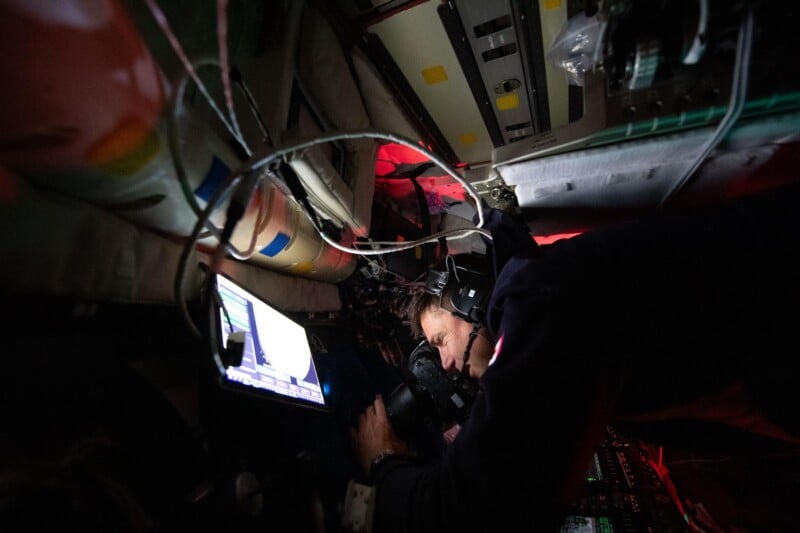 “Capturing the Lunar Flyby from Orion” | CSA (Canadian Space Agency) astronaut and Artemis II Mission Specialist Jeremy Hansen is seen taking images through the Orion spacecraft window during the Artemis II lunar flyby. Hansen and his fellow crewmates spent approximately seven hours taking turns at the Orion windows capturing science data to share with their team back on Earth. At closest approach, they came within 4,067 miles of the Moon’s surface.
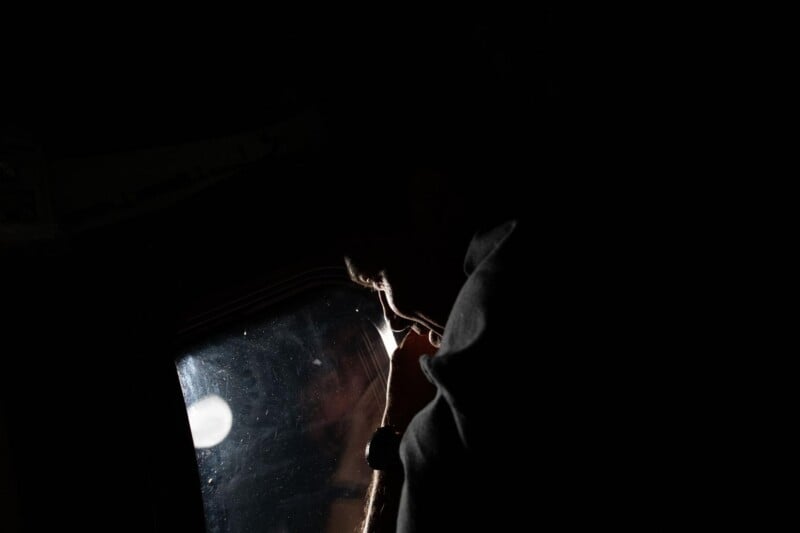 “A Mesmerizing Moon” | NASA astronaut and Artemis II Commander Reid Wiseman pictured here in the Orion spacecraft during the Artemis II lunar flyby. Wiseman and his fellow crewmates spent approximately seven hours taking turns at the Orion windows capturing science data to share with their team back on Earth. At closest approach, they came within 4,067 miles of the Moon’s surface.
These photos remind me of the importance of the human touch. Right now, surrounded by soulless corporations and artificial intelligence, I really need that.
I need to be reminded that together, people can achieve great things.
Matt Growcoot
One of the things that kind of flew under the radar is the fact that NASA accurately predicted what kind of photos they were going to take. I wrote an article about the crew’s photo training, and it included a simulation of the photos they were expected to get. The comparison is fascinating.
 This is a generated image of the relative sizes of Earth and Moon that the astronauts inside the Orion spacecraft could see on the Artemis II mission. This is hopefully the kind of spectacular image Koch and crew will capture.
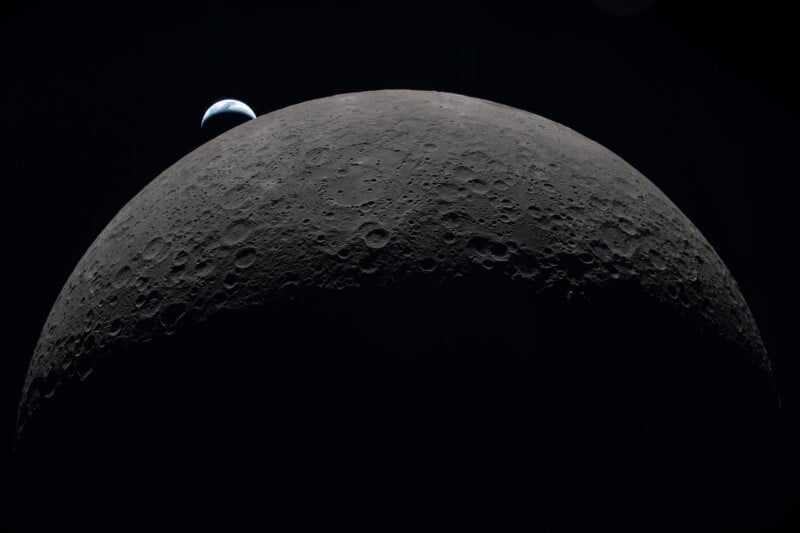 Earth sets at 6:41 p.m. EDT, April 6, 2026, over the Moon’s curved limb in this photo captured by the Artemis II crew during their journey around the far side of the Moon.
And while all the incredible space photos they captured were truly amazing and inspiring, for me, seeing mission specialist Christina Koch giving the Orion module a great big hug after safely splashing down in the Pacific Ocean warms the cockles. I’ve been following the Artemis mission pretty closely, and I knew that re-entry into the atmosphere was the most perilous part of the journey (on Artemis I, the protective heat shield disintegrated). I went to bed on the evening of April 10 a little nervous about the headlines I was going to wake up to in the morning. Seeing them crew back safe and sound was the icing on the cake.
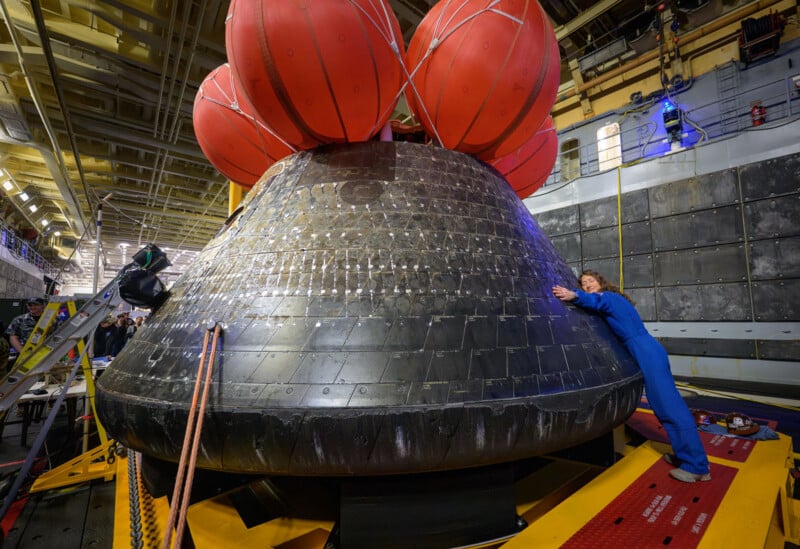 Mission specialist Christina Koch hugs the Orion spacecraft that brought her safely home. | NASA/Bill Ingalls
Jeremy Gray
Anyone who knows me even just a little bit, even if only by my bylines, knows that I love space. It’s bordering on obsession. I can spend hours poring over deep space photos captured by the most sophisticated telescopes ever crafted, both on Earth and in space itself. I’ve been fortunate to spend much of my life living in places with dark, clear skies and have spent many nights out in the field, camera fixed to my tripod, soaking in the cosmos. The ever-expanding infinity of space, where all things are, were, and will ever be, has an unbreakable hold over me. For the same reasons some people fear the cosmos, its incomprehensible vastness chief among them, I love it.
But as much as I embrace deep, distant, far reaches of space and love thinking about them and staring through the abyss, there is something so remarkably special about the intersection of humanity and space. Nothing yet has ever encapsulated that rare, beautiful intersection like NASA’s lunar missions, starting first with Apollo and now with Artemis. The Artemis II crew of Commander Reid Wiseman, Pilot Victor Glover, and Mission Specialists Christina Koch and Jeremy Hansen traveled farther from Earth than anyone ever has, nearly 253,000 miles away.
They didn’t just break records, and in the case of Koch and Glover, shatter ceilings that should have never existed in the first place, they rebuilt humanity’s bond with the cosmos and space exploration that had been severed for over 50 years since Apollo 17. It was as inspirational as the crew’s photos are beautiful.
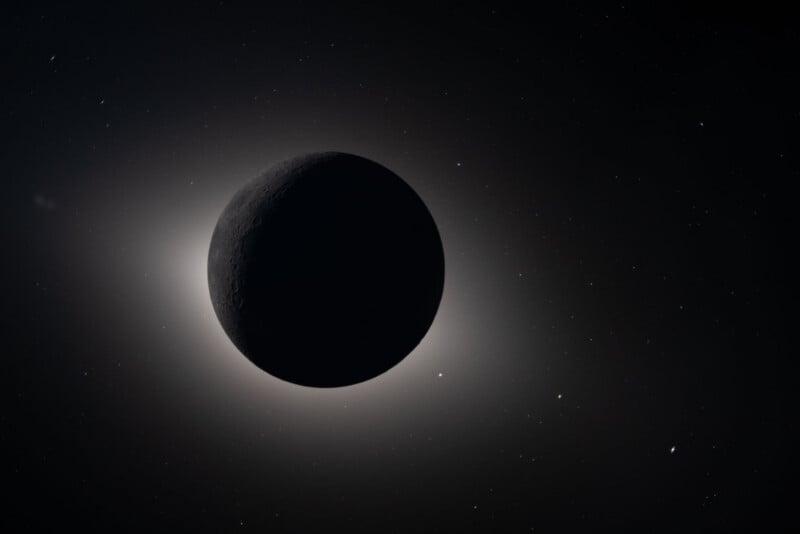 ‘Artemis II in Eclipse’ | From an aesthetic perspective alone, this has my vote as the Artemis II crew’s most beautiful photo of all. But it’s not strictly my favorite shot. | Credit: NASA
My colleagues picked fantastic photos above for great reasons, but for me, one of the very first shots NASA shared from the Artemis II mission itself proved the most moving. Commander Reid Wiseman’s photo of Earth as the crew hurtled away from it and everyone they care about is a powerful callback to the last time humans traveled to the Moon, when Apollo 17 astronaut Harrison Schmitt captured the iconic “The Blue Marble” photo of Earth, arguably among the most famous and most viewed photos in history. Wiseman’s new shot built a 54-year throughline between that moment in 1972 and Artemis II’s achievement this month.
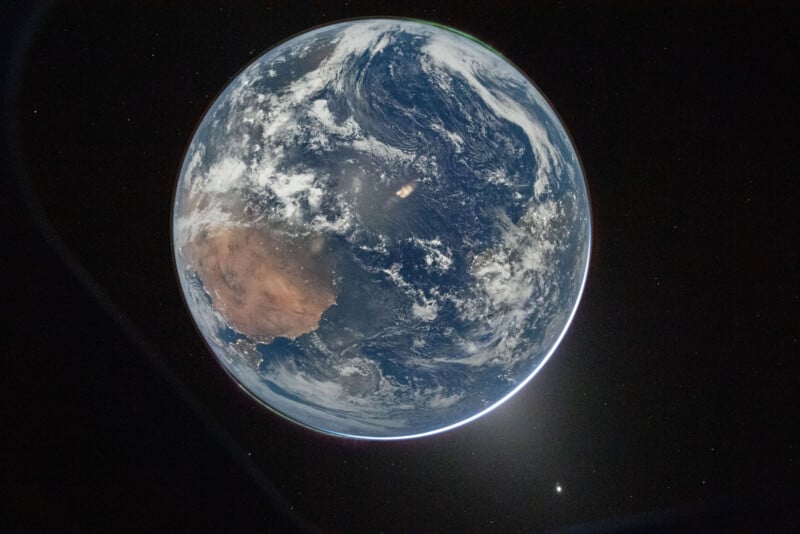 ‘Hello, World’ by Reid Wiseman, Artemis II, 2026 | Credit: NASA / Reid Wiseman
While perhaps not as visually spectacular as some of the Artemis II crew’s other photos, “Hello World” is a reminder that we all share a single planet and that no one of us is bigger than the rest. With the exceedingly rare exception of astronauts, every person who has ever lived (and probably will ever live) spent every second of their life squarely planted on this floating ball of rock and water, just like everyone they ever loved, hated, and never knew at all. There is no stronger thread that ties us all together than our shared home, and there it is, right there, somehow spectacular and entirely unremarkable all at once.
Image credits: NASA. The Artemis II crew comprises Reid Wiseman, Victor Glover, Christina Koch, and Jeremy Hansen. Although it is impossible to credit everyone who made Artemis II possible, it is important to recognize that hundreds, if not thousands, of people worked tirelessly behind the scenes to safely put the Artemis II astronauts into space, and more importantly, bring them home.





 English (US) ·