
 Image via New Line Cinema

Published May 15, 2026, 8:45 PM EDT
David is a Senior Editor at Collider focused primarily on Lists. His professional journey began in the mid-2010s as a Marketing specialist before embarking on his writing career in the 2020s. At Collider, David started as a Senior Writer in late 2022 and has been a Senior Editor since mid-2023. He is in charge of ideating compelling and engaging List articles by working closely with writers, both Senior and Junior, as well as other editors. Occasionally, David also reviews movies and TV shows and writes episode recaps. Currently, David is also writing his second novel, a psychological horror satire that will, hopefully, be picked up for publication sometime next year.
Sign in to your Collider account
Objectively speaking, The Lord of the Rings can be considered the peak of several crucial cinematic genres and themes. It's arguably the best fantasy movie, the best epic movie, the best trilogy, the most cinematic experience, the biggest spectacle, the best literary adaptation — the list literally goes on and on. Even those who don't love fantasy can appreciate The Lord of the Rings for the absolute masterpiece of execution, style, and excitement that it is. Now, over twenty years after its initial premiere, Sir Peter Jackson's trilogy remains the absolute peak of what the cinematic experience can offer.
A huge reason behind the three movies' huge success is the riveting and jaw-dropping battle sequences they offered. Indeed, the Battle of Helm's Deep in The Two Towers and the Battle of the Pelennor Fields in The Return of the King are two of the greatest depictions of warfare in cinema. That said, one can always make a case that some movies are better than The Lord of the Rings in certain departments. Here, we're making a case for the three movies that have better-realized battle sequences than the Jackson trilogy. These movies may or may not be overall better than The Lord of the Rings, but that's besides the point; here, we're focusing specifically on the battle sequences, and this trio might just do a better job at bringing the carnage to life.
'Lawrence of Arabia' (1962)
 Image via Columbia Pictures
It seems like we're always including Lawrence of Arabia in these lists, and you know what? It's for a good reason. David Lean's all-time great epic masterpiece is still the defining movie in terms of sheer cinematic spectacle; it makes sense that it's the standard against which all future movies are compared. The film stars Peter O'Toole as T.E. Lawrence, a British Lieutenant sent to Arabia to act as a liaison between the Arabs and the British in their fight against the Turks. Soon, however, Lawrence begins pursuing an agenda of his own, launching two dangerous and ambitious attacks on the cities of Aqaba and Damascus. An Oscar-nominated Omar Sharif and Sir Alec Guinness also star.
In terms of scope, few movies can match Lawrence of Arabia, if any. As a World War I movie first and foremost, it is greatly concerned with depicting the conflict in all its ugly fury. However, Lean, ever the auteur, still depicts the action with panache and a keen eye for spectacle, resulting in some of the best and most exuberant depictions of large-scale warfare in cinema. The attack on Aqaba is particularly striking, with Lean's camera capturing the camel and horse ride of thousands of Arabs through wide and close shots. Surrounded by the desert storm and under the scorching sun, the assault is both haunting and exhilarating, the war cries of the Arabs providing an alarming soundtrack to the action. The true magic here lies in Lean's ability to depict the sequence with such visual splendor while still offering a decidedly cynical look at the brutality of the act and the inherent cost of war. Whereas many war movies choose to romanticize conflict, Lawrence of Arabia offers a more pessimistic outlook on the cost of war and the shameless and corrosive nature of myths and larger-than-life figures.
'Ran' (1985)
Akira Kurosawa might just be the greatest director of the 20th century. It's a bold claim for sure, but one look at his filmography is more than enough to justify it; from the melancholic tenderness of Ikiru to the epic spectacle of Seven Samurai, Kurosawa was a true master of his craft who understood film as a medium better than most directors out there. Even in his late age, when he was approaching blindness and his health had deteriorated, his creative spirit and artistry could simply not be stopped, and at 75, he helmed Ran, one of his finest efforts. An adaptation of Shakespeare's King Lear, Ran tells the story of Hidetora Ichimonji (Tatsuya Nakadai), an elderly warlord who decides to abdicate and split his lands between his three sons. Little does he know that his sons will not agree to his arrangement, launching a war to control it all, ultimately leading to their demise.
Ran is a true cinematic spectacle of sweeping majesty, a tragedy about control, legacy, purpose, and the true meaning of one's life. Translating the Bard's seminal work from pre-Roman Britain to the Sengoku period allows for a reinterpretation of the play while still maintaining its essence. It, of course, also allows Kurosawa to stage some of the most spectacular and jaw-dropping battle sequences to have ever been captured on celluloid. The film's most recognizable battle is the sacking of the Third Castle, a sequence so lush and rich in both narrative content and thematic symbolism that it's nearly impossible to appreciate it all at once. Almost entirely deprived of dialogue, the extended scene soars on the strength of Nakadai's tour de force, as Hidetora's desperation escalates and slowly turns into resolve. Here, Kurosawa flexes his artistic muscles fully: the striking, commanding use of bold color immediately beckons the viewer, giving the carnage an almost beautiful, sorrowful mood. Arrows fly, smoke fills the air, bloodied bodies lie on the ground, and Toru Takemitsu's haunting score all work in unison to build a glorious depiction of warfare, a phantasmagoria of violence so powerful that it almost overwhelms.
'Saving Private Ryan' (1998)
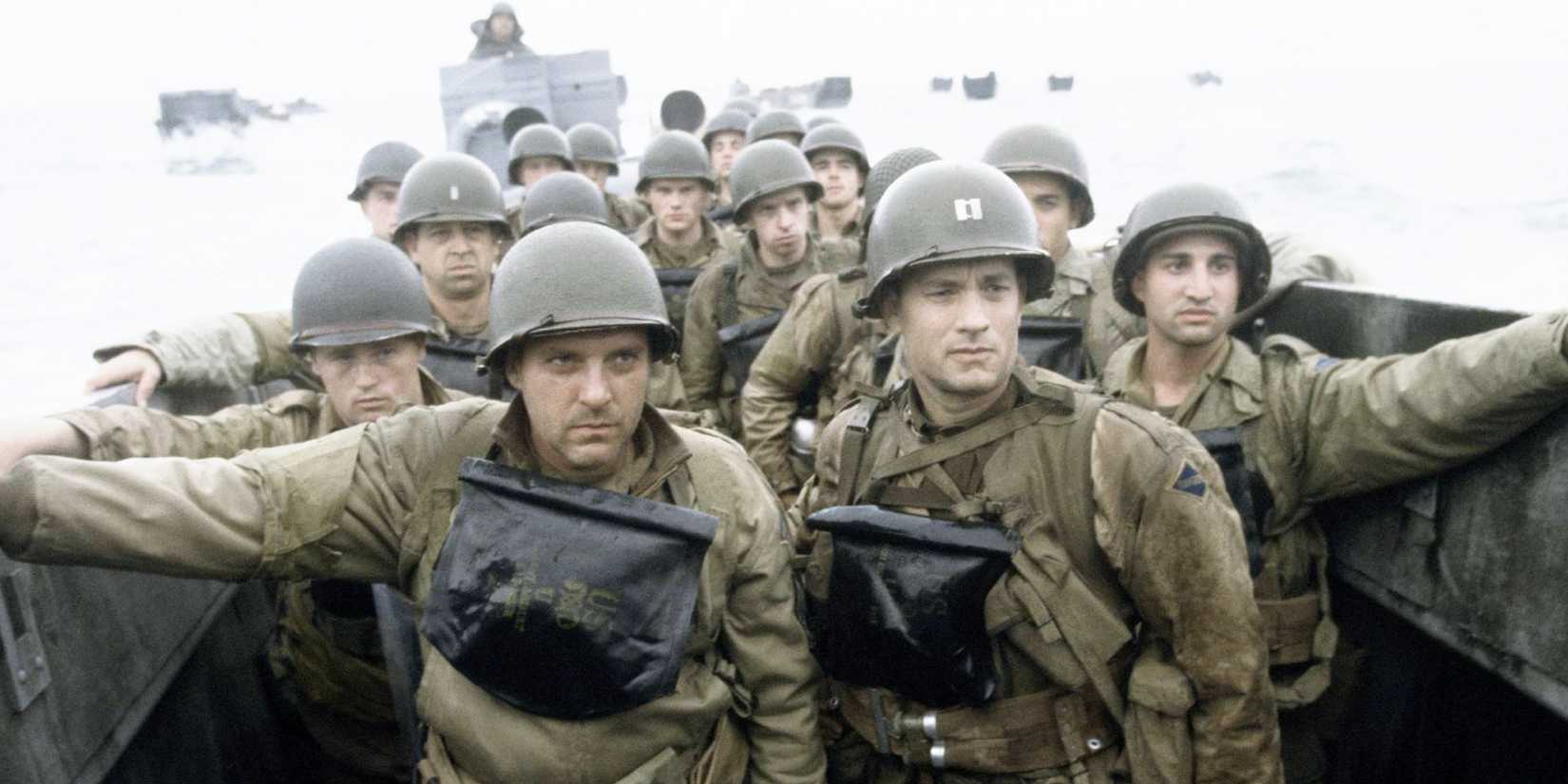 Image via DreamWorks Pictures
An admirer of Kurosawa's oeuvre, Steven Spielberg is another of the 20th century's great directors, pretty much defining the century's latter half and outright inventing the modern concept of the blockbuster. In 1998, twenty-seven years into his directorial career, Spielberg made what might just be his magnum opus, the World War II epic Saving Private Ryan. Written by Robert Rodat, the film follows a group of soldiers led by Captain John Miller (Tom Hanks), who go on a sensitive mission to locate Private James Francis Ryan (Matt Damon), whose three brothers have all been killed in action. Going deep into enemy lines, Miller and his squad will attempt to bring Ryan home, encountering the brutal realities of war first-hand.
Widely considered the defining triumph of the war genre, Saving Private Ryan was a major critical and commercial success, with many praising its emotional story and its unflinching, unrelenting commitment to accurately depict the atrocities of war. Nowhere is this approach better exemplified than in the film's now-iconic opening sequence, which chronicles the landing at Omaha Beach during the Normandy invasion, better known as D-Day. For nearly half an hour, Spielberg painstakingly recreates the events of that faithful day, immersing the audience in a battlefield where panic dominates, and chaos reigns; so hectic and harrowingly realistic it is that one can even fool oneself into smelling the fear these men must've felt. At points, the sequence gets so intense that it's actually unbearable; you'd be lying if you said you didn't look away once, seeking solace from the devastation. Indeed, actual veterans claimed it was the most realistic depiction of D-Day ever captured in cinema, to the point where an actual trauma hotline needed to be established. No movie, war or otherwise, has ever captured such brutality with such accuracy, making the Omaha beach scene in Saving Private Ryan arguably the greatest on-screen battle in cinematic history.



 English (US) ·