
 Image via Paramount Pictures

Published Apr 20, 2026, 5:53 PM EDT
Jeremy has more than 2400 published articles on Collider to his name, and has been writing for the site since February 2022. He's an omnivore when it comes to his movie-watching diet, so will gladly watch and write about almost anything, from old Godzilla films to gangster flicks to samurai movies to classic musicals to the French New Wave to the MCU... well, maybe not the Disney+ shows.
His favorite directors include Martin Scorsese, Sergio Leone, Akira Kurosawa, Quentin Tarantino, Werner Herzog, John Woo, Bob Fosse, Fritz Lang, Guillermo del Toro, and Yoji Yamada. He's also very proud of the fact that he's seen every single Nicolas Cage movie released before 2022, even though doing so often felt like a tremendous waste of time. He's plagued by the question of whether or not The Room is genuinely terrible or some kind of accidental masterpiece, and has been for more than 12 years (and a similar number of viewings).
When he's not writing lists - and the occasional feature article - for Collider, he also likes to upload film reviews to his Letterboxd profile (username: Jeremy Urquhart) and Instagram account.
He has achieved his 2025 goal of reading all 13,467 novels written by Stephen King, and plans to spend the next year or two getting through the author's 82,756 short stories and 105,433 novellas.
Sign in to your Collider account
Since the Academy Awards were first held way back in 1929, and there’s been one Best Picture winner awarded every year (okay, except for that first year, when they had two big prizes: one that went to Wings, for Outstanding Picture, and Sunrise, for Best Unique and Artistic Picture), there are naturally many Best Picture winners. If you're keeping count, almost 100. And it’s hopefully not too controversial a statement to say that The Godfather is one of the best of all the Best Picture winners. If you're talking about the greatest movies of all time, it’s usually a contender for that crown, too, so its status as a great Best Picture winner is almost irrelevant, compared to that (after all, there are hundreds – or maybe even thousands – of great movies that never even came close to winning Best Picture). In case you're one of the three people who haven’t heard of it, The Godfather is an epic gangster movie about the Corleone family, and they're both a proper family and then also a broader criminal family, with Vito Corleone (Marlon Brando) being its aging patriarch.
A lot happens, and then even more happens in The Godfather Part II, which is often recognized as being just as great as The Godfather, with it also happening to win Best Picture for its year (two years on from The Godfather). The Godfather Part II makes things more emotionally complex and downbeat, all the while having an even more ambitious structure, owing to much of it functioning as a prequel alongside being a sequel. It would be an easy pick for present purposes, but that would take some of the fun and challenge out of things… not that things need to be made a great deal more challenging, because the idea of saying “Hey, these three Best Picture winners are even better than The Godfather” is daunting. But still, that’s what’s being done here. It should be stressed again, The Godfather is still absolutely a top-tier Best Picture winner, and easily one of the most essential in the history of the Academy Awards, but it’s just that these ones could well be even better somehow. More perfect than perfection, if that’s even possible.
3 'Amadeus' (1984)
 Image via Orion Pictures
Since Amadeus is another Best Picture winner done on an epic scale, it doesn’t feel too extreme to compare it to The Godfather. Also, they're somewhat comparable in the sense that both are “about” certain things on a surface level, but those things are used to unpack and explore a whole host of other more interesting things. Like, The Godfather is about organized crime, but it’s also about family and the American dream and all sorts of other things, while Amadeus is technically about classical music, yet it goes so much deeper in exploring human nature and various emotions. The central conflict here revolves around Wolfgang Amadeus Mozart (Tom Hulce), whom everyone knows, and Antonio Salieri (F. Murray Abraham), who deals with feelings of intense jealousy because he’s not a terrible composer, by any means… he’s just not on Mozart’s level. He battles admiring and also hating Mozart simultaneously, especially because Mozart makes composing memorable music look so effortless. And then the whole thing’s made morally complex because you can understand Salieri’s angst, yet the lengths he goes to in an effort to bring Mozart down prove continually ghastlier.
It's a testament to how well-written and directed Amadeus is that the whole movie flies right by pacing-wise.
It’s not primarily a biographical film, since Amadeus plays around with real-life events, and is probably the cinematic equivalent of the literary genre known as historical fiction. Doing so works, though, because the events happened a long time ago, and certain things that are known to have happened in the lives of these two central figures are given attention, or depicted. It’s partly a historical drama, and more obviously a drama about jealousy, creativity, and desire, and then on top of all that, Amadeus is also a surprisingly funny movie at times, so you really do get thrown around in a great many directions emotionally. The film does all that without feeling messy, though, and it’s also a testament to how well-written and directed Amadeus is that the whole movie flies right by pacing-wise, even if you're watching the three-hour-long director’s cut (which adds about 20 minutes to an already lengthy theatrical cut). Amadeus does a lot, and does it all effortlessly, a little like Mozart himself, and maybe if you're creative-minded, you'll find yourself possibly being a bit jealous of it, Salieri-style.
2 'The Lord of the Rings: The Return of the King' (2003)
The Godfather expertly adapted a novel of the same name, and so too did The Lord of the Rings. Well, specifically, it was The Lord of the Rings: The Return of the King that won Best Picture at the Academy Awards, and it was an adaptation of about one third of J.R.R. Tolkien’s The Lord of the Rings. Some label Tolkien’s novel a trilogy, but it was more one massive work that was broken into three parts, and the same strategy was taken when making the movie adaptation. 2001 saw the release of The Fellowship of the Ring, and then in 2002, there was The Two Towers, and 2003’s The Return of the King finished things off. Three movies, one each year, but the production of The Lord of the Rings treated it as one massive film, and you'll be hard-pressed to find too many fans of these films who pace themselves, to a considerable extent, each movie when it comes time to rewatch The Lord of the Rings. And The Lord of the Rings is so very rewatchable, and maybe about as grand as epic movies have ever gotten so far this century. There is a prologue that outlines a massive conflict that’s set to be reignited, but after that, The Fellowship of the Ring is fairly quaint compared to what comes next, with the focus being on the Fellowship and their initial adventuring before being broken up.
The quest to destroy the One Ring continues in The Two Towers, but the surviving Fellowship members who aren’t Sam and Frodo set their sights on fighting a larger war that’s breaking out, or just distracting Sauron from being able to locate the Hobbits closest to the Ring he wants. You could sort of say The Return of the King is more of the same, scope-wise, compared to The Two Towers, if you wanted to be dismissive, but it does increase the scale of the story once more, and then it also ends up really delivering once it comes time to end. The ending here is long, but it has to be, wrapping up three movies’ worth of story… and three long movies, at that. The Return of the King, plus the other two movies, are even longer if you watch the extended editions, but it’s the theatrical version that’s being highlighted and celebrated here, since it is the one that won Best Picture. As a fantasy epic, it does just about everything right, and so few things about it come anywhere close to feeling aged, even as the 25th anniversary of this trilogy-capper creeps ever closer.
1 'Lawrence of Arabia' (1962)
 Image via Columbia Pictures
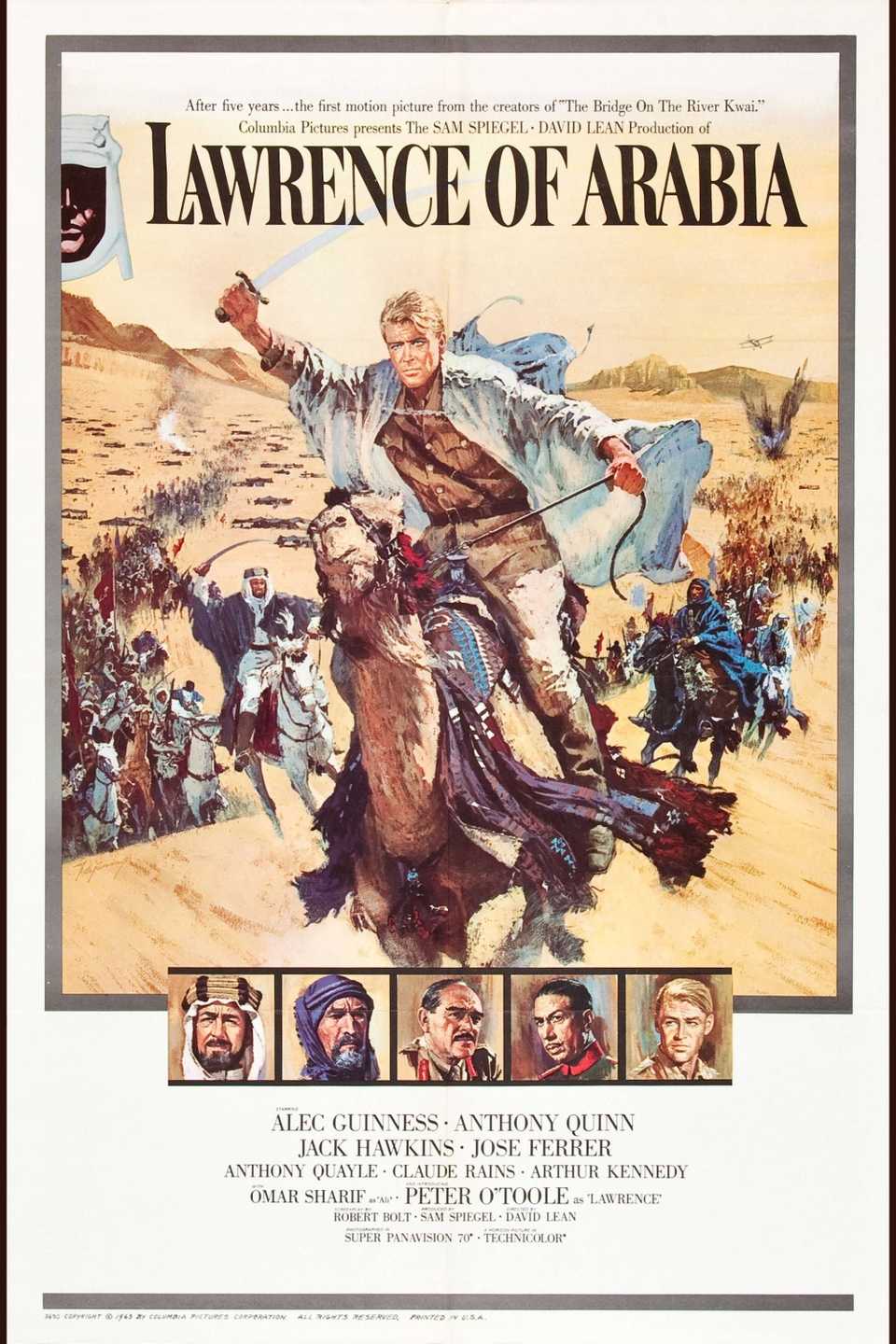
You know, it can feel a little absurd comparing The Godfather to Lawrence of Arabia. Both are all-timers as far as the epic genre goes, and both tend to get considered among the very best of the Best Picture winners. If you find yourself preferring one on one day, but then the other on another day, and then on some further days, you just don’t even know and don’t really want to try and compare, then really, that’s all fair. Oh, and they are both epics, but Lawrence of Arabia is a very different sort of epic movie; that should be stressed. This one takes place, for the most part, during World War I, and the central figure is T.E. Lawrence (Peter O’Toole, himself never an Oscar winner… though he was at least nominated a fair few times). Lawrence was a real-life person, but like just about any movie about someone who really existed, there are some liberties taken with history, and a bit by way of streamlining to make the film flow better. And what flow you’ve got here.
See, Lawrence of Arabia is almost four hours long, which sounds daunting for a film of any age, but then you take into account how old Lawrence of Arabia also is (1962 is now considerably further back in time than World War I was when the film was released), and it might sound even less appealing. But it really is the kind of film that feels timeless, and you might usually feel cautious around older and/or epic-length movies, but tackle this and find the process of watching it to be surprisingly effortless. Lawrence of Arabia is a great psychological drama that also has things occurring on an epic scale, with its main character sort of getting lost in it all, and this approach being something that makes the film also work as an adventure movie, a war film, and a true epic in every sense of the word. Of all the picks here, in terms of movies that might well be even better than The Godfather, Lawrence of Arabia is hopefully/probably the least controversial.
Collider Exclusive · Oscar Best Picture Quiz
Which Oscar Best Picture
Is Your Perfect Movie?
Parasite · Everything Everywhere · Oppenheimer · Birdman · No Country
Five Oscar Best Picture winners. Five completely different visions of what cinema can be — and what it can do to you. One of them is the film that was made for the way your mind works. Ten questions will figure out which one.
🪜Parasite
🌀Everything Everywhere
☢️Oppenheimer
🐦Birdman
🪙No Country for Old Men
FIND YOUR FILM →
01
What kind of film experience do you actually want? The best movies don't just entertain — they leave something behind.
ASomething that pulls the rug out — that makes me think I'm watching one kind of film and then reveals I'm watching another entirely. BSomething overwhelming — funny, sad, absurd, and genuinely moving, all at once. CSomething grand and weighty — a film that makes me feel the full scale of what I'm watching. DSomething formally daring — a film that pushes what cinema can even do. ESomething lean and relentless — pure tension with no wasted frame.
NEXT QUESTION →
02
Which idea grabs you most in a film? Great films are driven by a central obsession. What's yours?
AClass, inequality, and what people are willing to do when desperation meets opportunity. BIdentity, family, and the chaos of trying to hold your life together when everything is falling apart. CGenius, moral responsibility, and the catastrophic weight of a decision you can never take back. DEgo, legacy, and the terror of becoming irrelevant while you're still alive to watch it happen. EEvil, chance, and whether moral order actually exists or if we just tell ourselves it does.
NEXT QUESTION →
03
How do you like your story told? Form is content. The way a story is shaped changes what it means.
AGenre-twisting — I want it to start in one lane and migrate into something completely different. BMaximalist and genre-blending — comedy, action, drama, sci-fi, all in one ride. CEpic and non-linear — cutting between timelines, building a mosaic of cause and consequence. DA single unbroken flow — I want to feel like I'm living it in real time, no cuts to safety. ESpare and precise — every scene doing exactly what it needs to do and nothing more.
NEXT QUESTION →
04
What makes a truly great antagonist? The opposition defines the protagonist. What kind of opposition fascinates you?
AA system — invisible, structural, and almost impossible to fight because it has no single face. BThe self — the ways we sabotage, abandon, and fail the people we love most. CHistory — the unstoppable momentum of events that no single person can stop or redirect. DThe industry — the machinery of culture that chews up talent and spits out irrelevance. EPure, implacable evil — a force so certain of itself it becomes almost philosophical.
NEXT QUESTION →
05
What do you want from a film's ending? The final note is the one that lingers. What do you want it to sound like?
AShock and inevitability — a conclusion that recontextualises everything that came before it. BEarned emotion — I want to cry, laugh, and feel genuinely hopeful, even if the world is a mess. CDevastation and grandeur — an ending that makes me sit in silence for a few minutes after. DAmbiguity — something that leaves enough open that I'm still thinking about it days later. EBleakness — an honest refusal to pretend the world is tidier than it actually is.
NEXT QUESTION →
06
Which setting pulls you in most? Where a film takes place shapes everything — mood, stakes, what's even possible.
AA gleaming modern city with a hidden underside — beauty masking rot, wealth masking desperation. BA collapsing suburban life that opens onto something infinite — the multiverse of a single ordinary person. CThe corridors of power and science at a world-historical turning point — where decisions echo for decades. DThe grimy, alive chaos of New York and Hollywood — fame as both destination and trap. EVast, indifferent landscape — desert and highway where violence arrives without warning or reason.
NEXT QUESTION →
07
What cinematic craft impresses you most? Every great film has a signature — a technical or artistic element that makes it unmistakable.
AProduction design and mise-en-scène — every frame composed to carry meaning beneath the surface. BEditing and tonal control — the ability to move between registers without losing the audience. CScore and sound design — music that becomes inseparable from the dread and awe of what you're watching. DCinematography as performance — the camera not recording events but participating in them. ESilence and restraint — what's left unsaid and unshown doing more work than any dialogue could.
NEXT QUESTION →
08
What kind of main character do you root for? The protagonist is the lens. Who you choose to follow says something about you.
ASomeone smart and resourceful who makes increasingly dangerous decisions under pressure. BSomeone overwhelmed and ordinary who turns out to be capable of something extraordinary. CA brilliant, tortured figure whose gifts and flaws are inseparable from each other. DA self-destructive artist whose ego is both their superpower and their undoing. EA quiet, principled person trying to make sense of a world that has stopped making sense.
NEXT QUESTION →
09
How do you feel about a film that takes its time? Pace is a choice. Some films sprint; others let tension accumulate slowly, deliberately.
AI love a slow build when I know the payoff is going to be seismic — patience for a devastating reveal. BGive me relentless momentum — I want to feel breathless and emotionally spent by the end. CEpic runtime doesn't scare me — if the material demands three hours, give me three hours. DI want it to feel propulsive even when nothing is technically happening — restless energy throughout. EDeliberate and unhurried — I want dread to accumulate in the spaces between the action.
NEXT QUESTION →
10
What do you want to feel walking out of the cinema? The best films leave a mark. What kind of mark do you want?
AUnsettled — like I've just seen something I can't fully explain but can't stop thinking about. BMoved and energised — like the film reminded me what actually matters and gave me something to hold onto. CHumbled — like I've been in the presence of something genuinely important and overwhelming. DExhilarated — like I've just seen cinema doing something it's never quite done before. EHaunted — like a cold, quiet dread that stays with me for days.
REVEAL MY FILM →
The Academy Has Decided Your Perfect Film Is…
Your answers have pointed to one Oscar Best Picture winner above all others. This is the film that was made for the way your mind works.
Parasite
You are drawn to films that operate on multiple levels simultaneously — that begin in one genre and quietly, brilliantly migrate into another. Bong Joon-ho's Parasite is a film about class, desire, and the architecture of inequality that manages to be darkly funny, deeply suspenseful, and genuinely shocking across a single extraordinary running time. Your instinct is for cinema that hides its true intentions until the moment it's ready to reveal them. Parasite is exactly that — a film that rewards close attention and punishes assumptions, right up to its devastating final image.
Everything Everywhere All at Once
You want it all — and this film gives you all of it. The Daniels' Everything Everywhere All at Once is one of the most maximalist films ever made: action comedy, multiverse sci-fi, family drama, existential crisis, and a genuinely earned emotional core that sneaks up on you amid the chaos. You are someone who responds to ambition, who doesn't want cinema to choose between being entertaining and being meaningful. This film refuses that choice entirely. It is overwhelming by design, and its overwhelming nature is precisely the point — because the feeling of being crushed by infinite possibility is exactly what it's about.
Oppenheimer
You are drawn to cinema on a grand scale — films that understand history not as a backdrop but as a force, and that place their characters inside that force and watch what happens. Christopher Nolan's Oppenheimer is a film about the terrifying gap between what we can do and what we should do, told with the full weight of one of the most consequential moments in human history behind it. You want your films to feel important without feeling self-important — to earn their ambition through sheer craft and the gravity of their subject. Oppenheimer does exactly that. It is enormous, complicated, and refuses easy comfort.
Birdman
You are drawn to films that foreground their own construction — that make the how of the filmmaking part of the what it's about. Alejandro González Iñárritu's Birdman, shot to appear as a single continuous take, is cinema examining itself through the cracked mirror of a fading actor's ego. You respond to formal daring, to the feeling that a film is doing something that probably shouldn't be possible. Michael Keaton's performance and Emmanuel Lubezki's restless camera create something genuinely unlike anything else — a film that is simultaneously about creativity, relevance, self-destruction, and the impossibility of ever truly knowing if your work means anything at all.
No Country for Old Men
You are drawn to cinema that trusts silence, that refuses to explain itself, and that treats dread as a form of meaning. The Coen Brothers' No Country for Old Men is a film about the arrival of a new kind of evil — implacable, arbitrary, and utterly indifferent to the moral frameworks we use to make sense of the world. It is one of the most formally controlled films ever made, and its controlled restraint is what makes it so terrifying. You want your films to haunt you, not comfort you. You are not interested in resolution if resolution would be dishonest. No Country for Old Men is honest in a way that most cinema never dares to be.
↻ RETAKE THE QUIZ
Lawrence of Arabia
Release Date December 11, 1962
Runtime 228 minutes
Director David Lean
Writers Robert Bolt, Michael Wilson




 English (US) ·