


Published Feb 21, 2026, 1:01 PM EST
Emedo Ashibeze is a tenured journalist and critic specializing in the entertainment industry. Before joining ScreenRant in 2025. he wrote for several major publications, including GameRant.
Sign in to your ScreenRant account
Gear 5 stands as the most transformative power-up in One Piece since its 1999 premiere. When Luffy awakens his Devil Fruit, it’s no simple boost to his rubber powers. It’s the full awakening of the Hito Hito no Mi, Model: Nika, the legendary fruit tied to the Sun God and pure freedom.
The change gives him wild cartoon-like stretchiness, almost endless stamina in the form, and the power to wrap reality around whatever crazy idea he has. All of it comes wrapped with an unstoppable, joyful laughter that’s now his trademark.
Though Gear 5 has delivered countless unforgettable moves, its fighting style really rests on three core pillars: rubbery malleability, environmental manipulation, and Haki-enhanced attacks. Here's how Gear 5 abilities are ranked from the least limited in sheer destructive power to the ultimate, fight-ending weapon in his arsenal.
6 Toon Force / Reality Manipulation

The baseline of Gear 5 is the so-called Toon Force: the imposition of cartoon physics onto Luffy’s body and immediate actions. In this state, he can be flattened to paper-thin dimensions to evade strikes, inflated into buoyant spheres, rebound from catastrophic impacts without lasting damage, spin his limbs at velocities that generate afterimages, or casually ignore momentum and gravity.
He has been observed seizing bolts of lightning mid-air as though they were ropes, manifesting momentary cartoon effects, and executing rapid, multi-angle barrages that carry no recoil penalty. Augmented by advanced Haki, particularly Conqueror’s infusion, these seemingly playful movements deliver force far exceeding Gear 4 while sidestepping its brutal stamina drain and time restriction.
Toon Force is what allows Luffy to treat near-fatal blows as slapstick comedy and to keep fighting long after any other fighter would collapse. Its greatest strengths are endurance, unpredictability, and psychological pressure. On its own, Toon Force does not deliver devastation or force a conclusion to a battle. Toon Force sets the stage, not closes the curtain.
5 Environmental Rubberization
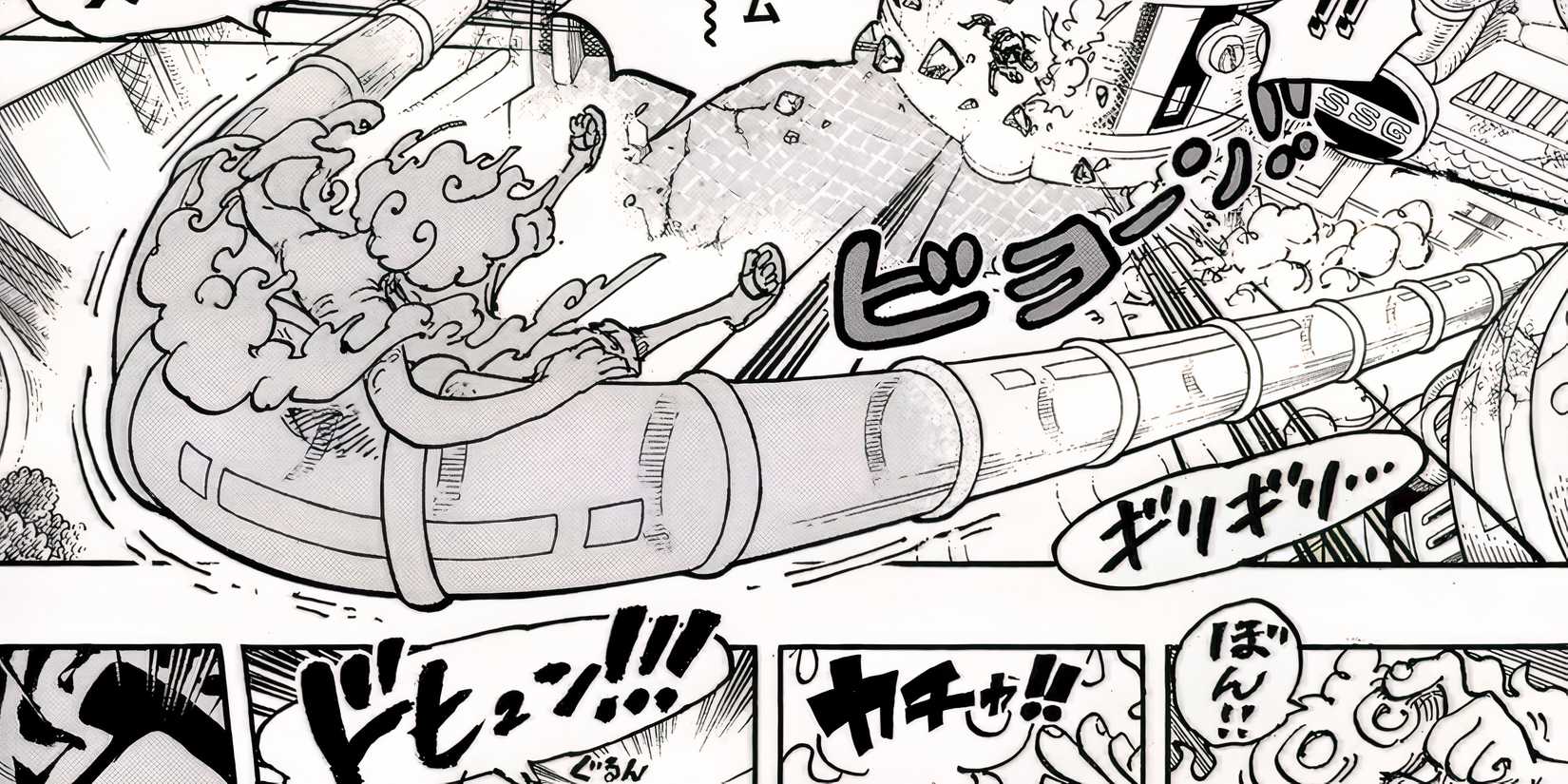
Once Gear 5 fully awakens, the rubber property stops being limited to Luffy’s body and starts bleeding into the surroundings. The ground beneath him turns into an enormous, living bounce house; heavy impacts send out slow, rolling waves that launch people like they’ve been hit by a trampoline.
Against Kaido, Luffy pulled lightning straight from storm clouds and turned it into a stretchy, crackling whip. Entire attack surfaces become rubberized on contact, letting him redirect colossal blows right back at whoever threw them. The fight shifts from straightforward combat to Luffy rewriting the battlefield’s physics in real time.
Add Armament Haki for crushing solidity or Conqueror’s for that signature oppressive aura, and the environment stops being neutral; rather an active threat. While everyone else stumbles, bounces, and gets flung, Luffy flows through the madness with perfect control, laughing the entire time like he’s having the best day of his life.
4 Bajrang Gun

Bajrang Gun is the single most decisive technique in Gear 5 and, arguably, in the entire series. Luffy channels cartoon-scale imagination to inflate his fist to island-dwarfing size, stabilizes the massive limb with rubberized air, then wraps it in the thickest, most concentrated Armament and Conqueror’s Haki he has ever displayed.
When the punch descends, there’s a burn like an orbital meteor strike. The raw force generates shockwaves powerful enough to level mountain ranges and overwhelm defenses no other attack has broken. A clean hit isn’t even required; the sheer pressure radiating off the fist ends most fights on impact alone.
Everything Gear 5 represents: every absurd cartoon trick, every inch of battlefield dominance, every layer of Haki mastery converges into this one overwhelming, conversation-ending blow. The cost is brutal: a miss leaves Luffy completely exposed. Still, when the punch lands, the joyful freedom of Gear 5 becomes pure apocalyptic destruction.
3 Giant Form / Extreme Body Inflation

Unlike other gear power-ups, Gear 5 lets Luffy go full giant mode whenever he wants. No need for Gear 3 limitations, where he only pumps up arms or legs. He scales up to towering heights, sometimes dwarfing the very monsters he’s up against, and the cartoon logic makes the growth feel seamless and effortless instead of strained or artificial.
Every move in this size carries catastrophic weight: punches shatter the earth for miles around, grabs become inescapable crushing holds, and his footsteps send out rattling shockwaves that shake the battlefield. Unlike old inflation techniques that left him dealing with recoil or post-use shrinkage, here the rubber simply obeys his imagination; he wills himself huge, and reality bends to match.
The psychological edge is massive, too. Opponents who relied on size or reach suddenly find themselves staring up at a grinning giant Luffy looming overhead. This flips the script completely. However, there are trade-offs: his movements are slower than his usual hyper-agile bounces, and sustaining that enormous mass quickly drains stamina in prolonged fights.
2 Freeform Cartoon Physics Attacks

What really makes Gear 5 stand out is the way Luffy just unleashes cartoon physics without any restraint. He throws out every normal rule of fighting and basically turns the whole battlefield into one giant, living comic strip, straight out of a Looney Tunes episode.
His body reacts the exact way you’d expect in a cartoon: eyes bug out huge the instant something lands, arms and legs stretch to ridiculous lengths then twang back like rubber bands with zero damage, and if anything is lying around; a boulder, a street sign, somebody else’s sword; he’ll snatch it up and swing without a second thought.
Every attack just flows straight out of whatever wild, ridiculous idea hits him. That constant ear-to-ear grin and the way he keeps laughing aren’t just for style. They’re what keep his energy high and the stream of insane creativity rolling nonstop. Still, for all the chaos and creativity these cartoon-style moves bring, they rarely end the fight on their own.
1 Haki-Infused Gear 5 Strikes

Haki-infused Gear 5 strikes are the moment Luffy drops the games and starts hitting with real intent to finish the fight. He channels every bit of the advanced Armament and Conqueror’s Haki coating he’s mastered directly into those elastic punches, kicks, or even headbutts.
The Conqueror’s Haki cloaks his fists in that oppressive aura; enough to make anyone with shaky resolve flinch or freeze before the blow even lands. Because his body is pure rubber, there’s no wasted recoil; all the force rockets straight forward. That turns what used to be rapid Gatling flurries or single huge hooks into something far more brutal.
Things turn truly vicious when he weaves these Haki-charged strikes into the rest of Gear 5’s arsenal. A swing that looked like pure cartoon nonsense a second ago suddenly rips open craters, shatters barriers, or drives clean through defenses that shrugged off regular attacks without a scratch. The Haki ensures nothing survives the collision intact.
Release Date October 20, 1999
Network Fuji TV
Directors Hiroaki Miyamoto, Konosuke Uda, Junji Shimizu, Satoshi Itō, Munehisa Sakai, Katsumi Tokoro, Yutaka Nakajima, Yoshihiro Ueda, Kenichi Takeshita, Yoko Ikeda, Ryota Nakamura, Hiroyuki Kakudou, Takahiro Imamura, Toshihiro Maeya, Yûji Endô, Nozomu Shishido, Hidehiko Kadota, Sumio Watanabe, Harume Kosaka, Yasuhiro Tanabe, Yukihiko Nakao, Keisuke Onishi, Junichi Fujise, Hiroyuki Satou
Writers Jin Tanaka, Akiko Inoue, Junki Takegami, Shinzo Fujita, Shouji Yonemura, Yoshiyuki Suga, Atsuhiro Tomioka, Hirohiko Uesaka, Michiru Shimada, Isao Murayama, Takuya Masumoto, Yoichi Takahashi, Momoka Toyoda
-

Mayumi Tanaka
Monkey D. Luffy (voice)
-
Kazuya Nakai
Roronoa Zoro (voice)








 English (US) ·