
 3 weeks ago
19
3 weeks ago
19
A keen nozzle-head has dramatically sped up their 3D printer using the portable power of a Nintendo Switch. Cocoanix 3D Printing shared a video earlier this week demonstrating the Switch-powered acceleration of their venerable Prusa MK3S. Instead of taking 90 minutes to output the famous standard 3DBenchy tugboat model, the Nvidia-accelerated MK3S took a brisk sub-nine minutes. Should you repurpose your Switch to accelerate your 3D printer? That, of course, depends…
Klipper on a Nintendo Switch Made My Prusa MK3S 10x Faster - YouTube
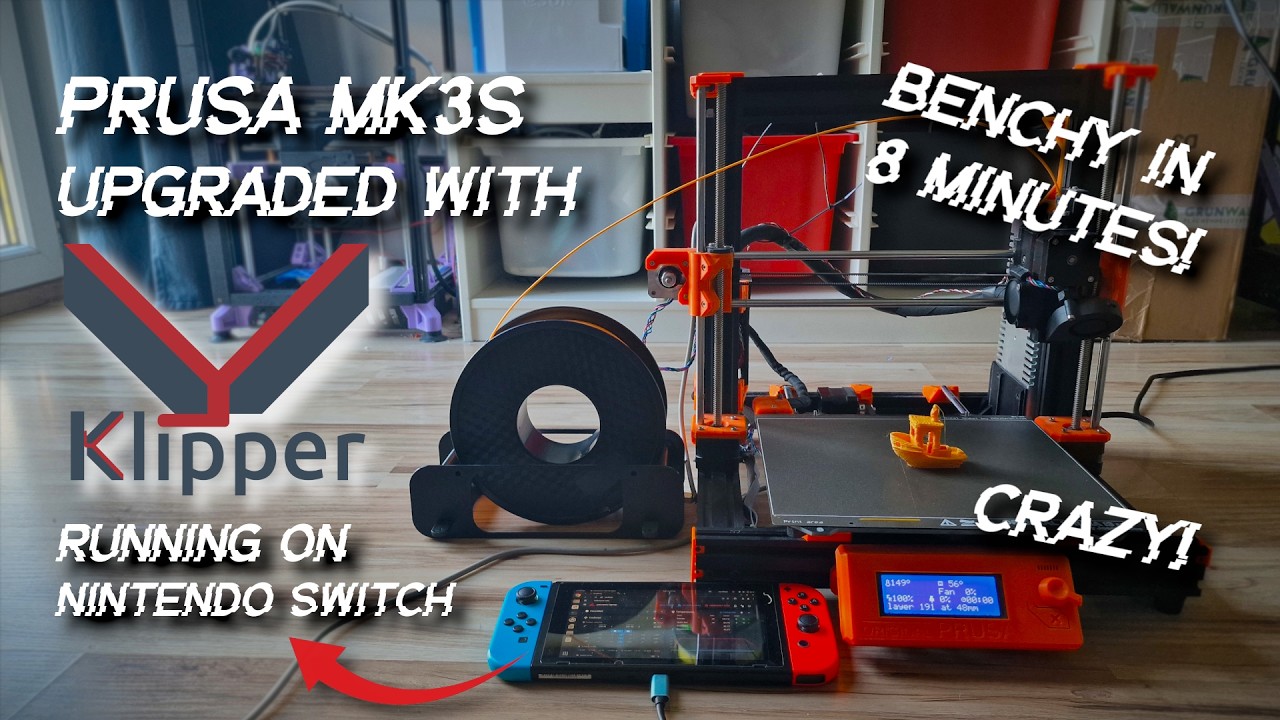
In the video above, Cocoanix boasts about not just the increased performance but quality improvements. Using Klipper instead of Prusa’s custom firmware (originally based on Marlin years ago) delivers modern features like more extensive planning, advanced vibration compensation, and other techniques. As well as getting your output in a fraction of the time, “less ringing and ghosting” will be present in the output, according to Cocoanix.
Klipper is also a champ when it comes to configuration, with a simple and easily editable text file ready for tweaks. More traditional firmware recompilation techniques for the granular control here are thus simply not necessary. Moreover, while the printer’s motion‑control firmware is replaced by Klipper, the user interface is handled through the slick Mainsail/Fluidd web dashboard.
Thanks to the power of the Switch and Klipper, with the Prusa MK3S, the bottleneck stops being processing power or advanced features, and is instead the 3D printer’s hotend and extruder. Running the new Input Shaper, the TechTuber manages to push the MK3S “to its absolute speed limit: 400mm/s at 17,000mm/s² of acceleration.”
Modern 3D printers aren’t so short on horsepower
The touch screen Switch is a great add-on for the Prusa MK3S. However, the MK3S is of a certain vintage now, and while contemporary designs addressing the same market may suffer from similar processing bottlenecks, adding an SBC or Switch to a modern 3D printer may not be so desirable.
Here, instead of motion planning running on the 8-bit microcontroller on the system motherboard, the machine is enhanced by Klipper, farming out all the heavy compute work to the attached handheld console with a quad-core Nvidia SoC.
Users of devices like the MK3S usually employ something like a Raspberry Pi or connect to their laptop to accelerate and advance their 3D printing. The use of the Nintendo here is mostly stylish tech flair – but the integrated touchscreen might be welcomed by some.
Practicalities
A large segment of the Cocoanix video is devoted to showing folks how to install and setup Klipper on a Switch with Ubuntu Linux installed. We are then guided through how to configure and flash the MK3S to complete this project.
To witness the 3DBenchy results, you can skip forward to around 7 minutes 50 seconds in the video, where you see the little tugboat successfully printed in under nine minutes (8 minutes 41 seconds while adhering to SpeedBenchy rules, says Cocoanix).
The result looks a bit rough, but this is primarily due to how the aforementioned hotend and extruder have become the bottleneck. We’d also suggest that cooling and the bed‑slinger Y‑axis are also near their physical limits, as the design stands.

Follow Tom's Hardware on Google News, or add us as a preferred source, to get our latest news, analysis, & reviews in your feeds.




 English (US) ·