
The elevated horror-western “The Trek,” set in Africa’s barren Kalahari desert, isn’t an easy watch. But it is a beautiful one.
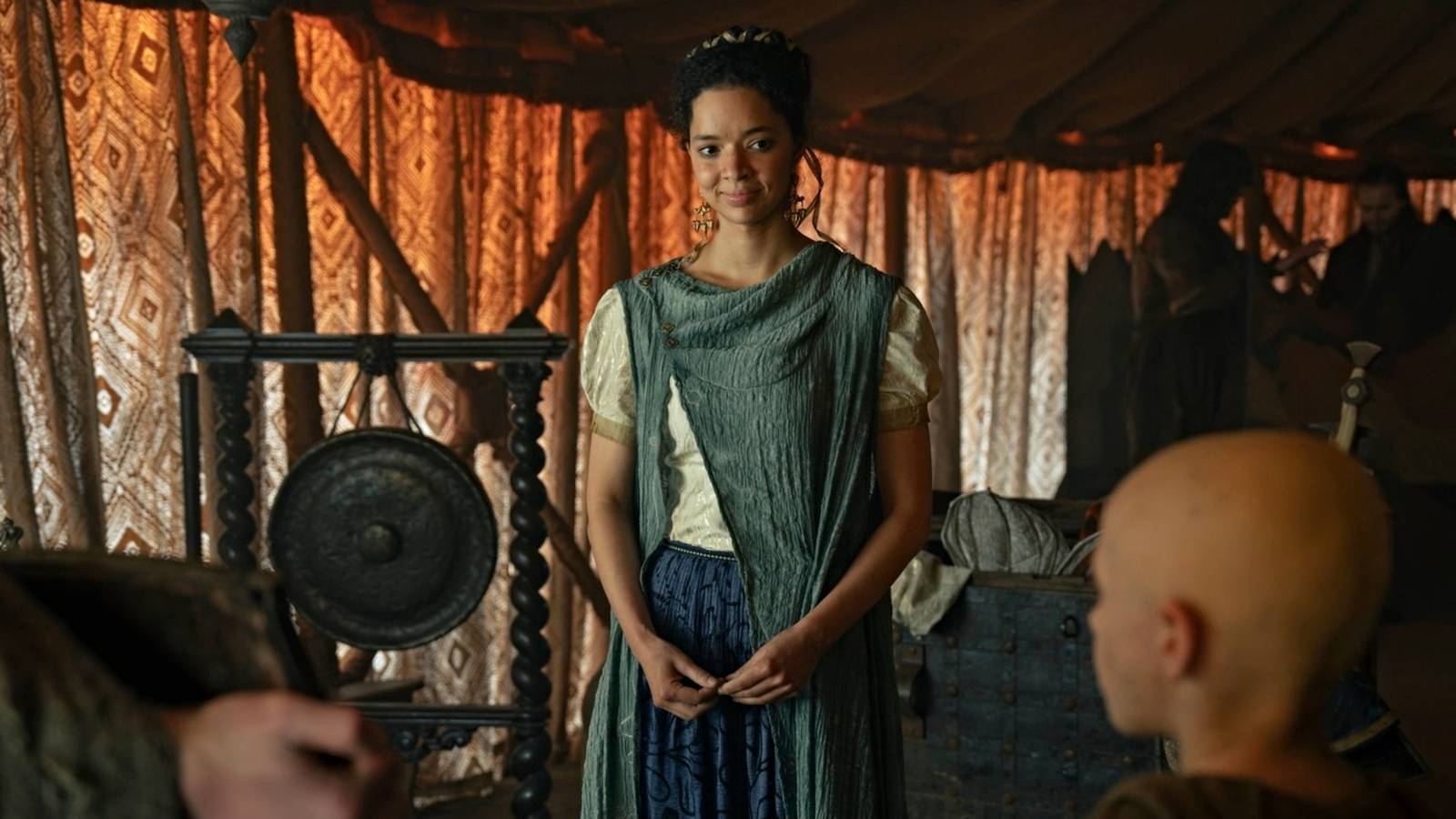
As one of South Africa’s most daring new voices, Meekaeel Adam makes his directorial debut in this gripping story, set in 1846, of a Dutch-Afrikaans family and their British benefactor who make the perilous journey across the Kalahari Desert, watched over by two shapeshifting spirits.
“The Trek,” produced by The Department of Special Projects, stars Morne Visser, Rob van Vuuren, Trix Vivier and Maurice Carpede as Atshumao – the mysterious Khoen man who guides the characters through the wasteland.
Are they heading towards salvation or doom?
The group is preyed upon by not only the harsh terrain, beset by hunger and desperation, but are also stalked by something older and far more merciless than the desert itself.
“While the land rights of indigenous communities the world over are still under threat today, ‘The Trek’ reimagines a new mythology inspired by Khoen folktale – one where the land itself might rise up and rewrite history,” explains producer James C. Williamson.
Shot in Nieuwoudtville in South Africa’s desolate Northern Cape province, the production was led by Adam in dual roles as both director and cinematographer, who tells Variety “The Trek” simply demanded a desolate, desert locale.
“When I read the script, it was kind of unforgiving. It dictated that ‘The Trek’ had to be as remote as possible, with the location itself a character.”
“So we had to make this commitment to going out – getting everybody four and a half hours’ drive outside of Cape Town. And moving an entire unit out there was definitely a task,” he says.
The 37-year-old Adam explains that out in the middle of nowhere, similar to “The Trek’s” characters, “All you have is each other and you find the best in each other. I think the crew and cast of “The Trek” really brought something extremely unique to this film.”
About tackling “The Trek” as clearly a very ambitious visual and physical project, Adam says, “in any industry and in anything scalable, if you treat it from a granular perspective, anything is possible, as long as you get the right people involved.”
“And I firmly believe that any success comes from many hands.”
“So it’s not necessarily what I may have considered as ambitious or what is challenging. It’s really tucking into that old ode of ours where we are problem solvers. As a collective, you can solve a lot of problems if you put your minds together and keep that discourse open, because that’s where I believe concept really galvanizes into something formidable – something executable.”
To find the perfect remote location, Adams reveals that the production travelled out three times and had a look at ground level, and then from a drone perspective to make sure that nothing of modern-day civilization remotely intrudes on the story they wanted to showcase.
They also limited the production’s physical on-location footprint – literally – as much as possible.
“Navigating through a space on-screen also means travelling with a camera and a camera crew and everything else that goes along with it,” he says.
“And it was a process of finding and figuring out what we could reduce, so in case of a reset, it would really just be the footsteps and the cart’s wheels. That helped mitigate the sort of sprawling effect of what a crew can bring to a set.”
“I tried to keep it as lean as possible and my approach was not to call for major resets,” Adam says.
“When you are working with people in this kind of capacity where the littlest details can create the biggest flaws in an image, having people who care about what you care about, and vice versa, knowing what they care about, is ultimately the reason why you get to do this fantastical work and why we are able to make it feel like we’re really in the middle of nowhere,” Adam says.
An unbelievably stunning piece of scene setting and cinematography work features on-screen during the latter part of “The Trek,” where the characters find themselves at the bottom of a ravine – a haunting desert cathedral of rock and browns and light and shadows and despair.
No green screen, virtual wall or in-studio painted wall set was used for this.
The haunting and moving scenes lensed inside this narrow alcove-like space were all really shot on-location and make for mesmerizing viewing.
“It’s really all on-location,” Adam says with a smile.
“When we recce’d, we looked at various locations to be as accurate to the scene descriptions as possible, but at the same time, you have to consider the logistics, like how would we get the crew in safely into such a space?”
Secondly, how would we be able to occupy the space and maintain a sense of continuity and also geography? Contours play such a big role in ‘”‘The Trek,'” he says.
“The ravine is a dried-up riverbed that we had found on a farm. And weeks before, there was water running through it. At that time of the year and the season, it had completely dried out and left something that was just, dare I say, perfect for us. We were lucky to have found it.”
“It was a 45-minute drive away from where we were staying. Working inside a riverbed is always going to be a challenge because there’s soft soil and equipment is heavy, including everybody moving through it.”
“Everything for us became about the talent occupying that space, and we made sure that that’s what it was all about. Once the cameras were rolling, we had our boundary as a technical team and we tried to lens it in a way that compressed this environment so that it felt as real and as visceral as possible,” he explains.
On pushing the envelope of what’s possible to put on screen as a South African film, Adam says his advice to the industry is “if you include the right people in your dreams or ambitions, you can make anything.”
“No matter how limited it may be from a budget point of view, no matter how challenging it may be from a conceptual point of view, anything is possible.”
“I think that if you do have the right people around you, it becomes a lot easier when it comes to considering the scale of something, both as a challenge in all respects. I think that dreams are great to have, so long as you know how to action them. Implementation is the thing that really will truly define whether or not you can achieve it.”
“If it’s a dream, it means you just haven’t figured out how to physically or actively do it yet,” Adam says.
“Having the right people around you changes that. It mobilizes you and them. That’s the basic approach: It’s not necessarily about dreaming. It’s just about figuring out how to activate that dream.”



 English (US) ·