
Steve Wilkie/Disney
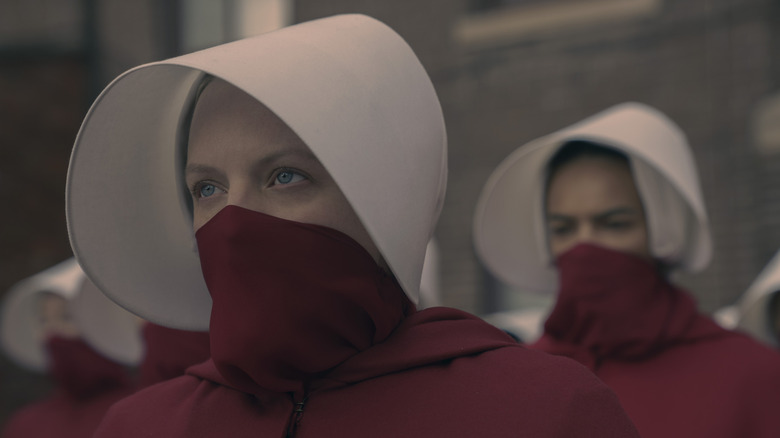
Hulu's adaptation of Margaret Atwood's classic novel "The Handmaid's Tale" ran for six seasons and was a massive success as it expanded Atwood's original story of oppressed women rising up to form a resistance. So what does Atwood think of the film adaptation, which came out in 1990 and was directed by Volker Schlöndorff and written by famed playwright Harold Pinter?
She does not like it.
In a 2018 interview with Variety about the show created by Bruce Miller, Atwood opened up about the main structural issue with the 1990 movie "The Handmaid's Tale," which stars the late Natasha Richardson, Faye Dunaway, Robert Duvall, Aidan Quinn, and Elizabeth McGovern. As she revealed, Schlöndorff removed the voiceover meant to come from the protagonist, Offred (Richardson), whose name is actually pronounced "of Fred" (Duvall's powerful Commander, Fred Waterford, "owns" Offred).
"The 1990 movie, the screenplay was by Harold Pinter, and it included voiceover by the central character. And then the director, being in a minimalist phase, took it out," Atwood said. "I think it would have been better with it in." She continued, "Natasha, who I knew, she expressed to me in rather p*ssed off terms, she had recorded all the voiceover and tailored her performance against it. It was a lot more like we have now, in which you heard Offred thinking from time to time." Atwood is exactly right here, and Offred's voiceover in the novel and the Hulu series, where the character — whose real name is June and is played by Elisabeth Moss — sets an impactful tone.
So what did Atwood think of the acclaimed Hulu series that adapted her most famous book? Thankfully, she liked that a lot better.
Margaret Atwood's book The Handmaid's Tale finally got a worthy adaptation in 2017 on the small screen
George Kraychyk/Hulu
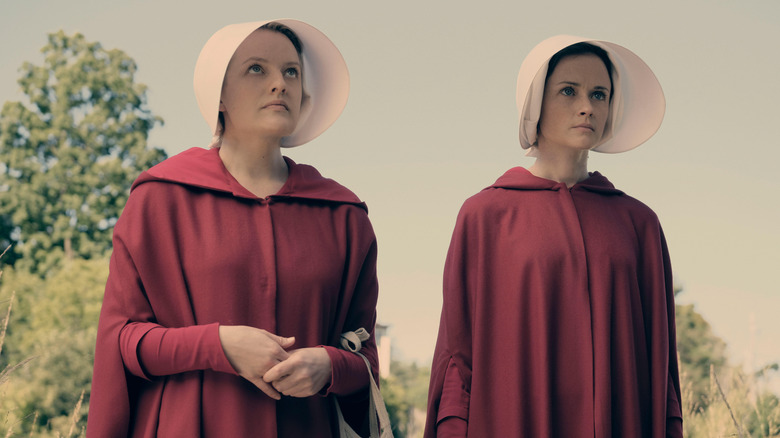
The TV adaptation of "The Handmaid's Tale" premiered in 2017 with Elisabeth Moss, fresh off her success as Peggy Olson on "Mad Men," in the lead as Offred and Bruce Miller as the showrunner. So what did Margaret Atwood say about it in that 2018 Variety interview? As she pointed out, TV wasn't the artistic juggernaut back then that it was now ("When we wrote [the movie], the only kind of TV series that was on was basically like 'Dallas,' she said in what I imagine was a pretty wry tone). Atwood felt like the advent of streaming helped bring her story to life in the fullest possible way. "There was too much story for 90 minutes," she added. "That's another answer to why the movie didn't work."
Thankfully, Atwood met Miller, and the rest, they say, is history. Miller, for one, was always committed to bringing Atwood's vision to life as faithfully as possible, which he told The Hollywood Reporter during an interview about "The Testaments." As Miller put it:
"When making 'Handmaids,' I followed the 'when in doubt, follow Margaret' policy. And it worked very, very well. Not just out of fealty to her or to the book, but practically, she's a very good storyteller. Sometimes there are things that I don't understand, even though I've read that book for 30 years, and it's great that I can put this in the show and it's really interesting, even though I didn't quite know how it would go."
Now, Atwood's world is expanding with a new Hulu series also helmed by Miller, and thankfully, she's a fan of this one, too.
The world Margaret Atwood created in The Handmaid's Tale continues in The Testaments
Steve Wilkie/Disney
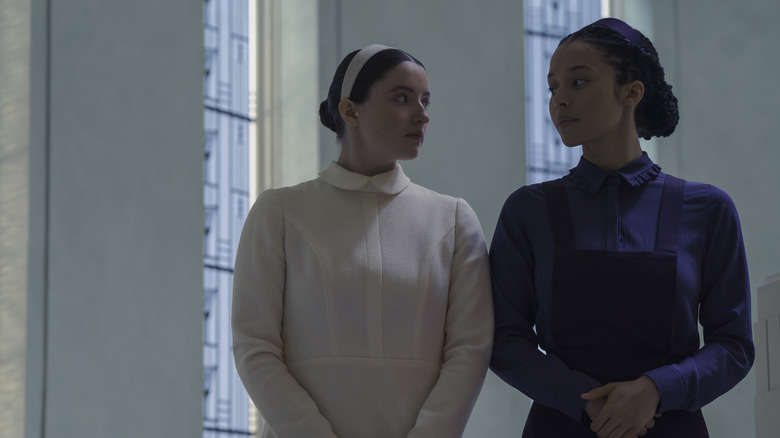
Based on Margaret Atwood's 2019 literary sequel of the same name, "The Testaments" jumps four years past the ending of "The Handmaid's Tale" (the television show, not the novel, because the show widely expands the relatively brief story in Atwood's 1985 novel). The story centers around Agnes ("One Battle After Another" standout Chase Infiniti), a young woman in the oppressed and intensely religious theocracy known as Gilead — and even though she's actually the long-lost daughter of Elisabeth Moss's June Osborne, Agnes was stolen and "adopted" by Commander MacKenzie (Nate Corddry) when she was very young.
As Agnes prepares to embrace womanhood and even become a Commander's wife, Agnes's world is thrown off-kilter by the arrival of a new girl named Daisy, played by Lucy Halliday. Though Daisy is presented to Agnes and her friends as a Pearl Girl — a young woman who wants to convert and join Gilead — she was actually also stolen from Canada and her parents, members of the resistance, were killed. All the while, that resistance, known as "Mayday," quietly operates on the fringes of Gilead and seems to be drawing Daisy in to become some sort of double agent.
Atwood, who plays a cameo role we haven't seen as of this writing on "The Testaments," really likes this stunning adaptation (and is apparently just pleased that the legendary Ann Dowd reprised her role as Aunt Lydia). After the first attempt to adapt "The Handmaid's Tale" flopped, it's thrilling to see this author's incisive, thoughtful, and jarring work adapted on her terms — and you can stream "The Handmaid's Tale" and "The Testaments" now.

 English (US) ·