The boys became stranded on the island in Lord of the Flies when their plane crashed, killing all the adults. At first, the children came together under Ralph's leadership, assisted by an intellectual boy named Piggy (David McKenna). They set up a signal fire and established a system of order and survival. However, the leader of the chorus boys, Jack (Lox Pratt), ultimately led the boys into savagery.
The chaos began as the children became fearful of a mysterious "beast" that seemed to roam the island. Simon (Ike Talbut) discovered that the creature was, in truth, the corpse of a parachuter that had become caught in the trees. Before he could warn the others, however, Simon was killed by Jack and the other children, who mistook him for the beast. This act solidified the loss of innocence in Lord of the Flies, and it all went downhill from there.
The next death was a more intentional act of murder, as Roger (Thomas Conner) hit Piggy over the head with a rock. Jack and his savage clan of boys then turned their attention to Ralph and began hunting him throughout the island. They set fires in the forest to smoke him out, and it was this that caught the attention of a passing ship. A naval officer rowed to shore to investigate and discovered the boys at the height of their savagery. Yet, as Lord of the Flies came to a close, this adult seemed not to take the boys' murderous behavior very seriously.
The Irony Of Lord Of The Flies' Ending Explained
Though the naval officer discovered the boys just as they prepared to murder Ralph, he identified their behavior as simple children's games. He acted as if they were only playing at war, even as Ralph explained that two of his friends had been killed and more had likely died that he didn't know about. The naval officer criticized Ralph only for his poor leadership, since he was unable to say how many children needed rescue. With little more word, the boys ran to the adults' boat, tossing down their weapons and returning to childhood.
The central idea behind Lord of the Flies is that even the most innocent of humanity has an inherent potential for evil. On the island, there was a persistent battle between civilization and savagery, but the "beast" within the children led to the fall of order and innocence. The burning of the island was the final, reckless straw, since it meant the boys were destroying what remained of home and security for the sake of violence. Ironically, this act is what led to their rescue.
The irony only becomes more poignant from there. Though the boys have been rescued from their isolated display of savagery, they are returning to the adult world that is in the midst of even more savage destruction. The naval officer treated the children's violence as a game, criticizing them for being poor representations of British propriety, but he is participating in a terrible, violent war himself. The boys leave the island behind, but they can't shed the savagery they discovered there.
What Piggy's Death Really Meant In Netflix's Lord Of The Flies
Piggy's death in the final episode of Lord of the Flies was a devastating, tragic, and heartbreaking moment. He and Ralph had come to Jack's camp to offer the boy one last chance to do the right thing and return Piggy's glasses. However, the exchange turned out to be the definitive destruction of law and order. Piggy, as a character, represented the rational side of civilization. He was intelligent and clung wholeheartedly to the democratic order represented in the conch. By murdering Piggy, Roger put a definitive end to those concepts within their micro-society.
What Each Character In Lord Of The Flies Represented
Piggy wasn't the only character in Lord of the Flies that represented an element of society or human nature. While he reflected intellect and rationality, the other "biguns," Ralph, Simon, Jack, Roger, and the twins, Sam and Eric, demonstrated a variety of other concepts.
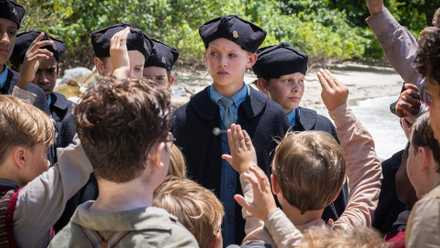
Ahead of his major role as Draco Malfoy in HBO's Harry Potter series, Lox Pratt can be seen in a class novel adaptation coming to Netflix this spring.
Ralph represented order and democratic leadership. Simon embodied inherent goodness and spirituality. Jack embodied savagery and dictatorship. Roger represented the dark, sadistic human instincts that emerge when society's constraints are lifted. Then, Sam and Eric represented the loss of individuality and the tendency for conformity within society.
When characters like Simon and Piggy died, Lord of the Flies emphasized that goodness and intellect are the first things to dissolve when society gives in to savagery and sadism. Had Jack and Roger had their way, Ralph would have been killed as well, but he lived long enough to be rescued. It's a sign that order and good leadership persist, but how much weight does that really hold in the face of so much chaos?
How Netflix's Lord Of The Flies Is Different From The Book
Netflix's Lord of the Flies adaptation is highly faithful to the book. However, as the series delved into each character's story, layers of nuance were added. This is especially intriguing for Jack's character. The boy had no real redeeming qualities in the 1954 novel, but in this version of the story, we see a lot of hurt and loneliness. It was this pain that fueled Jack's desire for more power and control. Still, it's clearly not an excuse for his behavior, since we see that Simon shared the same hurt and loneliness but remained inherently good.
Other differences between Netflix's Lord of the Flies adaptation and the original book include Piggy and Ralph's involvement in Simon's murder, as well as Piggy's own death. In Golding's version of the story, Ralph and Piggy were caught up in the chaos of the storm and the fear of the beast, and were among those who attacked Simon, though they felt intense remorse. Then, in the novel, Piggy died instantly when Roger's rock struck him, but in the show, his death was drawn out and more emotionally devastating.
Overall, the changes in this version of Lord of the Flies don't hinder the story, but enhance it. The more nuanced characters reflect the various reasons that humans may lean toward certain behaviors, all while maintaining that central metaphor. It makes this adaptation all the more disturbing and difficult to watch, yet engrossingly powerful.
Release Date
2026 - 2026-00-00
Network
BBC One
Directors
Marc Munden








 English (US) ·