
 3 weeks ago
36
3 weeks ago
36
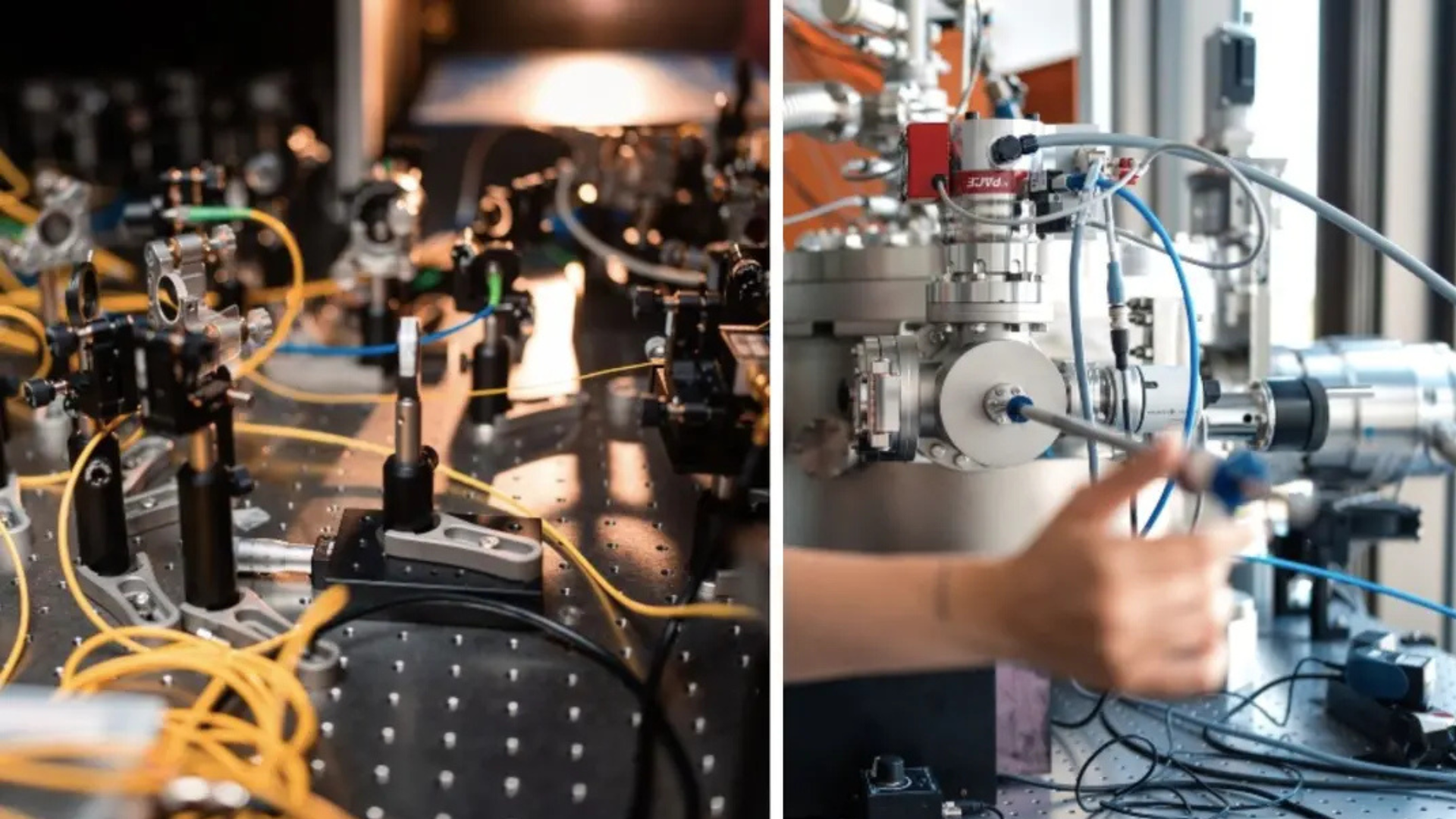
A team of researchers led by the University of Stuttgart has identified unusual magnetism in twisted, two-dimensional chromium triiodide, revealing long-range spin textures that extend beyond the material’s underlying moiré pattern. The findings, which were published in the journal Nature Nanotechnology on February 2, were observed in twisted double-bilayer chromium triiodide structures using nanoscale magnetic imaging at cryogenic temperatures. The research could have big implications for the creation of ultra-dense magnetic data storage.
Twisted van der Waals materials have become a major focus area for researchers over the past several years because small, angular offsets between atomically thin layers have been found to produce moiré superlattices that strongly modify electronic and magnetic behavior.
Using scanning nitrogen-vacancy magnetometry, the researchers directly imaged ordered, dot-like magnetic textures that span multiple moiré unit cells. As the twist angle increased within a narrow long-angle range, the characteristic size of these textures grew, reaching roughly 300 nanometers at around a 1.1-degree twist before vanishing at about two degrees. Individual features within those textures measured on the order of roughly 60 nanometers.
Unlike previously reported moiré-locked magnetic states in chromium triiodide, the researchers say that these textures aren’t confined to a single stacking configuration or local energy minimum within the moiré lattice. Instead, they form a higher-order “super-moiré” magnetic state that reorganizes magnetism on a larger length scale.
As always with studies such as these, it’s important to remember that the work is still in the earliest research stages. Measurements were performed at low temperatures, and chromium triiodide itself is air-sensitive and thus unsuitable for direct integration into any applications outside of the laboratory. However, the authors note that the underlying mechanism should be transferable to other layered magnetic materials, including systems with higher ordering temperatures.
Follow Tom's Hardware on Google News, or add us as a preferred source, to get our latest news, analysis, & reviews in your feeds.







 English (US) ·