
 2 hours ago
6
2 hours ago
6
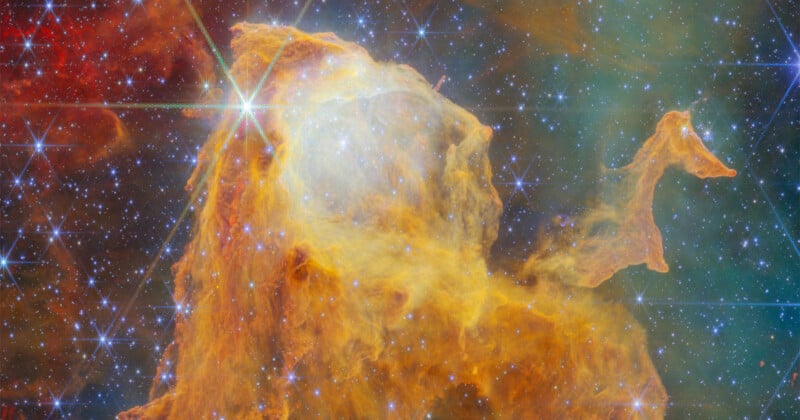
The newest NASA/ESA/CSA James Webb Space Telescope Picture of the Month delivers a spectacularly colorful look at a cosmic “Treasure Chest,” a neat feature of the nearby Carina Nebula, located just 7,500 light-years away.
The Treasure Chest, as it’s called, is actually a cometary globule in the Carina Nebula. A cometary globule is an “isolated cloud of gas and dust with a dense, dark head and a sweeping tail,” the European Space Agency explains.
While the clouds of gas and dust typically look like comets, hence the name, in the case of the Treasure Chest, it looks more like, well, an open treasure chest. As is often the case in television shows or movies, the chest opens to expose something bright and glowing, a hint at some yet-unseen treasure within.
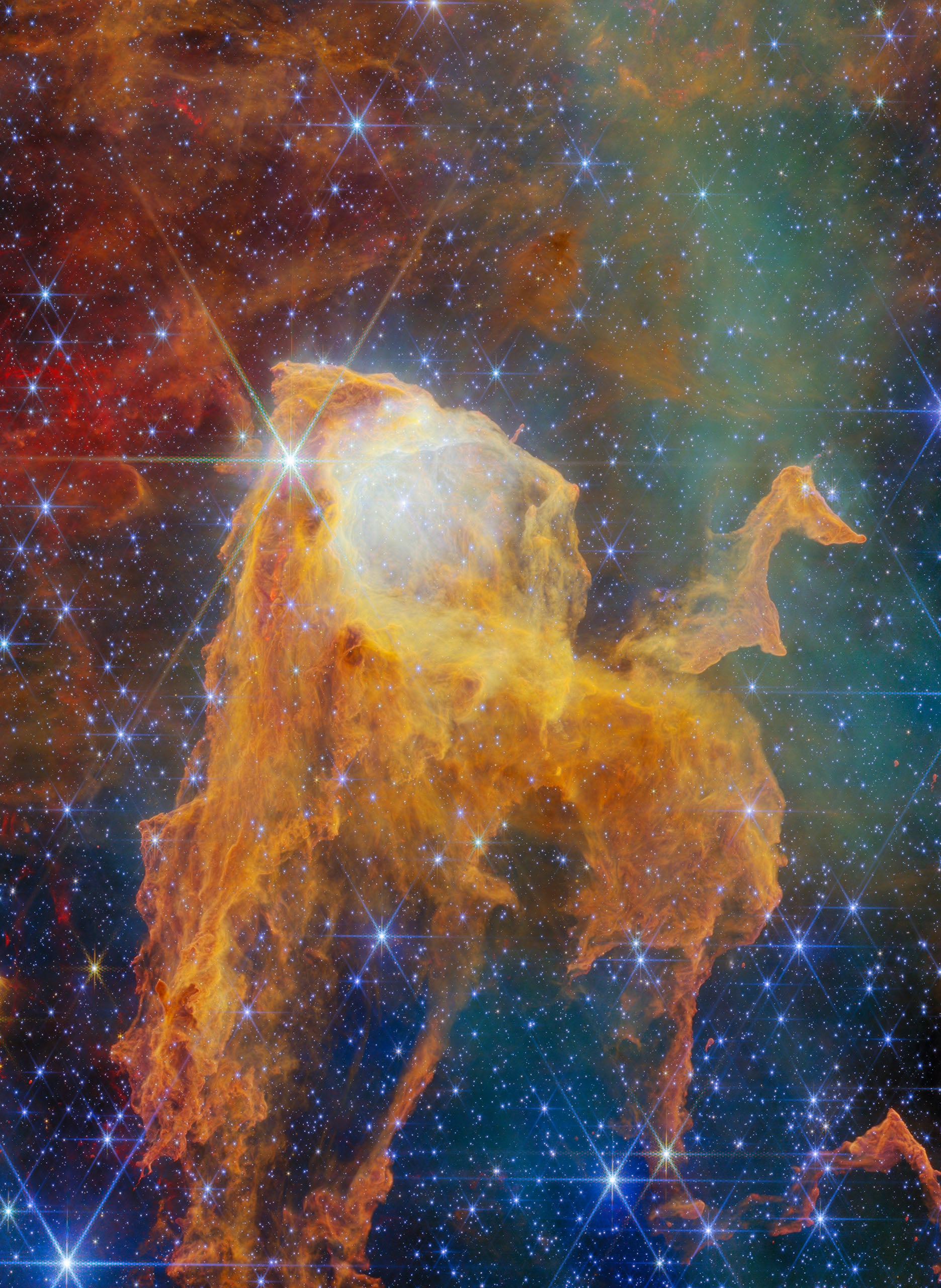
“However, this chest doesn’t contain jewels or gold coins,” ESA explains, “but instead a compact cluster of young stars.”
These young stars tucked within the Treasure Chest are what give the cosmic spectacle its glow, which the James Webb Space Telescope’s Near-Infrared Camera (NIRCam) can detect through the cosmic dust surrounding it.
Researchers estimate that the Treasure Chest’s stellar cluster has around 70 stars, the most massive of which is a rare O-type star, about 19 times as massive as the Sun.
The star cluster is “likely” around 1.3 million years old, although previous estimates had its age at just 100,000 years. In either case, it’s a relatively young star cluster.
“Because of its youth, the cluster is still deeply embedded within the dusty clouds of the Treasure Chest. The individual stars in the cluster are wrapped up in dust as well; astronomers have found evidence that many of these stars are surrounded by circumstellar discs,” ESA explains.
Over time, the starlight from the young stars will dissipate, and the entire cluster will be revealed.
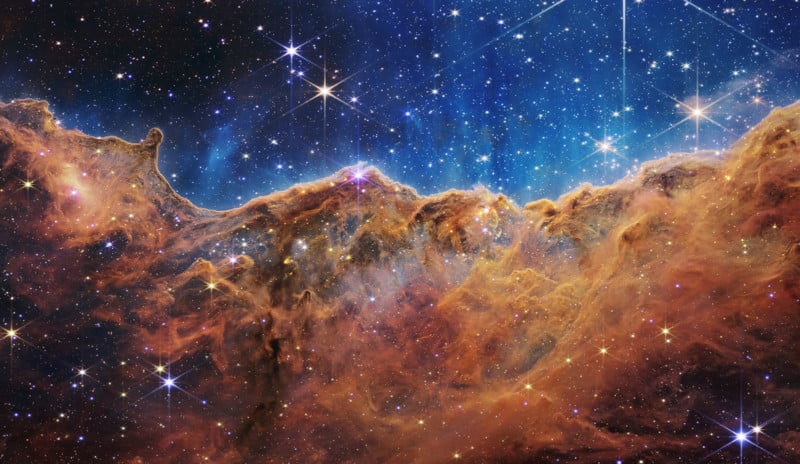 Carina Nebula. This was one of the very first images captured by the James Webb Space Telescope, showing the sculptural Carina Nebula, which is roughly 260 light-years across. | NASA, ESA, CSA, and STScI
While Webb’s new image is spectacular, an important bit of context is just outside the frame. The shape of the Treasure Chest itself is due to a star system, Eta Carinae, the most luminous object in the entire Carina Nebula. This star system is just 39 light-years to the northwest of the Treasure Chest, and one of its stars is 100 times the mass of the Sun and five million times as luminous. This gargantuan star has some serious gravitational pull.
Like all of Webb’s beautiful photos, there’s also important science happening behind the scenes. In the case of the Treasure Chest, scientists are studying it to learn more about how young stars in the larger Carina Nebula collect and expel gas from their environment.
Image creditsESA/Webb, NASA & CSA, M. Reiter. Acknowledgements: M. H. Özsaraç
Affiliate Disclosure PetaPixel articles may include affiliate links; we may earn a commission if you buy through one.



 English (US) ·