
 4 hours ago
6
4 hours ago
6
Go deeper with TH Premium: GPUs
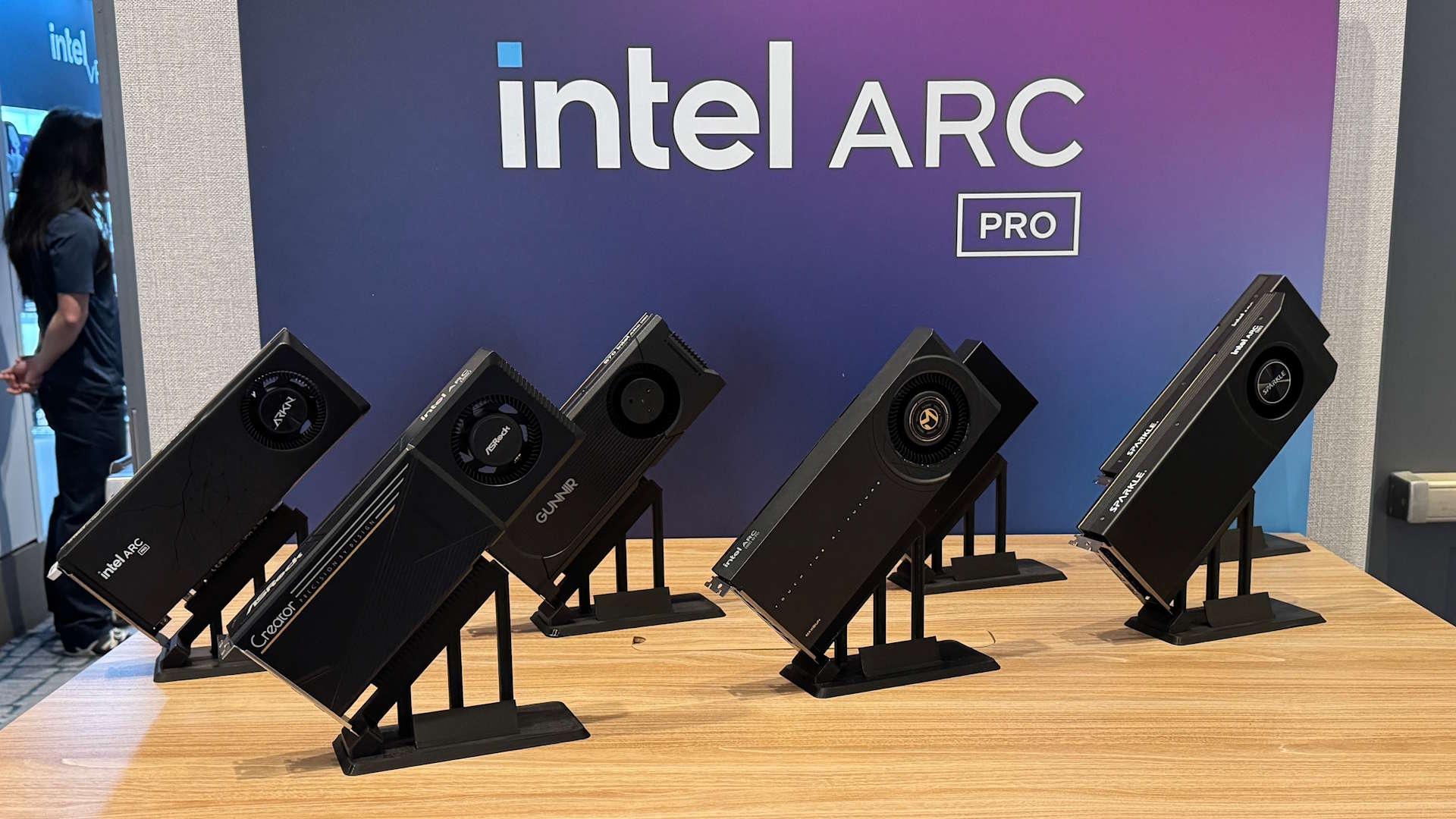
It's been almost two years since the BMG-G31 silicon first showed up in the rumor mill, pointing toward a highly capable Battlemage GPU that could solidify Intel's position among the best graphics cards. While the company's gaming ambitions have significantly slowed down since then, the BMG-G31 now powers the new Arc Pro B70 workstation GPU, which has just been tested by Expreview with a solid showing in games.
Swipe to scroll horizontally
Cyberpunk 2077 | 90.27 | 79.06 | 66.02 |
Monster Hunter Wilds | 51.33 | 56.53 | 39.23 |
Marvel Rivals | 69.00 | 74.00 | 49.00 |
Assassin's Creed Shadows | 49.00 | 58.00 | 42.00 |
Black Myth: Wukong | 44.00 | 53.00 | 32.00 |
Switching to ray tracing performance, the Arc Pro B70 expectedly looks a lot better, pushing 1% more frames than the RTX 5060 Ti on average, beating it in three of the five titles. Against the Arc B580, the workstation offering is about 40% faster. F1 2025 sees the biggest win for the B70 where it gets 14% more FPS compared to the 5060 Ti. Across all games in both raster and RT, however, the RTX 5060 Ti 16GB is still 2.9% ahead of the B70 — that's mighty close for a GPU not even meant for gaming.
Article continues below
Swipe to scroll horizontally
F1 25 | 58.00 | 51.00 | 35.00 |
Kingdom Come: Deliverance II | 62.29 | 56.19 | 42.92 |
Cyberpunk 2077 | 35.05 | 33.90 | 25.12 |
Assassin's Creed Shadows | 37.00 | 40.00 | 30.00 |
Monster Hunter Wilds | 43.10 | 51.14 | 33.87 |
As a reminder, the Arc Pro B70 is Intel's top-end Battlemage offering at the moment, while the Arc B580 remains its flagship gaming-focused GPU. The B70 features a whopping 32GB of (ECC) GDDR6 VRAM, so it has an inherent advantage over pretty much any gaming GPU. There's a software disadvantage, however, with the Arc Pro B70 using Intel's Pro driver as opposed to its gaming-focused Arc driver.
As such, in MLPerf Client, the Arc Pro B70 had a token throughput of 95.5 tokens per second, compared to just 73.7 tok/s on the RTX 5060 Ti. When it comes to TTFT (time to first token), the B70 absolutely annihilated the Nvidia GPU by being more than 4 times as fast thanks to its bigger memory pool. The Arc Pro B580, which has only 12GB of VRAM, was also about 64.52% faster here compared to the 5060 Ti.
Swipe to scroll horizontally
Llama 3.1 8B | 95.5 | 73.7 | 76.6 |
Phi4 Reasoning 14B | 55.3 | 39.7 | 43.7 |
Swipe to scroll horizontally
Llama 3.1 8B | 0.07ms | 0.31ms | 0.11ms |
Phi 4 Reasoning 14B | 0.15ms | 0.51ms | 0.23ms |
Expreview also ran some 3DMark tests where the Arc Pro B70 was about 21% ahead of the RTX 5060 Ti, while 45% ahead of the Arc B580. Intel has specific optimizations for 3DMark that make Arc GPUs appear faster than in real-world tests.
Still, the results show that if the BMG-G31 die was repurposed into a discrete gaming GPU, it could be an excellent midrange option. It wouldn't need nearly as much memory, which would alleviate some of the RAM shortage concerns, and with some driver optimization, it could reach RTX 5070 levels of performance.
Of course, that'll remind many of the forever-rumored Arc B770, the successor to the Arc A770 and a flagship gaming GPU that has been in the news cycle for years with no release in sight. Recent reports have even pointed that that the Xe3P "Celestial" family will have no discrete gaming GPU, along with the next-gen Xe4 "Druid" lineup, so we're stuck with the Arc B580 as the Blue Team's best offering for now.
Then there's the issue of pricing; if an Arc B770 were to come out, it will need to be positioned under $500 if it actually wants to compete with AMD and Nvidia, besting their 70-series MSRPs. As it stands, the Arc Pro B70 in this test costs $949, mostly because of the 32GB VRAM and the fact that the AI focus. For that price, you can instead get a used RTX 3090 or RX 7900 XTX easily, if gaming's your only concern, and both of them will destroy any GPU featured here.

Follow Tom's Hardware on Google News, or add us as a preferred source, to get our latest news, analysis, & reviews in your feeds.






 English (US) ·