
 1 month ago
40
1 month ago
40
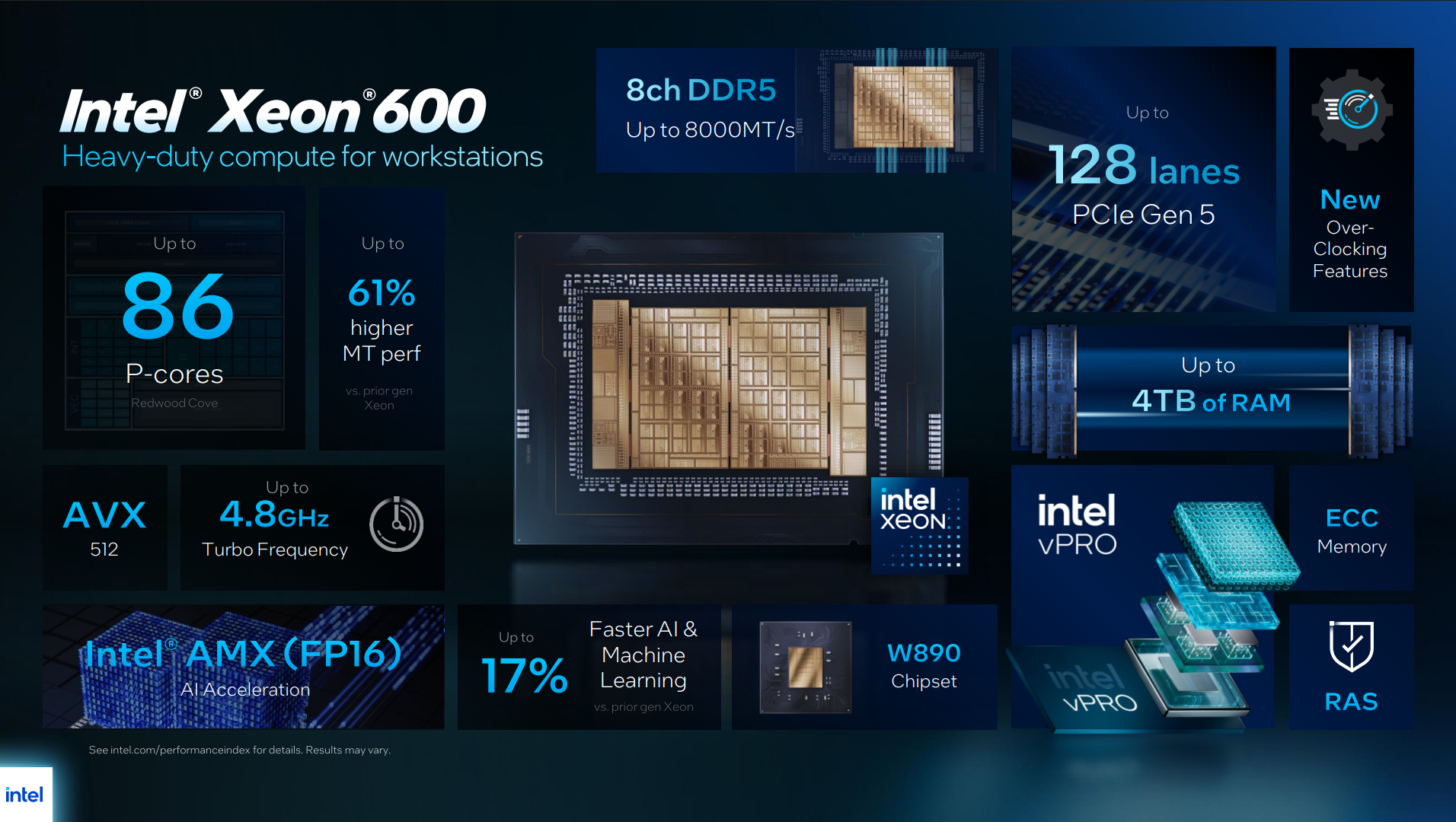
After revealing them last month, Intel has officially launched its Xeon 600 range of workstation CPUs. Previously known as Granite Rapids-WS, the range includes 11 SKUs, five of which will be available in boxed retail units. The chips support Intel’s updated vPro platform, alongside a range of Panther Lake chips that are now certified for business use with vPro.
Go deeper with TH Premium: CPU
As a recap, Xeon 600 are supported on the new W890 chipset, supporting up to 4TB of ECC memory in eight channels at up to 8000MT/s. The platform also supports up to 128 PCIe 5 lanes. For the chips themselves, they scale up to 86 scores using the Redwood Cove microarchitecture. Xeon 600 chips exclusively use the P-core design, with support for Hyper-Threading. They also come with Intel AMX in each core, with support for FP16 instructions to accelerate AI workloads, along with AVX-512 support.
Article continues below
Swipe to scroll horizontally
| Row 0 - Cell 0 | 698X | 696X | 678X | 676X | 674X | 658X | 656 | 654 | 638 | 636 | 634 |
Cores / Threads | 86 / 172 | 64 / 128 | 48 /96 | 32 / 64 | 28 / 56 | 24 / 48 | 20 / 40 | 18 / 36 | 16 / 32 | 12 / 24 | 12 / 24 |
Frequency (Base / Boost) | 2 GHz / 4.8 GHz | 2.4 GHz / 4.8 GHz | 2.4 GHz / 4.9 GHz | 2.8 GHz / 4.9 GHz | 3 GHz / 4.9 GHz | 3 GHz / 4.9 GHz | 2.9 GHz / 4.8 GHz | 3.1 GHz / 4.8 GHz | 3.2 GHz / 4.8 GHz | 3.5 GHz / 4.7 GHz | 2.7 GHz / 4.6 GHz |
All-core Turbo | 3 GHz | 3.5 GHz | 3.8 GHz | 4.3 GHz | 4.3 GHz | 4.3 GHz | 4.5 GHz | 4.5 GHz | 4.5 GHz | 4.5 GHz | 3.9 GHz |
L3 Cache | 336MB | 336MB | 192MB | 144MB | 144MB | 144MB | 72MB | 72MB | 72MB | 48MB | 48MB |
Base TDP | 350W | 350W | 300W | 275W | 270W | 250W | 210W | 200W | 180W | 170W | 150W |
Memory channels | 8 | 8 | 8 | 8 | 8 | 8 | 8 | 8 | 4 | 4 | 4 |
MRDIMM Support | 8000 MT/s | 8000 MT/s | 8000 MT/s | 8000 MT/s | 8000 MT/s | — | — | — | — | — | — |
PCIe 5.0 Lanes | 128 | 128 | 128 | 128 | 128 | 128 | 128 | 128 | 80 | 80 | 80 |
Boxed | — | Yes | Yes | Yes | — | Yes | — | Yes | — | — | — |
Suggested Price | $7699 | $5599 | $3749 | $2499 | $2199 | $1699 | $1399 | $1199 | $899 | $639 | $499 |
As a recap, Xeon 600 are supported on the new W890 chipset, supporting up to 4TB of ECC memory in eight channels at up to 8000MT/s. The platform also supports up to 128 PCIe 5 lanes. For the chips themselves, they scale up to 86 scores using the Redwood Cove microarchitecture. Xeon 600 chips exclusively use the P-core design, with support for Hyper-Threading. They also come with Intel AMX in each core, with support for FP16 instructions to accelerate AI workloads, along with AVX-512 support.
Alongside Xeon 600, Intel is launching Core Ultra Series 3 (formerly known as Panther Lake) chips for businesses with vPro certification. The lineup is slimmer compared to the client Core Ultra Series 3 stack, but the specs are identical. The difference, of course, is Intel vPro support.
Swipe to scroll horizontally
| Row 0 - Cell 0 | Core Ultra X9 388H | Core Ultra 9 386H | Core Ultra X7 368H | Core Ultra 7 366H | Core Ultra 7 365 | Core Ultra 5 338H | Core Ultra 5 336H | Core Ultra 5 335 | Core Ultra 5 332 |
Core Count (P + E + LP-E) | 16 (4 + 8 + 4) | 16 (4 + 8 + 4) | 16 (4 + 8 + 4) | 16 (4 + 8 + 4) | 8 ( 4 + 0 + 4) | 12 (4 + 4 + 4) | 12 (4 + 4 + 4) | 8 ( 4 + 0 + 4) | 8 ( 4 + 0 + 4) |
Max P-Core Frequency | 5.1 GHz | 4.9 GHz | 5 GHz | 4.8 GHz | 4.8 GHz | 4.7 GHz | 4.6 GHz | 4.6 GHz | 4.4 GHz |
Intel Smart Cache (L3 Cache) | 18MB | 18MB | 18MB | 18MB | 12MB | 18MB | 18MB | 12MB | 12MB |
NPU TOPS | 50 | 50 | 50 | 50 | 49 | 47 | 47 | 47 | 46 |
Graphics Brand | Arc B390 | Intel Graphics | Arc B390 | Intel Graphics | Intel Graphics | Arc B370 | Intel Graphics | Intel Graphics | Intel Graphics |
Xe Cores | 12 | 4 | 12 | 4 | 4 | 10 | 4 | 4 | 2 |
Platform PCIe Lanes (Gen 5 / Gen 4) | 12 (4 / 8) | 20 (12 / 8) | 12 (4 / 8) | 20 (12 / 8) | 12 (4 / 8) | 12 (4 / 8) | 20 (12 / 8) | 12 (4 / 8) | 12 (4 / 8) |
Thunderbolt | Four Thunderbolt 4 ports, Thunderbolt 5 support | Four Thunderbolt 4 ports, Thunderbolt 5 support | Four Thunderbolt 4 ports, Thunderbolt 5 support | Four Thunderbolt 4 ports, Thunderbolt 5 support | Four Thunderbolt 4 ports | Four Thunderbolt 4 ports, Thunderbolt 5 support | Four Thunderbolt 4 ports, Thunderbolt 5 support | Four Thunderbolt 4 ports | Four Thunderbolt 4 ports |
Wireless Connectivity | Wi-Fi 7 R2, Bluetooth Core 6 | Wi-Fi 7 R2, Bluetooth Core 6 | Wi-Fi 7 R2, Bluetooth Core 6 | Wi-Fi 7 R2, Bluetooth Core 6 | Wi-Fi 7 R2, Bluetooth Core 6 | Wi-Fi 7 R2, Bluetooth Core 6 | Wi-Fi 7 R2, Bluetooth Core 6 | Wi-Fi 7 R2, Bluetooth Core 6 | Wi-Fi 7 R2, Bluetooth Core 6 |
Max Memory Speed and Capacity | 96GB LPDDR5x-9600 | 96GB LPDDR5x-8533 / 128GB DDR5-7200 | 96GB LPDDR5x-9600 | 96GB LPDDR5x-8533 / 128GB DDR5-7200 | 96GB LPDDR5x-7467 / 128GB DDR5-6400 | 96GB LPDDR5x-8533 | 96GB LPDDR5x-8533 / 128GB DDR5-7200 | 96GB LPDDR5x-7467 / 128GB DDR5-6400 | 96GB LPDDR5x-7467 / 128GB DDR5-6400 |
Base / Turbo Power | 25W / 65W, 80W | 25W / 65W, 80W | 25W / 65W, 80W | 25W / 65W, 80W | 25W / 55W | 25W / 65W, 80W | 25W / 65W, 80W | 25W / 55W | 25W / 55W |
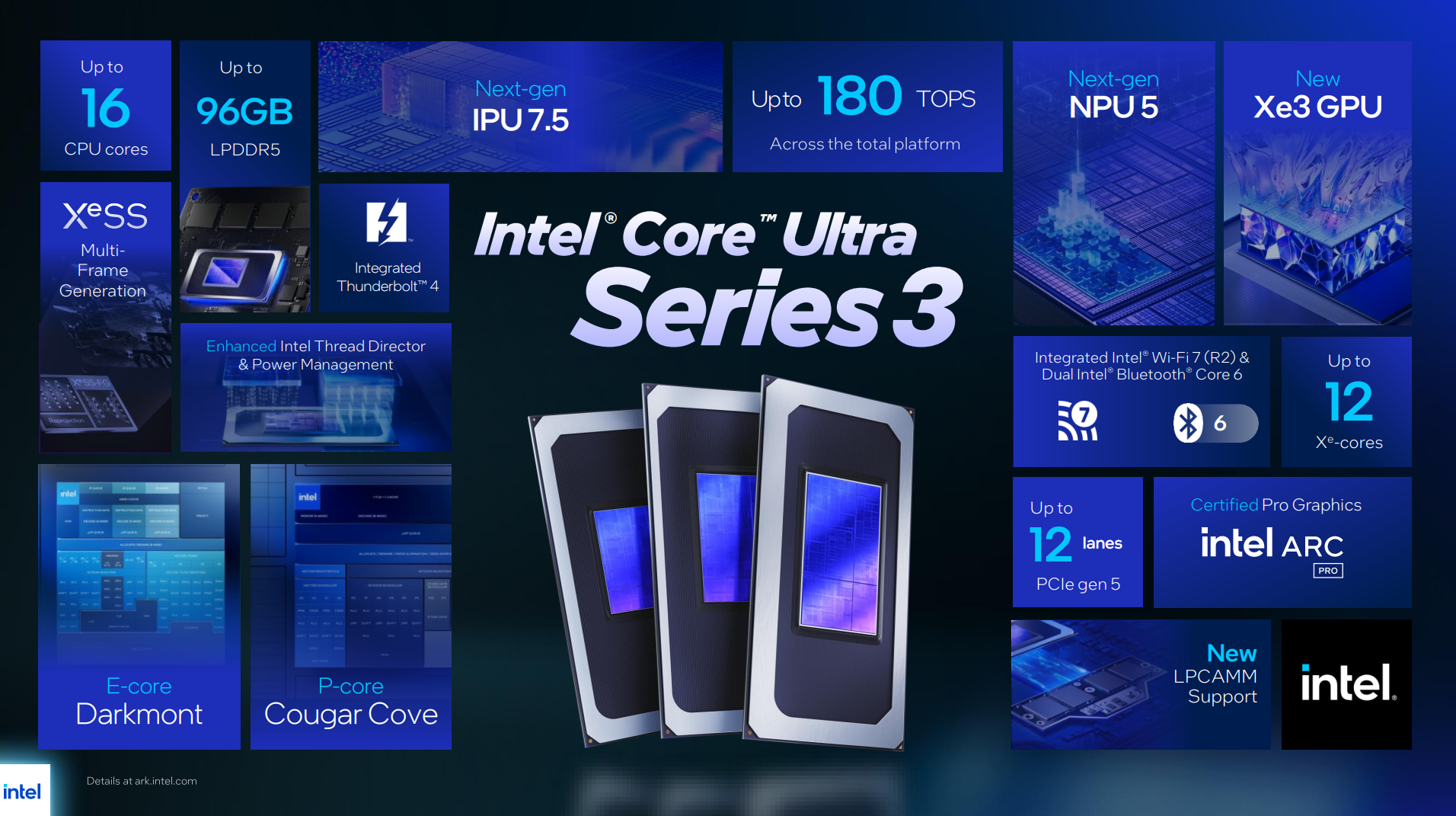
Like the client stack, Core Ultra Series 3 processors with vPro support up to 96GB of LPDDR5 memory and up to 12 PCIe 5 lanes. The SoC is the first to use Intel’s 18A node on the compute tile, which combines Cougar Cove P-cores with Darkmont E-cores. The chips also come with Intel’s latest NPU 5 AI accelerator and an Xe3 iGPU with up to 12 cores. As we’ve seen with devices like the Asus Zenbook Duo, the iGPU is where Core Ultra Series 3 processors really earn their stripes, particularly the X-series models with the full 12 Xe3 cores.
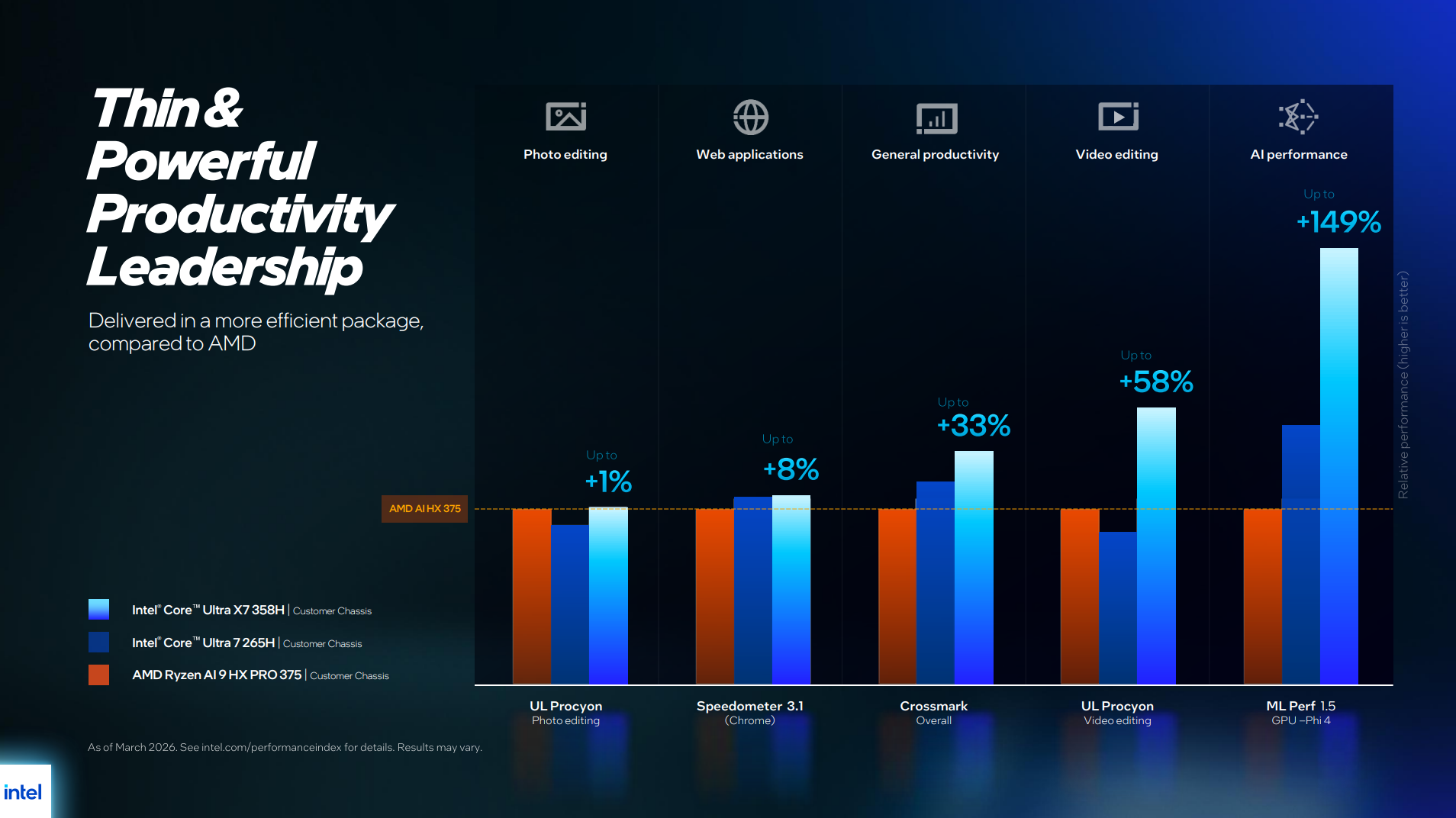
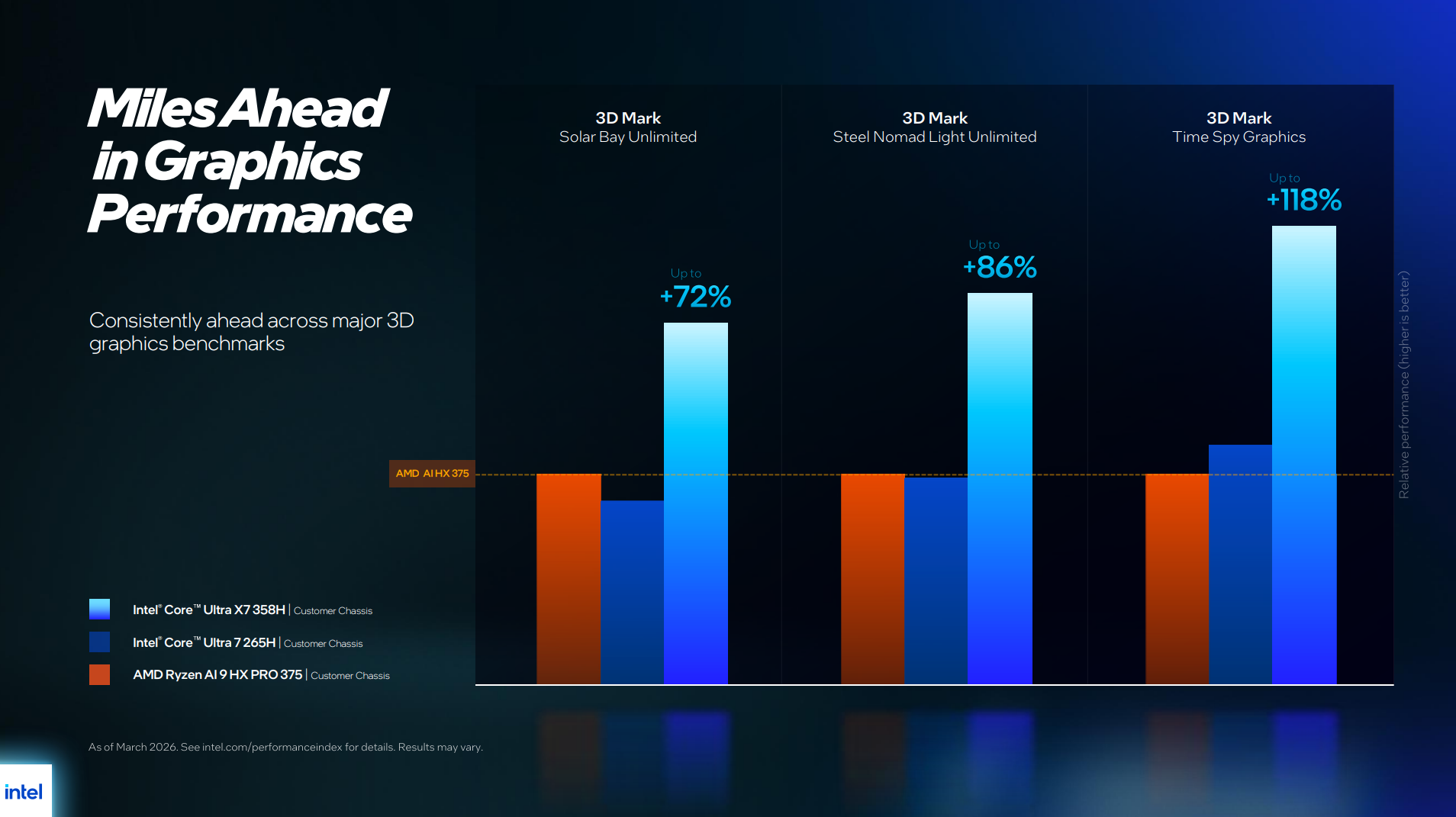
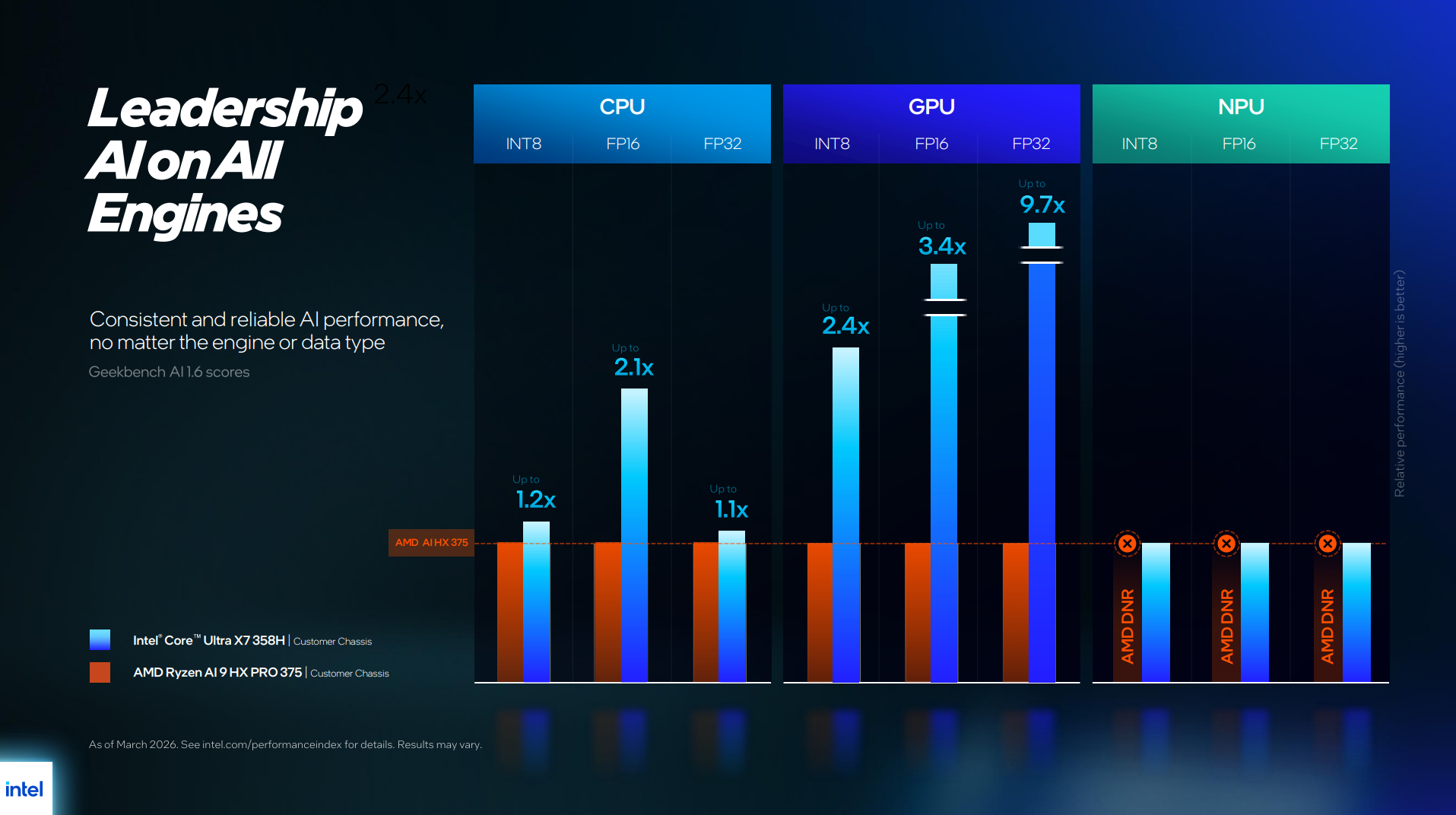
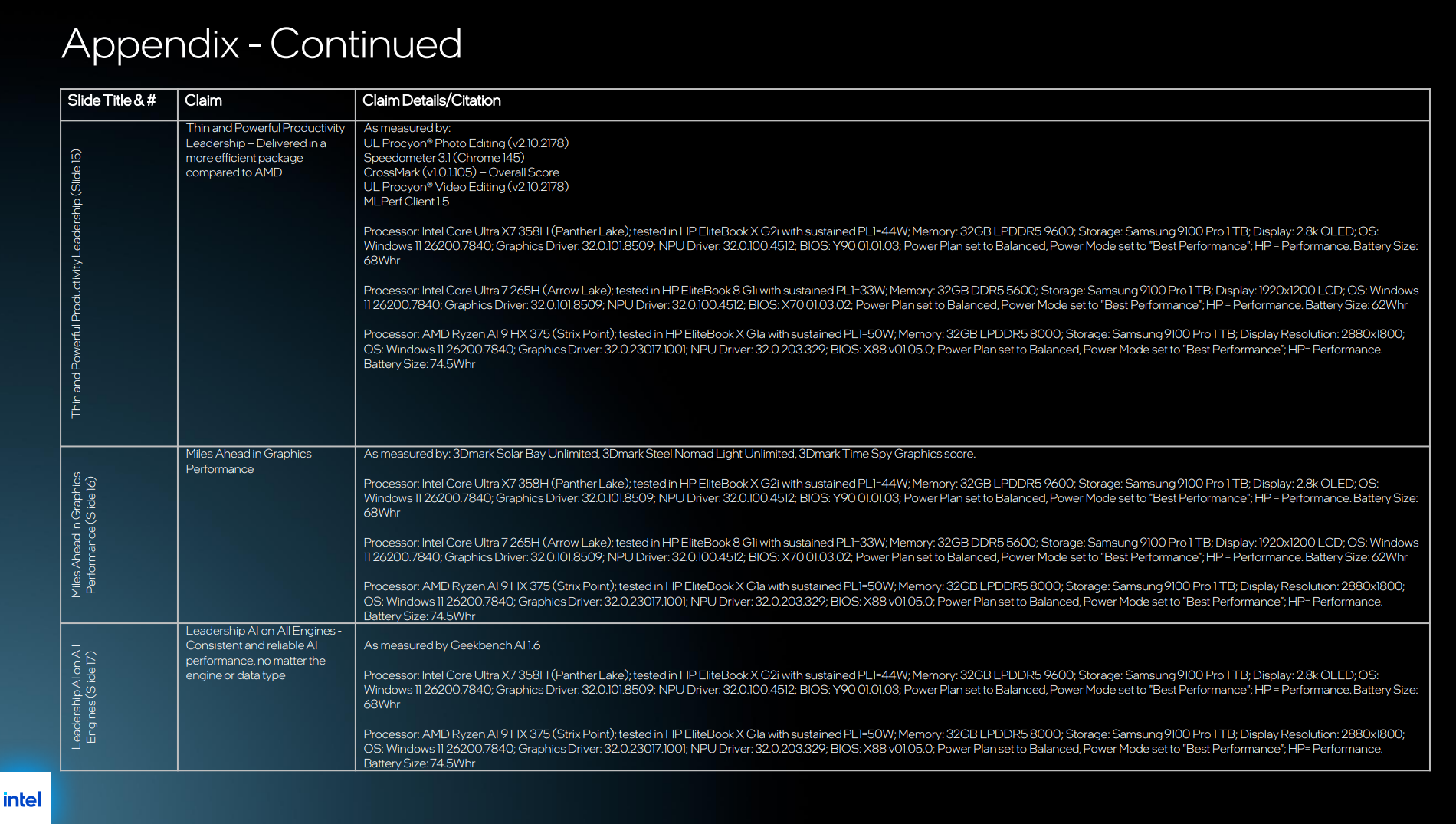
You can see that from Intel’s internal benchmarks, as well. The Core Ultra X7 358H holds some victories over AMD’s competing Ryzen AI 9 HX PRO 375 in general productivity workloads, but it runs away with graphics performance. Intel also claims significantly higher AI performance in Geekbench AI 1.6. Keep in mind, however, that Geekbench is a pure benchmark; it isn’t a real-world workload.
Intel details ‘all-new’ vPro platform
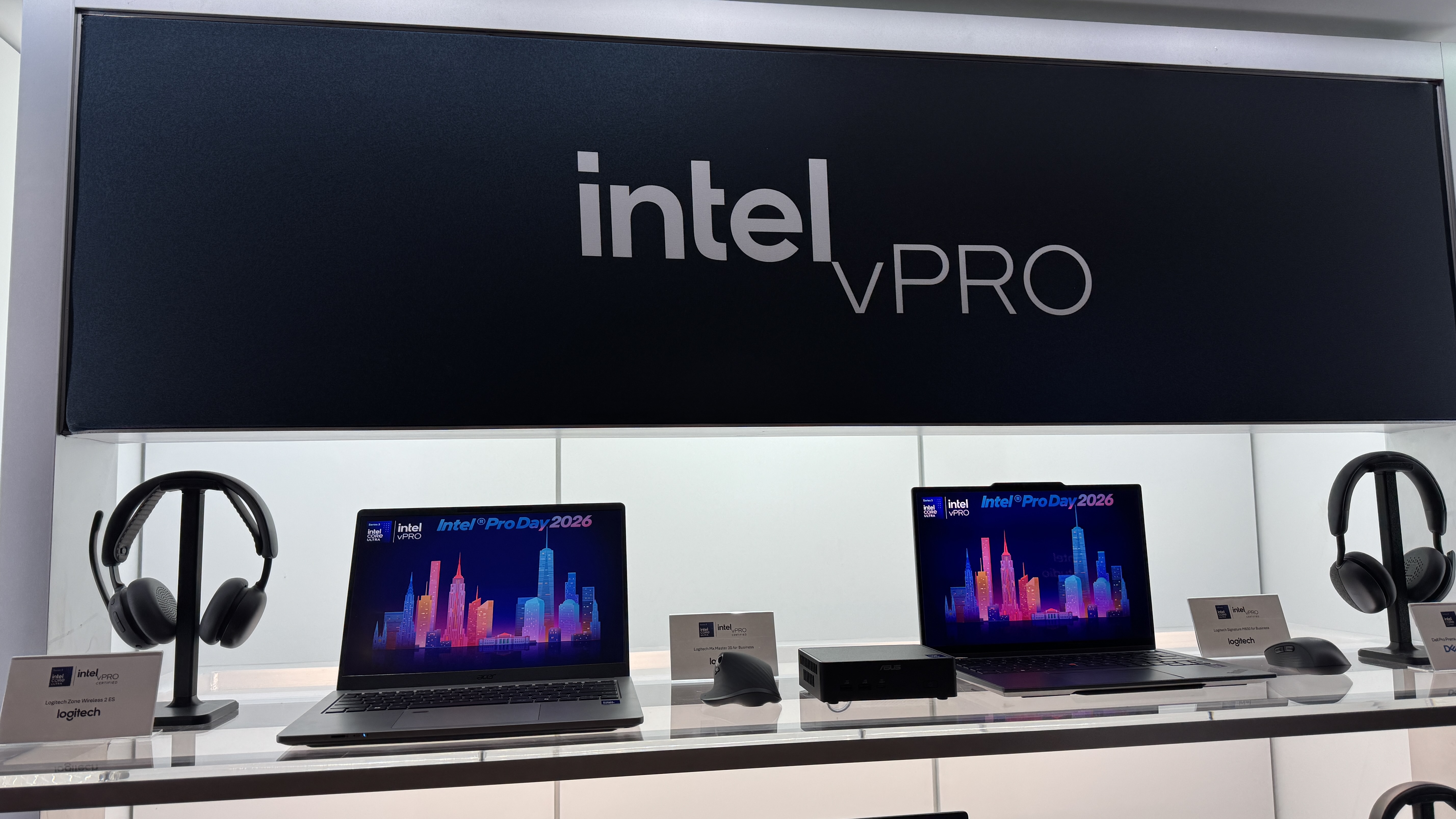
Both Xeon 600 and Core Ultra Series 3 chips for business support Intel’s updated vPro platform, which includes a handful of new features. For starters, Intel is expanding what vPro covers with the vPro Certified Apps and Accessories Program. As the name suggests, Intel is working with ISVs and OEMs to validate applications and accessories for vPro use. On the application side, Intel says vPro certification means apps are “optimized for battery life and performance,” while for accessories, they’re “certified for seamless connectivity.”
Through early engagements with ISVs, Intel says it’s seen up to a 59% reduction in CPU utilization in FlexxAgent (an endpoint application for centralized IT management) with vPro optimizations, a 56% improvement in power efficiency in Riverbed Aternity (an employee management platform), and a 74% reduction in background activity in Absolute Secure Endpoint. Alongside these applications, Intel says it has partnerships with ESET, Citrix, and Crowdstrike, among others, along with Dell, HP, Jabra, Lenovo, and Logitech on the accessories front.
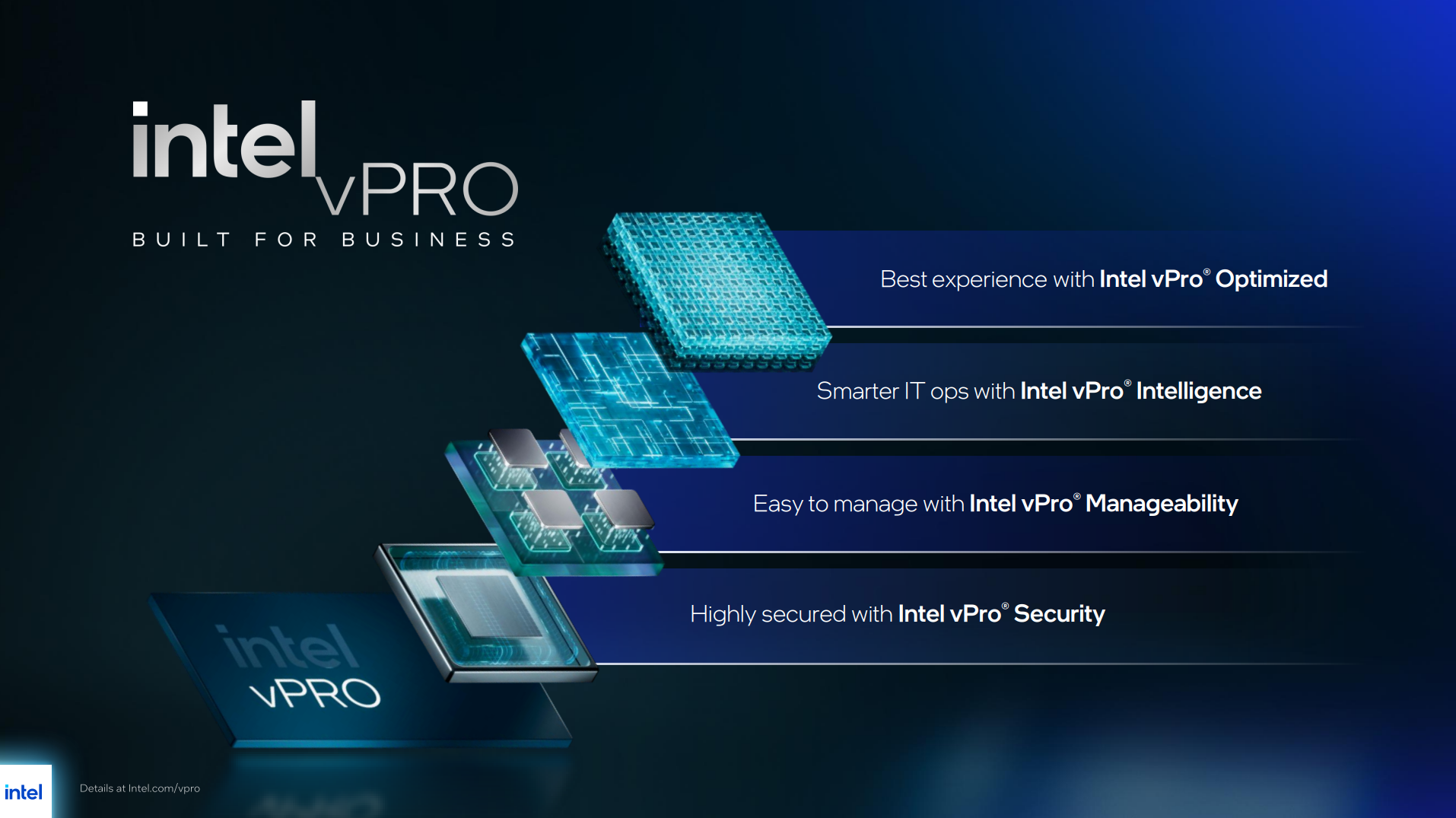
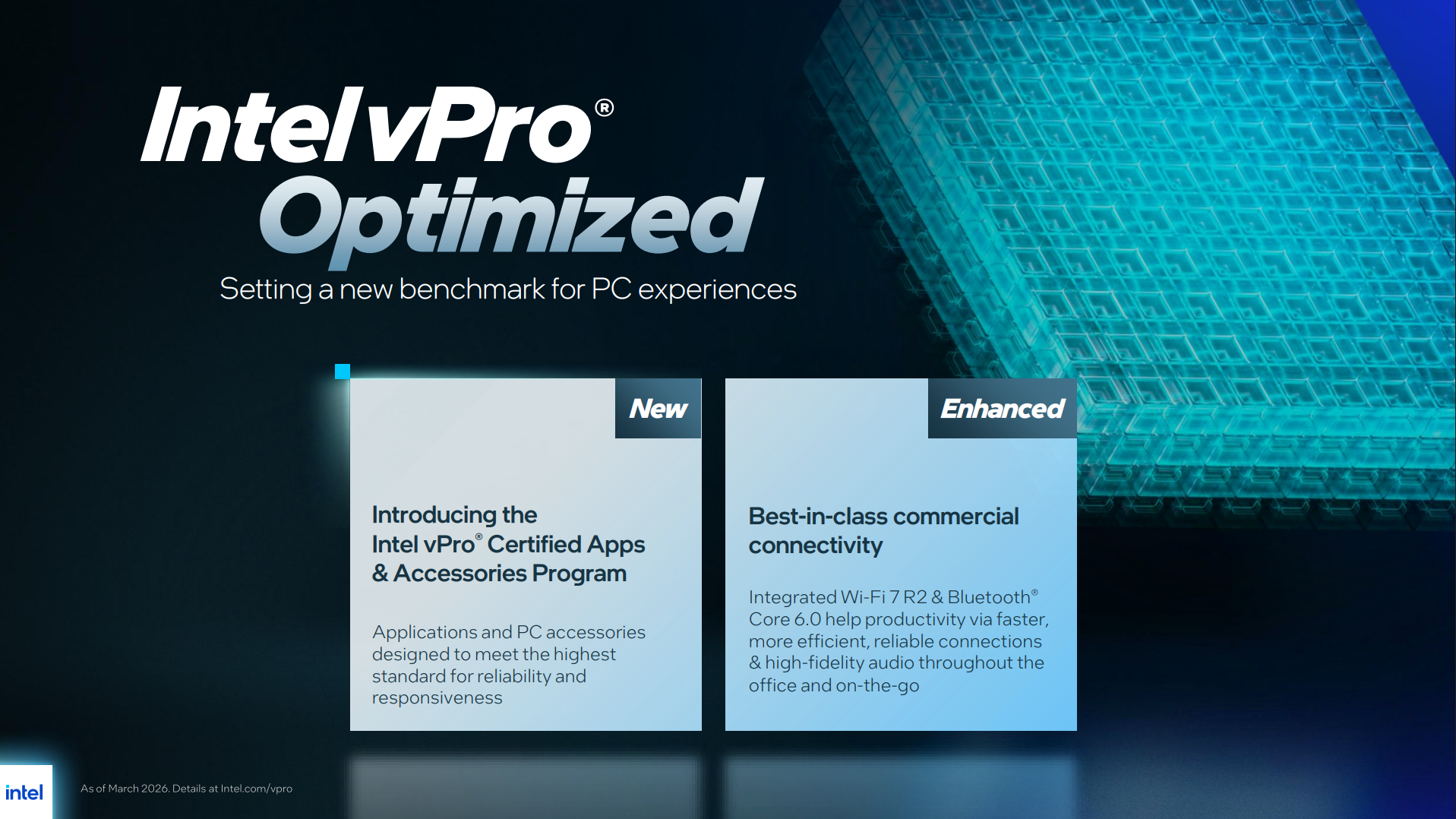
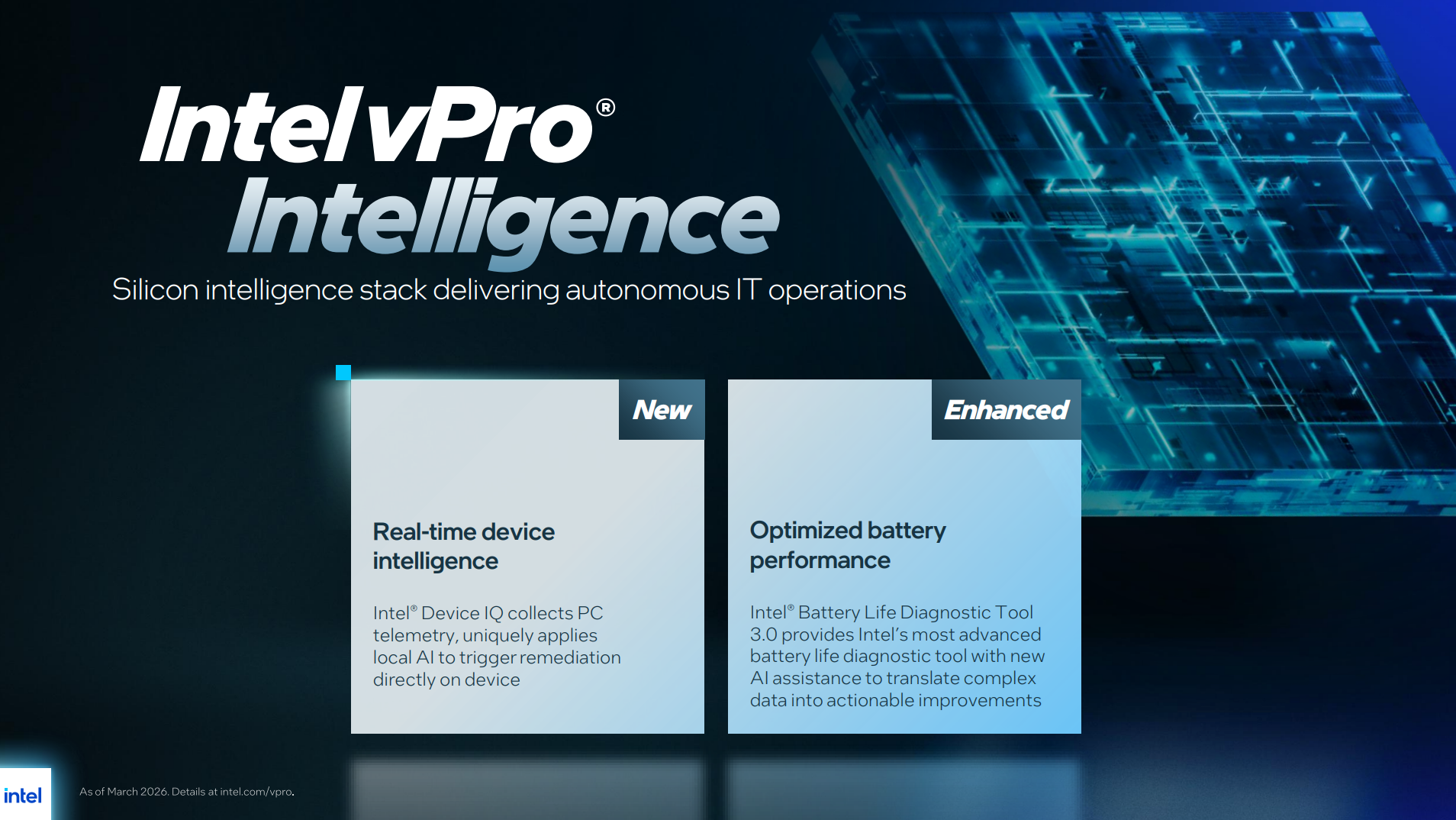
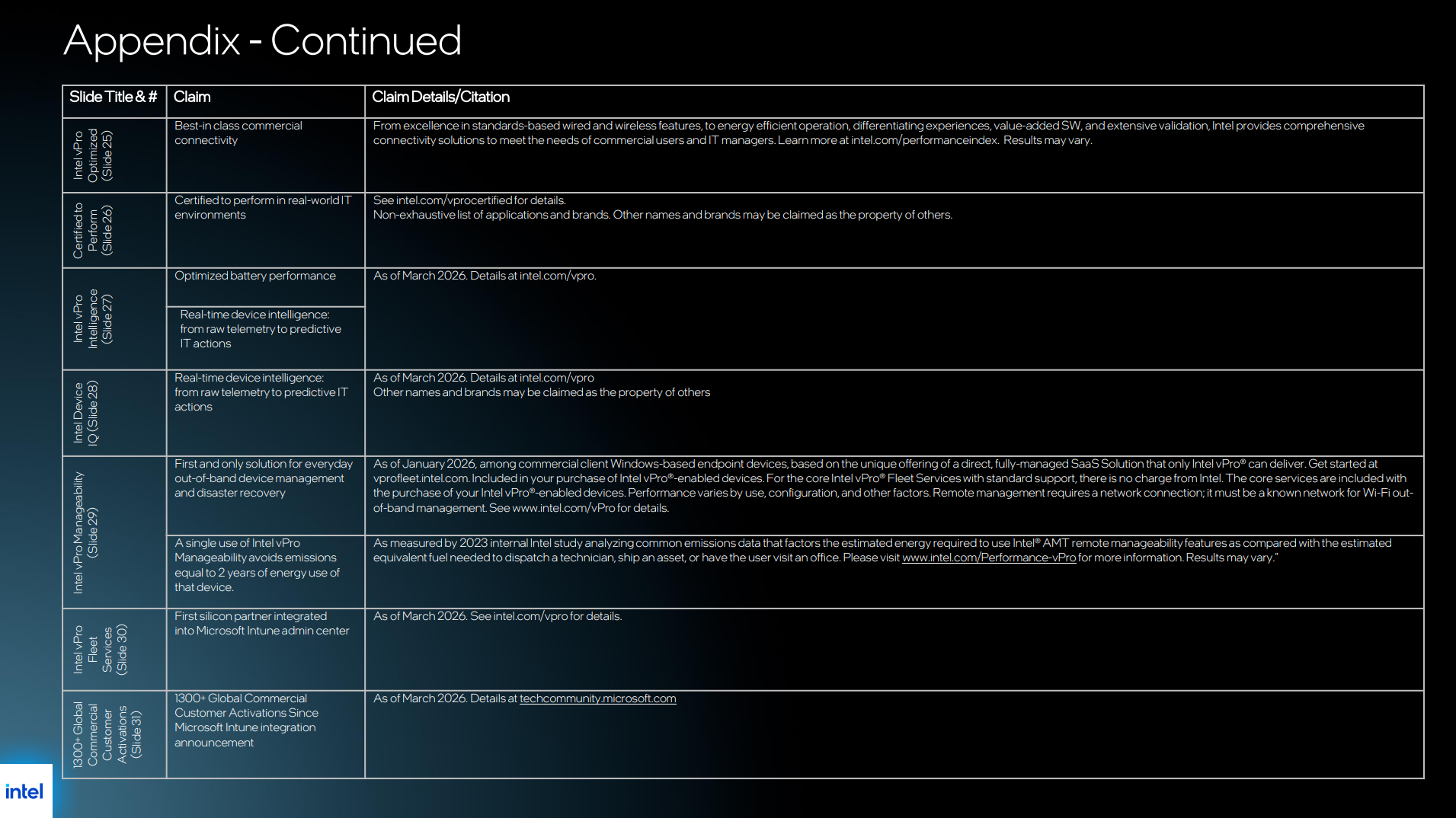
Also new is Intel Device IQ, which is enabled through Lakeside, Riverbed, Control Up, and Flexxible software. Intel says Device IQ “collects PC telemetry, [and] uniquely applies local AI to trigger remediation directly on the device.”
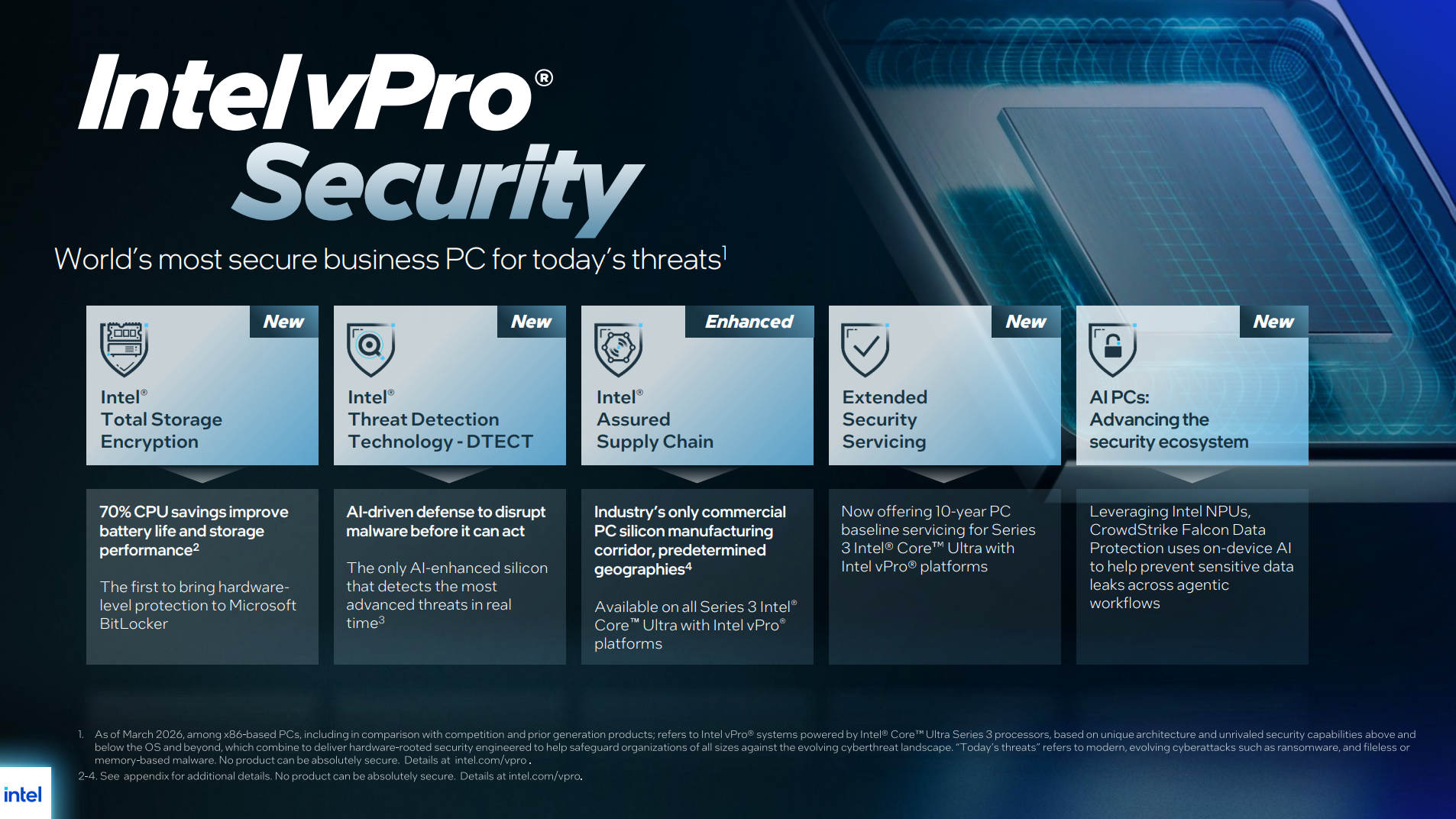
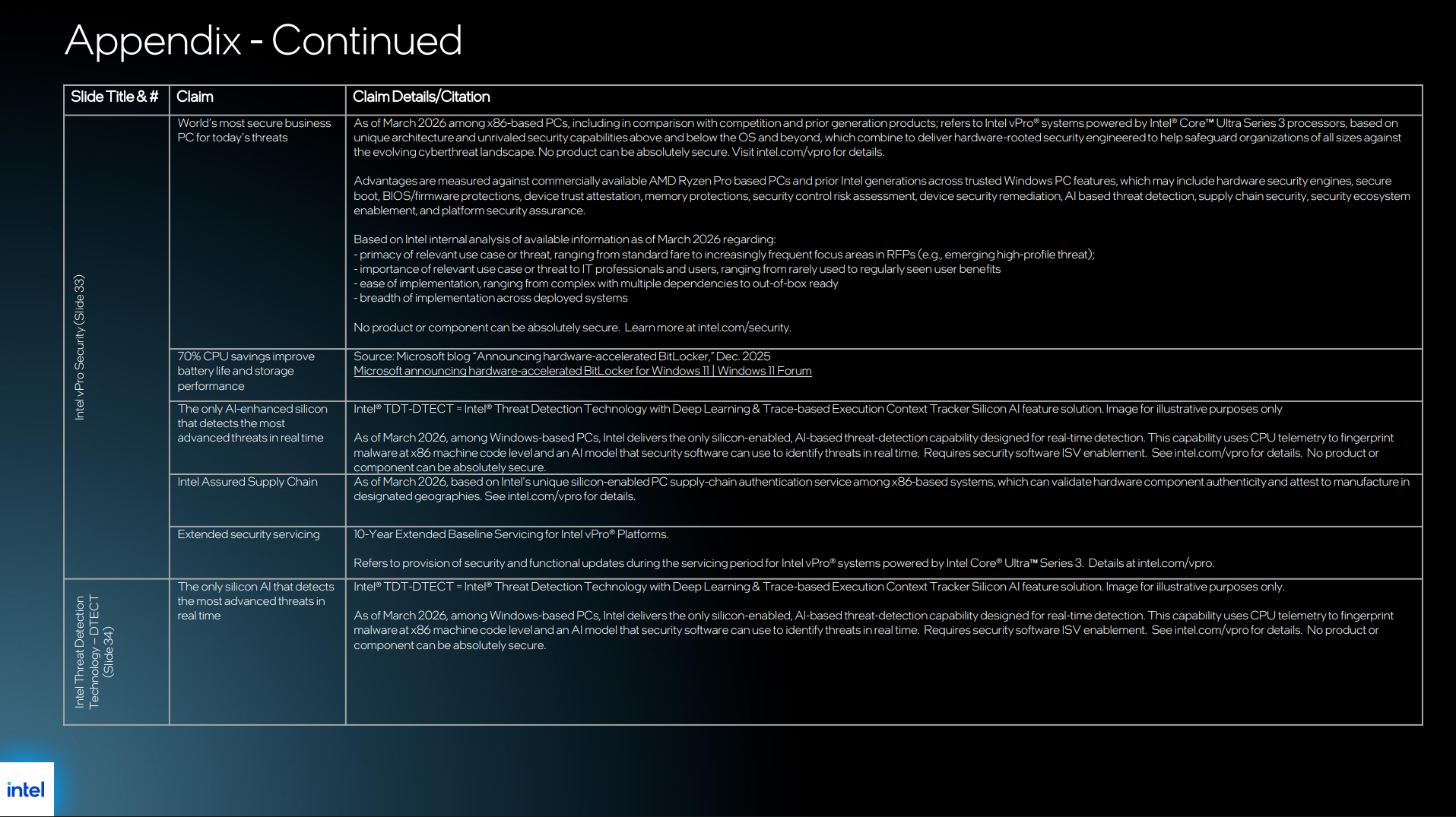
On the security front, Intel has added its Total Storage Encryption (TSE) feature to vPro, alongside Intel Threat Detection Technology. The latter can detect malware in real-time using AI, says Intel. On the NPU, Intel announced support for CrowdStrike Falcon Data Protection, using the onboard AI capabilities to protect sensitive data during agentic AI workloads (we’ve certainly seen those workloads go wrong in the past). Finally, Intel is extending the servicing window for Core Ultra Series 3 machines with vPro to 10 years.
Intel says it has over 125 designs for Panther Lake machines that support vPro, including the usual names like Acer, Asus, Dell, and HP, alongside more commercial-focused OEMs like Fujitsu, Panasonic Connect, and Dynabook. Designs start rolling out on March 31.

Follow Tom's Hardware on Google News, or add us as a preferred source, to get our latest news, analysis, & reviews in your feeds.





 English (US) ·