
 7 hours ago
17
Burning
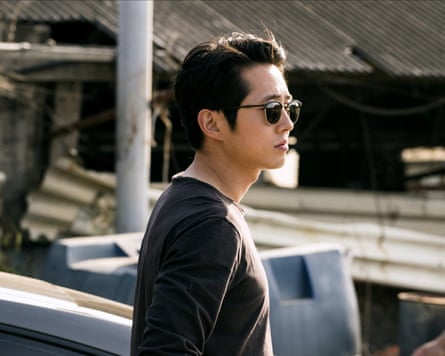
Hiding in plain sight throughout Lee Chang-dong’s deliciously enigmatic Burning, in which a spirited young woman (Jeon Jong-seo) disappears, and a wealthy playboy (Steven Yeun) gives serial killer vibes, is a disaffected male rage. That’s perhaps the most commonplace horror of our times, whether on the internet or politics, and you feel the tremors of it steadily breaking the surface in Yoo Ah-in’s performance. He plays Jong-su, an aspiring writer, quietly frustrated with his lot in life. Jong-su works odd jobs and tends to his incarcerated father’s dilapidated farm, growing more desperate to grasp some sense of control over the world around him, which is where the scary part comes in. Chang-dong is the master dramatist who with Burning tilts violently into thriller territory, navigating elements from Taxi Driver, The Vanishing and Michael Haneke’s Caché, using the language of horror movies to conjure up a creeping anxiety and dread that erupts into pure existential fear. Radheyan Simonpillai
-
Burning is available to watch on Mubi and Tubi in the US, to rent digitally in the UK, and on Netflix in Australia
The Hunchback of Notre Dame
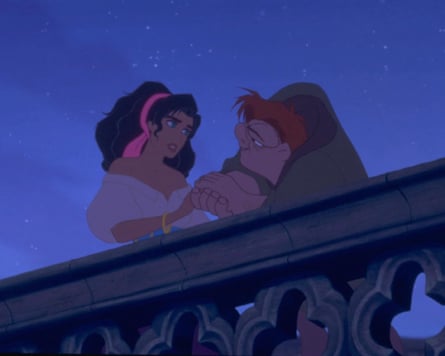
The scariest non-horror movie for me is Disney’s The Hunchback of Notre Dame. The scene where Quasimodo is bound to a pillory where the townspeople throw food and jeer at him because of his appearance and disability will for ever be seared into my brain since I first watched it as a six-year-old child. To this day, I still believe that I was far too young to witness that particular depth of human cruelty even though it’s very real. Not to mention that the story deals with xenophobia and bigotry towards the Romani people and sexual predation from a religious leader that takes the basic idea of good versus evil to a whole new level. The Hunchback of Notre Dame reminds me that you don’t need jumpscares and gore to frighten someone. Sometimes, the real monsters are human beings with a bit of social standing over someone else due to money, beauty, authority or all of the above. Morgan Jerkins
-
The Hunchback of Notre Dame is available on Disney+
The Sniper
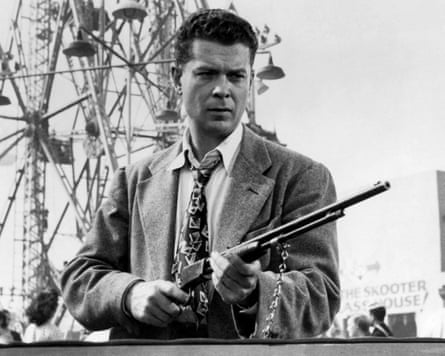
An insane loner motivated by his all-consuming misogyny perches beside his bedroom window, methodically shooting women on the street below. He writes of his compulsion to kill in a series of letters to police and begs the authorities to hurry up and catch him. This grimly prescient noir from 1952 feels all too familiar for modern viewers who are numb to stories of gun violence and incel culture. It’s a disturbingly acute portrait of urban alienation and the destructive nature of obsession, released more than two decades before Taxi Driver epitomized those themes. Equally haunting is The Sniper’s backstory. Director Edward Dmytryk was one of the blacklisted Hollywood Ten who refused to testify in front of Joseph McCarthy. He later reversed course after a six-month prison sentence, ghoulishly ratting on his contemporaries and ending countless careers. Alaina Demopoulos
-
The Sniper is available on YouTube in the US and to rent digitally in the UK and Australia
2001: A Space Odyssey
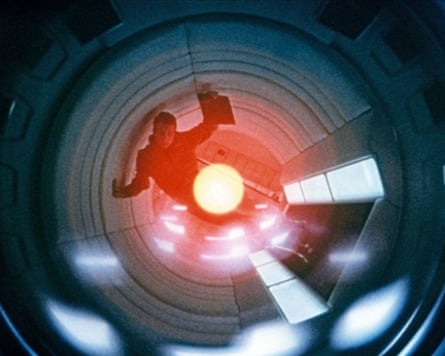
In Stanley Kubrick’s magisterial 2001, human creativity is such a mysterious and foreboding thing that it isn’t even couched as of this world – rather, an eerie alien monolith gives it to the primates who later evolve to be human beings. The film will for ever be remembered for its visionary jump cut from a bone spinning in slow motion – tossed triumphantly into the air by a primate in a fit of conquering rage – to an orbiting space satellite carrying nuclear weapons: in one deft motion Kubrick encapsulates the history of creativity as a carrier of our liberation, but also our destructive potential. From there, what unfolds is a carefully choreographed dance of death between humanity’s ability to responsibly discharge its ever-growing technological powers and the devices that become more and more dangerous to our survival as a species. Although Kubrick ends the movie on a note of hope and transcendence, what sticks with me more is the existential terror that one of our greatest strengths as beings will ultimately lead to our collapse. In an age of extremes where we are regularly reminded of the many technologically fueled threats to global civilization, it’s hard not to feel that fear. In 2001, astronaut-protagonist Dave Bowman manages to save himself – and thus take the next leap in human evolution – by simply disconnecting the runaway AI known as HAL 9000, but in our world we’ve already passed the point where that would have been possible. Veronica Esposito
-
2001: A Space Odyssey is available on HBO Max
Howard the Duck
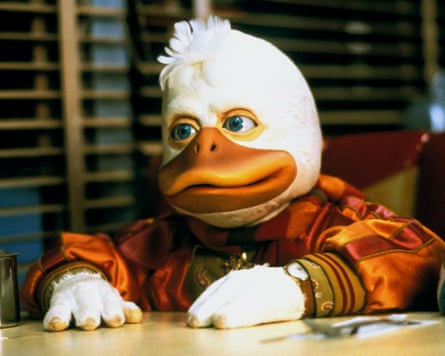
There’s so much I loved about growing up in the 80s: the funny pages, the power ballads, going for a drive, malls of genuine value – entertainment and otherwise. But one thing I did not love and still don’t was the era’s obsession with animatronic realism, of stuffed animals come disturbingly to life. And by far the worst offender was Howard the Duck. Here was a human adult-sized mallard foisted from his alien nest on to the unwitting citizens of Cleveland, Ohio, looking for all the world like a Donald Duck mascot who had fallen into a vat of primordial ooze (with those golf ball eyes screaming Help!). That Howard also happens to be a martial arts-wielding feminist with an appreciation for hair bands never endeared him to me more than the Dark Overlord who’s also summoned from deep space to … fuck with him? With us? (His true goals still remain somewhat unclear.) My nine-year-old mind was not prepared to see him in bed with Lea Thompson, and rarely does a Halloween go by when some part of me isn’t bracing for a surprise reunion with this quack at a backwoods haunted house. You simply cannot release a movie like this two years after Child’s Play and expect people not to mistake it for a horror. I wonder if the comics company that spawned this duck ever recovered … Andrew Lawrence
-
Howard the Duck is available to rent digitally in the US, on YouTube in the UK and to rent digitally in Australia
How to Have Sex
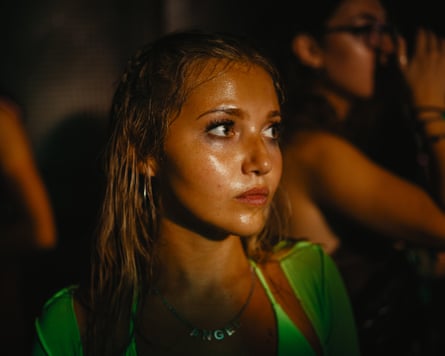
Remember the backseat scene in Bo Burnham’s excellent Eighth Grade, where a horny teen tries to seduce its young lead through a coercive game of truth or dare until her guilelessness catches up to his intentions? How to Have Sex is that unbearable, all-too-recognizable dread blown up to 91 minutes. In an extraordinary breakout performance, Mia McKenna-Bruce plays a 16-year-old on holiday in Greece with two more developed girlfriends. As they flirt with boys and party endlessly, she realizes that keeping up with a shot count might not equal sexual maturity. What’s brilliant about writer-director Molly Manning Walker’s debut is that the worst rarely ever happens: the girls can stumble home down a dark alley and make it back all right, but the threat of the worst-case scenario suffuses every single frame. It’s a queasy, unforgettable viewing experience, activating both parental and innocent impulses as we hope for the best for McKenna-Bruce’s fully realized heroine. Juan A Ramirez
-
How to Have Sex is available on Netflix and Mubi in the US, on Mubi in the UK and on SBS on Demand in Australia
8mm
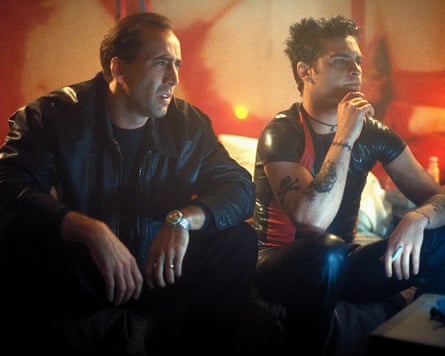
The horror movie my friends and I were supposed to see that day was The Rage: Carrie 2, a little-seen sequel to the 1976 masterpiece. We did see it – I’d even call it mildly underrated! – and it was indeed a horror film, albeit not the scariest one. But the movie that sent us off into the night so rattled that my buddy briefly drove down the wrong direction of a one-way street was what we casually ducked into afterward: 8mm, a thriller starring Nicolas Cage. Cage was the draw there, so I didn’t think much either way about the subject matter, which was snuff films; Cage plays a private investigator hired to find out if such a film, starring a teenage runaway, is real. I understand why critics at the time mostly shrugged the Joel Schumacher movie off as exploitative, histrionic and even cheesy, but screenwriter Andrew Kevin Walker knows his way around bringing rococo horrors into a stylized version of the real world (he also wrote Seven), sneaking horror into more quasi-respectable genres. The movie’s detective-thriller trappings are probably what ultimately made its more over-the-top elements, including multiple gruesome deaths, an extended confrontation between Cage and a creep played by James Gandolfini, and Cage tracking down a mysterious snuff-film performer called Machine, so viscerally upsetting. My two buddies and I left shellshocked. I like to pretend that I haven’t revisited 8mm since its 1999 release because I’d be embarrassed by how affected I was by such shlock, but the truth is, I’m still a little afraid of the damn thing. Jesse Hassenger
-
8mm is available to rent digitally in the US, the UK and Australia
Awake
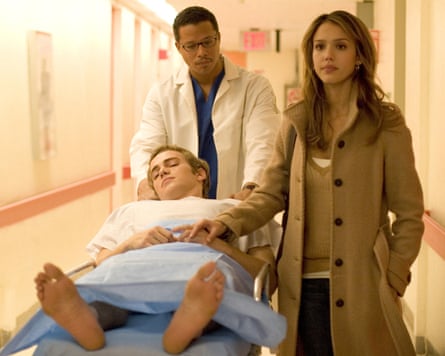
There are many reasons why Awake – the melodramatic thriller in which Hayden Christensen plays a wealthy finance bro who undergoes a heart transplant but remains conscious for the entire operation – continues to scare me the more I think about it. First, the idea of anesthesia failing is terrifying enough. But being paralyzed and unable to communicate that it’s not working? That feels unnecessary. Then there are the film’s many competing plot points. Christensen’s billionaire protagonist, Clay (a name I’ve yet to encounter in nearly a decade in the US), is apparently saint-like. While awake on the operating table, he gleans that his friend and cardiac surgeon (Terrence Howard) is in cahoots with his new wife (Jessica Alba) to kill him. The film is largely confined to a New York hospital, which sounds like a compelling chamber drama? Well, you’d be wrong. Because there apparently isn’t enough anxiety in Joby Harold’s directorial debut, we also get Clay’s hallucinations, including memories of his abusive father. It becomes a race against time for Clay’s mother (Lena Olin), another benevolent billionaire, to stop the plot. Somehow, it only gets more unbelievable. Still, Awake is weirdly exhilarating. Everyone commits fully to the madness, acting with a capital A. Shrai Popat
-
Awake is available on Tubi in the US, to rent digitally in the UK and on Netflix in Australia
Dark Waters
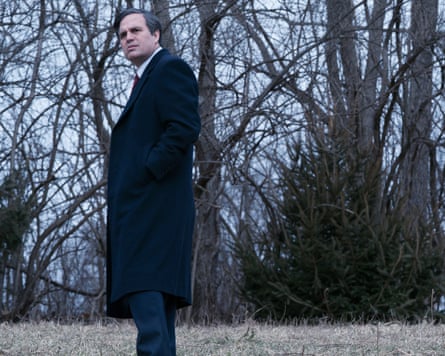
Todd Haynes’s 2019 legal drama, Dark Waters, tells a familiar American story: a principled lawyer goes up against a massive, unscrupulous corporation and loses. But there is a lot in this film, which was based on Nathaniel Rich’s 2016 New York Times profile of former corporate defense lawyer Robert Bilott, to make this duel terrifying. Throughout his career, Haynes has looked at how external forces contaminate the domestic sphere, and here, it’s no different: the obsessive spiral that sweeps Mark Ruffalo’s Bilott is nearly as scary as the complete indifference with which DuPont, the chemical corporation responsible for knowingly poisoning West Virginians with “forever chemicals”, regards human life. One image in the film haunts me more than others: Bilott kneels among stacks of paper that tower over him as menacingly as Nosferatu’s shadow. It’s a terror of scale – all that work won’t kill Bilott, but it will whittle him down to a wisp. To DuPont, crushing Bilott is as simple as swatting a fly. Once you see the horror, you can’t unsee it. Rafaela Bassili
-
Dark Waters is available to rent digitally in the US and the UK and on SBS on Demand in Australia
The Hunt
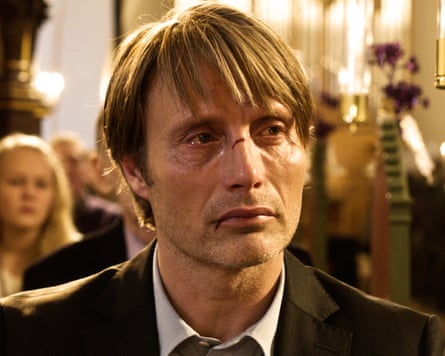
There’s something uniquely, nightmarishly terrifying about trying to defend yourself against a false accusation. It’s what makes documentaries about particularly egregious examples of injustice not just enraging but seriously scary – how mechanically efficient the system can be when it’s focused on destroying you, often as the result of something as random as bad luck. In Thomas Vinterberg’s almost unbearably clammy drama The Hunt, a claim is made and believed and it’s cleverly one we’re never kept in the dark about. We know instantly that Mads Mikkelsen’s kindly kindergarten teacher didn’t sexually abuse the young daughter of a friend who, through a confused blur of emotions, makes a comment that is seen as proof of something devastating. With every small decision then made by those around her, some initially understandable and some maddeningly ill-advised, a tight-knit community turns on someone they had previously embraced. It’s horrifying to watch for so many reasons, exposing just how incredibly fragile the trust and acceptance of others can be and how so many are happy to rely on grim preconceptions about men who work with children. What’s chilling is how unstoppable the spiral can often seem and, in a disquieting final scene, how unfathomable it can be to move on from even if the crime has been disproved. In The Hunt, a pitchfork is far scarier than a knife. Benjamin Lee
-
The Hunt is available on Tubi in the US and to rent digitally in the UK and Australia
Zodiac
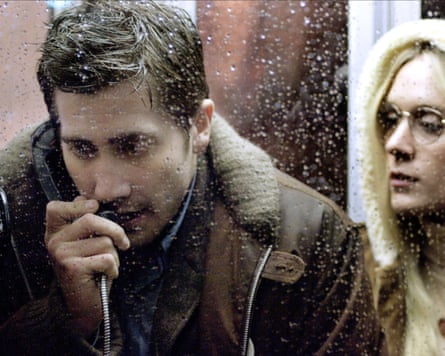
There are many reasons why Zodiac, David Fincher’s 2007 film on the infamous serial killer, is considered one of the best detective movies of all time: its precise detail, its masterclass escalation of suspense, its immersive and unsettling mood. But the legacy of Zodiac, to me, isn’t Jake Gyllenhaal’s obsessive spiral, or the vexatious unsolved cryptograms, or even Guillermo del Toro’s viral tweet thread on the movie’s perfection. It is the unnerving re-enactment, about 20 minutes in, of a black-clad man striding in broad daylight toward a picnicking couple. At first he appears to be just another park visitor; only after a few paces can you see that he is masked, marked by an ominous symbol and carrying a gun. Fincher mostly keeps the camera trained on the female victim’s face, as her initial curiosity morphs to concern, then fear, then terror. That shift – when she knows something is off, but can’t yet tell it’s dire – pops into my mind when, say, a stranger approaches on an empty sidewalk, or when I am alone in a park. My dread has yet to ever be substantiated, but that scene is a pathway to panic: sometimes, as in this actual 1969 murder, your fear was right. Adrian Horton
-
Zodiac is available on YouTube and Paramount+ in the US, on Netflix and Amazon Prime in the UK, and on Netflix in Australia
Requiem for a Dream
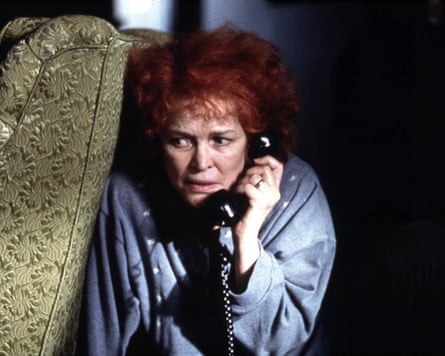
As a committed avoider of actual horror movies, my most scary experiences at the cinema tend to sneak up on me when I’m not really expecting them. Both the original Vanishing and Jonathan Glazer’s Under the Skin contained scenes that temporarily put the fear of God into me, but I think for cumulative dread and general misery, Darren Aronofsky’s mighty adaptation of Hubert Selby Jr’s junkie novel stands supreme. As its title indicates, Requiem is a nightmare inversion of the American dream: after attempting to go into business with a “pound of pure”, the three youthful protagonists, played by Jared Leto, Marlon Wayans and Jennifer Connelly in manifestly career-high performances, end up having an arm amputated, being battered by prison guards and being forced into gruesome sex work, respectively. In this film, heroin is the equivalent of the creepy killer doll, or hulking monster no one else can see; it’s the silent, remorseless slayer THAT CAN’T BE STOPPED. And that’s not even counting the fourth protag, Ellen Burstyn’s gameshow wannabe, so hopped up on speed-laced diet pills that she goes into amphetamine psychosis. This isn’t a tale of terror, as such, but their collective descent into abject misery is as profoundly disturbing an experience as cinema has ever recorded. Andrew Pulver
-
Requiem for a Dream is available on Peacock and Tubi in the US and to rent digitally in the UK and Australia




 English (US) ·