
 3 weeks ago
27
3 weeks ago
27
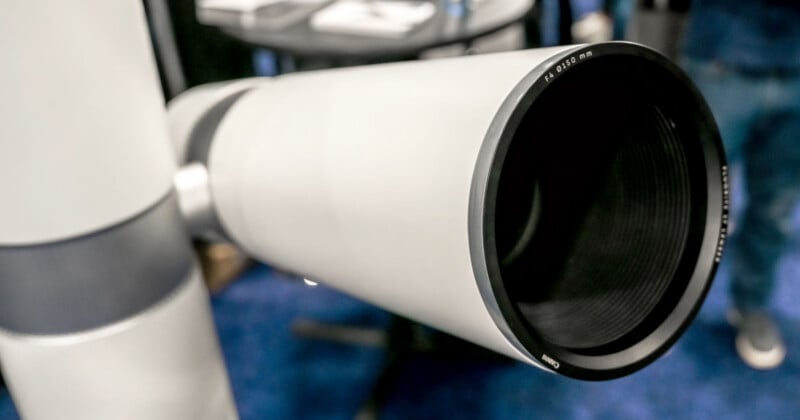
Vaonis’ new $99,000 Hyperia smart telescope with Canon optics is high-end astronomy gear with an astronomical price to match. Although designed primarily for educational institutions and museums, wealthy stargazers in the U.S. and the Middle East have already placed orders to get Hyperia’s first deliveries in 2027.
This blend of consumer-facing automation with professional-grade optics and sensors has been on a lenghty journey of its own, especially considering the collaboration with Canon. However, rather than a fully co-developed system with Canon, this was more of a “technical collaboration” that Vaonis says was essential to making the system viable. Canon, for its part, confirmed with PetaPixel Vaonis as a business partner in the European region but doesn’t consider Hyperia a co-development effort.
A ‘Technical’ Collaboration
The Hyperia’s 45-megapixel full-frame Canon sensor (likely the EOS R5 II) measures 36 x 24mm, paired with a complex optical chain made up of 17 lenses. The collaboration involved months of “technical exchanges” with Canon engineering teams in both Japan and Europe, except neither side has confirmed specifics over the exact sensor or optics inside the lens. Vaonis led the overall system architecture, integration and product development, rather than jointly creating bespoke Canon hardware.
 Credit: Vaonis
“This wasn’t co-development in the sense of designing a custom Canon sensor or lens from scratch,” says Cyril Dupuy, CEO of Vaonis, in an interview with PetaPixel. “But Canon engineers worked closely with our teams to help select and adapt the most suitable optical and sensor technologies for our use case, which is new territory for them.”
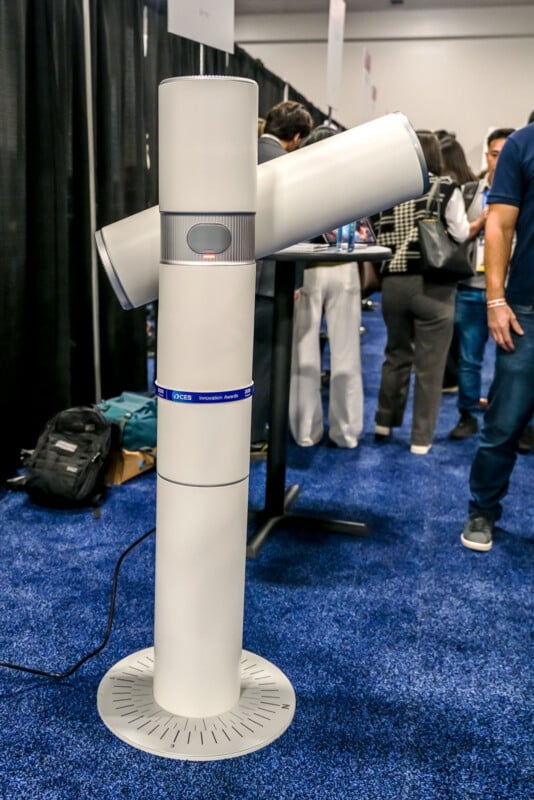
That use case is deep-sky astronomy at a scale and speed rarely seen in refractor-based systems. Hyperia is built around a 150mm aperture refractor with an f/4 focal ratio, a combination Dupuy says does not currently exist on the market. While telescopes with similar apertures are available, achieving such a fast focal ratio at this size is technically difficult and expensive, which partly explains Hyperia’s high price.
A fast f/4 optical system like this is designed to speed up astronomers’ ability to capture faint galaxies, nebulae, and other deep-sky objects. While presenting the Hyperia at CES 2026 in Las Vegas, Vaonis reps noted this capability as central to Hyperia’s appeal, particularly for educational settings and live demonstrations where results need to appear quickly. The only demo at the show consisted of a preset automated movement showing the fluidity and smoothness.
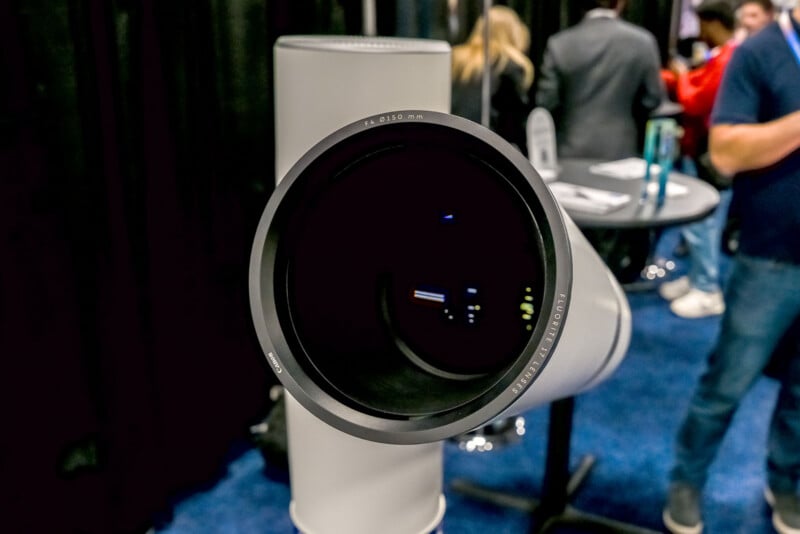
Then there’s the focus on long-exposure stability through a direct-drive mount combined with field-rotation compensation, so the system can maintain accurate tracking for individual exposures lasting up to 30 minutes.
“Hyperia captures multiple exposures of the same target and then aligns and combines them automatically,” says Dupuy. “The real signal from the object accumulates, while random noise averages out. Stacking also helps remove transient artifacts such as satellite or aircraft trails. The result improves progressively as the total integration time increases.”
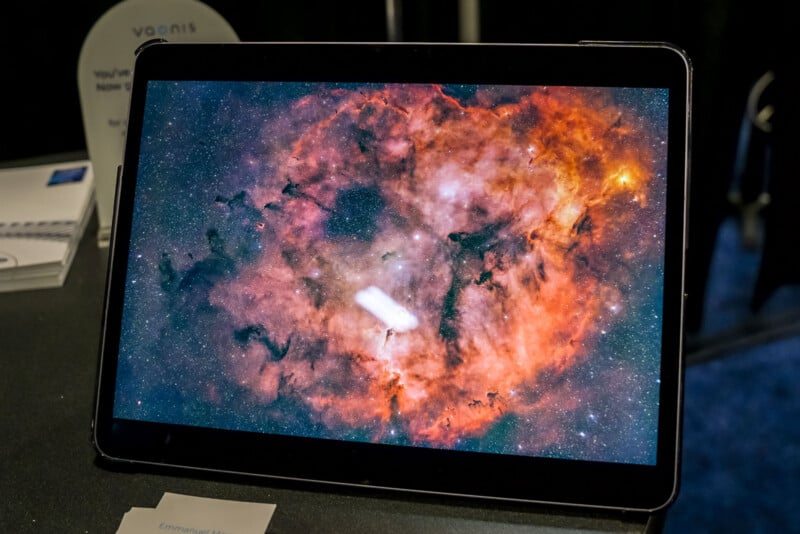
 Elephant Trunk Nebula | Credit: Vaonis
Vaonis also designed the Hyperia to work just about anywhere, including in urban or suburban areas with ample light pollution. A set of interchangeable filters can suppress unwanted wavelengths from artificial lighting, but the company concedes it’s unlikely to become a common sight on city rooftops.
Vaonis tells PetaPixel that Hyperia has a built-in IR-cut filter designed to preserve H-alpha and SII transmission. The telescope also supports standard 2″ astronomy filters, so users can take advantage of filters from other brands as well.
Taking Control From Afar
Control is meant to be turnkey and plug-and-play to minimize complexity. Vaonis reps say the goal is to let educators focus on explaining the universe rather than managing software, while still giving advanced users deeper control. The company is also developing a dedicated Hyperia app for setup and remote access for users to control the telescope from anywhere in the world and still receive images in real time. Someone with a Hyperia on a rooftop in New York, for example, could operate it from a patio in Dubai, seeing images stream back in real time. That could open more opportunities for remote observatories and networked astronomy.

 Credit: Vaonis
Since Vaonis is tailoring Hyperia forfor advanced individual users, educational institutions, and science outreach programs, it sees a fundamental change in how astronomy is presented in classrooms, planetariums, and public demonstrations, enabled by the ability to reveal structure and detail within minutes rather than hours. Instead of showing static images captured long beforehand, educators can let audiences watch celestial objects emerge live on screen as data accumulates.

 North America Nebula | Credit: Vaonis
“Users can adjust exposure time and gain, watch the image build in real time, and optionally export RAW data for processing in third-party software,” says Dupuy. “Thanks to Hyperia’s fast optics, initial results appear within minutes, while the highest-quality results come from longer integrations.”
Despite its pricey proposition, the Hyperia is trying to push smart telescopes into new territory. Even without Canon’s bespoke hardware, bringing together consumer imaging and astronomical access in a single system may be just the start for a company hinting at more to come.





![20 Years Later, One of the Best Sitcoms of the 21st Century Returns With Hilarious First Look [Exclusive]](https://static0.colliderimages.com/wordpress/wp-content/uploads/2026/02/malcolm-in-the-middle-life-s-still-unfair-feature.jpg?w=1600&h=900&fit=crop)

 English (US) ·