
 3 weeks ago
29
3 weeks ago
29
Demystifying orbital data centers
“The ISS radiators are expensive and heavy. We’re focused on making them cheap and light.”

An examination of the technical challenges behind orbital data centers. Credit: Aurich Lawson | Getty Images
An examination of the technical challenges behind orbital data centers. Credit: Aurich Lawson | Getty Images
Editor's note: This is the second of three feature articles Ars is publishing to explore the financial, technical, and competitive dimensions of orbital data centers. Although the idea of putting data centers into space has long been discussed on a theoretical basis, the technology has rapidly become a red-hot topic. This series attempts to ground-truth some of the rhetoric flying around.
In this article, we discuss the technical challenges of building an orbital data center constellation: launching all of it, dissipating heat in space, dealing with radiation, and addressing latency issues in orbit. Read part one here.
SpaceX has pinned the bulk of its future value on orbital data centers. Not rockets. Not spacecraft.
Instead, it envisions launching and maintaining a constellation of 1 million satellites capable of generating 120 GW to power tens of millions—and potentially up to 100 million—frontier-class GPUs for data center services.
The company’s founder, Elon Musk, revealed plans for this massive constellation months ago, but until recently, the scope of the individual satellites was largely unknown. That changed in June, when Musk and Ian Dahl, director of satellite engineering for SpaceX, spoke in a promotional video about the company’s plans to develop the first iteration of an orbital data center, called an AI1 satellite. The video finally provided the company’s numbers about the satellite’s size and power capabilities.
“There’s not some magic that’s necessary that doesn’t exist,” Musk said during the video, reflecting on the challenge of building AI1 satellites. “A lot of this is technology we’ve already made for Starlink V3 satellites. Basically, we don’t think this is a super hard problem.”
As Ars wrote in part 1 of this series, the physics of orbital data centers are indeed non-magical. But the economics are, to put it mildly, challenging.
This subject has sparked a broad debate about the near-term viability of this technology, both in terms of feasibility and whether it’s all hype now that SpaceX is a publicly traded company.
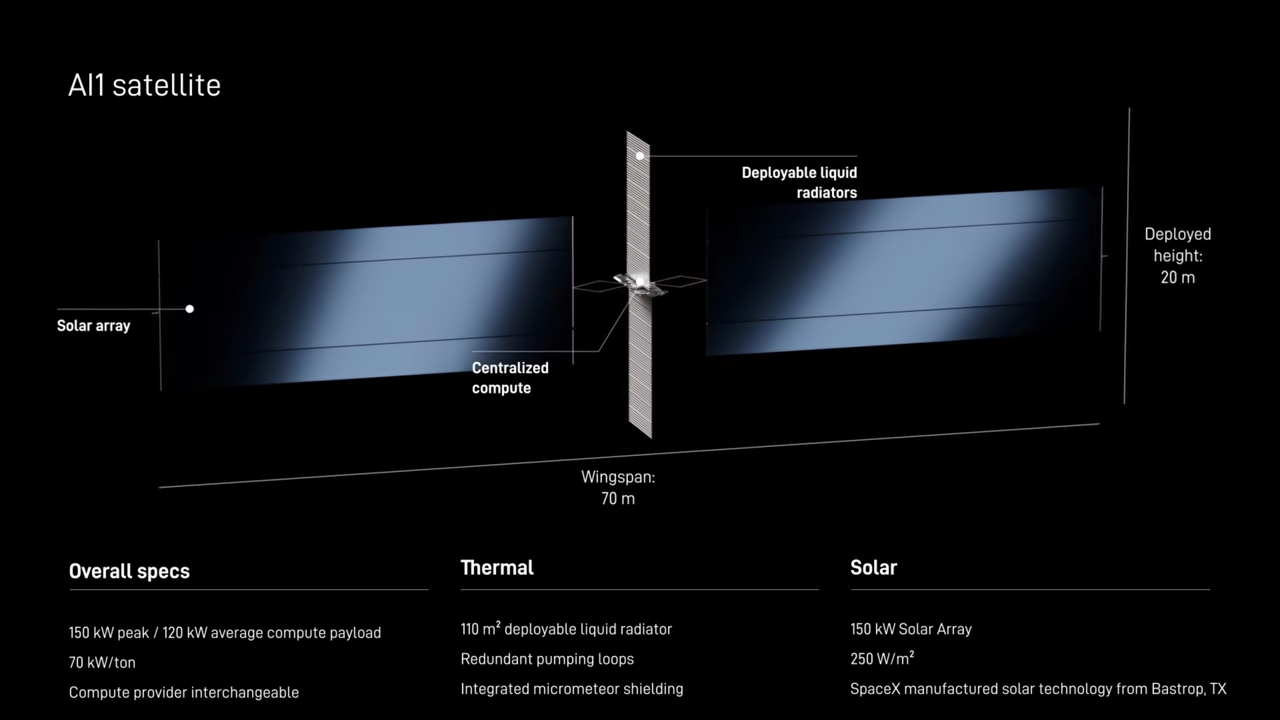
SpaceX’s design for its AI1 satellite.
Credit: SpaceX
SpaceX’s design for its AI1 satellite. Credit: SpaceX
Iridium Communications chief executive Matt Desch, a long-time, level-headed satellite industry executive, was asked during an earnings call earlier this year what he thought about the concept.
“It’s a hot, hot area right now of discussion, mainly because of Starlink’s announcement and some others,” Desch replied. “It looks like a problem that can be solved in space… (But) there’s massive technical challenges to overcome.”
Desch speculated that the recent enthusiasm for orbital data centers is not driven by a profound need to put them into space but by pecuniary reasons.
“It’s a really, really long-term opportunity at best, and I wonder if all the discussion isn’t for other reasons than maybe just solving an immediate problem,” he said. “I could jump on that bandwagon to try to, you know, hitch our wagon to that for a valuation. But we’re a really pragmatic company that focuses on really delivering results in cash and growth, so I’d rather kind of stick to the themes that I’m currently around.”
So who is right? With part 2 of this series, we want to see if we can put some rough numbers on the true viability of orbital data centers in general and SpaceX’s concept in particular.
The short answer is that a lot has to go right.
The optimistic, neutral, and pessimistic cases
A chief reason to put orbital data centers in space is the free, limitless power from the Sun. Based on the schematic SpaceX released, each of its AI1 satellites would have solar panels encompassing about 600 square meters, or about 1.5 times the size of a basketball court. These solar panels would generate 150 kW of peak power and 120 kW of average power for computing.
The weight of these solar panels adds up quickly—we’re looking at probably 1 to 2 metric tons. Satellite industry consultant Stuart Taylor told Ars that SpaceX might consider using a newer material called perovskite (there are some Internet rumors about this) instead of silicon, which could enable much lighter solar panels. But questions remain about the long-term stability of perovskites, so we’ll base our analysis on standard silicon solar cells.
The satellites’ on-board computing power will generate significant heat, requiring a large radiator (more on this below). Estimates from various sources put this at around another 1 to 2 metric tons at a minimum. Adding everything else in, such as a bus (backbone), GPUs, and other components, the satellites will likely weigh between 3.5 and 7.5 metric tons.
To get all of this mass into orbit, you need a super heavy lift rocket. SpaceX’s Starship V3 rocket is estimated to have a payload capacity of 100 metric tons to low-Earth orbit, but the company’s engineers are already planning a V4 with a significantly higher capacity: 200 metric tons.
A final variable to consider is launch costs. The platonic ideal for Starship is full reusability, with both the first and second stages returning to the launch site and being re-stacked for launch within hours. The only costs would be propellant (perhaps $1.5 million per launch for liquid oxygen, methane, and other consumables) and personnel to manufacture and maintain the rockets and ground support equipment. For the sake of argument, let’s assume an idealized Starship launch cost of $20 million, which would translate to a truly remarkable $100 per kg to low-Earth orbit. That’s not unattainable if things go well for Starship, but it would take time.
So those are the basic numbers. For the purposes of this analysis, we will consider three cases: optimistic, neutral, and pessimistic.
- Optimistic: Starship payload capacity of 200 metric tons; AI1 satellite mass of 3.5 tons; Starship launch cost of $20 million
- Neutral: Starship payload capacity of 150 metric tons; AI1 satellite mass of 5.5 tons; Starship launch cost of $50 million
- Pessimistic: Starship payload capacity of 100 metric tons; AI1 satellite mass of 7.5 tons; Starship launch cost of $100 million
Let’s run the numbers
SpaceX likely plans for each satellite to last five to seven years before being moved into a heliocentric disposal orbit or burning up in Earth’s atmosphere. Assuming a five-year lifetime, putting the 1-million satellite constellation into orbit and then replenishing it over time would require thousands of launches per year.
How many depends on your assumptions in each case above:
- Optimistic: 57 AI1 satellites per launch; 17,500 total launches; 3,500 launches per year
- Neutral: 27 AI1 satellites per launch; 37,000 total launches; 7,400 launches per year
- Pessimistic: 13 AI1 satellites per launch; 77,000 total launches; 15,300 launches per year
Even in the best-case scenario, that’s 10 launches a day. Worst case is 42 launches a day.
Clearly, that’s a lot. Last year, the world set a new record for orbital launch attempts: 329, with 321 reaching at least a marginal orbit, according to astrophysicist Jonathan McDowell. Of these, more than half—170—were conducted by SpaceX.
So for SpaceX, this data center megaconstellation would represent at least a 20-fold increase in its launch capacity. SpaceX currently has one Starship launch pad at its Starbase facility in Texas, and within a couple of years, it should have a total of four launch towers at sites in Texas and Florida. Those launch pads are optimized for equatorial orbits, so SpaceX may need launch sites for missions to Sun-synchronous orbits. It is considering sites in Louisiana and elsewhere to launch due south.
How much would the satellites cost? The analytics firm Quilty Space has estimated that Starlink V3 satellites—the template upon which the orbital data centers will be based—will cost around $1 million. Even if we allow for some economies of scale in building so many new satellites, an estimate of $1 million per spacecraft seems like a reasonable best-case scenario given that orbital data centers will have significantly larger solar panels and expensive computer hardware.
Finally, there are the ground systems to handle all the data moving to and from orbit all across the globe. Let’s estimate that at roughly $100 billion for all three scenarios.
This leads to our all-in, cocktail-napkin estimates for the cost of a 1-million satellite SpaceX orbital data center constellation:
- Optimistic: $350 billion in launch costs; $1 million per satellite; all-in cost of $1.45 trillion
- Neutral: $1.85 trillion in launch costs; $1.5 million per satellite; all-in cost of $3.45 trillion
- Pessimistic: $7.7 trillion in launch costs; $2.0 million per satellite; all-in cost of $9.8 trillion
That’s a real chunk of cash, even if you’re the world’s first trillionaire.
But SpaceX just completed the most lucrative initial public offering of stock in the history of stock markets. So it has cash. It will just need a lot more. It also really, really needs Starship to dramatically reduce launch costs. Unless that happens, none of this seems remotely feasible.
What about the radiation?
The physics challenges of orbital data centers are formidable but not insurmountable. Let’s start with radiation, a concern with all space hardware.
Based on its experience with the Starlink constellation, SpaceX has found that many of the required computing components, such as processors and memory, are already fairly radiation-tolerant. Sam Waldman, a physicist who worked at SpaceX from 2012 to 2018 on avionics for various programs, including Starlink, said power supplies and other components are more vulnerable to radiation, but there are known techniques to address the issue. SpaceX has learned a lot from operating thousands of Starlink satellites in orbit, often for five or more years.
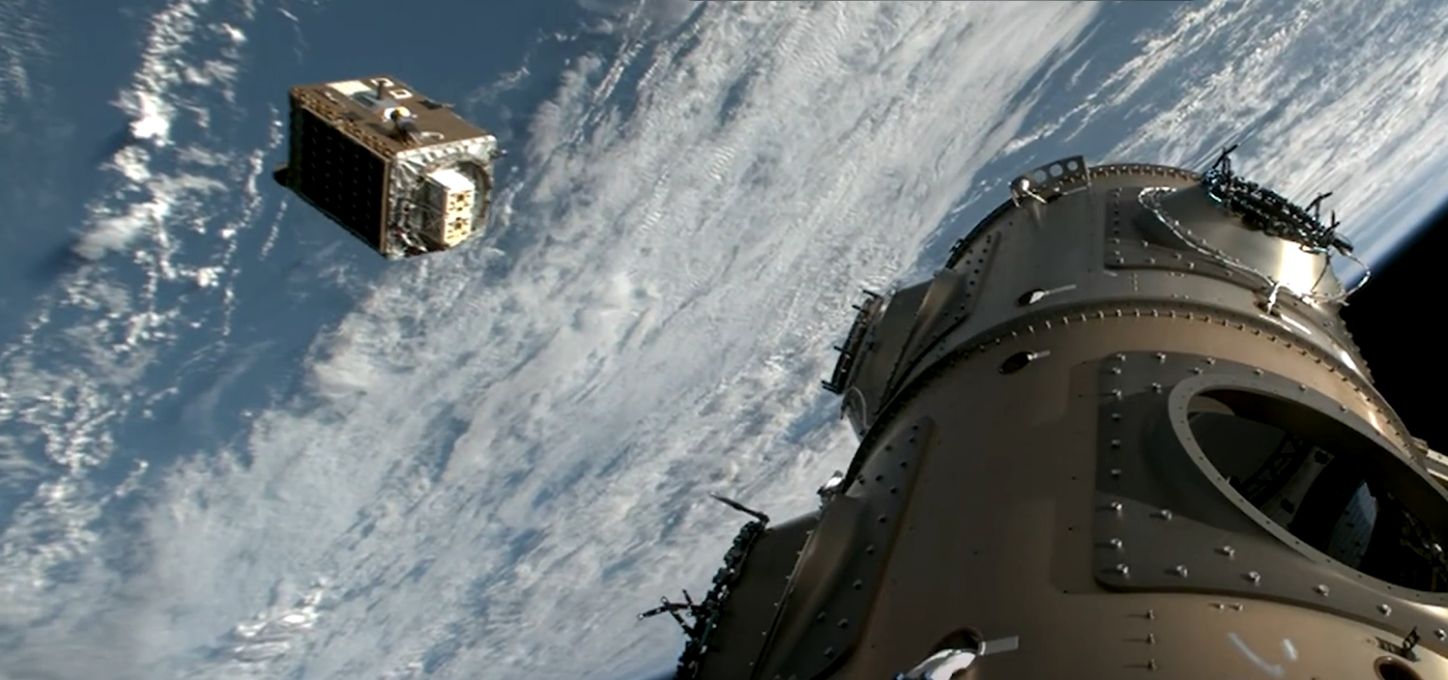
The Starcloud-1 mission is released into space on a Transporter mission last fall.
Credit: SpaceX
The Starcloud-1 mission is released into space on a Transporter mission last fall. Credit: SpaceX
So what about high-end computer chips? Musk said SpaceX is initially planning to use Nvidia Rubin chips in its baseline architecture before ultimately making its own. There is some evidence that the kinds of chips used in conventional data centers on Earth can function in space, with modifications.
One of the first companies to seriously consider space-based data centers is a small startup called Starcloud, and it’s banking on the technology becoming practical. Last year, it performed extensive ground testing of an Nvidia H100 GPU before slapping one onto a small satellite bus and launching it into space. The goal was to determine whether a chip commonly used in terrestrial data centers could withstand the vibrations of launch and the radiation of space.
So far, the Nvidia chip has performed well, Starcloud co-founder and chief executive Philip Johnston said. Based on early data from the spacecraft, he believes chips like the H100 can be adapted for space with modest shielding. “The lifetime will be the same as on the ground, and there’s an argument to be made that it could be even longer,” Johnston said.
This is a useful early data point but not the definitive word.
Hewlett-Packard has been experimenting with high-performance computers on the International Space Station with its Spaceborne program. Google also performed experiments with its V6e Trillium TPU compute tray and found that, over time, ionizing radiation can cause device failures. But it found that devices should be able to operate reliably in space for about five years.
That seems like a reasonable benchmark for orbital data centers in terms of chip failures. For the foreseeable future, in-space repairs are likely off the table. So we can probably expect an orbital data center launched from Earth to last about five years before radiation begins to take its toll. This is also the time frame in which a chip goes from cutting-edge to aging out.
Of course, all this will have to be tested in the real world of spaceflight—and at scale.
Heat dissipation
Shedding waste heat is a significant problem—and probably the biggest challenge in orbit.
On Earth, most cooling happens through convection as heat transfers from a hot object into the air and is carried away as the warmer air rises. In space, there is no air, so convective cooling cannot take place. Spacecraft generally rely on “thermal radiation,” in which infrared light is emitted into space. This process is weak, so one ends up with very large aluminum panels that glow faintly. A radiator also needs tubes to carry fluid through warmer parts of the spacecraft to bring this heat to the radiator panels.
NASA has already tackled this problem at a scale comparable to SpaceX’s plans. The six radiators on the International Space Station, which use ammonia as a coolant, have a combined mass of just over 6 metric tons. Together, they dissipate about 70 kW of heat, roughly in line with what SpaceX would need to do for its proposed orbital data centers.
Waldman said SpaceX has gained significant experience dealing with the problem through its Starlink satellites, which generate a lot of heat during operation. “Starlinks look the way they do because they’re maximizing the surface area to radiate heat,” he said. “They [SpaceX] have very good data for this problem.”
Starcloud is also working on this technology. The CEO, Johnston, said that two-thirds of his engineering team is focused on developing a low-cost, low-mass radiator that can be deployed in space. It’s conceptually similar to the technology on the International Space Station.
The company is now assembling the Starcloud-2 mission, a 450 kg satellite with 8 kW of power generation. The spacecraft is due to launch in October and, if successful, will demonstrate the ability to radiate heat efficiently and run useful workloads for customers, Johnston said. It will provide a proof of concept that the company is on the right track.
Overall, the engineering challenge of radiating heat in space is well understood—there’s no cutting-edge physics here. The difficulty will be in doing it more efficiently than current space station systems. Six tons for a radiator is way too massive.
“The ISS radiators are expensive and heavy,” Johnston said. “We’re focused on making them cheap and light.”
One problem with drawing conclusions about cooling—as with massive solar panels and the economics of launch—is that we don’t really have any benchmarks for truly massive orbital constellations. We lack real-world examples to show whether cooling data centers at scale is practical with current technology. It’s physically possible, but does it scale? As Scott Manley notes in a recent video, cooling is the most significant issue that would-be space data center operators must solve.
Latency concerns
Latency—the time it takes for data to travel from one point in a system to another—is a critical factor in any computing problem. Unsurprisingly, it figures heavily into how effective a satellite-based data center can be, especially when those satellites are separated by dozens or hundreds of meters (or kilometers!) while working together on distributed workloads.
Ars spoke with several high-performance computing specialists who deal with latency-related issues in terrestrial data centers to explore the issue of satellite-to-satellite latency. In the absence of specific data about each satellite’s size, on-board computing power, and separation from its neighbors, we must be careful not to make too many assumptions. But we can take it as a given that an orbital constellation of satellites performing data center-like tasks will be more affected by latency than a terrestrial data center, if only because the distances between satellites are likely to be greater than those between server racks.
Dig deeper, though, and the picture becomes muddled—because how much of that really matters?
For certain types of tasks, such as large-scale AI training running across thousands of GPUs and synchronized by high-speed GPU fabric interlinks, inter-satellite latency could be crippling if it greatly exceeds terrestrial rack-to-rack latency (typically a few microseconds or less, depending on how your servers communicate).
On the ground, GPU-hosting servers doing this kind of work need to be able to quickly exchange data with essentially any other similarly engaged device and are typically arranged in racks separated by a few meters. That model becomes far more complicated when your computing elements are flying on satellites that could be kilometers apart. Distance begets latency; each kilometer of satellite separation adds more microseconds of latency, and those microseconds matter.
But other types of AI workloads—like inference—are much less dependent on satellite-to-satellite latency and may be adaptable to operate within satellite constellations. A key factor is how “shardable” a workload is and how well those “shards” fit within the capabilities of a single satellite. The more a workload requires coordination or synchronization between satellites, the more satellite-to-satellite latency becomes an issue.
So far, we have focused on satellite-to-satellite latency, not ground-to-space latency, a separate issue that mainly affects how quickly data can move between the ground and a satellite. For any batch task, satellites must have sufficient local storage to pre-stage their working data, as with HPC work on Earth. For more interactive tasks or those involving data streaming rather than big-batch uploads or downloads, the problem becomes more pronounced. You wouldn’t want to use orbital data centers for a cloud gaming service like GeForce Now, for example.
That’s a lot of words to say “it depends,” but that’s the answer. Latency—both satellite-to-satellite and ground-to-space—is an issue for orbital data centers, but how much of an issue depends on how carefully one can adapt one’s computing problems to the medium. It’s a speed bump that might mean certain kinds of workloads aren’t a good fit, but it’s not a showstopper that sinks the entire idea of orbital data centers.
Basically, it depends
That really is the bottom line. Whether a constellation like this holds together depends on some massive assumptions that will only be put to the test in the coming years, when SpaceX starts to launch its first AI1 satellites.
There are no real fundamental barriers to building data centers in space—just some very serious technical problems to solve. You need unprecedented heavy lift: reusable and rapid launch. You need the ability to manufacture the largest satellites humans have ever built and to build 100 times more of them than humans ever have for a single constellation. You have to hope that radiation’s impacts on chips are manageable and that radiational cooling scales.
You also need a few trillion bucks.

Eric Berger is the senior space editor at Ars Technica, covering everything from astronomy to private space to NASA policy, and author of two books: Liftoff, about the rise of SpaceX; and Reentry, on the development of the Falcon 9 rocket and Dragon. A certified meteorologist, Eric lives in Houston.








 English (US) ·