
 3 weeks ago
26
3 weeks ago
26
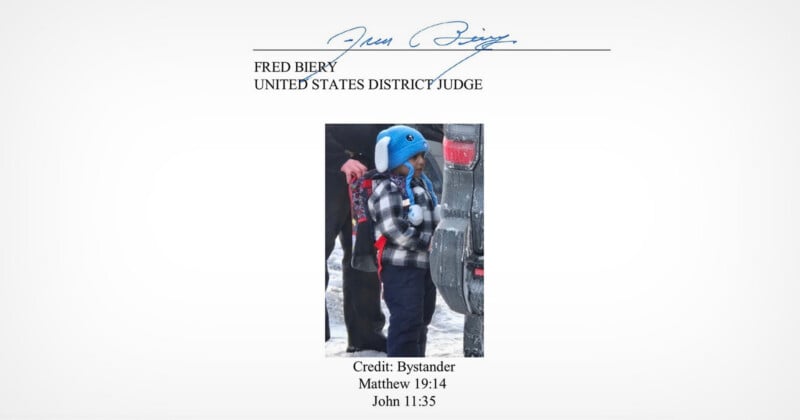
A sharply worded judicial Order to release a 5-year-old boy and his father from a federal immigration detention center includes a color photo of the child.
Publishing a photo like this in a court ruling is unusual, legal experts say.
On January 31, U.S. District Court Judge Fred Biery in the Western District of Texas issued an Opinion and Order in the case of Liam Conejo Ramos and his father vs federal officials.
The judge added a photo of Liam at the end of his three-page opinion, with photo credit to “Bystander.”
Liam and his father were detained in Columbia Heights, Minnesota, on January 20. The boy’s father, said federal officials, was a target for immigration enforcement. Liam and his father were sent to a federal detention facility in Texas.
U.S. Rep. Joaquin Castro (D-Texas) picked up the father and son on Saturday night (January 31) and escorted them back to Minnesota, the congressman said.
On the day the boy was detained, a bystander took a widely published photo of Liam wearing a winter hat with bunny ears. Local school officials made the photo available to news outlets along with another photo of Liam with a federal agent.
Kristen Stuenkel of Columbia Heights Public Schools said, “As of Friday, January 30, 2026, Columbia Heights Public Schools officials were given permission by the photographer to identify her no longer as ‘bystander’ but as Ali Daniels.”
 Widely published photo of Liam Conejo Ramos, January 20, 2026 (Ali Daniels courtesy Columbia Heights Public Schools)
Photos Are Rare in Court Rulings
“It is highly unusual for a federal judge to include a photograph in a written opinion or order, particularly a photograph of a minor,” said Mickey H. Osterreicher, General Counsel at the National Press Photographers Association (NPPA).
“As a general matter, judicial orders are expected to rest on legal reasoning and facts established in the record, not on visual or emotive material. When photographs appear in federal court filings, they are typically introduced as exhibits by the parties, authenticated, and expressly referenced in the text. Here, the photograph appears at the end of the order but is not cited, discussed, or relied upon anywhere in the court’s legal analysis. As a result, it has no legal effect on the ruling itself and does not form part of the court’s factual findings or reasoning.”
‘It is highly unusual for a federal judge to include a photograph in a written opinion or order, particularly a photograph of a minor.’
“That said, the inclusion is nonetheless atypical and noteworthy. Because the image is not incorporated into the opinion or tied to an evidentiary purpose, its presence is best understood as illustrative or symbolic rather than adjudicative.”
Thomas Hodson, a former judge and director emeritus of the E.W. Scripps School of Journalism at Ohio University, said, “Don’t know if I have ever seen it before,” referring to similar use of photos in court rulings.
Court Order Criticizes Feds
Judge Biery’s order was critical of federal authorities who detained Liam and his father.
“The case has its genesis in the ill-conceived and incompetently-implemented government pursuit of daily deportation quotas, apparently even if it requires traumatizing children. This Court and others regularly send undocumented people to prison and orders them deported but do so by proper legal procedures,” the judge wrote.
Judge Biery also made the unusual move to include two Bible verses in his court order, cited beneath the photo of Liam:
- Matthew 19:14: “Jesus said, ‘Let the little children come to me, and do not hinder them, for the kingdom of heaven belongs to such as these.’”
- John 11:35: “Jesus wept.”
The Big Picture
On February 1, the National Press Photographers Association (NPPA) posted commentary that said the image of 5-year-old Liam “reminds us of the power of photography.”
“Whatever your view regarding the immigration debate,” said Visual Communication Professor Josh Birnbaum on the NPPA site, “the can’t-look-away photo of Liam puts a face on America’s attempt at mass deportation.”
About the author: Ken Klein lives in Silver Spring, Maryland; he is retired after a career in politics, lobbying, and media, including The Associated Press and Gannett in Florida. Klein is an alumnus of Ohio University and a member of the Dean’s Advisory Council of the Scripps College of Communication. Professionally, he has worked for Fort Myers News-Press (Gannett), The Associated Press (Tallahassee), Senator Bob Graham, and the Outdoor Advertising Association of America (OAAA).






![20 Years Later, One of the Best Sitcoms of the 21st Century Returns With Hilarious First Look [Exclusive]](https://static0.colliderimages.com/wordpress/wp-content/uploads/2026/02/malcolm-in-the-middle-life-s-still-unfair-feature.jpg?w=1600&h=900&fit=crop)

 English (US) ·