
 3 weeks ago
34
3 weeks ago
34

Published Oct 5, 2026, 3:00 PM EDT
Giovanni Colantonio is a video game journalist who has covered the industry for two decades. He was formerly a senior editor at Digital Trends and has contributed to publications like Inverse, Fanbyte, and Hard Drive. His specialty is criticism, as he’s focused on a modern approach to video game reviews that’s focused on the nuances of how interactivity communicates to players. He is currently a member of the New York Video Game Critics Circle.
I give this feature five stars
 Grand Theft Auto 6Image: Rockstar Games
Sign in to your Polygon.com account
With Grand Theft Auto 6 so close that you can practically taste Leonida’s bog water, I’m starting to reflect on why the GTA series still excites me after decades of playing. It’s easy to write off Rockstar’s series as typical open-world games, but the truth is that GTA is filled with brilliant design decisions that are too easy to take for granted. Case in point: the Wanted system, one of the brightest ideas in a series full of them.
In video games, consequences can be a tricky beast to wrangle. How do you give a player enough agency to create a sense of freedom and expression while still creating a set of rules that are meant to be followed? One solution is to create design guardrails that discourage certain behaviors without preventing players from trying something risky altogether. Sure, you can go straight to the ending of The Blood of Dawnwalker right from the start, but there will be consequences in the form of your ass getting kicked in. For developers, it’s a bit like creating a system of laws.
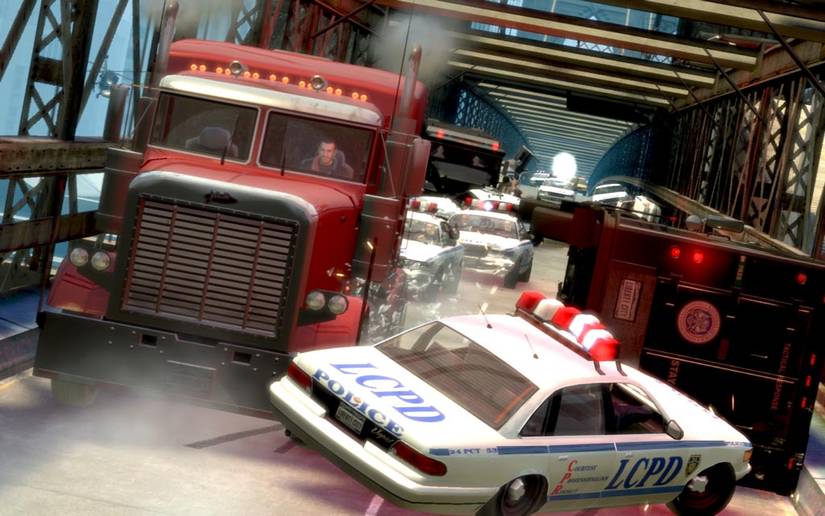 Image: Rockstar Games
GTA’s Wanted system is a smart literalization of that philosophy. The system, which has been baked into the series from the very beginning, gives players a tangible consequence for committing crimes. If you mow down a pedestrian, you’re going to become a criminal in the eyes of the local police force. Get one star and you’ll find yourself trying to outrun a lazy cop who will give up the chase eventually because your misdemeanor isn’t worth it. Reach three stars and you’ll have to evade a more aggressive fleet of aggressive cops. Five stars? Say your prayers.
That system has always been the appeal of GTA to me, right alongside its cheat codes. Whenever I play, I pride myself on how expertly I can ride the Wanted level. What can I get away with without getting the fuzz on my tail? How quickly can I shake off one star with clean driving? Can I cause enough damage to reach five stars without getting gunned down like Sonny Corleone? That’s the game.
The Wanted system feels like it’s letting you peek behind the curtain; it shows you the backend magic that’s usually invisible to players. For every action in GTA, there’s a tangible consequence. You can see that logic play out in front of you when you sidewipe a car and watch a star light up. A fundamental pleasure of GTA is that it’s a testing ground for experiments with a game’s design. You get to see what you can — and can’t — get away with every time you break one of the game’s laws.
Perhaps that’s why GTA resonates so much with players who grew up playing it. I was still a young student during the PS2 glory days, and I saw school as a way to test my relationship to authority. How much could I disobey a teacher without getting detention? What pranks could I get away with undetected? Sometimes, my friends would push that too far and end up in serious trouble, something that taught everyone in the class a good lesson about how much is too much. That only really worked as a formative experience because there were rules to be bent and proper consequences to be earned for playing stupid games.
 Free sign-up
Get Polygon’s Wishlister newsletter
A weekly cheat sheet to what you’ll eventually love to play. No buying, no commitment — just saving for later.
Sign up freeFree. Unsubscribe anytime.
GTA felt like an extension of that concept as a kid. It took that idea to a space that always made its own rules and consequences clear. To play a GTA game is to test your relationship to authority, and learn how to be a digital rebel without going too far. It’s all about heinous crimes in GTA’s power fantasy, but the takeaways I pulled from the series were never about violence. The Wanted system taught me something about standing up to the powers that be and disobeying the status quo in careful ways.
I’m still not sure if GTA 6, with its six-star Wanted system, is going to have the same impact on me as GTA 3 did in 2001. I’m older and wiser now, having learned a lot of these lessons that inspired me to push the envelope as a kid. But I still think I’m going to learn a lot about myself from engaging with the latest incarnation of that system from that place. Has age turned me into a complacent rule-follower who is scared to challenge the establishment, or do I still have a five-star rebel streak? I think I’ll find out come November.








 English (US) ·