
 3 weeks ago
27
3 weeks ago
27
In the quiet villages of North Bengal, when the heat of summer hangs heavy in the air and the fields wait for rain, something ancient wakes up. Drums start thumping. Metal plates clash. Wooden masks—bold, fierce, almost supernatural—come out of hiding. This is Gomira, a ritual masked dance that isn’t just performed, but experienced. It’s loud, raw, chaotic, spiritual, and deeply human all at once.
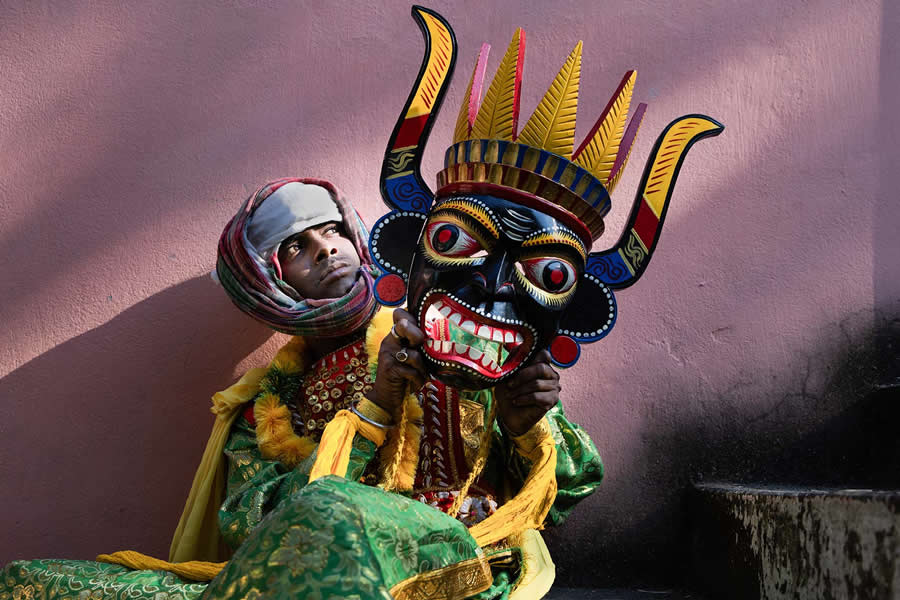
Gomira isn’t stage art. It doesn’t care about perfection or applause. This is about belief. About invoking Adya Shakti, the primordial feminine energy, through movement, rhythm, and masks known locally as mukha. When dancers put on these masks, they’re no longer just villagers—they become vessels. The line between performer and deity blurs. What you’re watching isn’t choreography; it’s possession, devotion, and release.
Held between Chaitra Sankranti (April) and the Ashar months (June–July), Gomira has no fixed calendar. Each village decides its own moment. Each troupe carries its own legacy. Once closely tied to Mukha Khel—a more recreational masked performance popular in Cooch Behar and Jalpaiguri—Gomira evolved into something far more ritualistic, surviving while many folk traditions faded into silence.
Photographed in Mahishbathan, Dakshin Dinajpur, this photo story by Anjan Ghosh steps inside that living tradition. His lens doesn’t chase spectacle—it waits for the breath between drumbeats, the sweat beneath the mask, the trance in a dancer’s eyes. These images aren’t about nostalgia. They’re proof that Gomira is still breathing, still dancing, still calling the old gods into the present.
You can find Anjan Ghosh on the web:
#1
#2

#3

#4

#5

Gomira and the Power of the Mask
At the heart of Gomira is the mask, or mukha—hand-carved from the Gamhar (Gmelina arborea) tree, heavy with symbolism and sacred weight. These aren’t props you hang on a wall. Each mask represents a force: Chamunda Kali, Smashan Kali, Narsingha, spirits, demons, animals, and cosmic guardians. Once worn, the mask is believed to transfer power to the dancer. You don’t act the role—you become it.
There are strict rules around certain masks, especially Kali. Not everyone can wear them. Not every night is allowed. The villagers believe mistakes here aren’t just cultural errors—they’re spiritual risks. The result is intensity you can feel in your chest. The dancer moves wildly, unpredictably, driven by drumbeats and belief. This is ritual theater stripped of polish, powered entirely by faith and fearlessness.
#6

#7

#8

#9

#10

Music, Trance, and the Ritual Rhythm
Gomira doesn’t move without sound. The pounding dhak, the sharp cry of mehan (a local shehnai-style wind instrument), and the clash of kansar (bell-metal plates) create a rhythm that feels primal. It’s repetitive, hypnotic, and designed to push dancers into bhor—a trance state where possession is believed to occur.
There’s no fixed choreography here. The movements are improvised, instinctive, almost explosive. Dancers spin, stomp, leap, and collapse, reacting to sound and spirit rather than counts or cues. Two characters—Bura and Buri, folk manifestations of Shiva and Parvati—enter first, opening the sacred space known as the thaan. Once they arrive, the dance is officially alive. What follows is less performance, more eruption—emotion, devotion, and raw physical release pouring out under open skies.
#11

#12

#13

#14

#15

Myth, Buddhism, and the Roots of Gomira
Look closely at Gomira masks and you’ll spot something fascinating—echoes of Mahayana Buddhism, layered seamlessly with Hindu Shiv–Shakti philosophy. This blend isn’t accidental. Over centuries, belief systems merged, adapted, and survived together. Kali-centric deities dominate Gomira, each mask shaped with exaggerated expressions, wide eyes, and fierce teeth—visual language meant to command both fear and reverence.
The word Gomira itself remains a mystery. Some link it to Gram Chandi, others to Bodo linguistic roots, while another theory connects it to Gambhira, a regional performance form. The most grounded answer? The Gamhar tree itself—the literal source of the masks. Like the dance, the name resists a single definition. It belongs to many histories at once, carried forward not by textbooks, but by people who refuse to let it disappear.
#16

#17

#18

#19

#20

Anjan Ghosh: Witnessing a Living Tradition
Anjan Ghosh doesn’t photograph Gomira as an outsider hunting spectacle. His work comes from long-term trust, patience, and presence. Based in Kolkata, Anjan has spent years documenting rural Bengal—its rituals, labor, silences, and strength. His images of Gomira feel intimate because they are. He stands close, waits longer, and lets moments unfold instead of forcing them.
From international exhibitions across Europe and Asia to features in National Geographic, Adobe Creative Cloud, and 121Clicks, Anjan’s journey is rooted in empathy. His camera becomes a bridge between fading traditions and modern eyes. This photo story isn’t about freezing Gomira in time—it’s about honoring it while it still moves, sweats, and breathes in real villages, performed by real people who believe deeply in its power.
#21

#22

#23

#24

#25

In Summary
What is Gomira dance?
- Gomira is a ritual masked folk dance from North Bengal, rooted in Shakta worship and performed to invoke protective deities.
Where is Gomira traditionally performed?
- Primarily in the Dinajpur region, including Dakshin Dinajpur, with village-specific troupes and timings.
What do the masks symbolize in Gomira?
- Each wooden mask represents a deity, spirit, animal, or demon, believed to transfer spiritual power to the dancer.
When does the Gomira festival take place?
- Usually between April and July, with no fixed date—each village chooses its own time.
Why is Gomira culturally important today?
- It preserves living folk belief systems, ritual practices, and community identity in a rapidly modernizing world.






![20 Years Later, One of the Best Sitcoms of the 21st Century Returns With Hilarious First Look [Exclusive]](https://static0.colliderimages.com/wordpress/wp-content/uploads/2026/02/malcolm-in-the-middle-life-s-still-unfair-feature.jpg?w=1600&h=900&fit=crop)

 English (US) ·