
 3 weeks ago
45
3 weeks ago
45
GMKtec already has an AMD Strix Halo mini PC in its stables, in the form of the Evo-X2. Now, just six months later, we have another AMD Ryzen AI Max+ 395 processor-packing mini PC from GMKtec in the labs. The obvious difference is that the Evo-X3 has a brand new chassis and cooling design, it also comes with 128GB of LPDDR5X-8000 as standard. Those are welcome changes. Half a year later, though, the price has basically doubled as seemingly every electronics product with RAM and NAND chips inside has been affected by the ongoing component shortage.
The result is a desirable computer that will offer strong appeal to enthusiasts who want machines with a large pool of fast, unified RAM, in a competently revamped case. But you will have to have quite a compelling reason to part with the $3,799.99 our 128GB/2TB configuration costs in mid-2026.
Design of the GMKtec Evo-X3 AI Mini PC
Image 1 of 5
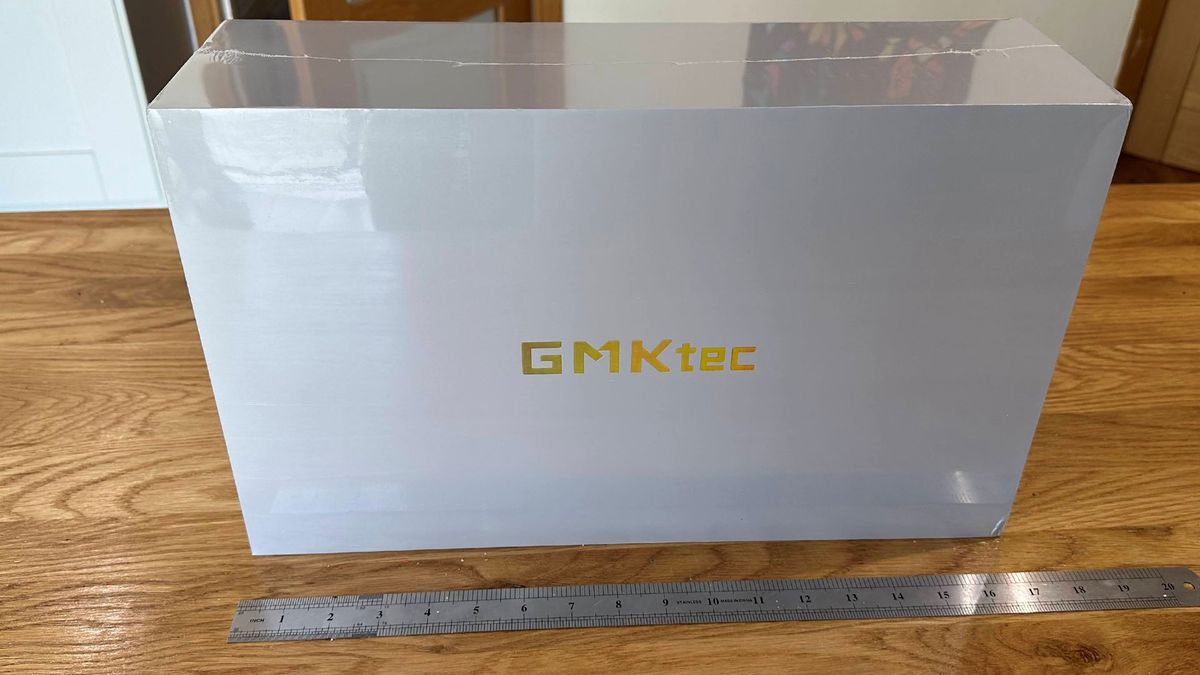
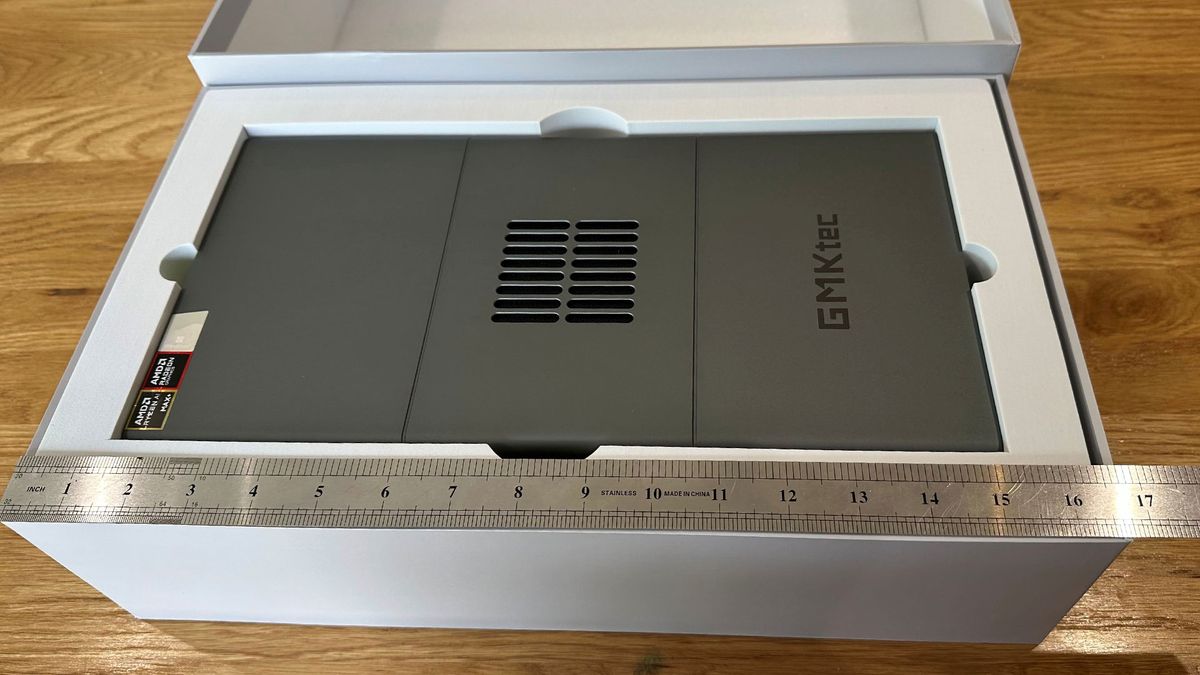
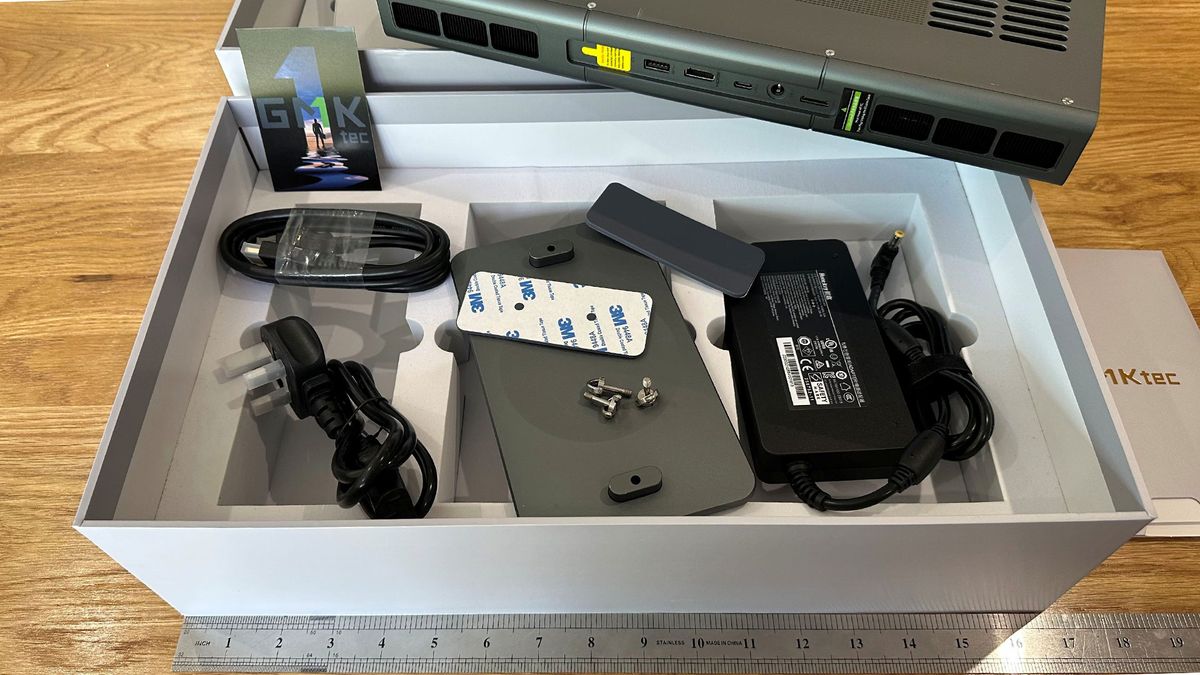
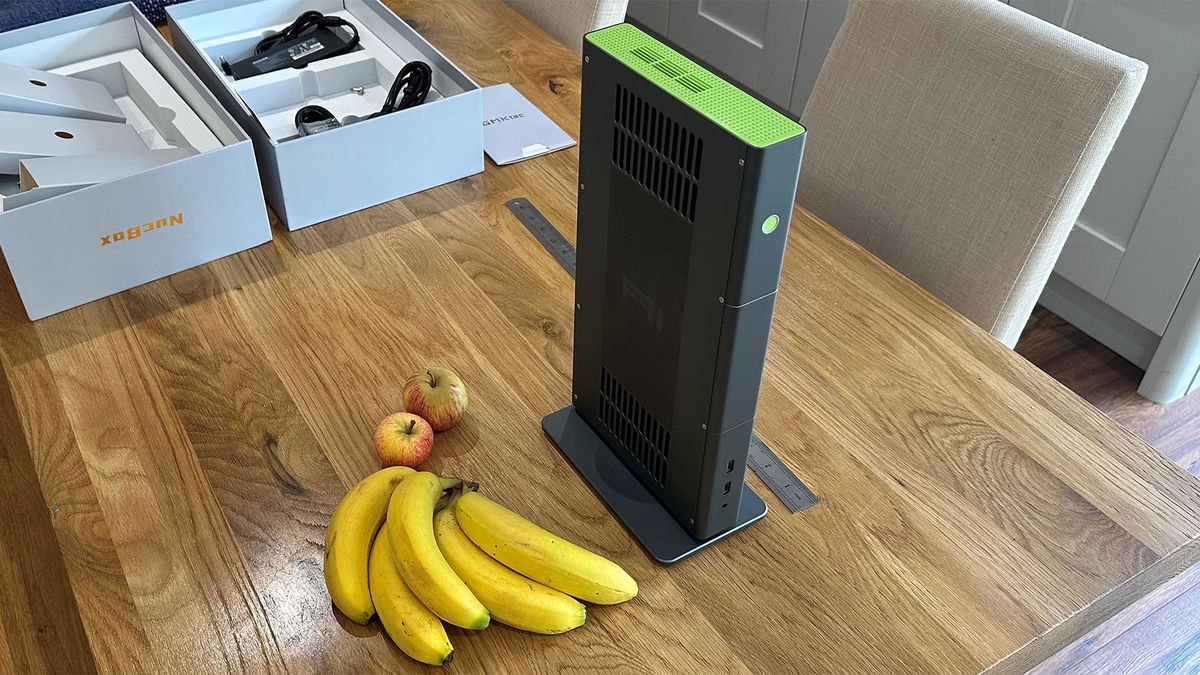
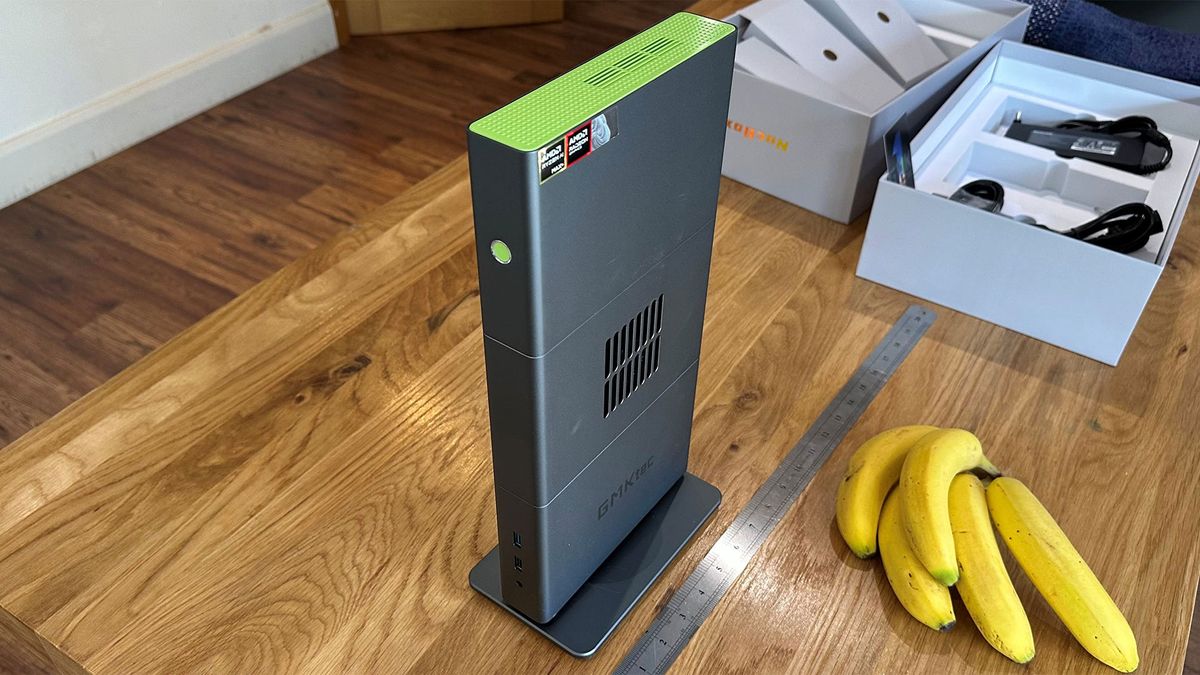
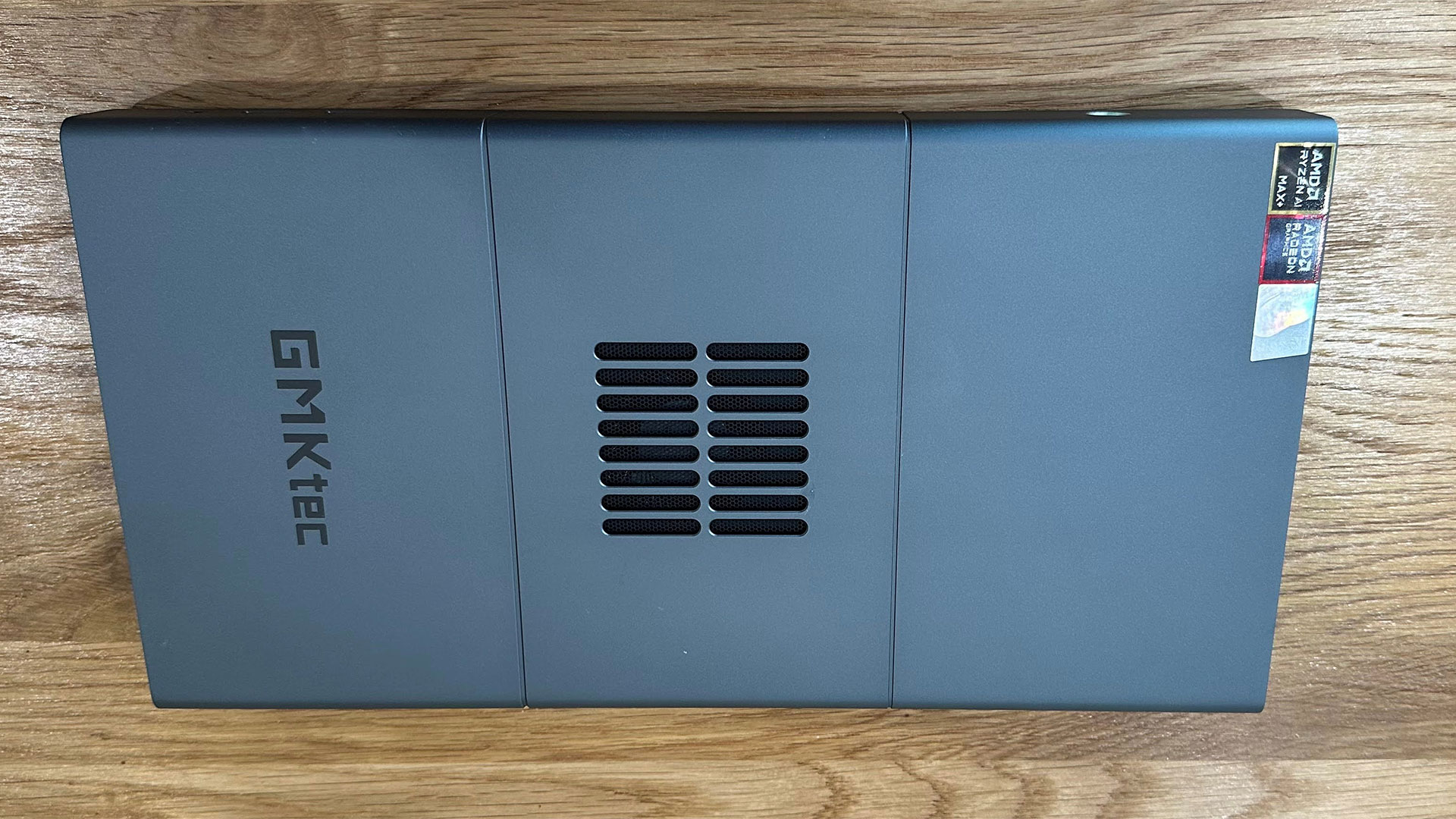
GMKtec has thoroughly revamped its Evo-X family with the new X3. Gone is the short-but-stout design, where we saw a plastic inner case sandwiched by some brushed aluminum. Now GMKtec has gone almost entirely metal, with the exception of a textured and vented soft-touch green plastic cap. This towering new design, which is over 14-inches tall with the base attached, features a metal CNC chassis. That body feels very strong, the panels seem thick, and the base is made from a matching material. Where the mini PC meets the desk, there’s a pair of broad padded rubberized feet that you stick on after unpacking and fixing the metal base on the device.
Latest Videos FromTom's Hardware
While still in mini PC territory, the Evo-T3 is pushing it a bit at roughly 2.7 liters. Its flat base is about 4-inches wide, which helps it stay very stable on the desk. There are no side feet, which makes running it on its side inadvisible. Users will also have to hide away the large power brick if they are after the cleanest minimal workspace.
GMKtec Evo-X3 specifications
Swipe to scroll horizontally
Processor |
AMD Ryzen AI Max+ 395 (16C/32T), up to 5.1 GHz , 85W |
Row 0 - Cell 2 |
Graphics |
AMD Radeon 8060S integrated GPU (40 RDNA 3.5 compute units, up to 2.9 GHz) |
Row 1 - Cell 2 |
RAM |
128GB LPDDR5X-8000 RAM (soldered) |
Row 2 - Cell 2 |
Storage |
Dual M.2 2280 PCIe 4.0 x4 NVMe SSD slots (2TB / 4TB options) |
Row 3 - Cell 2 |
Physical Ports |
Front: 2x USB‑A 3.2 Gen 1, 3.5 mm audio. Rear: 1x USB‑A 3.2 Gen 2, 1x USB4 Type‑C (PD 3.0 / DP-alt), 1x HDMI 2.1 , 1x OCuLink PCIe Gen 4 x4, 1x RJ‑45 2.5G LAN, DC‑IN barrel jack |
Row 4 - Cell 2 |
Wireless |
Wi‑Fi 7, Bluetooth 5.4 |
Row 5 - Cell 2 |
Dimensions |
Approx. 14.0 x 7.5 x 1.6-inches (≈ 2.7 L chassis) |
Row 6 - Cell 2 |
Operating System |
Windows 11 Pro, Linux compatible |
Row 7 - Cell 2 |
Price (as configured) |
$3,799.99 (128GB RAM + 2TB SSD) Use code GMKX3DP3 to get 5% off the prices listed on Amazon |
Row 8 - Cell 2 |
Ports and Upgradeability
GMKtec keeps the front of its mini PC simple with just three ports and the power button. In the top third of the tower’s facade, there’s a central green power button with a white LED ring lit when it is powered up. The middle third of the front is left plain, but the lower third has one USB 3.2 Gen 1, one USB 2.0, and a 3.5mm audio combo jack. I wish there was a Type-C port on the front, preferably USB4 or better.
Around the back it has a good variety of ports, but I wouldn’t describe them as numerous. You will find a USB‑A 3.2 Gen 2 port, a USB4 Type‑C (PD 3.0 / DP-alt) port, an HDMI 2.1 port, an OCuLink PCIe Gen 4 ×4 port, an RJ‑45 2.5G LAN port, and a DC‑IN barrel jack. Ideally, I’d like to have a full size DP port, as well as a second USB4 port, plus more USB-A ports. If I were to use this as a daily driver I think I’d need to connect a fast USB docking solution for the oodles of peripherals I like to have ready and connected.
Wireless connectivity seems adequate enough, with an M.2 2230 card inside providing Wi-Fi 7 and Bluetooth 5.4. I had no problems with either during the test period.
Stay On the Cutting Edge: Get the Tom's Hardware Newsletter
Get Tom's Hardware's best news and in-depth reviews, straight to your inbox.
Access to the components inside the GMKtec Evo-X3 is straightforward, but takes time as there are eight Torx-6 screws securing the side panel in place. Once they were all unscrewed I needed to use a guitar pick and a bit of gravity to tilt the heavy panel off. Removing of the panel allowed access to the two M.2 PCIe 4.0 x4 slots, one of which was already populated with a Crucial P310 2TB M.2 NVMe SSD fitted with a slim heatsink. In the opposite corner of the chassis I saw an M.2 2230 socketed MediaTek wireless card. There are no other internal user upgrade or repair options as the 128GB of LPDDR5X-8000 RAM is soldered to the motherboard.
Test System Setup
Swipe to scroll horizontally
System |
Solar Bay |
Steel Nomad |
Speed Way |
AVG - Shadow of the Tomb Raider |
Low - Shadow of the Tomb Raider |
AVG- SD Cyberpunk 2077 |
Low - SD Cyberpunk 2077 |
AVG- High Cyberpunk 2077 |
Low - HighCyberpunk 2077 |
GB6 Single_core |
GB6_MultiCore |
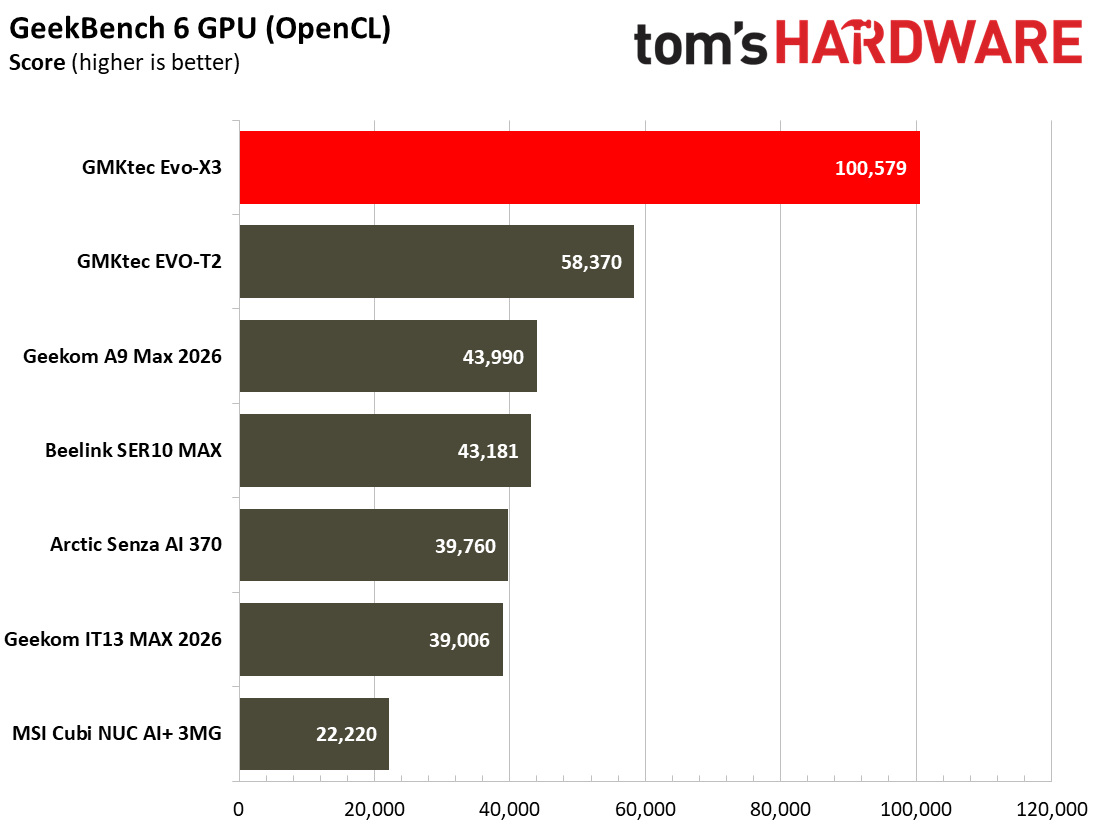
GB6 GPU OpenCL |
GMKtec Evo-T2 |
28,125 |
1,624 |
997 |
90 |
72 |
90 |
74 |
54 |
43 |
2,900 |
15,850 |
58,370 |
MSI Cubi NUC AI+ 3MG |
11,360 |
590 |
444 |
37 |
31 |
38 |
32 |
22 |
18 |
2,800 |
14,200 |
22,220 |
Geekom A9 Max 2026 |
10,230 |
414 |
262 |
26 |
19 |
29 |
24 |
17 |
14 |
2,960 |
12,500 |
43,990 |
Arctic Senza AI 370 |
17,750 |
627 |
613 |
54 |
47 |
56 |
46 |
32 |
27 |
2,830 |
15,110 |
39,760 |
Beelink SER10 MAX |
16,066 |
755 |
533 |
52 |
40 |
51 |
42 |
30 |
25 |
2,978 |
15,551 |
43,181 |
Geekom IT13 Max 2026 |
13,430 |
731 |
389 |
36 |
29 |
36 |
30 |
21 |
19 |
2,506 |
13,066 |
39,006 |
GMKtec Evo-X3 |
50,008 |
2,132 |
2,046 |
138 |
128 |
126 |
95 |
95 |
78 |
2,884 |
19,081 |
100,579 |
Productivity Performance on the GMKtec Evo-X3
GMKtec describes the Evo-X3 as a machine that targets AI workloads, but first we ran through our standard mini PC benchmark comparison suite, which targets more general computing usage.
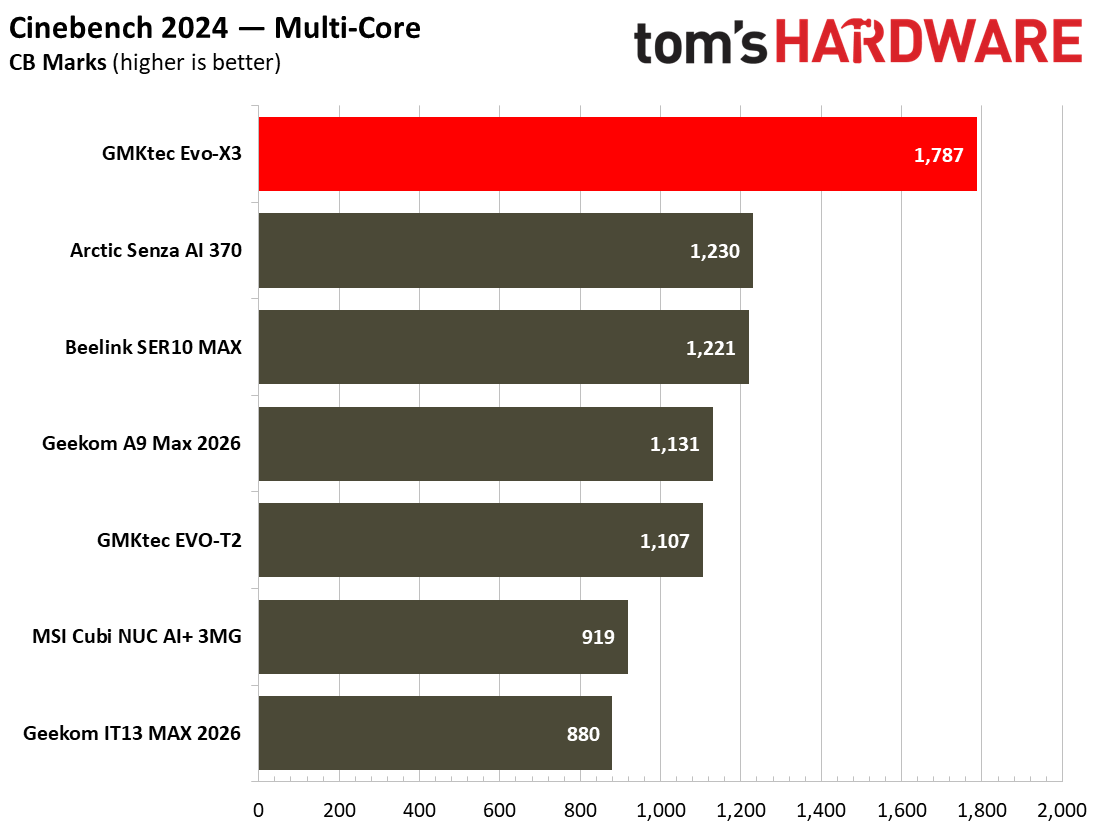
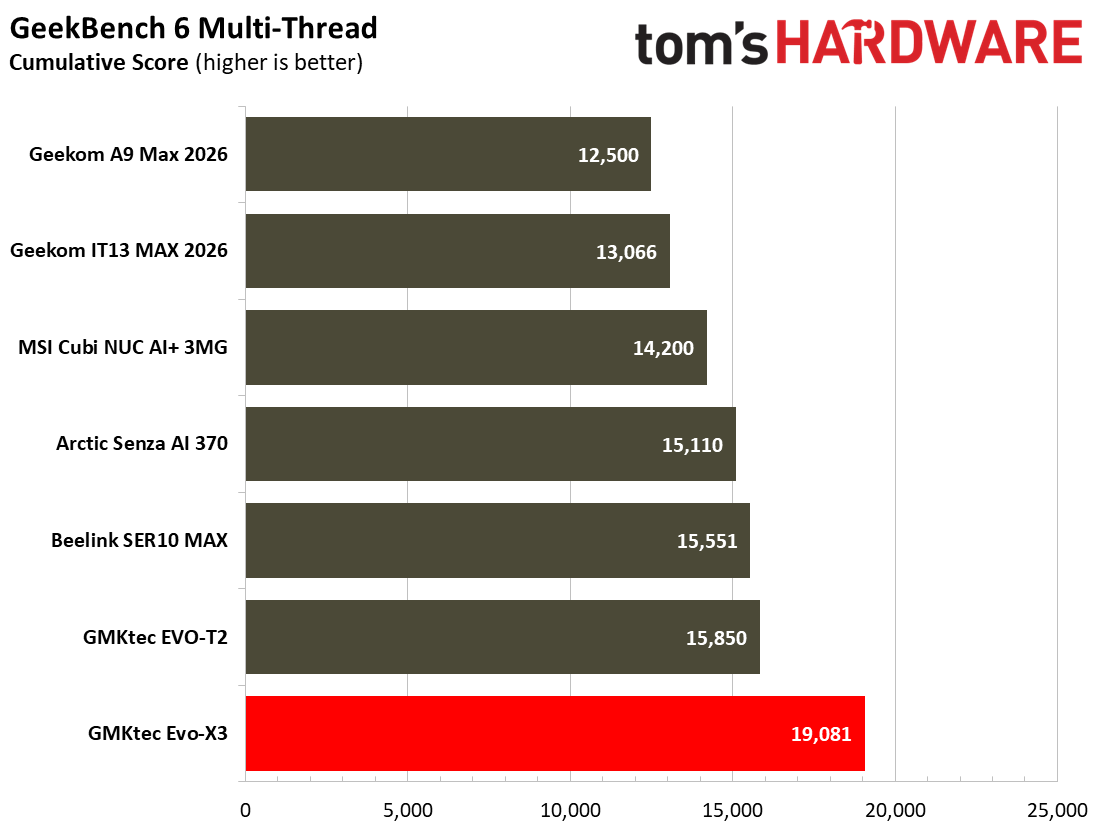
A brief glimpse at the tech specs of the X3 reveals that it has lots of modern fast CPU cores, supported by one of the best iGPUs, and plenty of RAM and storage. It should make light work of our productivity benchmarks, and indeed its 16C/32 core AMD Ryzen AI Max+ 395 CPU left its mini PC rivals eating dust, most strikingly in multi-threaded tests.
Image 1 of 8
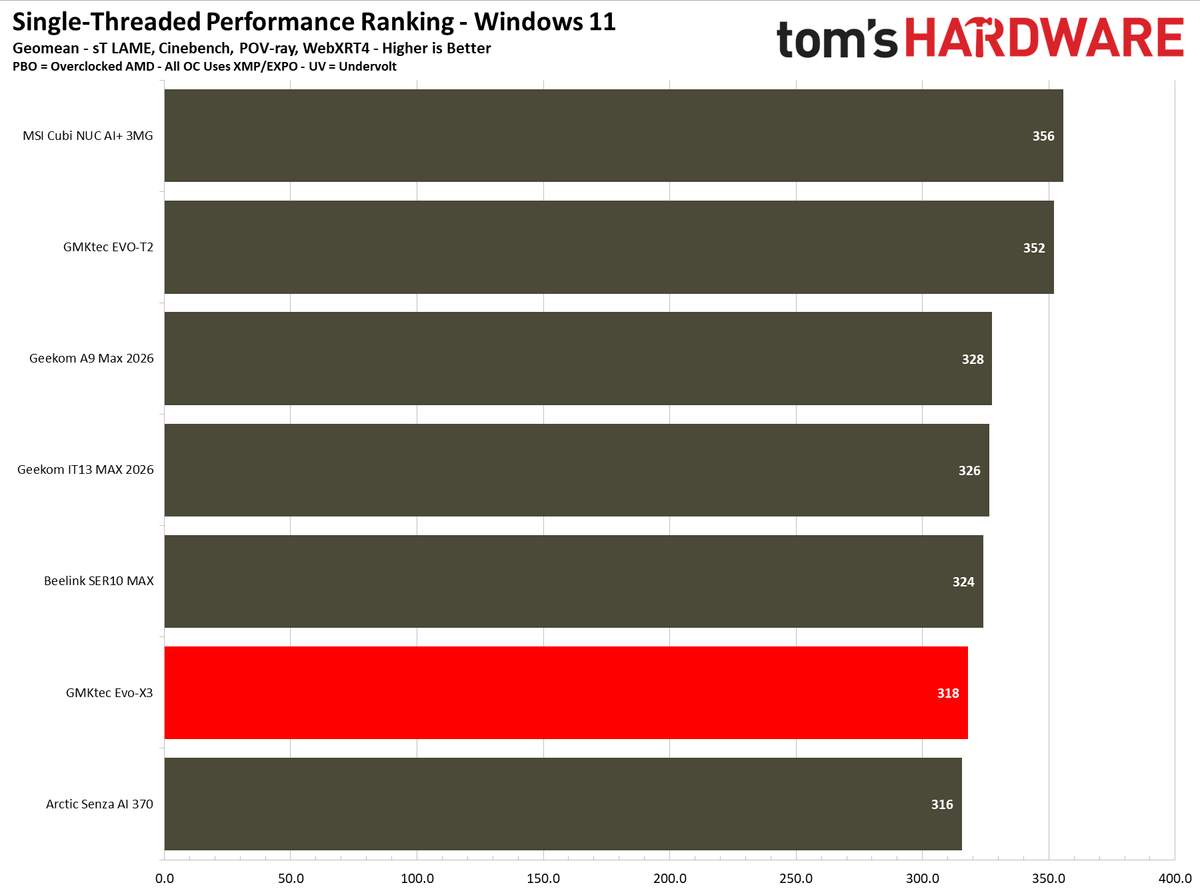
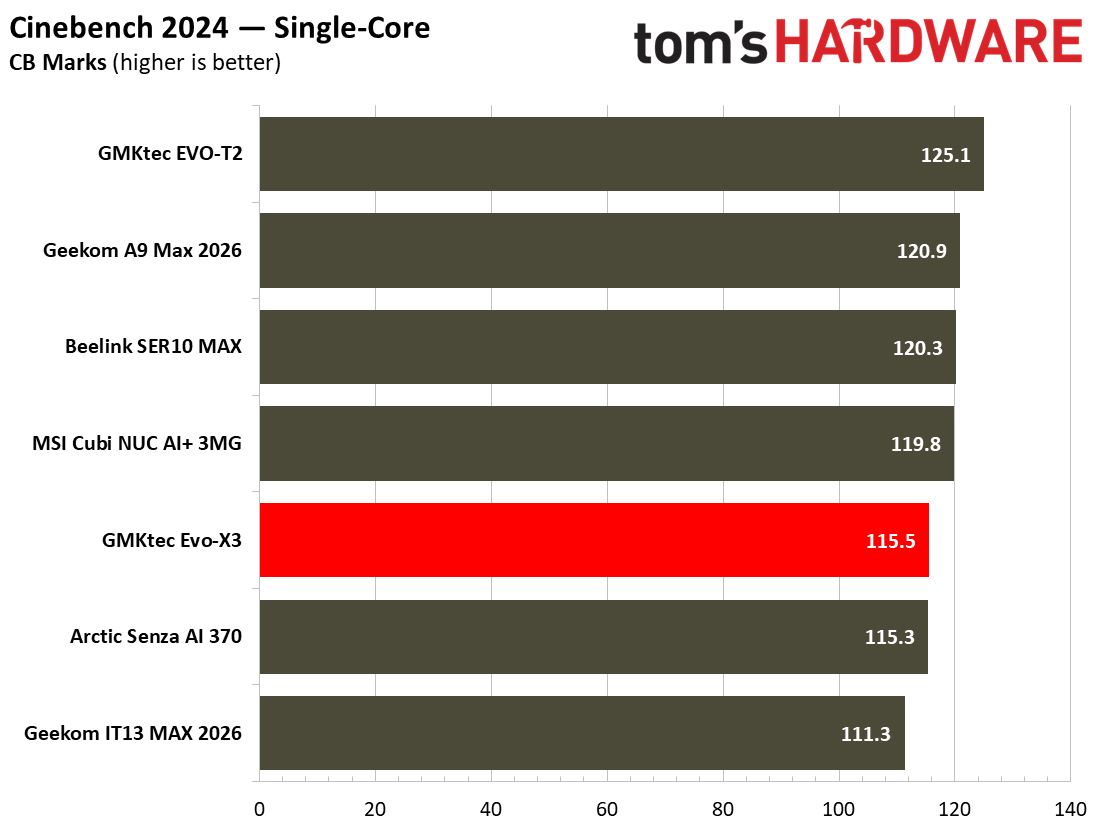
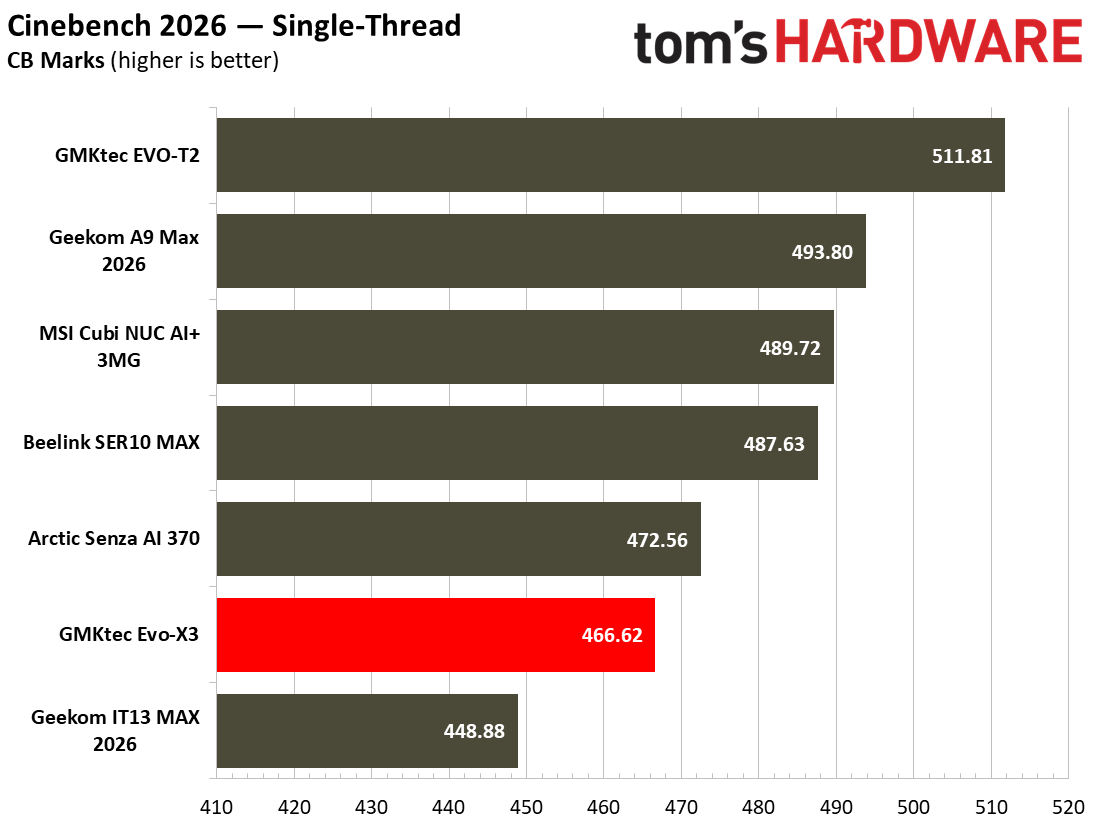
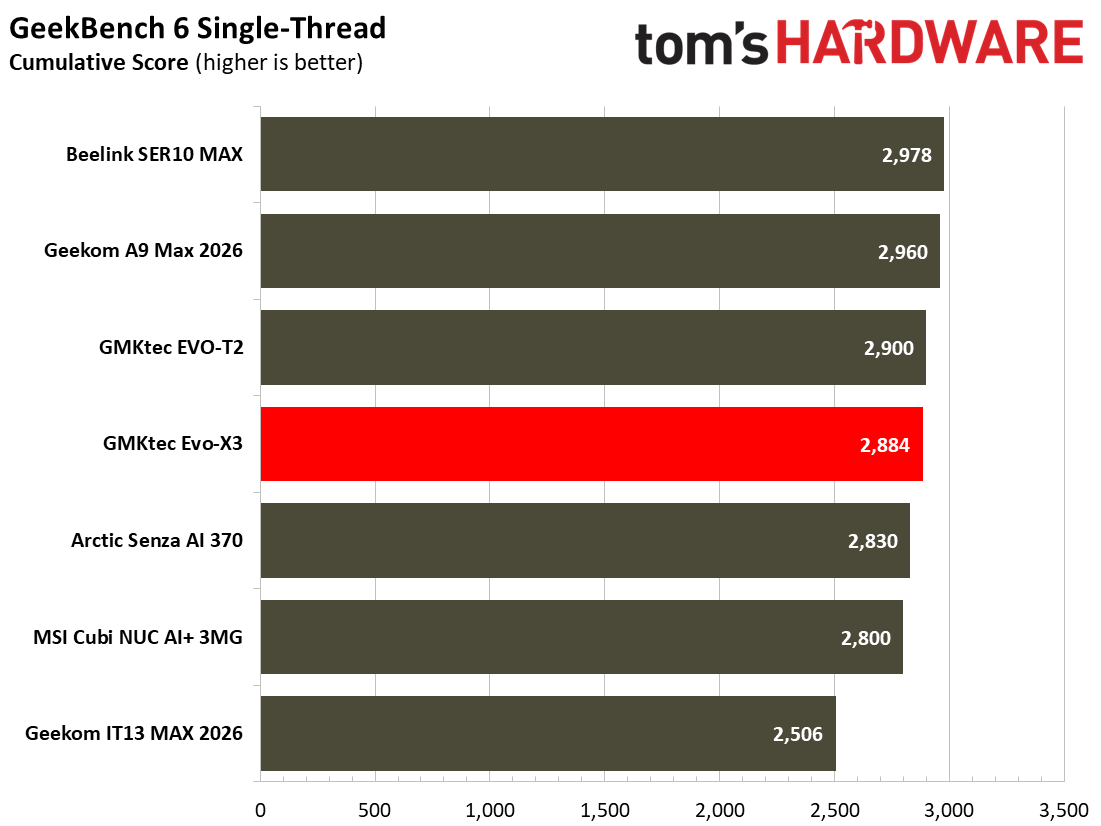
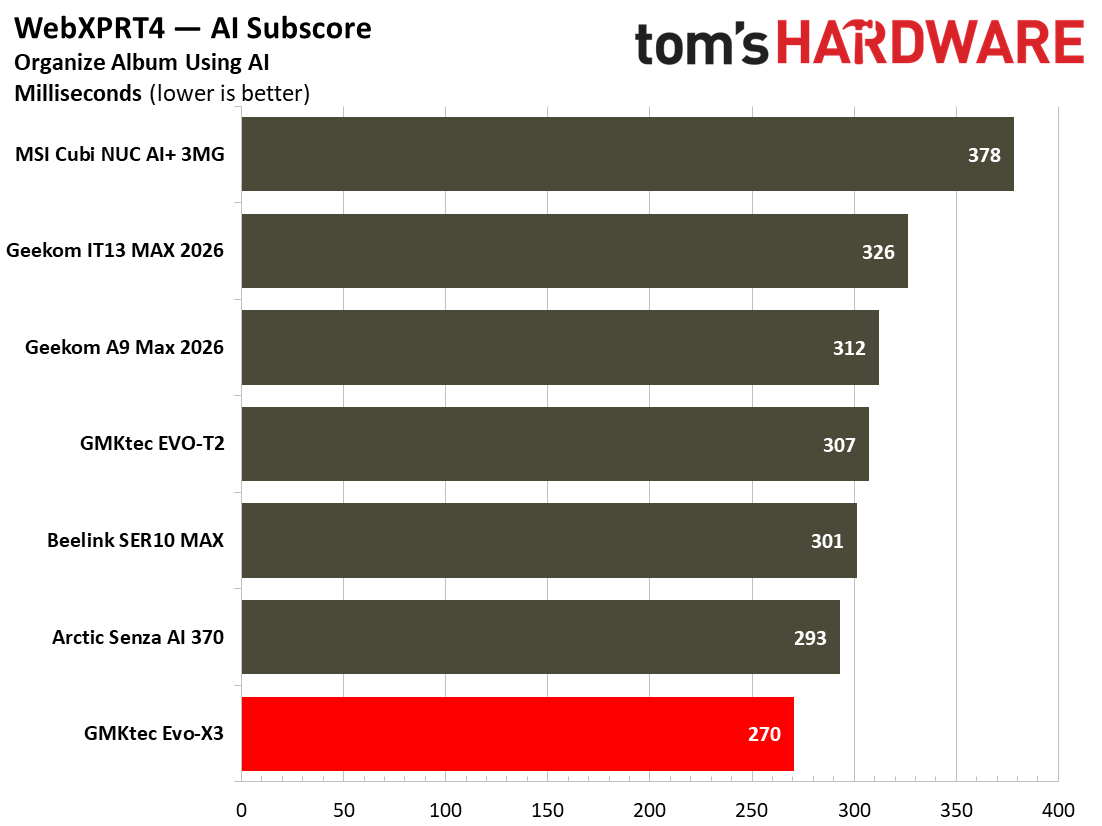
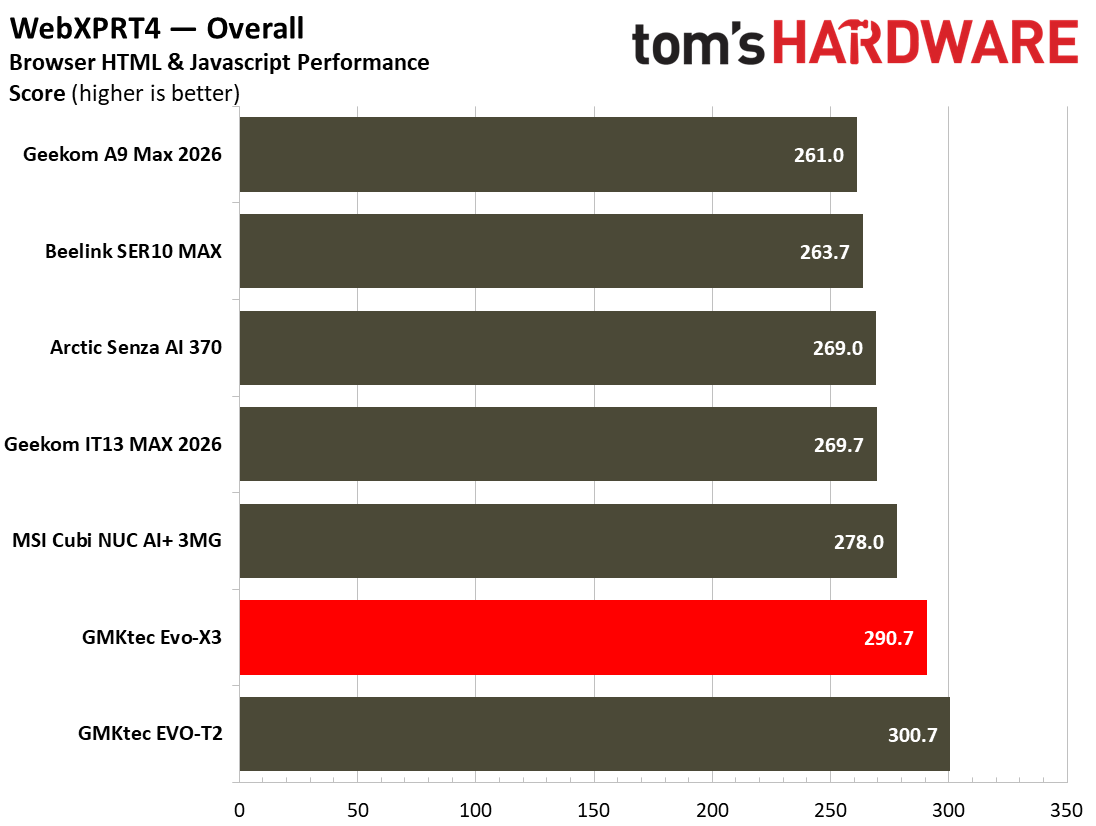
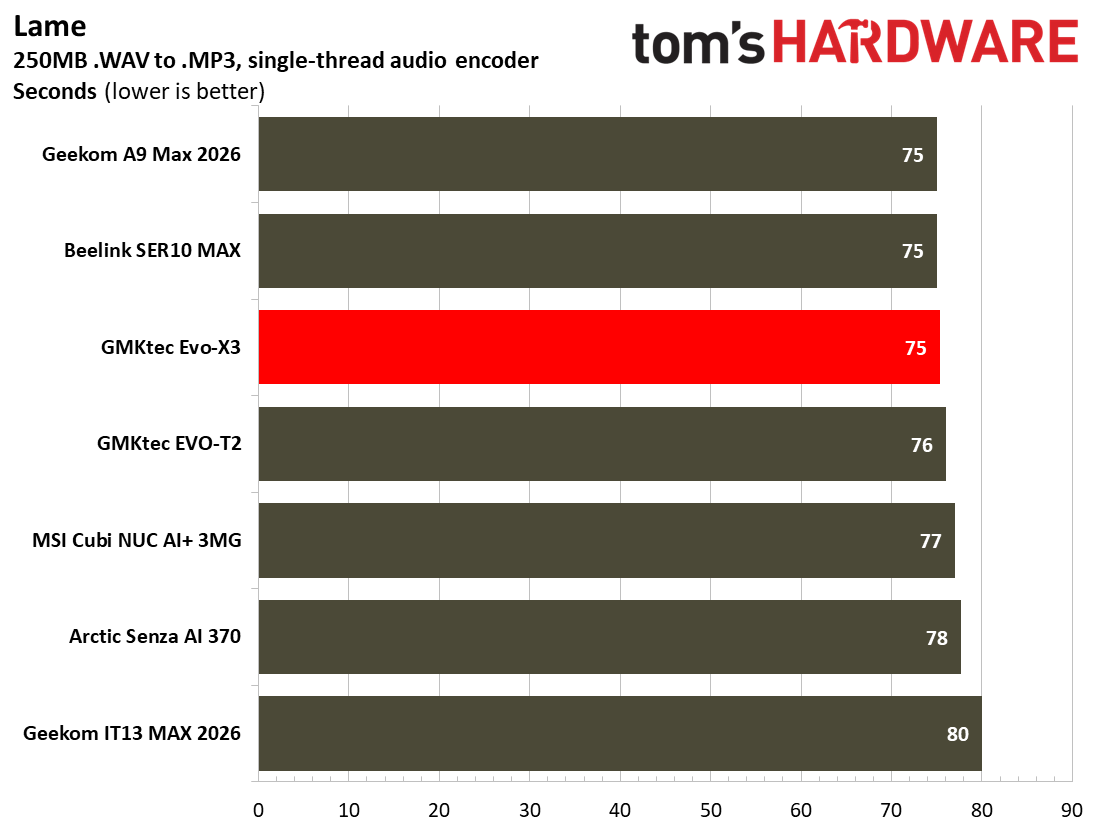
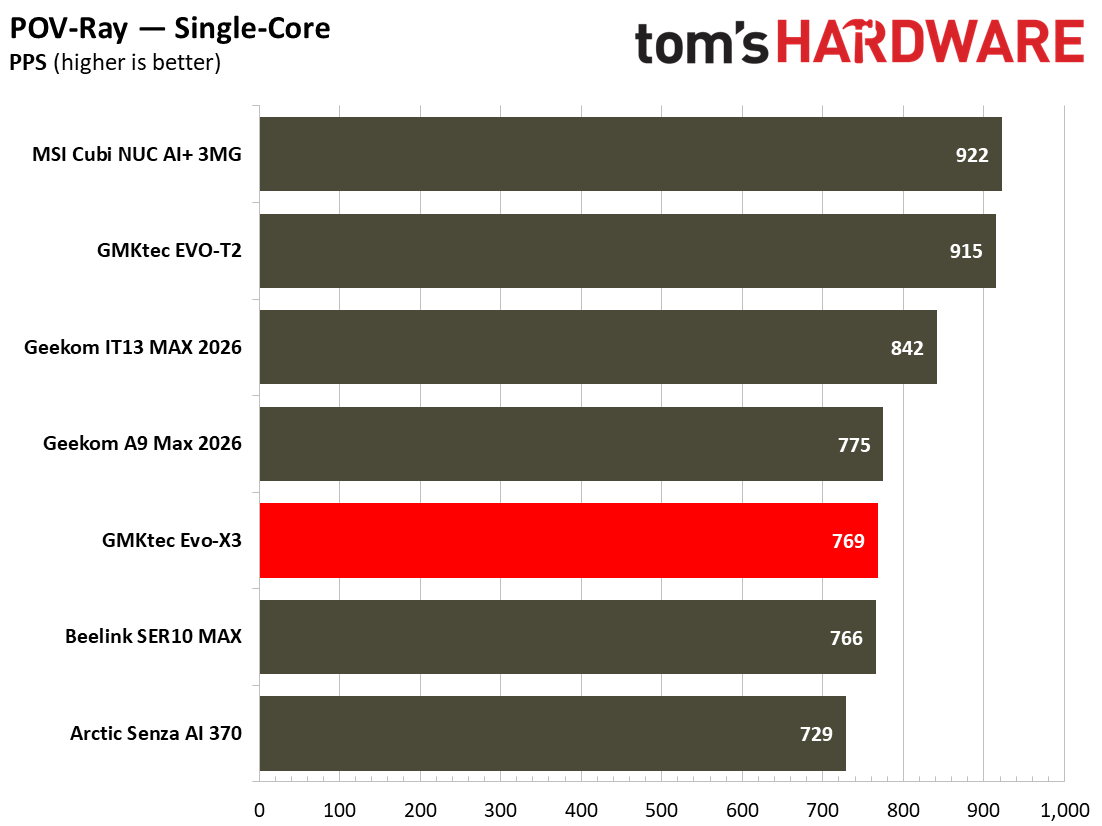
Image 1 of 11
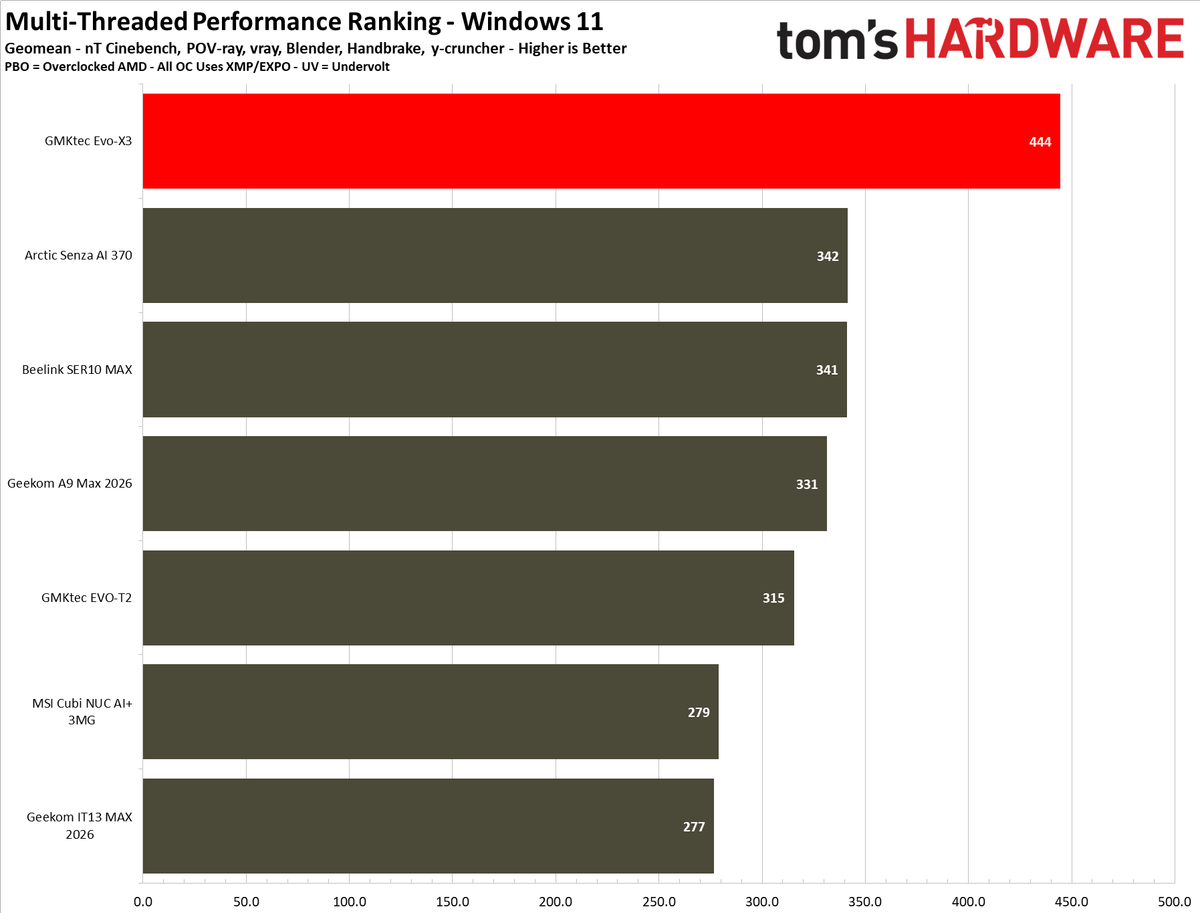
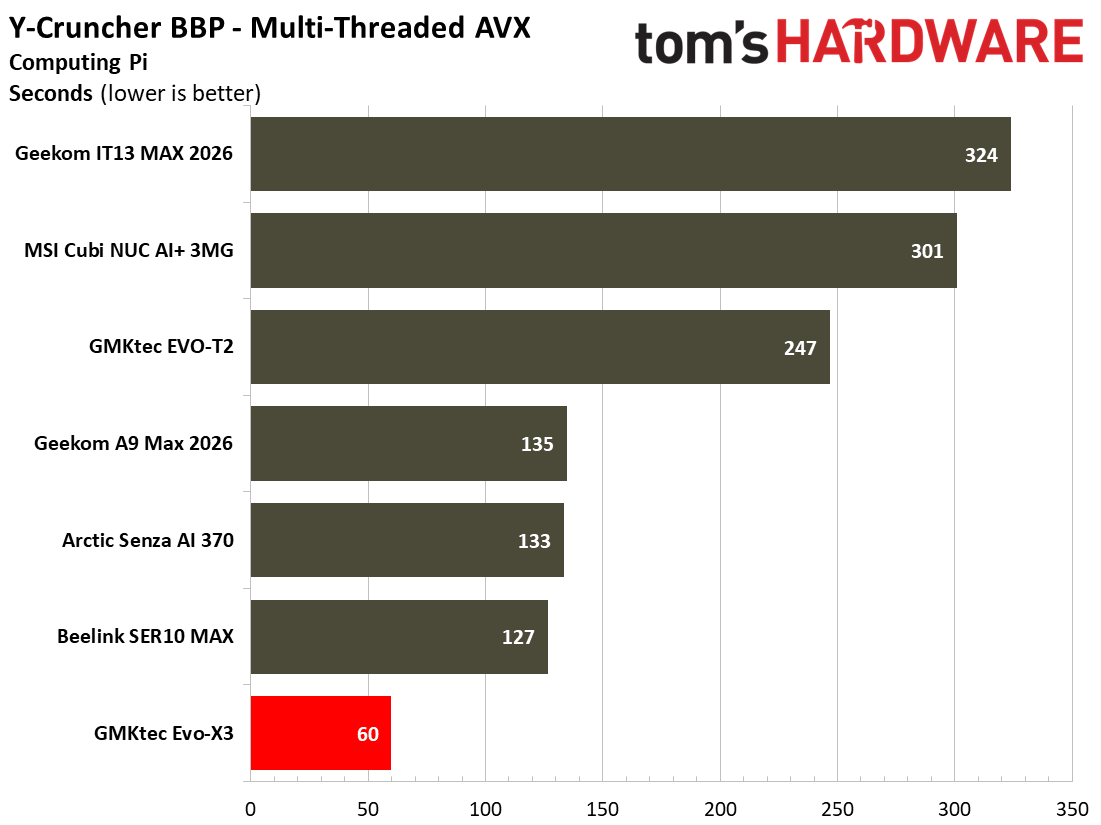
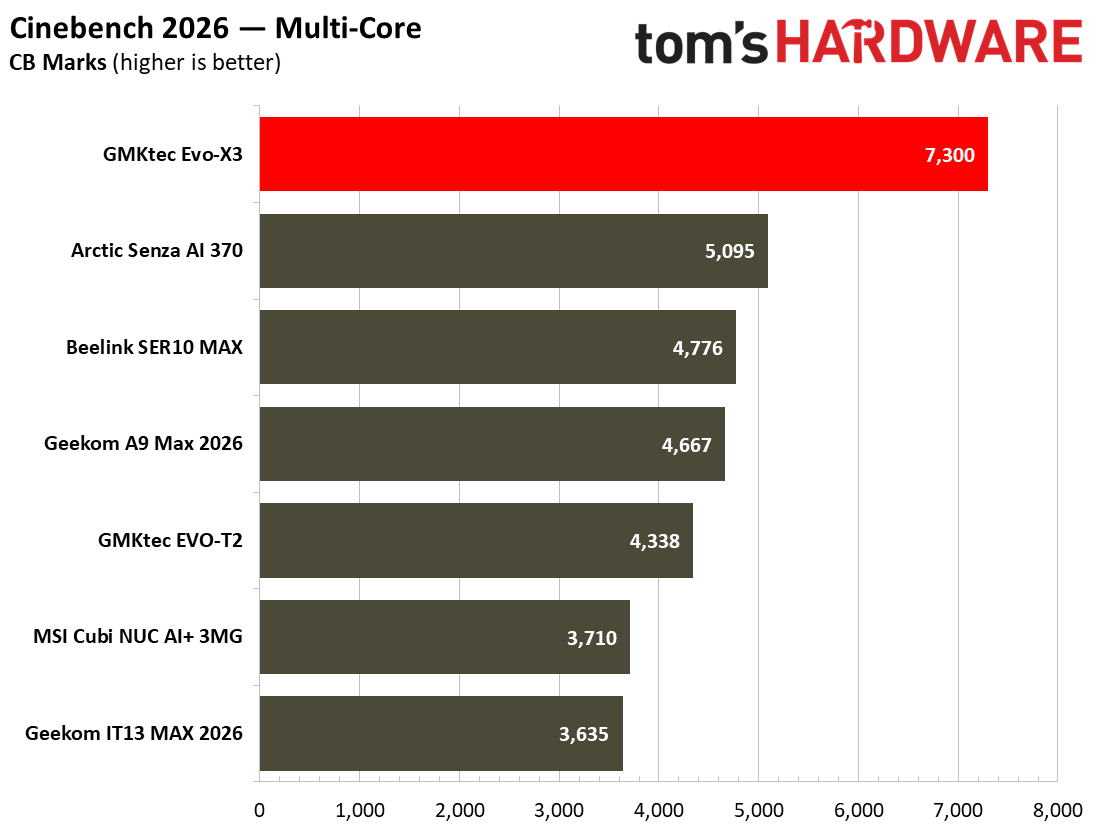
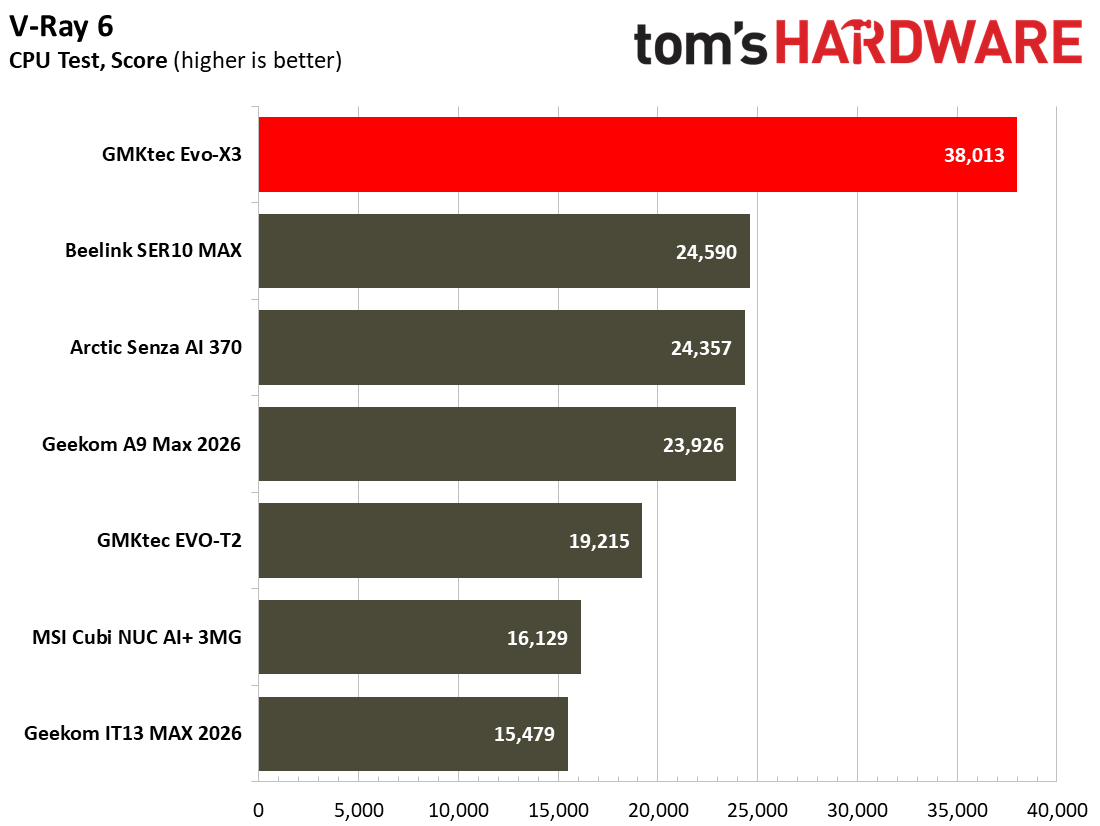
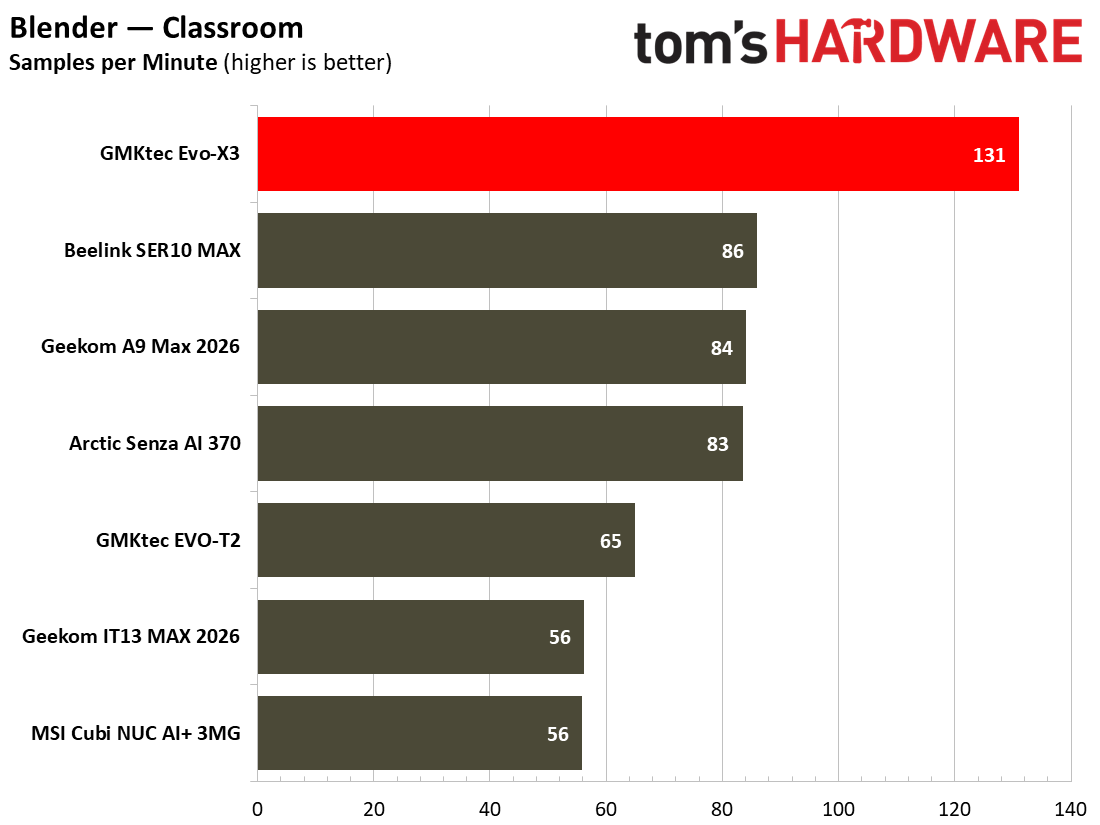
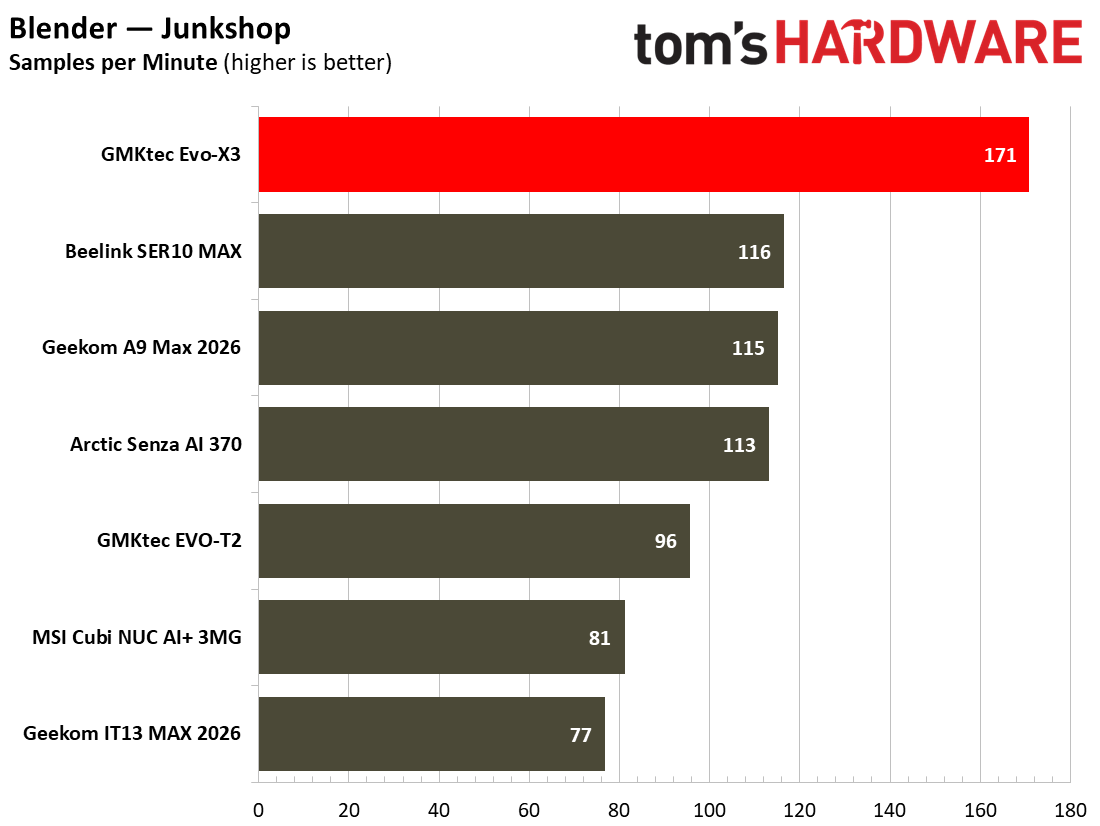
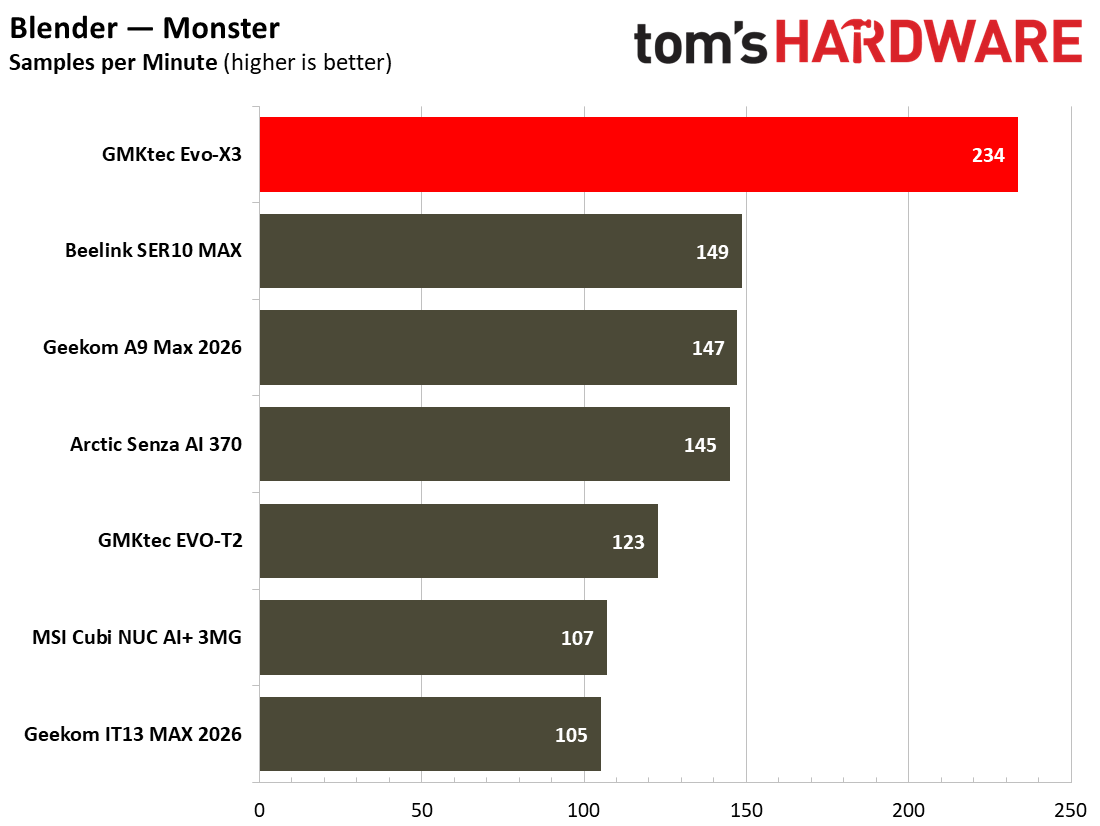
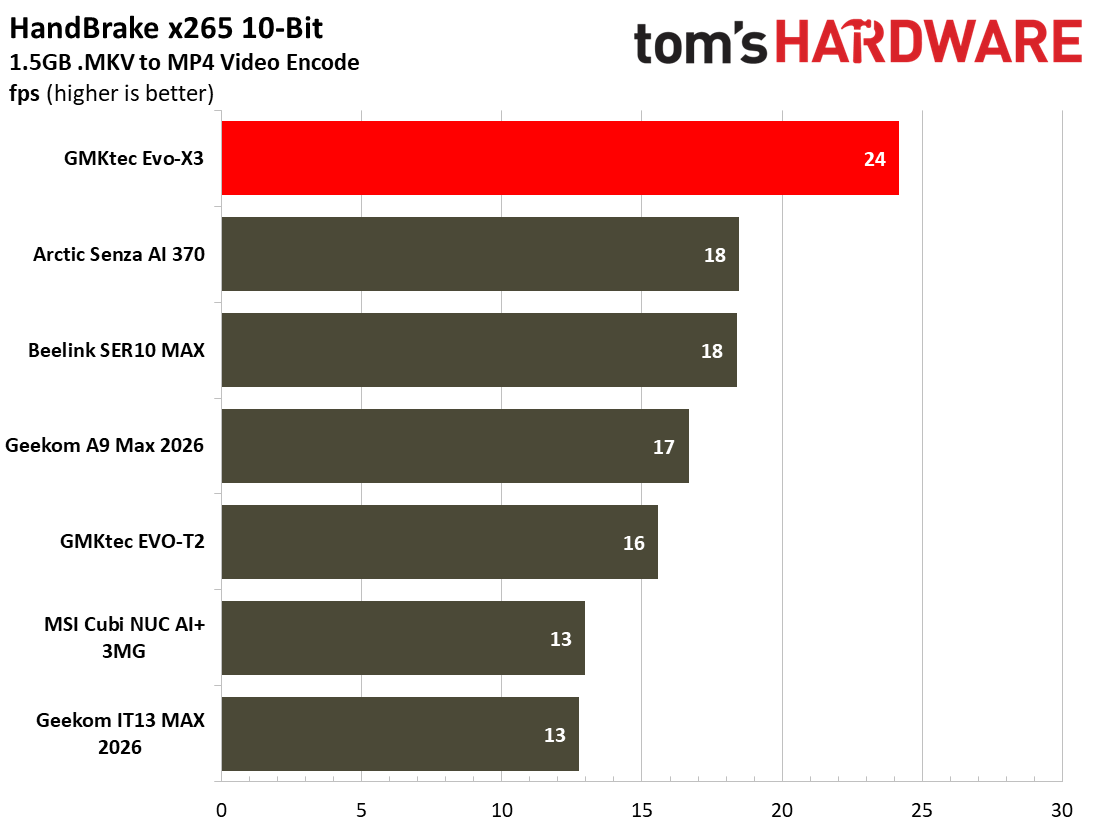
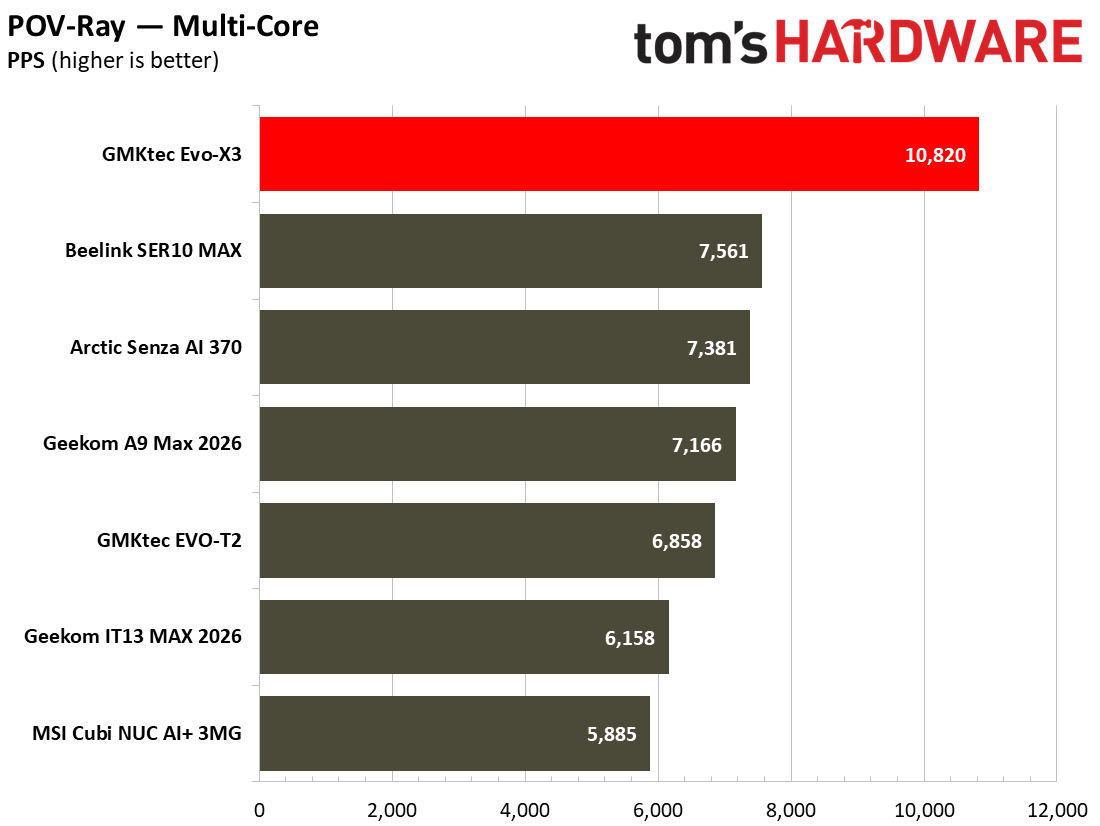
As we expected, the single core tests show the GMKtec Evo-X3 is a competent performer in the context of the competition in our charts. It isn’t the only Zen 5 machine in this race, so it doesn’t get a chance to dazzle yet.
Moving onto the multi-core tests is where the Ryzen AI Max+ 395’s 32 threads show their potential for real-world data crunching performance. For example, in Y-cruncher it completed its Pi compute in around 60 seconds. That’s twice as fast as its nearest competitor in our mini PC charts, the Beelink SER10 Max.
Rendering in Cinebench is also strong. In Cinebench 2026, the X3 scored roughly 7,300 points in multi-core. That’s over 40% faster than its nearest competitor, the Arctic Senza AI 370. Video transcoding performance is also in a new class, with the Evo-X3 crushing the competition, achieving around 24 frames per second.
For some added AI benchmarking stats, we did a few tests in Geekbench AI and LM Studio Bionic to weigh the GMKtec Evo-X3 against the Evo-T2. These are both machines with large unified memory pools by default and which the makers claim to be local LLM champs.
Using Geekbench AI with the ONNX framework and DirectML backend the Evo-X3 achieved a half precision score of ~37,100. On the Evo-T2 using the same options, a score of ~23,060 was achieved.
However, machines like the GMKtec Evo-X3 and T2 might be picked up by consumers to work with local LLMs considerably larger than most consumer GPUs can load. With this in mind, I ran LM Studio Bionic chat sessions powered by the new Qwen3.8 27B Q4_K_M model on both machines. To use this 27 billion parameter model as intended, a machine needs around 20GB of ‘VRAM’ of shared memory to avoid undesirable side effects like out-of-memory errors and slowdowns.
I prompted the same tasks on both machines then analyzed the logs and found prompt processing was pretty similar between the platforms, ranging either side of 200 tok/s. However, the AMD Strix Halo Evo-X3 far outpaced the Panther Lake Evo-T2 by generating responses at up to 28 tok/s, compared with around 8 tok/s at best, respectively. It would be possible to tune these LLM speeds for each machine, but I didn’t tweak settings for the comparison tests. With 128GB of unified memory in the Evo-X3, allowing up to 96GB to be dedicated to the GPU, even larger models can be utilized for the most capable local AI chatbots, agents, generation workloads.
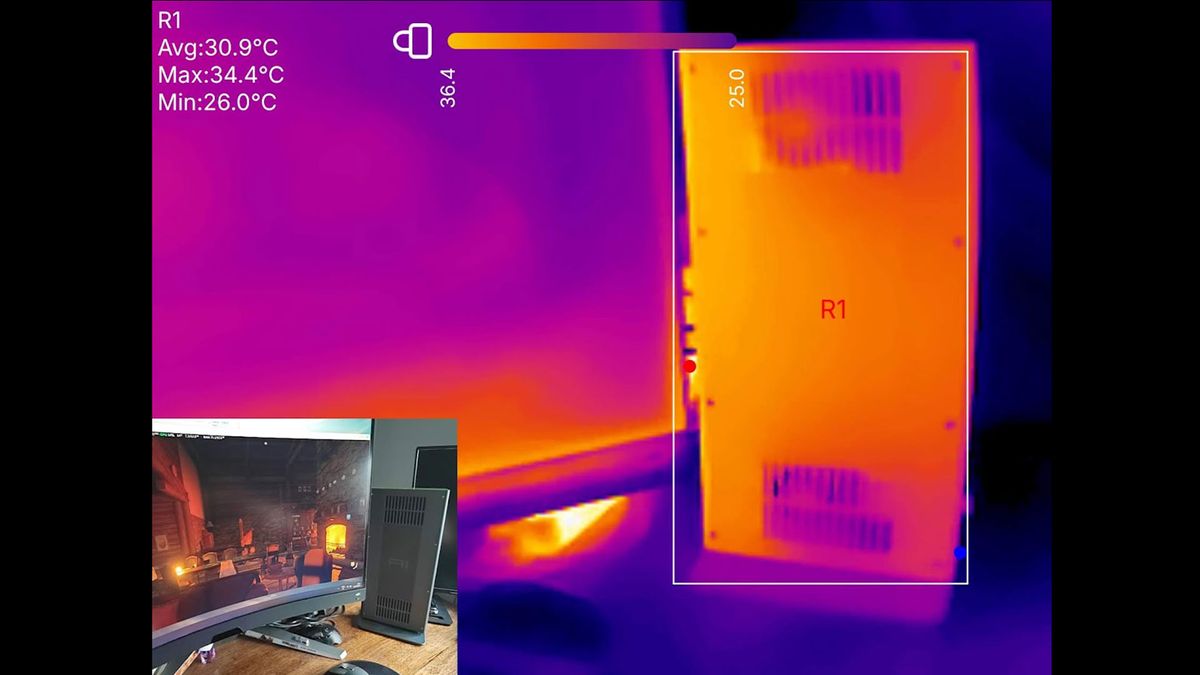
During our demanding tests, the GMKtec Evo-X3 stayed admirably cool and quiet. All our tests were done with the default 85W balanced profile, as the system shipped. Owners can also choose to run this system in Silent Mode (54W) or push it to Performance Mode (peak 140W).
Gaming and Graphics on the GMKtec Evo-X3
The GMKtec Evo-X3 is pretty good at gaming, thanks to its powerful CPU and iGPU with lots of fast memory onboard. Remember, the Ryzen AI Max 395+ has 16 Zen 5 CPU cores with 32 threads, and its Radeon RX 8060S iGPU features 40 CUs and 2,560 shader cores – more CUs than a vanilla PlayStation 5. The capacious LPDDR5X-8000 memory pool has a 256-bit interface.
Before moving onto our standard synthetic and AAA PC gaming tests, I decided to run around in Star Wars Outlaws. I chose the High preset, at 1440p, and kind of enjoyed this game, experiencing a performance level of mostly between 60 and 90 frames per second. The graphics weren't anything special, but I noticed the game was using about 9GB of VRAM which could have meant dips and stutters on systems packing 8GB GPUs and using the same graphics settings. While the CPU usage was mostly under 20%, the iGPU was nearer to 90%.
Image 1 of 2
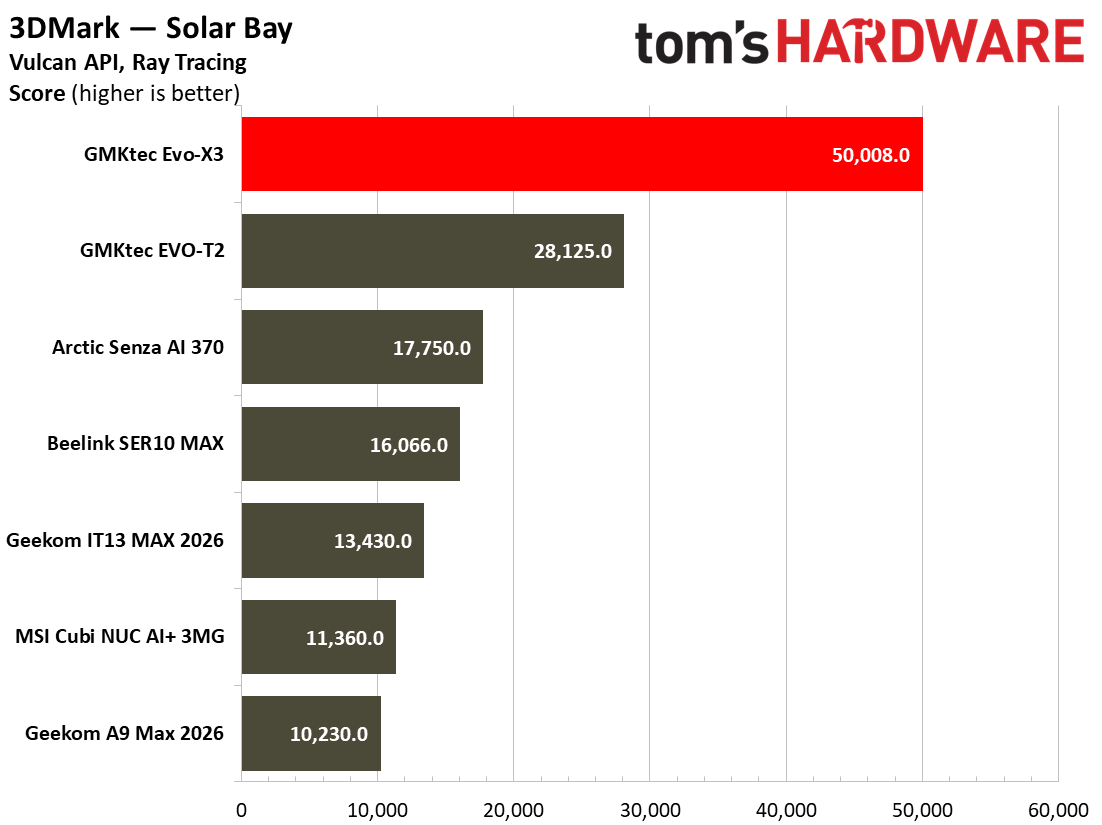
Next up, our benchmarks include a trio of 3DMark synthetics and two iconic PC gaming standards. In the 3DMark Solar Bay test, which seems most appropriate to the mini PCs we have tested in 2026, the Evo-X3 left the competitors in the dust with over 50,000 points. It was almost twice as fast as the Panther Lake B390 iGPU, and about three times as fast as the Radeon 890M machines that came with fast dual-channel RAM (like the aforementioned Arctic and Beelink mini PCs).
In 3DMark Steel Nomad we got a respectable score of 2,132, and the frame rate reached 21 FPS. It was a similar story in 3DMark Speed Way, where the Evo-X3 managed a score of 2,046. For some context this Speed Way result still lags behind my Asus Zephyrus G16 laptop with RTX 4060 Laptop GPU, which scored up to 2,425.
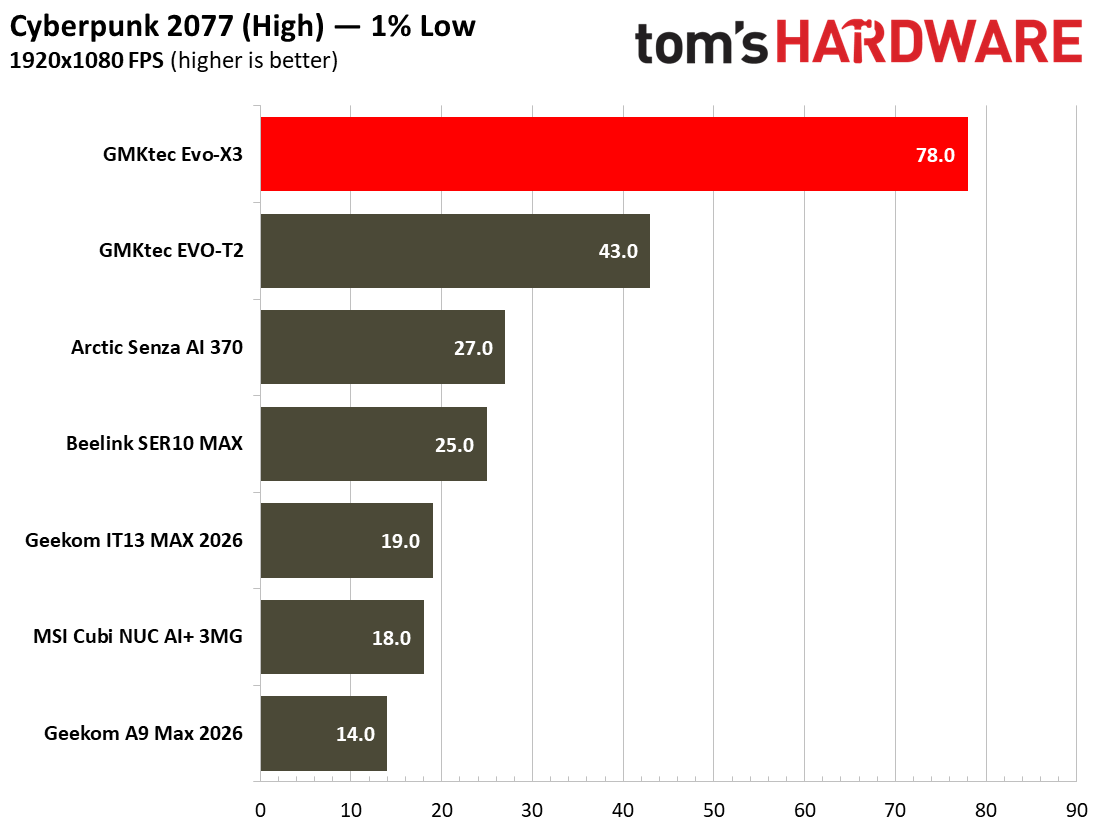
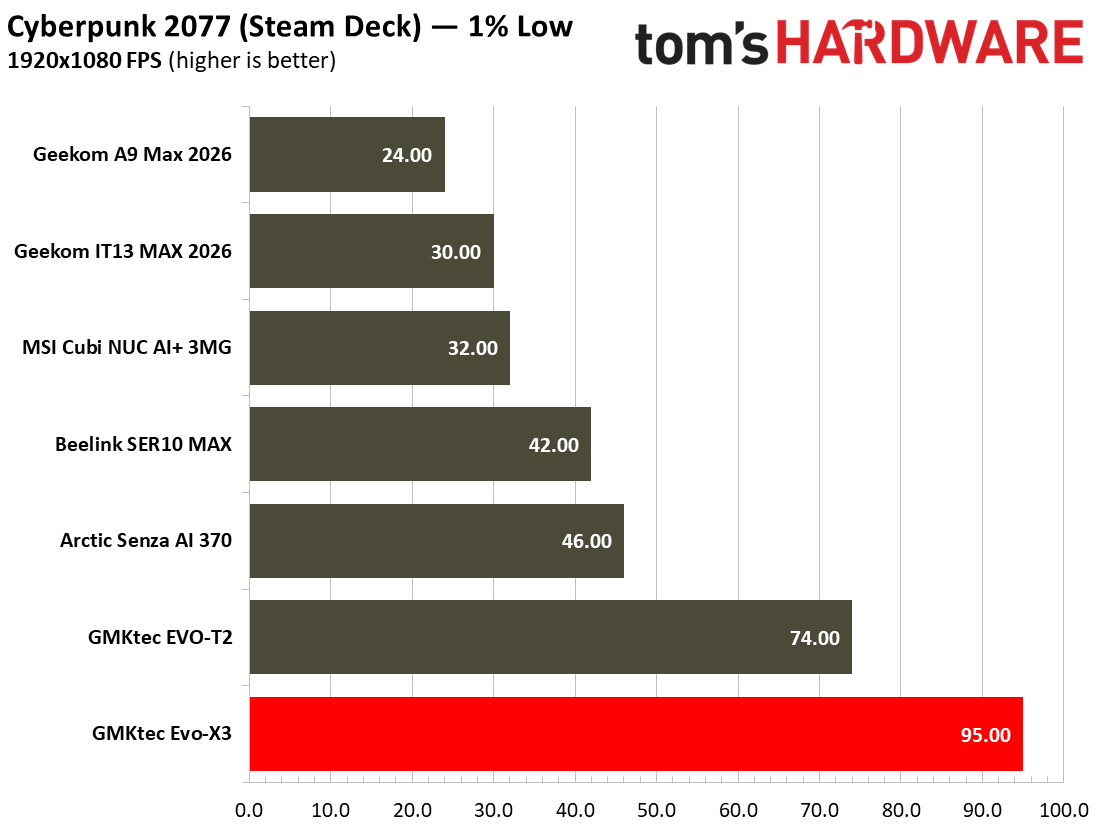
Moving on to real AAA games, let’s check the data provided by the multi-scene benchmarks built into Shadow of the Tomb Raider and Cyberpunk 2077. The former scales well with processor resources and can still often look and run great on humble iGPUs. As for Cyberpunk 2077, it can really push even the strongest modern GPUs, so here we've used two settings to show how the GMKtec Evo-X3 can perform. I thought both these titles looked better than Star Wars Outlaws, too.
Image 1 of 6
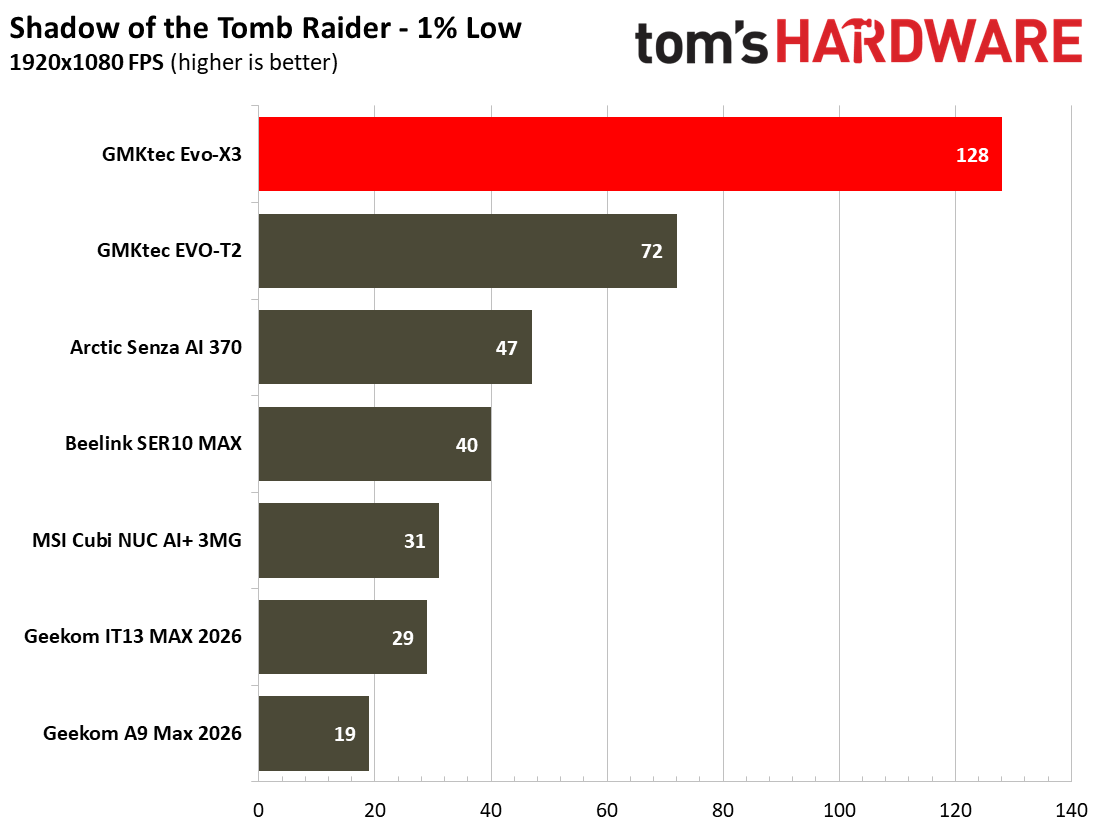
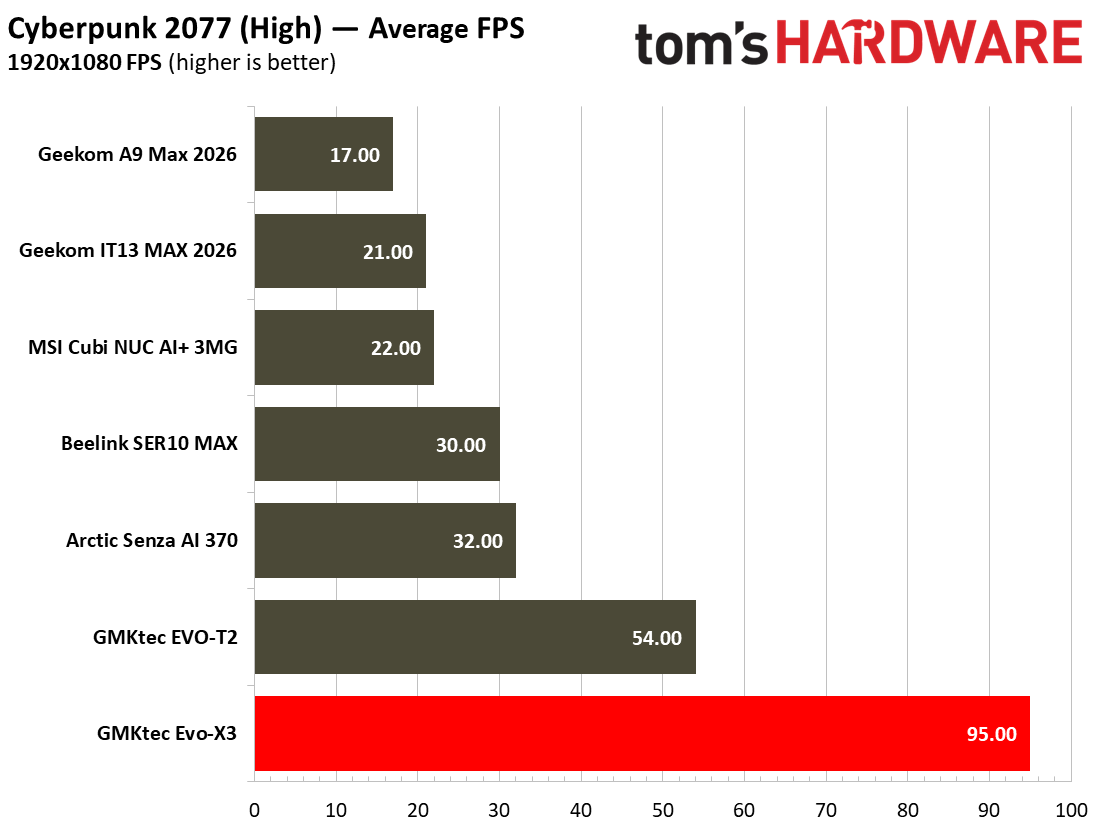
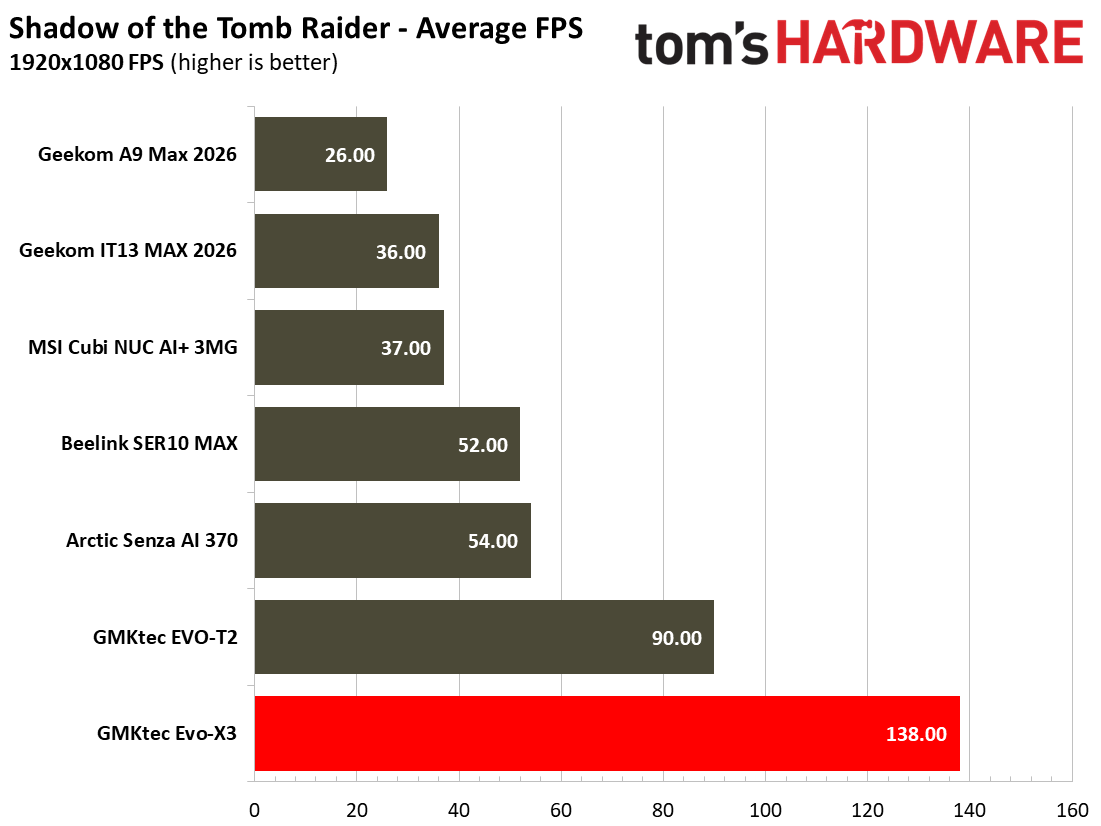
The Shadow of the Tomb Raider High 1080p test resulted in an impeccably smooth 138 FPS on average, with the low of 126 FPS, on the Evo-X3. That’s a great score for a mini PC without a discrete graphics card. I was inspired to re-test at 1440p High, and the X3 still achieved an average 96 FPS / low 86 FPS.
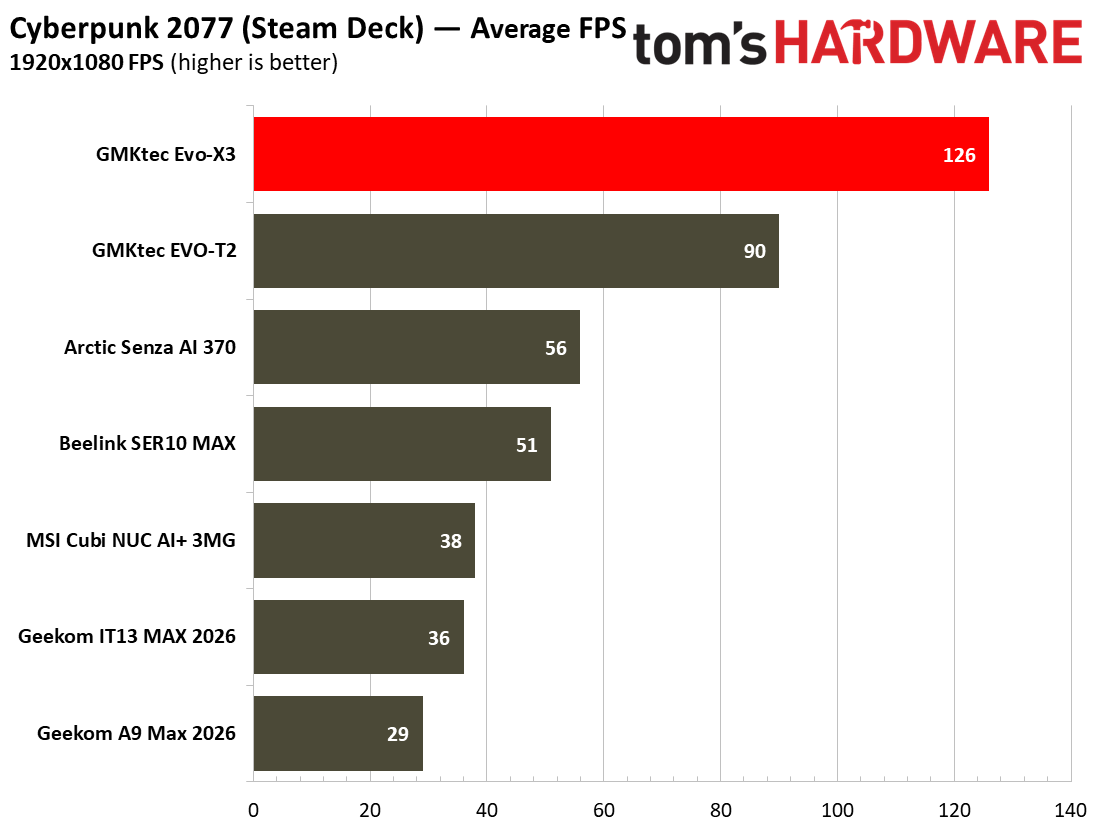
In Cyberpunk 2077 the Evo-X3 managed to achieve 96 FPS using the 1080p High preset, with 1% lows at 78 FPS. This is certainly another candidate for moving up to 1440p and/or higher quality presets. CD Projekt Red also provides lots of upscaling tech (DLSS, FSR, XeSS) settings to adjust in this futuristic RPG, to try and get your sweet spot performance / resolution / quality setting dialed in.
Power, Heat, and Noise when using the GMKtec Evo-X3
Image 1 of 2
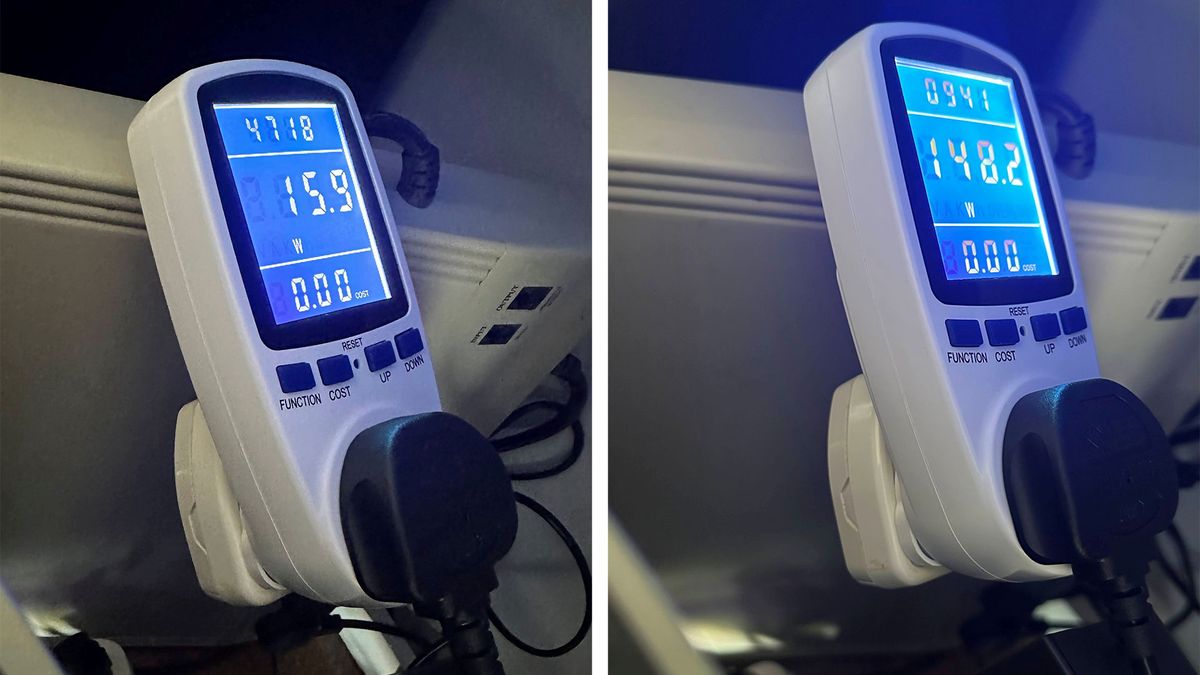
When I left the GMKtec Evo-X3 to idle, my power meter measured wattages around 16W from the wall for the whole system. When the PC was pushed with simultaneous CPU and GPU benchmarks running, power draw seemed to peak at a little under 150W. GMKtec shipped this device with ‘Balanced Mode’ set in the BIOS, allowing the processor to consume up to 85W. The supplied 230W power brick had plenty in reserve, and it might need it in ‘Performance Mode’ where GMKtec says that the processor alone will demand up to 120W with peak power spikes to 140W.
System tools showed that during light activities like browsing the web, and typing reports like this one, the CPU temperature stuck around 42 degrees Celsius (in a 22 C room). Playing games for 30 or 40 minutes, the reported CPU temperature seemed to stay between 75 C and 82 C most of the time. The peak CPU temperature I saw was 85 C.
GMKtec’s powerful mini PC was a quiet operator at idle and under load. My measurements from about half a foot in front of the device show noise levels under 30 dBA at idle, which is very quiet and under the measurement threshold of my meter. Stressing the system with multiple CPU and GPU loads I managed to get nearly 37 dBA out of the system. This seemed an exceptional result during my testing, as most of the time the max noise level during benchmarks was nearer 33 dBA.
Software and Warranty on the GMKtec Evo-X3
The GMKtec Evo-X3 ships with Windows 11 Pro installed. Unlike its Evo-T2 brother, I found no pre-installed AI apps and tools on the X3. However, I note that the product page mentions GMKtec Claw and Wrangler as features. I installed LM Studio Bionic and Comfy UI for some AI testing, though.
GMKtec sells the Evo-X3 with a one-year warranty.
GMKtec Evo-X3 configurations
GMKtec sells only two Evo-X3 configurations in the U.S. Both machines feature the same processor and generous amounts of RAM. The only configuration choice is between a 2TB SSD (our model) and a 4TB SSD equipped model.
At the time of writing our 2TB configuration is listed at $3,799 but the product page says the price is normally $4,100. The 4TB model is currently $3,999, discounted from $4,349. We don’t know when the prices might get adjusted. Pricing for computers and devices with lots of RAM and storage is volatile right now.
Bottom Line
I was impressed by many aspects of the GMKtec Evo-X3 mini PC. Computing on a machine with so much RAM felt quite liberating. Especially when so much of it can be allocated to the system's iGPU. Moreover, the CPU and iGPU components of the SoC are plenty powerful for the compact form factor. I was also impressed by the X3's sleek design, solid build quality, and quiet operation.
No machine is perfect, though. For example, despite having a variety of ports available including USB4 and OCuLink, I felt there were not enough ports in total. To use this as my daily driver I’d feel pinched by the Evo-X3’s design offering just a single USB4 port, and one HDMI out.
The price is high, even considering the spec, but that's unfortunately common during this component shortage.
GMKtec sells its new Evo-X3 direct at the offer price of $3,799, as mentioned and linked above. At the time of writing we note that our GMKtec Evo-X3 128GB/2TB configuration is also available from Amazon U.S. at the same price, if you prefer.
If you like what you’ve seen of the Evo-X3, the nearest competitors that we have experience of are the Evo-X2, also from GMKtec, and AMD’s first-party, turn-key Strix Halo mini-PC. However, we know there are several next-gen Ryzen AI Max 495+ machines coming to retail soon. Depending on market pricing, configurations, design, and port selections of these refreshed ‘Gorgon Halo’ models, they might be worth waiting for. We saw Minisforum, Lenovo, GMKtec, Chuwi, and AceMagic with AI Max 495+ designs at IFA 2026 earlier this month.







 English (US) ·