
 1 week ago
16
1 week ago
16
Listen, we’ve all been there. You’re staring at your suitcase, and space is tighter than a pair of vintage skinny jeans. You want to capture those neon Tokyo nights or the dusty vibes of a Moroccan souk with something better than your iPhone 17 Pro, but you’re torn. On one side, you’ve got the Fujifilm X-T5, a total beast that looks like it stepped out of a 1970s spy movie but packs 40 megapixels of pure "stop-everything-and-look-at-this" power. On the other side, you’ve got the brand new Ricoh GR IV, the stealthy little ninja that literally slides into your pocket and disappears until you’re ready to snap a candid that looks like a high-fashion editorial.
It’s February 2026, and the gear war has reached a fever pitch. Ricoh just dropped the GR IV with that insane 5-axis stabilization and the "HDF" filter that makes every highlight look like a dream. Meanwhile, Fuji’s X-T5 is still holding the crown for the most versatile travel rig for folks who actually like changing lenses. One is a powerhouse; the other is a pocket rocket.
Choosing between them isn’t just about megapixels—it’s about how you want to feel when you’re wandering through a foreign city at 2 AM. Do you want the tactile click of Fuji’s dials, or the "now you see me, now you don’t" vibes of the Ricoh? Grab a coffee, because we’re diving deep into the ultimate travel showdown to see which one earns that precious spot in your carry-on. We’re talking vibes, specs, and cold hard cash. Let’s get into it.
More Info about these Cameras:
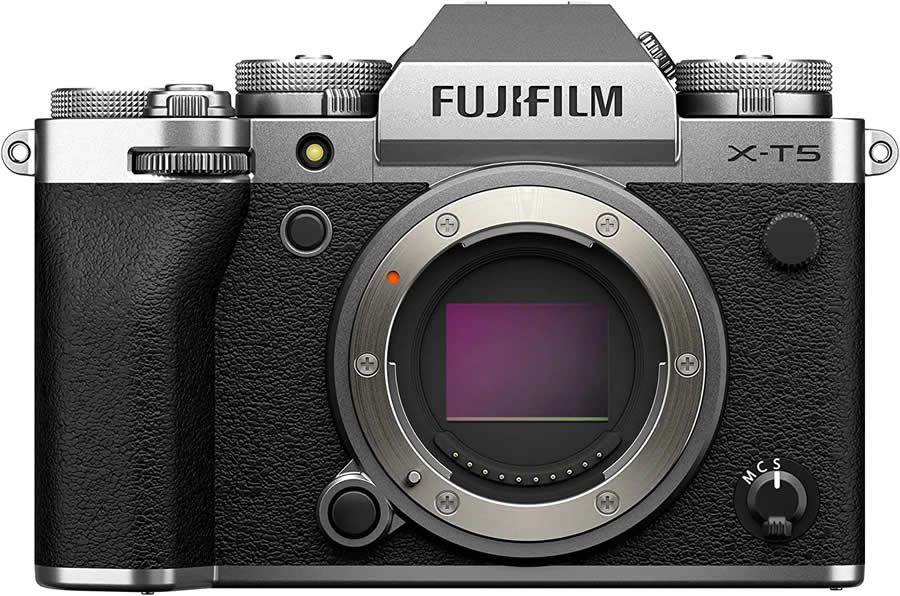
Fujifilm X-T5 Camera
Technical Details: Pixels vs. Portability
The spec sheet is where the "big vs. small" battle gets real. The Fujifilm X-T5 is a resolution monster with its 40.2MP X-Trans sensor. It’s the king of cropping; you can take a wide shot of a cathedral and crop in until you see the pigeon on the roof, and it’s still sharp. It’s got a gorgeous EVF (electronic viewfinder) and a 3-way tilting screen that’s a godsend for low-angle street shots.
The Ricoh GR IV, fresh for 2026, brings a 25.7MP BSI sensor to the party. While it has fewer pixels than the Fuji, it has 53GB of internal storage (finally!) and a redesigned 28mm equivalent lens that is clinical in its sharpness. The big news? The GR IV finally matched Fuji’s 5-axis IBIS, giving you up to 6 stops of shake reduction. You won’t find a viewfinder here, but the new air-gapless touchscreen is bright enough to use under the scorching Greek sun.
The Price Tag: Invest or Save?
Let’s talk bread. The Fujifilm X-T5 body generally floats around $1,699, but remember, you still need glass. If you pair it with a sleek prime lens like the 23mm f/2, you’re looking at a $2,100+ investment. It’s a "buy once, cry once" situation—this camera is weather-sealed and built like a tank, meant to survive a drizzle in London or a sandstorm in Dubai.
The Ricoh GR IV has seen a bit of a price hike for 2026, sitting at $1,499. If you want the "HDF" version with the built-in diffusion filter, it’ll run you $1,599, and the niche "Monochrome" version is a staggering $2,199. While the entry price is lower than a full Fuji kit, you’re locked into that one 28mm lens. It’s a premium for portability—you’re paying for the engineering feat of cramming a pro sensor into a deck of cards.

Ricoh GR IV Camera
Pros and Cons: The Real Talk
Every camera has its "main character" energy and its annoying quirks.
Fujifilm X-T5 Pros:
- 40MP Power: Unmatched detail for large prints.
- Battery Life: The NP-W235 battery is a marathon runner.
- Weather Sealing: It doesn’t fear a little rain.
Fujifilm X-T5 Cons:
- Size: It’s "small" for a pro camera, but it still needs a dedicated bag.
- Weight: Your neck might feel it after 10 miles of hiking.

Ricoh GR IV Pros:
- True Pocketability: Literally fits in your pocket. No camera bag needed.
- Stealth Mode: People don’t realize you’re a "photographer," perfect for candid street shots.
- Snap Focus: The fastest way to shoot on the move.
Ricoh GR IV Cons:
- No Viewfinder: Harder to compose in blinding light.
- Fixed Lens: If you want to zoom, you’re walking.

Why Go With This Gear?
Choosing your weapon depends on your travel DNA. You should go with the Fujifilm X-T5 if you’re the type of traveler who wakes up at 5 AM for the "golden hour" and doesn’t mind carrying a small backpack. It’s for the creator who wants 6K video, dual SD card slots for backup, and the ability to switch to a telephoto lens for a safari. It’s a complete creative studio.
On the flip side, grab the Ricoh GR IV if your idea of travel photography is "don’t let the gear get in the way of the trip." If you’re hitting up Michelin-star dinners or crowded night markets where a big camera feels awkward, the Ricoh is your best friend. It’s for the minimalist who wants the highest quality possible without the "gear-head" aesthetic. It’s about the freedom of having nothing around your neck.

In Summary
Which camera is better for travel: Fujifilm X-T5 or Ricoh GR IV?
It depends on your style. The Fujifilm X-T5 is better for versatility and resolution (40MP), while the Ricoh GR IV is the winner for portability and stealth.
Is the Ricoh GR IV weather-sealed?
No, the Ricoh GR IV lacks weather sealing. For dusty or rainy environments, the Fujifilm X-T5 is a safer bet as it is fully weather-resistant.
Does the Ricoh GR IV have a zoom lens?
No, the Ricoh GR IV features a fixed 18.3mm lens (28mm full-frame equivalent). To "zoom," you must use the built-in crop modes (35mm and 50mm) or move your feet.
Can the Fujifilm X-T5 shoot 4K video?
Yes, the X-T5 can shoot up to 6.2K video at 30p, making it much more capable for hybrid travel vloggers than the Ricoh GR IV, which is limited to 1080p.
Which camera has better battery life?
The Fujifilm X-T5 has significantly better battery life, rated for approximately 580 shots, whereas the Ricoh GR IV is rated for about 250 shots.





![20 Years Later, One of the Best Sitcoms of the 21st Century Returns With Hilarious First Look [Exclusive]](https://static0.colliderimages.com/wordpress/wp-content/uploads/2026/02/malcolm-in-the-middle-life-s-still-unfair-feature.jpg?w=1600&h=900&fit=crop)

 English (US) ·