
 5 hours ago
5
5 hours ago
5
In brief
- France's Finance Committee adopted an amendment treating swaps of crypto into MiCA-regulated stablecoins as taxable sales from Jan. 1, 2027, and another extending the exit tax to crypto held by households worth more than €800,000.
- The committee then rejected the budget's revenue section on Oct. 9 by 31 votes to 3, so the floor debate starts from the government's original text.
- A third adopted amendment would let investors carry crypto losses forward for 10 years; the Assembly debates the revenue section from Oct. 13 and votes Oct. 20.
France’s National Assembly Finance Committee voted this week to tax crypto holders who swap into stablecoins—tokens tied to a single official currency, such as the dollar or the euro—and to charge an exit tax on wealthy holders who move abroad.
The votes may not matter much yet: on Friday the committee rejected the budget’s entire revenue section by 31 votes to 3, so the full Assembly starts from the government’s original text, without the crypto amendments.
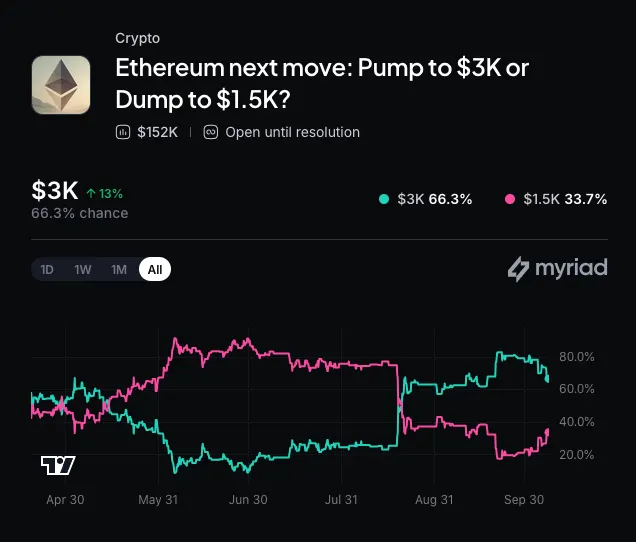 Myriad: Where does Ethereum go next? Click to make your prediction.
The committee’s amendments do not carry over to that text, so their backers would have to table them again for the floor debate that begins Oct. 13. Neither measure is law, and both still have to get through the rest of the legislative process.
The stablecoin amendment, filed by Nicolas Sansu of the left-wing GDR group and 16 co-signers, goes after what the authors call “a hole in the legislation.” Today, swapping Bitcoin for a stablecoin triggers no tax in France, because the state only collects when gains are sold for regular money or spent.
The text covers the electronic money tokens defined under MiCA, the EU’s crypto rulebook, a category that includes most stablecoins tied to a single currency. From Jan. 1, 2027, swapping into one would count as a sale, with the gain measured against what the holder originally paid.
The amendment names no rate and defers to France’s flat tax, which rose to 31.4% on Jan. 1 after the 2026 social-security financing law lifted the social-charge portion from 17.2% to 18.6%. The authors insist they are not creating a new burden, only applying existing law to a case it missed.
The authors say stablecoins can be perfectly ordinary investment vehicles, since they can pay for things at crypto service providers or buy other tokens, so the deferral on swapping into them is unjustified and lets the gain escape the flat tax.
A second amendment from Sansu would extend France’s exit tax to crypto. That is a levy on gains you have not cashed in yet, charged when you move your tax residence abroad.
It would apply when a tax household’s combined crypto, including holdings kept through custodians, is worth more than €800,000 and the taxpayer was a French tax resident for at least six of the previous 10 years, for moves from Jan. 1, 2027. The threshold matches the one already used for shares, and the payment deferral rules are borrowed from the stock regime.
Swaps between cryptocurrencies with no cash component would not count as sales for exit-tax purposes. Taxpayers would have to attach a statement of all crypto held on the date of the move, including assets held abroad or in self-custody, meaning wallets they control themselves without an exchange.
The authors argue that crypto held directly escapes the exit tax today while shares of the same value do not, and they flag how easily digital assets can be moved across borders.
Daniel Labaronne’s loss amendment also won committee approval. It would let investors carry crypto losses forward for 10 years to offset future gains, as they already can with stocks, whereas today unused losses cannot be carried over.
The Assembly adopted another crypto-inclusive tax in first reading in late October 2025, voting 163-150 for an amendment creating a 1% annual levy on “unproductive” wealth above €2 million that lumped digital assets in with gold and yachts. Attorney Burçak Ünsal told Decrypt that taxing early token holders was potentially “economically unjust.”
Coinbase said in October 2024 it would delist stablecoins that fail to comply with MiCA for European customers by Dec. 30, pointing them toward compliant coins like USDC and EURC.
The floor debate on the budget’s revenue section opens Oct. 13, with a formal vote scheduled for Oct. 20. If the measures return and survive, the stablecoin and exit-tax rules would apply from Jan. 1, 2027.
Daily Debrief Newsletter
Start every day with the top news stories right now, plus original features, a podcast, videos and more.








 English (US) ·