
 5 hours ago
4
5 hours ago
4
Back in 1999, 87 acres of land in Taylor, Texas, was donated (nominal fee $10) to the city by a farmer, with a condition in the deed that it would be used for community parkland. In 2025, the land was sold for $10M to a data center developer, who has won several legal battles against the nearby residents who are trying to stop the massive construction project, reports 404 Media. Now, the disgruntled locals are planning to take their case to an appeals court.
To introduce this case, let’s go back to 1999, when the $10 deed was inked. For some background, 404 Media talked to long-time local Pamela Griffin, who used to play on the farmland, and watched her children grow up and enjoy the same freedom. Griffin recalled that old farmer Mr. Bland used to talk to her father from time to time. According to her, Bland once said to her dad, “I see the kids don’t really have nowhere to play.” He continued, “I’m thinking about giving this land for parkland because these kids need somewhere to play.” The original July 1999 deed has since been unearthed, and the farmer did indeed follow through with his words. Now, let’s make the following chain of events simple using a bullet point timeline:
- Pre 1999 – a farmer’s promise to his neighbors,
- July 7, 1999 – Bland granted the land to the Texas Parks and Recreation Foundation, a public trust, for $10 on the condition it be used as a park,
- 2003 - Texas Parks and Recreation Foundation granted the land to another non-profit called the Williamson County Park Foundation,
- 2003, one month later, Williamson County Park Foundation gave the land to the City of Taylor,
- 2008 - the city of Taylor sold the land to the Taylor Economic Development Corporation (TEDC) for $15,000,
- 2025 – TEDC sold the land to data center developers Blueprint for $10 million.
This is quite a tale, and there appears to be a lot at stake for parties on either side of the dispute. In summary, locals face a multitude of undesirable side effects coming from having a data center in their backyard. There’s also the principle of the original deed being ignored, a big deal in Texas. Meanwhile, the council asserts that stopping this kind of development (in the city zone it is situated) is beyond its scope, and the millions in tax raised will benefit residents.
Griffin only found out about the planned 135,000-square-foot data center on the land when local organizers called around the neighborhood to raise awareness in 2025. She didn’t even know what a data center was at the time. Looking it up with her family, the idea of such a construction on your doorstep didn’t appeal.
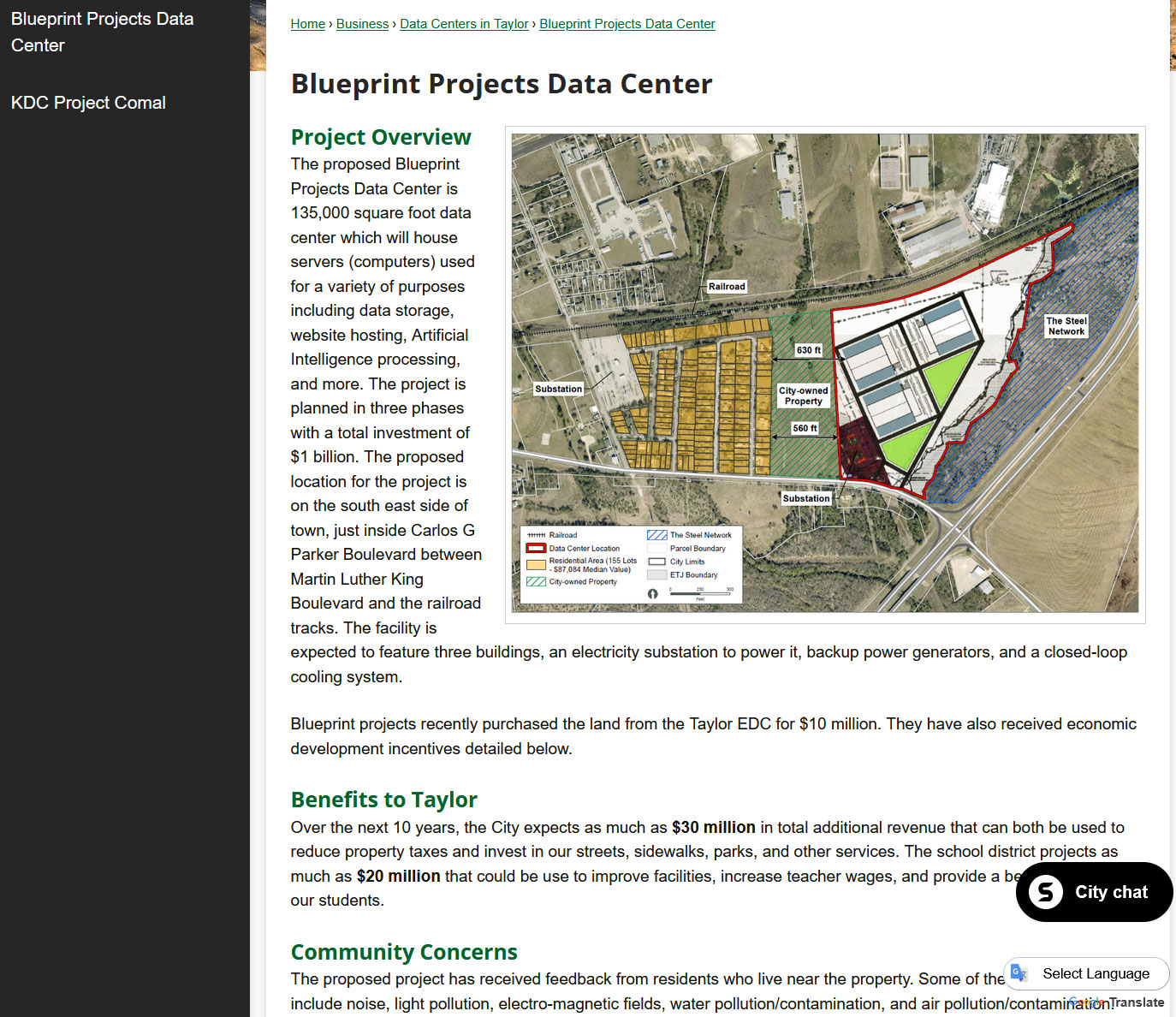
Locals like Griffin became concerned about impacts to air, water, electricity, and noise. In correspondence with the City Council, they have been assured that work will be done to minimize health risks to people living nearby. Mitigations like a barrier wall, landscaping, closed-loop water cooling, and the developers building their own power substation were mentioned.
While folks might not want to live near a data center for the aforementioned reasons. It may also negatively impact the resale price of nearby homes. However, the City Council says that the expected extra $30M in tax revenue over the coming decade will be a positive for the area. With $20M earmarked for the school district.
Meanwhile, the council has also painted its situation as one where it is powerless to resist the data center development. This was made clear in a council website FAQ. 404 Media investigations revealed that this lack of power to change the course of the development is likely because of the property’s existing Employment Center zoning. The City can only regulate form, not function, it seems. However, the dev hasn’t yet secured the City’s approval for planning and building permits.
With the lack of satisfactory response from the council, Griffin and her family decided to hire a lawyer. There then followed a series of legal disputes, which, so far, have favored Blueprint. Nevertheless, Griffin and family members are filing an appeal with the Third Court of Appeals in Austin, Texas.
Land deeds are powerful documents in Texas. Activists opposed to the data center unearthed the original July 7, 1999, deed, which is shared on the 404 Media site. Indeed, we can see the legal document does stipulate that the 87.97 acres of land “be held in trust for future use as parkland.”
Central to Griffin’s determination to continue is the notion that “I’m not fighting just because of a data center. I’m fighting because this land was deeded for parkland.” Texas deeds need to be upheld, and the community should have a park, according to the resident.

Follow Tom's Hardware on Google News, or add us as a preferred source, to get our latest news, analysis, & reviews in your feeds.







 English (US) ·