
 15 hours ago
2
15 hours ago
2

During a random dictionary delve last week I learned that "explore" once meant to cry out. It comes from an old Latin word formed from the prefix "ex-", describing outwardness, and "plorare", meaning to cry or weep. Compare "implore" - to beg, cry for something - and "deplore" - to berate, 'cry of' something or somebody.
The OED explains ("ex + "planō", meaning to level off, flatten for understanding) that "explore" may originally have referred to hunters, shouting to scare up animals lurking in the area around them. Exploration was always somewhat predatory, then, perhaps a little anguished. I have to admit, I got misty-eyed on discovering all this, thinking about how this word I've written a million times in videogame reviews is a kind of silenced wail.
The idea that exploration is vocalisation fills the exploration of videogame worlds with new vigour, for me - new strangeness and possibility. Especially open worlds, in which exploration can feel so zombielike and perfunctory, a drumbeat to disclose and paint the map, to conquer terra incognita in the name of content. Whether I am 'going in all-guns-blazing' or not, I realise that my presence in these spaces is a shout. I gaze tight-lipped from the Throat of the World and the mountains on the other side of Whiterun seem jolted, even deafened by my regard.
Let's fus ro dwell on this for a moment. How does it change how we think about these games, when we position ourselves as crying out into them?
Amongst other things, it reminds me that WASD is three consonants and one vowel. A videogame control device can be reconsidered as a source of inarticulate sound, corresponding to the lettering of inputs. The most ubiquitous such device, the keyboard, is fundamentally a medium for textual communication, an inheritance from typewriters, repurposed as a means of traversal and encounter. My wanderings in open worlds are thus available to transcription. They are a restless, asemic address, a rolling warbling and spitting, an exasperating blue-bottle monotone: wwadadwadssdwdsdd
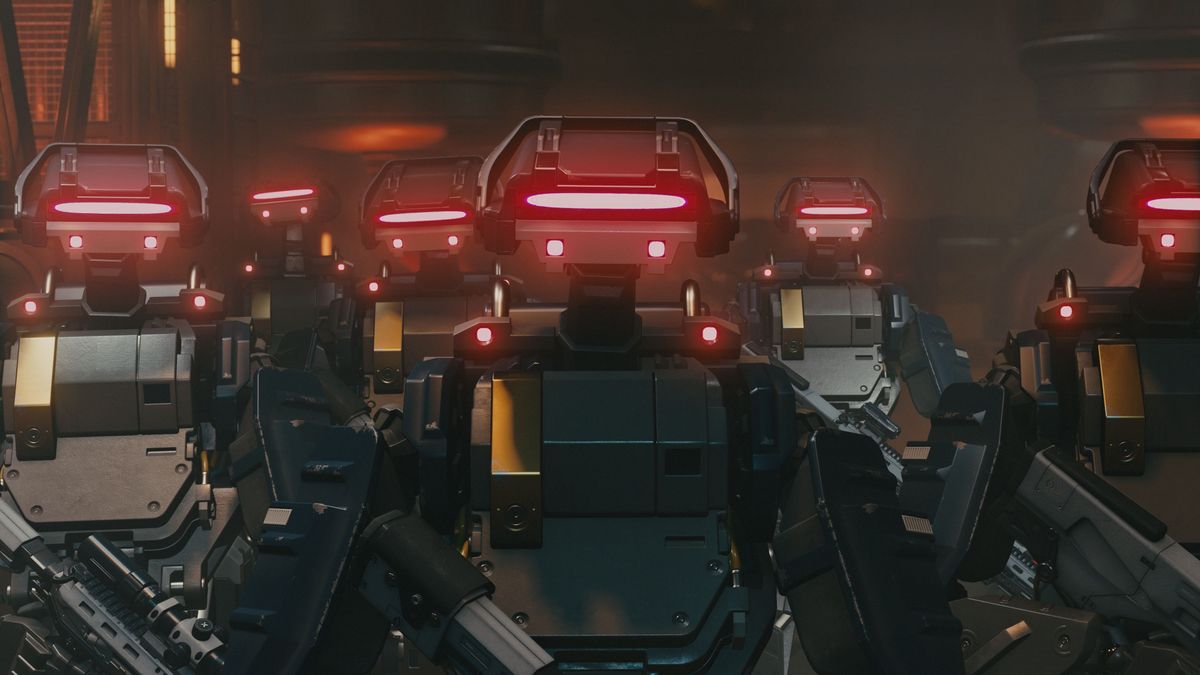
If you're versed in such games, you might be able to translate the above keyboard spam into a series of decisions and incidents. It suggests that players could converse simply by advancing, retreating and strafing, like dancing bees, with the kind of thrillingly constrained vocabulary that has proven so fecund in Dark Souls: dad, saw, was, sad, wad, as. But perhaps it's more useful to follow Dada and lean into the gibberish. It lends some comedy to Tom Clancy open worlds, especially, with their military tourism disguised as surgical intervention. You might think you're a trim tactical operator, here to stabilise another exotic enclave, but transcribe your controller inputs and you become a distracted muttering in the undergrowth, a ghost in search of a haunt: wssswsssswsssswssswaawawawwwawa
Whether operated with a mouse or analogue stick, the player's gaze is itself a wordless bawl for information, not just capturing images of some persistent external realm, but demanding that objects and entities appear and live. In the computational economy of the open world, much remains inert, unrealised till your gaze touches its coordinates. You peer through your spyglass and distant deer and soldiers startle into motion, as though roused by your yell.
I confess, I also feel a certain amount of contempt, thinking about videogame exploration as a cry - probably also some displaced and narcissistic self-loathing. I find the industry's religious emphasis on "choices with meaningful consequences" infantile, or at least, expressive of complex insecurity, a tearful demand to be heard and responded to in some utterly literal way.
It's not enough that the artwork Make Me Think; it must sing back to my call. I cry into the videogame's world because I need an echo to reassure me that I matter. I need the fiction to be capable of acknowledging me, even as I remorselessly overpower it, and I cry because I know that, being fiction, the videogame is ultimately incapable of any such soothing reciprocity. The faraway, safari park structure of, say, Ghost Recon: Wildlands is my emptiness projected, sucking me towards the horizon.
Sometimes, the association between exploration and sound has more direct correspondences in videogames. In Far Cry 4, you climb and hijack radio towers to reveal quests and opportunities. You flip the switch, the hectoring voice on the speaker is replaced by one of your faction's own propagandists, and waypoints flush from the bushes like flocks of pheasants.
The first Far Cry began life as a tech demo named X-Isle: Dinosaur Island, to be distributed as Nvidia benchmarking software; the name change was apparently suggested by Ubisoft when they signed up Crytek to develop a 'proper' game. It speaks readily enough to the premise of visiting and ransacking places "a far cry" from here, stirring in a little of Call Of Duty's recruiting-drive grandeur.
The idea of somewhere being a "far cry" from here appears to come from Scotland, referring to whether you could shout to the people in the next household. The OED cites a passage from Walter Scott's Tales of My Landlord - "‘It is a far cry to Lochow’; a proverbial expression of the tribe, meaning that their ancient hereditary domains lay beyond the reach of an invading enemy."
I emailed Crytek last week to ask whether Far Cry's naming has any connection with the idea of exploration as a cry. They've yet to respond, but I imagine one observation they might make is that Far Cry is just a dorky bit of incestuous studio branding, like CryEngine and Crysis. The comparison there with how "plorare" survives in various everyday English compounds is agonisingly neat. Crytek as a company were named partly for the desire to create technology that is "so emotionally true that it makes you cry", as Cevat Yerli told Ars Technica in 2013. I have never shed a tear over a Crytek game, nor even over my PC's inability to run one, but it turns out that when I play Far Cry, there is a steady undertone of weeping.







 English (US) ·