
 Image via Warner Bros.

Published Feb 17, 2026, 12:06 PM EST
Sign in to your Collider account
Filmmaker Stanley Kubrick was a British-American filmmaker responsible for some of the greatest films of all time. He is a filmmaker with a complicated legacy. On the one hand, he revolutionized all of cinema and created many amazing films, but his methods were known to be harsh and demanding when it came to his actors. Whatever you think about the man himself, there's no denying that his work is a crucial piece of cinema history.
Throughout his life, Kubrick produced 13 films, of which 10 are based on novels. From romance to epic war movies to black comedy, Kubrick created some true masterpieces off the back of popular novels. The following is a ranking of every book-to-movie adaptation headed by Kubrick, from worst to best. Do note that for this list, 2001: A Space Odyssey will not be considered, because it is only inspired by two short stories, and isn't directly based on any particular book.
10 'Lolita' (1962)
 Image via MGM
 Lolita was a hit for its time, but in a modern context, it's aged like milk left out on a hot summer day. This movie might be well-made, but it has one of the foulest, most disgusting plotlines ever conceived. Of course, it's not entirely Kubrick's fault, because the movie is based on a book by Vladimir Nabokov. To be fair, there is a genuine social commentary to be found between the lines, but it's kind of hard to see past the actual content itself.
The plot is about a middle-aged college professor who enters a romantic relationship with a 14-year-old girl. It shouldn't take a whole lot of explaining to state why this is off-putting to people--and rightfully so! It's not easy to get past the glorification of one of the most abhorrent criminal activities imaginable and try to decipher what the film is trying to say, which is why this movie is generally considered one of Kubrick's worst, if not his least approachable.
9 'Eyes Wide Shut' (1999)
 Image via Warner Bros. Pictures
Eyes Wide Shut was Stanley Kubrick's final film before he died. The film was actually released posthumously, just four short months after Kubrick's death of a heart attack at age 70. This wasn't just Kubrick's final film, it was also his return to cinema following a whopping 12-year hiatus from his craft. Unfortunately, this kind of shows. It's not a bad movie whatsoever, but it's nowhere near the level of excellent that many Kubrick fans have come to expect from him.
Based on a novel by Arthur Schnitzler, Eyes Wide Shut stars Tom Cruise as Dr. Bill Harford, a Manhattan-based physician who embarks on a night-long personal journey after discovering his wife may be cheating on him. This is an erotic drama film at first, featuring plenty of sex, but also lots of psychological themes. Erotica isn't exactly for everybody, but even then, the film is fine, it's just not up to Kubrick's usual standards. Perhaps he was losing his touch since his last film, perhaps his health was deteriorating. Either way, he could've done better.
8 'Barry Lyndon' (1975)
 Image via Warner Bros.
Barry Lyndon is a historical drama film set during the Seven Years' War. The Seven Years' War was a global conflict that saw action in North America, Europe, and Asia, with many major powers involved in the fighting. This one is based on a novel by William Makepeace Thackeray, who originally penned a longer title for the story. In any event, the film isn't one of Kubrick's best, nor is it his most famous.
The movie follows the titular Barry Lyndon, played by Ryan O'Neal, an Irishman who falls in love with an aritocrat's widow, later assuming his positon and working his way into high society. While primarily a drama, it does contain its fair share of comedy. The film is divided into two parts, and used a lot of familiar faces who appeared in many of Kubrick's other films, as well. It's a pretty good time, but it's not as thematically complex or profound as his other films.
7 'A Clockwork Orange' (1971)
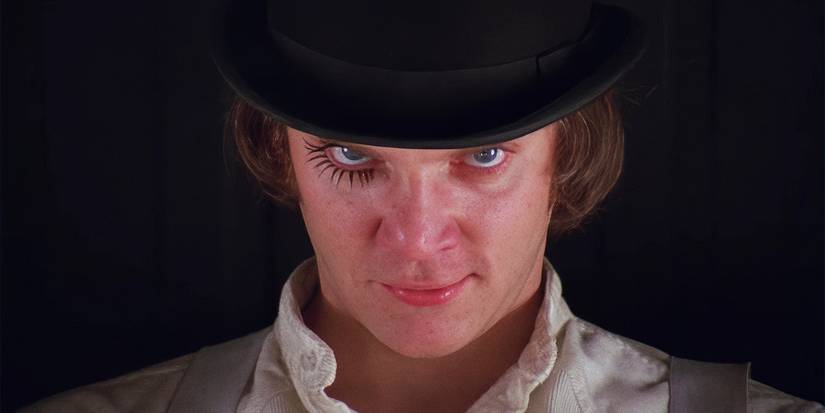 Image via Warner Bros.
A Clockwork Orange is another movie that is pretty hard to stomach due to its controversial content, but at least this one doesn't feel like an overt glorification of criminal activity. The story is based on a novel of the same name by Anthony Burgess, who wrote the book in 1962. This is one of those movies that's synonymous with Kubrick, because it perfectly encapsulates his signature directing style.
The plot is set in a dystopian future, specifically in a decaying future version of Britain where crime runs rampant. The main characters are a gang of "droogs," a goofy group of criminals that opt to engage in one big night of ultra violence. This involves physical assault, fighting rival gangs, breaking into homes, and other crimes that are truly unspeakable. While this movie isn't for everyone, the psychological and moral commentaries about this movie make it alluring to many, because it's much more complex than it seems on the surface.
6 'Spartacus' (1960)
 Image via Universal International
Many don't realize this, but Spartacus is indeed based on a novel, this time by author Howard Fast. Of course, this novel is, in turn, based on true events. Yes, Spartacus was actually a real person, although it's unlikely he resembled Kirk Douglas in real life. This was Kubrick's first film in colour, and stood as a cinematic marvel for the time due to the sheer scale of it, featuring hundreds of extras and large-scale battle sequences.
The plot follows a small portion of Spartacus' claim to fame. It's about how Spartacus, a Thracian gladiator, broke free of slavery and led a slave revolt known as the Third Servile War in the First Century BCE, which lasted two years. This movie has aged remarkably well. It was really special at the time because there was nothing else like it, pioneering the epic genre. Today, it's still visually impressive, with impeccable dialogue and exciting action. It's not Kubrick's most in-depth or philosophically profound effort, and definitely not his finest, but it's still an amazing movie.
5 'Paths of Glory' (1957)
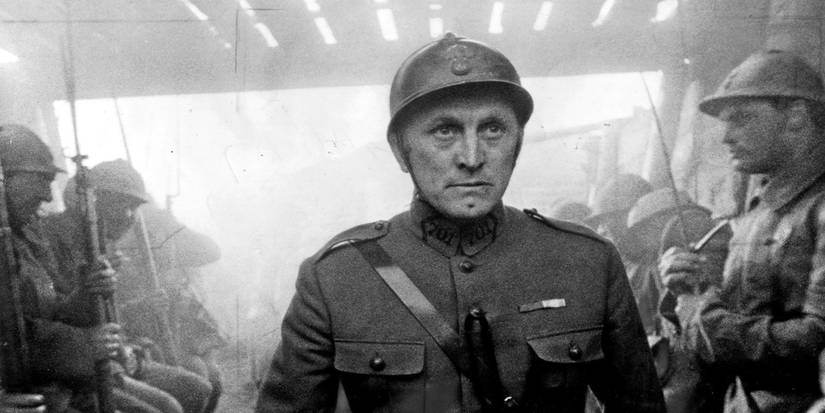 Image via United Artists
Paths of Glory is another Kubrick film starring Kirk Douglas, who once again plays a military leader. Only this time, it's for a more modern conflict. The movie is set during the First World War, prior to the United States' direct involvement beginning in 1917. The Allied forces are being pushed into a stalemate on the Western Front, which causes the British to enlist the help of an experienced and distinguished American military leader.
The movie is based on a 1935 novel by Humphrey Cobb, who tragically passed away before the film's release, so he never got to see his creation come to life on the big screen. While Paths of Glory isn't always the most popular pick for a Kubrick film, it is one of his best, and is one of the earliest examples of anti-war cinema to be found in Hollywood.
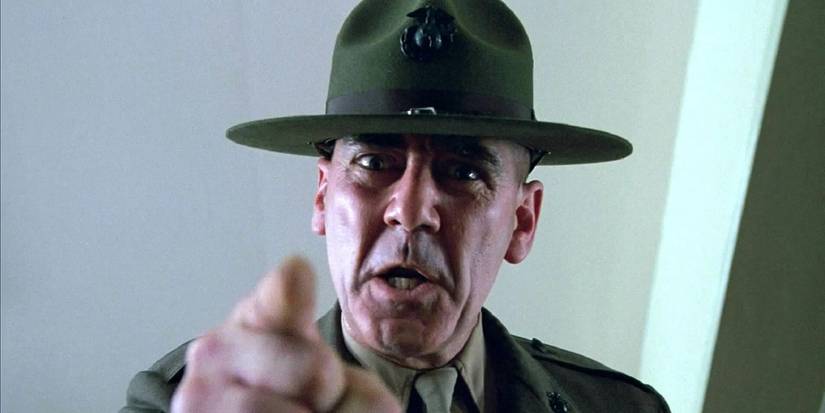 Image via Warner Bros.
A lot of people don't know this, but Full Metal Jacket is also based on a novel, this time by Gustav Hasford. The movie is set during the Vietnam War, focusing on American recruits who have come to boot camp to endure the gruelling training regiment. Much of the film examines the psychological impact of war, both in training and in actual live combat. It dives deep into PTSD, and some of the darkest parts of the human psyche.
The movie is not only a brutally honest look at how the training regiment is meant to break down the new recruits and build them up into killing machines, but it's also highly critical of American involvement in the conflict in the first place. It's one of the most powerful anti-war films ever, one that really defined the war movie genre and wasn't afraid to de-glorify the horrors of war.
3 'The Killing' (1956)
 Image via United Artists
 The Killing is one of Kubrick's most unknown films, one that often gets overlooked when compared to the rest of his repertoire. This is because it's actually the third film he ever made, and the first that was based on a novel. While it might not be as popular, it is definitely one of the most underrated. The original book was penned by Lionel White, an American journalist and part-time crime novelist.
The film's title implies a murder mystery, but actually, it feels a bit more like a heist film. The story concerns a notorious criminal who assembles his gang crooks to pull off an elaborate heist by rigging a horse race. This movie earned near-perfect scores from critics and audiences, even though it is 70 years old at this point. It's the perfect film for any fan of crime movies, and one of Kubrick's finest achievements.
2 'Dr. Strangelove, or: How I Learned to Stop Worrying and Love the Bomb' (1964)
 Image via Columbia Pictures
Dr. Strangelove, or: How I Learned to Stop Worrying and Love the Bomb has a really long-winded title, but this actually does pretty well for it, establishing early on its signature blend of dark and quirky humour. The fictitious plot is based on a novel by Peter Bryant, but obviously takes plenty of creative liberties. The plot follows an unhinged United States military official during the Cold War, who decides to launch a preemptive strike against the USSR, beginning a nuclear war.
The movie is unapologetically dark, especially in its ending, and comes with its own unique brand of dark humour. While it is a bit goofy, it's also a sobering reminder of how just one irresponsible person in power can turn the world on its head, especially when concerning the use of nuclear weapons. While not blatant about it, it is pretty obviously a call for disarmament, but it does this in a bit of an unconventional way. The timeless message, coupled with making a bold statement for the time, make it one of Kubrick's finest efforts.
1 'The Shining' (1980)
 Image via Warner Bros.
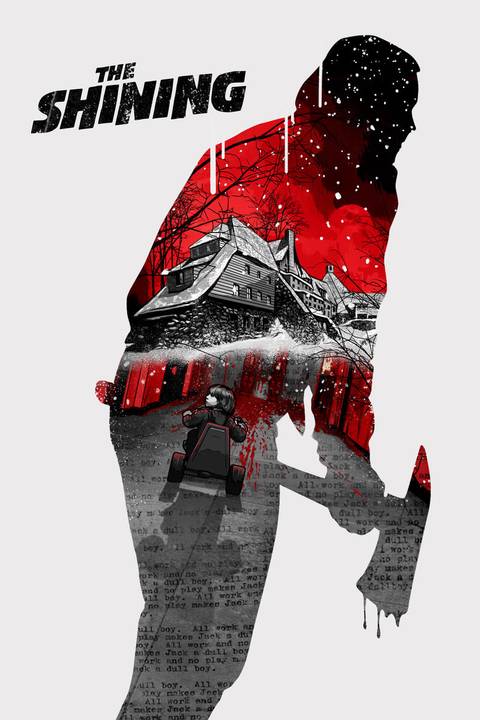
The Shining might not be the most well-made of Kubrick's flicks, but it is widely considered the most famous and the most palatable for newcomers to Kubrick's work. As many already know, the horror film is based on a novel by Stephen King, one of the most prolific and accomplished horror writers in history. While King himself famously hated this adaptation, it was a major hit with audiences, with the film becoming an overnight box office success.
The story follows a family who gets snowed in at a local hotel, trapping them inside. At the same time, the patriarch of the family, Jack, played by Jack Nicholson, is overcome by a supernatural phenomenon known as the Shining, which prompts him to begin a murderous rampage against his family and the other guests at the hotel. This movie is easy to digest despite on-set challenges, and is one of the highest-quality horror films ever made. For these reasons, it is arguably the best Stanley Kubrick film based on a book.
Release Date June 13, 1980
Runtime 144 minutes
Director Stanley Kubrick
Producers Jan Harlan
-

-

Shelley Duvall
Wendy Torrance





![20 Years Later, One of the Best Sitcoms of the 21st Century Returns With Hilarious First Look [Exclusive]](https://static0.colliderimages.com/wordpress/wp-content/uploads/2026/02/malcolm-in-the-middle-life-s-still-unfair-feature.jpg?w=1600&h=900&fit=crop)
 English (US) ·