
 3 weeks ago
48
3 weeks ago
48
Quick Summary
- Dutch natural gas futures climbed more than 2% Monday, reaching approximately €56.90 per megawatt-hour with a 2.9% increase
- Final agreement between Iran and Oman regarding Strait of Hormuz shipping routes remains unresolved
- Iran states complete waterway reopening depends on fulfillment of further U.S. requirements
- European Union gas reserves stand at approximately 56%, below typical mid-August levels
- Tight market conditions persist due to competition with Asian purchasers for available LNG shipments
Natural gas prices across Europe experienced an upward swing Monday following diminished prospects for swift resolution of Strait of Hormuz shipping constraints. Dutch benchmark futures for the front month advanced 2.9% to settle near €56.90 per megawatt-hour. Meanwhile, British wholesale gas contracts registered a 2.6% increase, reaching 139.50 pence per therm.
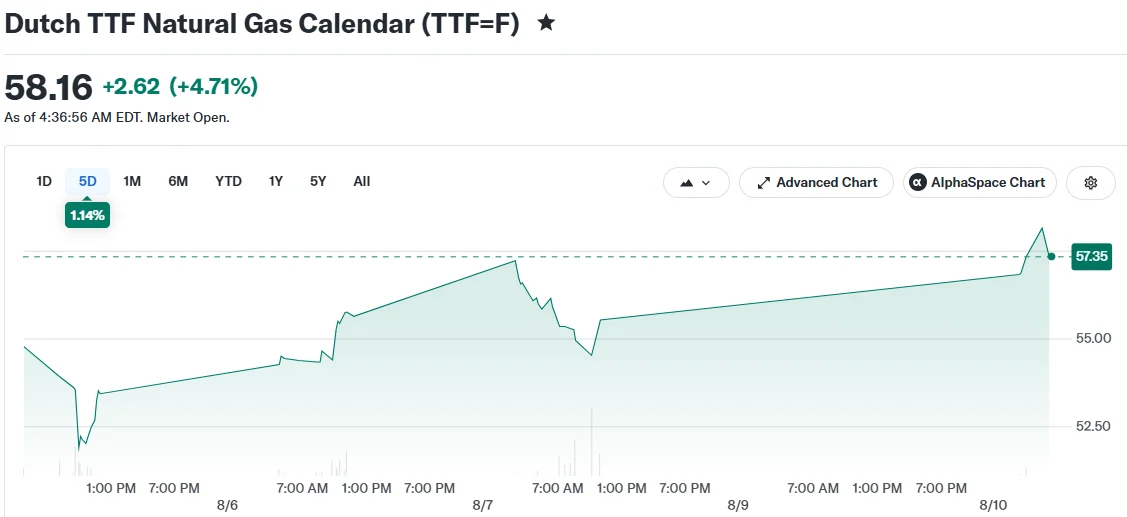 Dutch TTF Natural Gas Calendar (TTF=F)
The upward movement followed Iran’s indication that an arrangement with Oman concerning alternative shipping corridors through the strait was nearing completion, before subsequently attaching additional stipulations that postponed full access. Iranian officials stated the strategic waterway would remain restricted until supplementary U.S. conditions were satisfied. Furthermore, Tehran rejected the possibility of engaging in direct negotiations with Washington.
The inconsistent messaging left commodity traders without the anticipated supply certainty they had been expecting.
Middle East LNG Transit Remains Restricted
The Strait of Hormuz serves as a critical passage for liquefied natural gas shipments originating from Middle Eastern producers. With navigation continuing to face obstacles, deliveries from significant exporters such as Qatar are experiencing delays. This situation is intensifying pressure on worldwide supply precisely when European nations should be replenishing their storage infrastructure.

 BREAKING: Trump ready to declare victory over Iran without a nuclear deal.
Trump is willing to walk away if Tehran fully reopens the Strait of Hormuz.
With midterms three months away and gas prices still elevated, Trump is seeking a victory narrative, per WSJ. https://t.co/MwotL6TPET pic.twitter.com/1MpCpUizim
— Coin Bureau (@coinbureau) August 9, 2026
Storage facilities throughout the European Union currently hold roughly 56% of total capacity as mid-August approaches. This represents a notable shortfall compared to historical benchmarks for this calendar period. Market observers and energy specialists indicate this deficit elevates vulnerability as the winter demand period approaches.
Elevated summer temperatures throughout southern European regions have compounded the challenge. Increased heat has driven up electricity consumption for cooling systems, resulting in greater natural gas combustion for power production rather than inventory accumulation.
European Buyers Face Asian Competition for LNG Supply
European purchasers now find themselves in direct competition with Asian consumers for accessible spot market LNG deliveries. This competitive dynamic is sustaining elevated pricing and complicating efforts by European utilities to establish adequate storage reserves ahead of the heating season.
Market specialists indicate pricing will continue responding sensitively to developments emerging from the Iran-Oman-U.S. diplomatic efforts. Without a concluded agreement and complete strait reopening, supply ambiguity appears set to persist.
Iranian representatives confirmed negotiations remained viable but acknowledged limited advancement. Officials provided no specific timeframe regarding when discussions might reach conclusion.
The Dutch benchmark contract had declined during the previous week before Monday’s reversal. The rebound positions it once again above the €56 per megawatt-hour threshold, a benchmark closely monitored by market participants.
Currently, European energy trading reflects expectations that Hormuz transit disruptions will extend through the immediate future at minimum.
The post European Gas Futures Climb Amid Stalled Iran-Oman Shipping Negotiations appeared first on Blockonomi.





 English (US) ·