
 6 hours ago
6
6 hours ago
6
Enermax has been in the PSU market long enough that its name alone carries weight, and the Revolution III S represents the company's current answer to the 1000W mainstream-premium segment. It is not the flagship — that distinction belongs to the Platimax II. Enermax has positioned the Revolution III S to compete in the middle segment of the market without meaningfully compromising electrical quality, but how does it rank against today's best power supplies?
The platform is RSY's work, the same Shenzhen-based OEM behind several other well-regarded units, and the design choices reflect a manufacturer thinking carefully about efficiency and reliability rather than simply hitting a spec sheet target. This is also not a Platimax II with the wattage dialed back. The two units differ meaningfully: a different fan, no dust-free reversal mode, different platform altogether. Whether those differences matter to a given buyer is worth examining.
Specifications and Design
Swipe to scroll horizontally
RAIL | +3.3V | +5V | +12V | +5Vsb | -12V |
MAX OUTPUT | 20A | 20A | 83.3A | 3A | 0.4A |
| Row 2 - Cell 0 | 100W | 100W | 999.6W | 15W | 4.8W |
TOTAL | 1000W | Row 3 - Cell 2 | Row 3 - Cell 3 | Row 3 - Cell 4 | Row 3 - Cell 5 |
AC INPUT | 100 - 240 VAC, 50 - 60 Hz | Row 4 - Cell 2 | Row 4 - Cell 3 | Row 4 - Cell 4 | Row 4 - Cell 5 |
MSRP | $180 | Row 5 - Cell 2 | Row 5 - Cell 3 | Row 5 - Cell 4 | Row 5 - Cell 5 |
In the Box
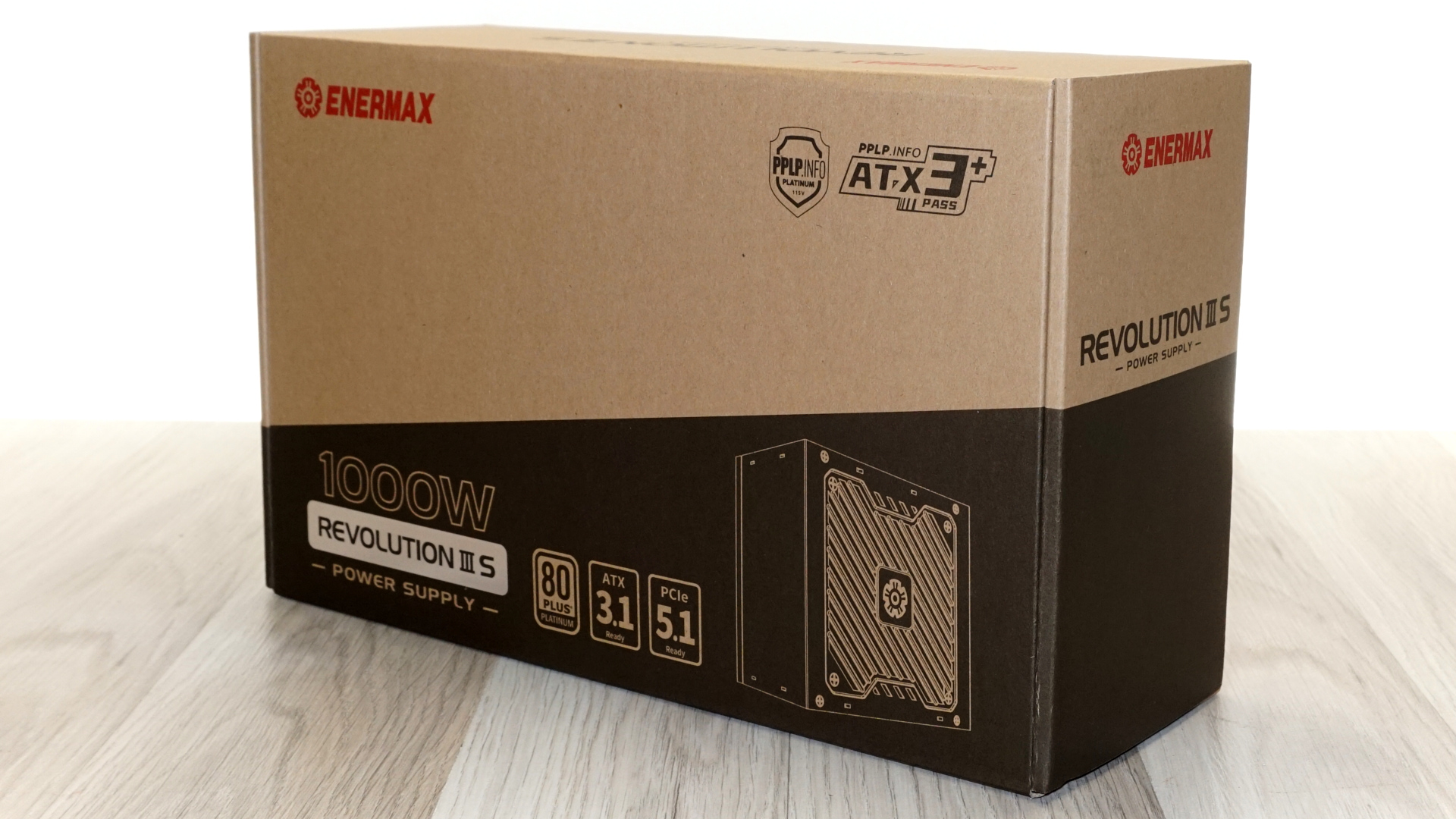
The Revolution III S ships in a no-nonsense cardboard box, printed mostly in neutral tones with the red Enermax logo providing the only real visual punch. It is a consciously restrained presentation, meant to promote an environmentally-friendly face. The unit inside is wrapped in a protective pouch and foam inserts.
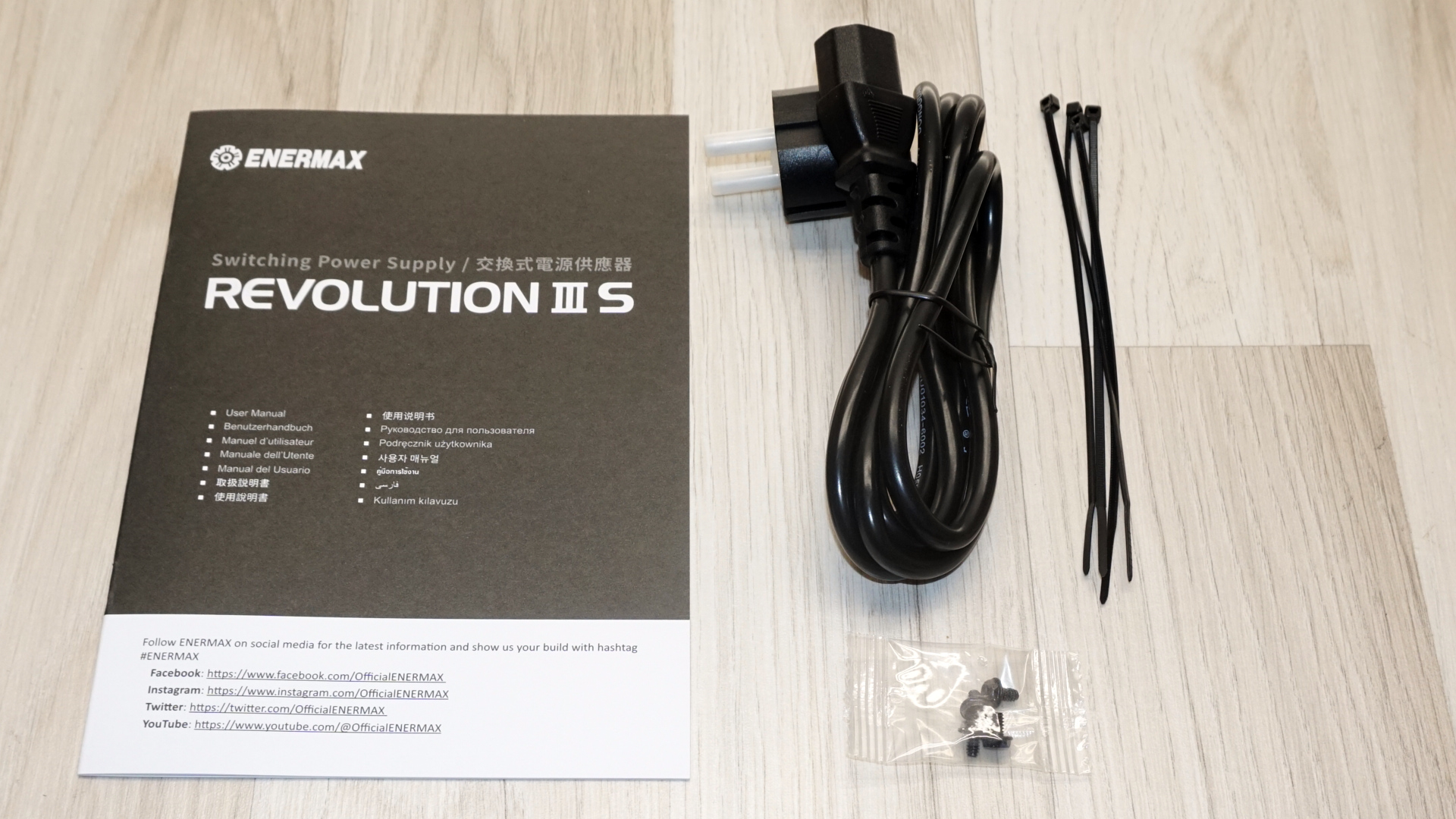
The bundle is absolutely minimal. Only mounting screws, an AC power cable, and a few basic cable ties are included. There is also a printed user’s manual. No cable combs are provided, which is a missed opportunity given that the scaled, per-wire shielded cables would visually benefit from such hardware.
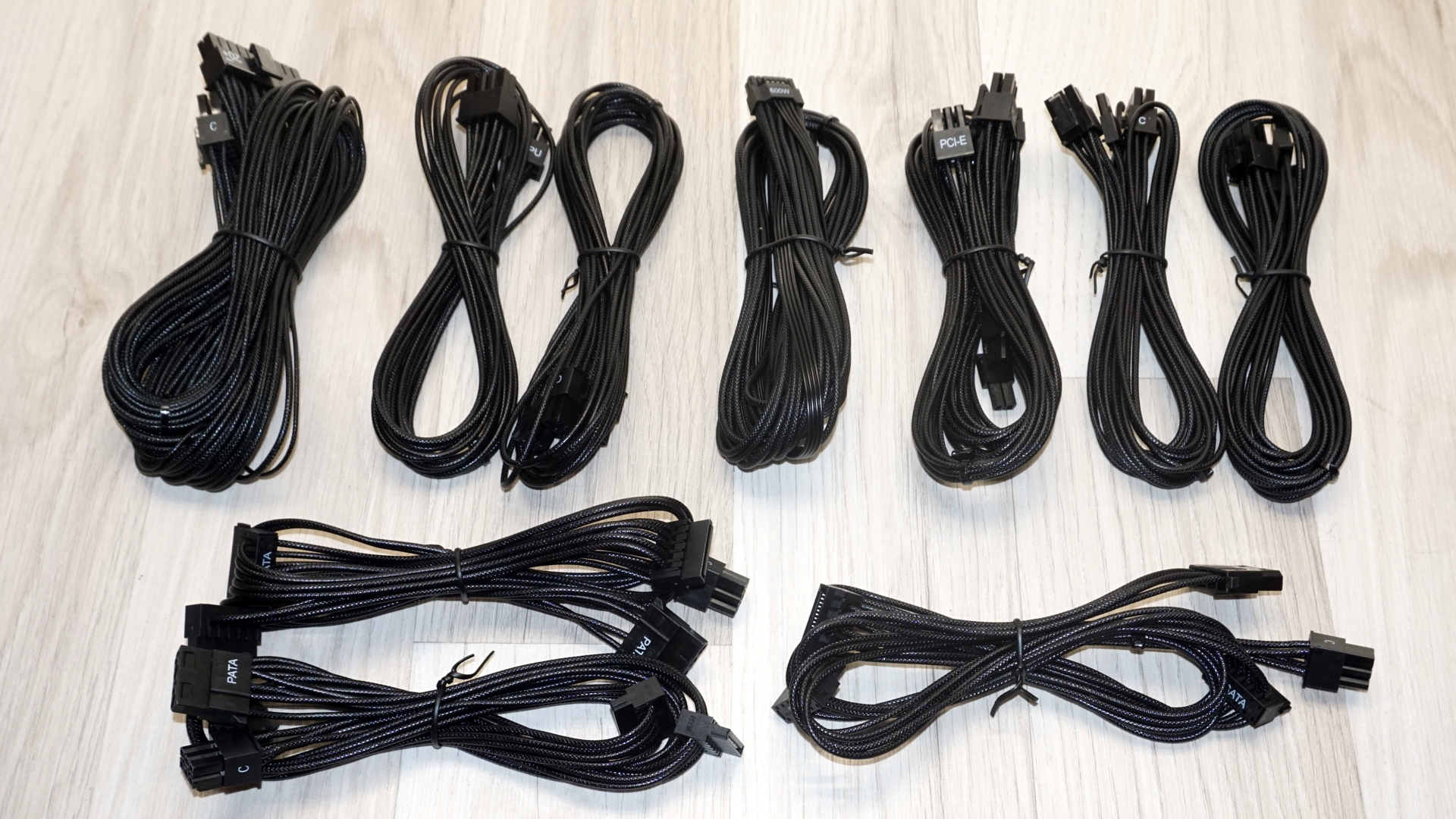
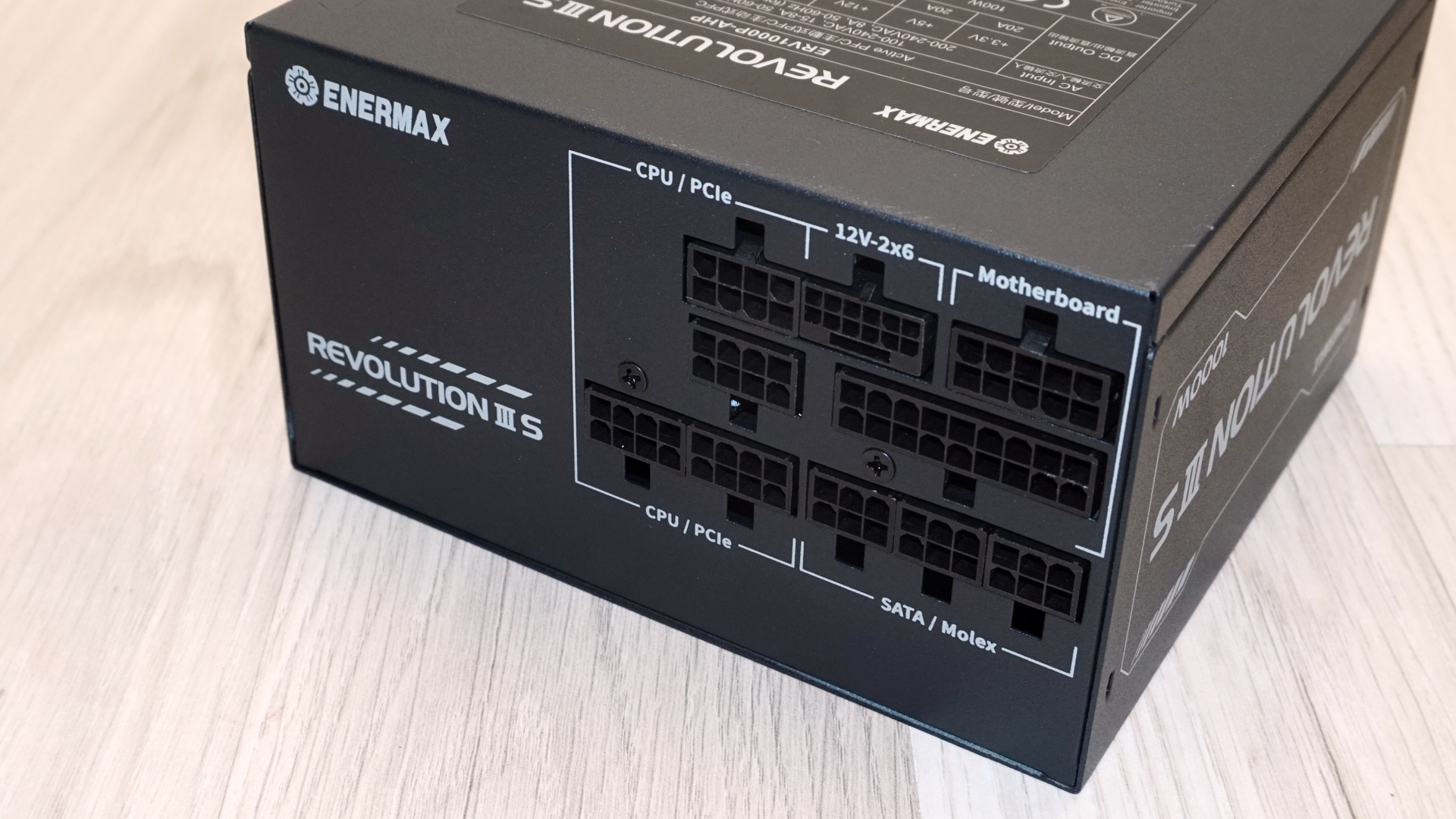
Cabling is fully modular and all-black throughout, wires and connectors alike. The one notable cosmetic exception is the sense pins of the 12V-2x6 connector, which are left unsleeved. It is a small detail but it may be noticeable in a well-lit build. The connector count comprises one 12V-2x6 and four 6+2 pin PCI Express connectors. However, there is a catch - one of the PCIe cables carries two of those 6+2 connectors and draws from the 12V-2x6 port. This means using all four PCIe connectors simultaneously is not possible if a 12V-2x6 cable is installed.
Swipe to scroll horizontally
Connector type | Hardwired | Modular |
ATX 24 Pin | - | 1 |
EPS 4+4 Pin | - | - |
EPS 8 Pin | - | 2 |
PCI-E 5.0 | - | 1 |
PCI-E 8 Pin | - | 4 |
SATA | - | 9 |
Molex | - | 3 |
Floppy | - | - |
External Appearance
At exactly 140mm in length, the Revolution III S hits the standard ATX spec precisely, which is a meaningful statement for a 1000W unit. Power density is not golden by today’s standards but it certainly is very good. Case compatibility will not be a concern for any modern build.
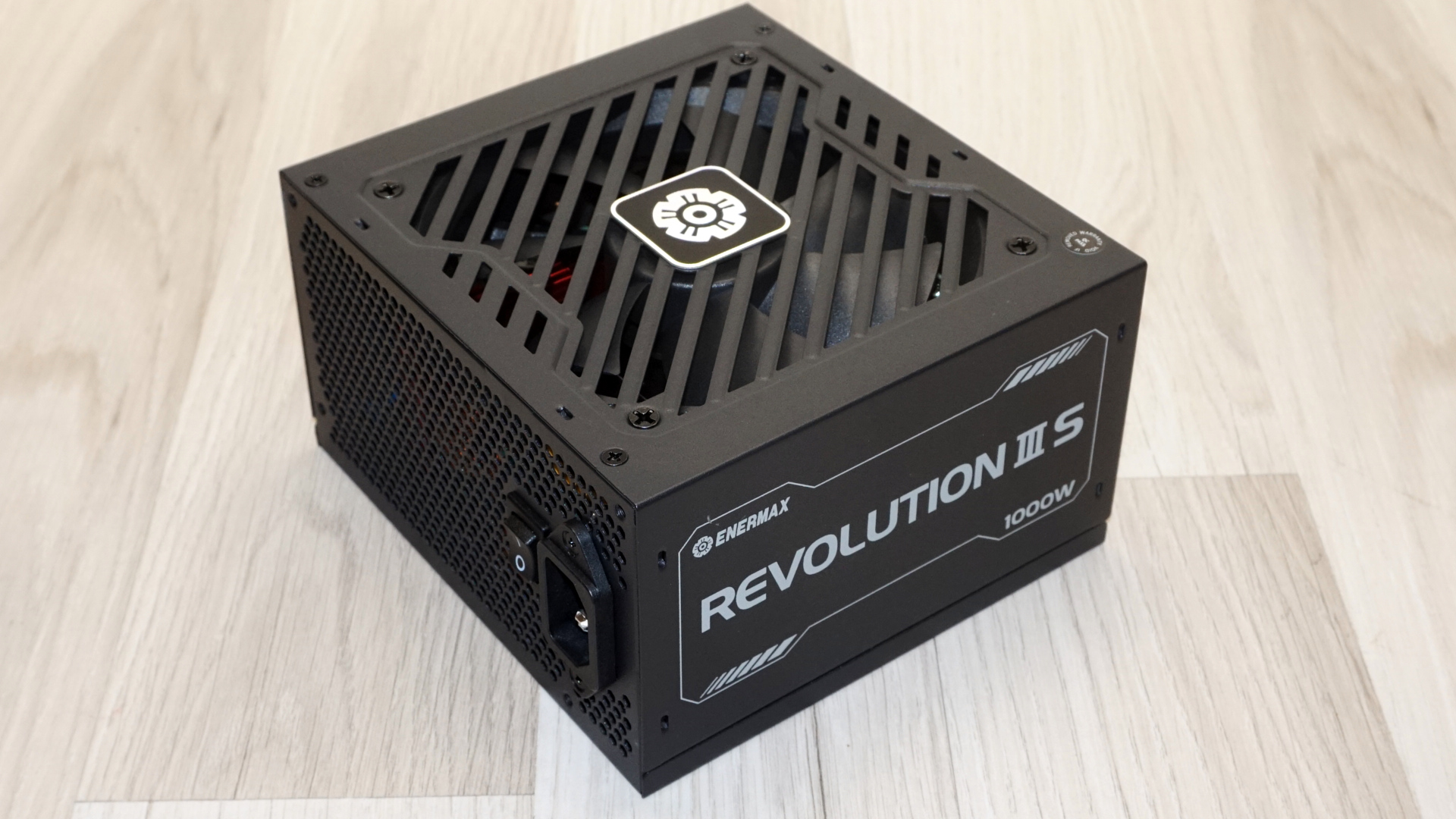
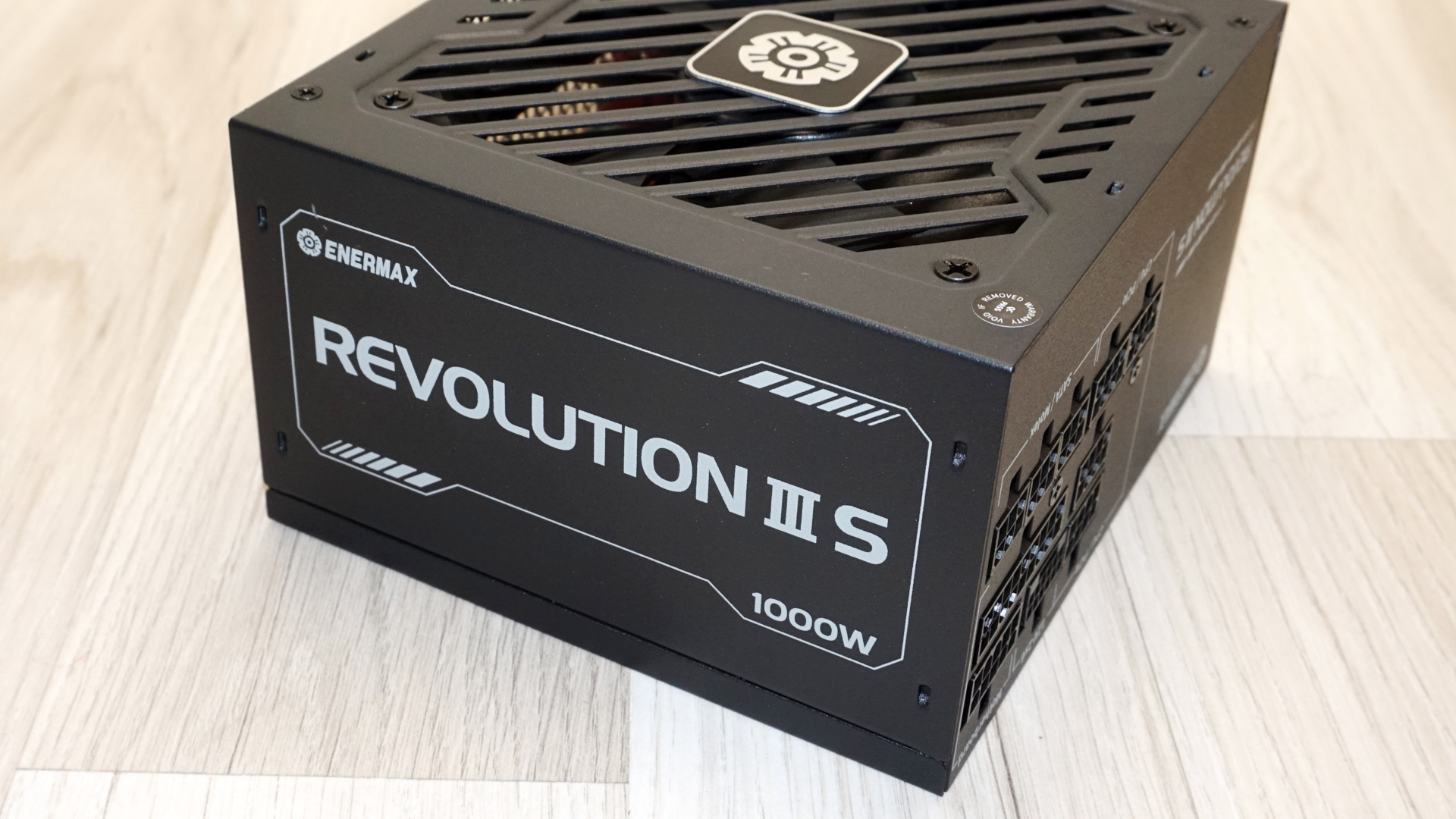
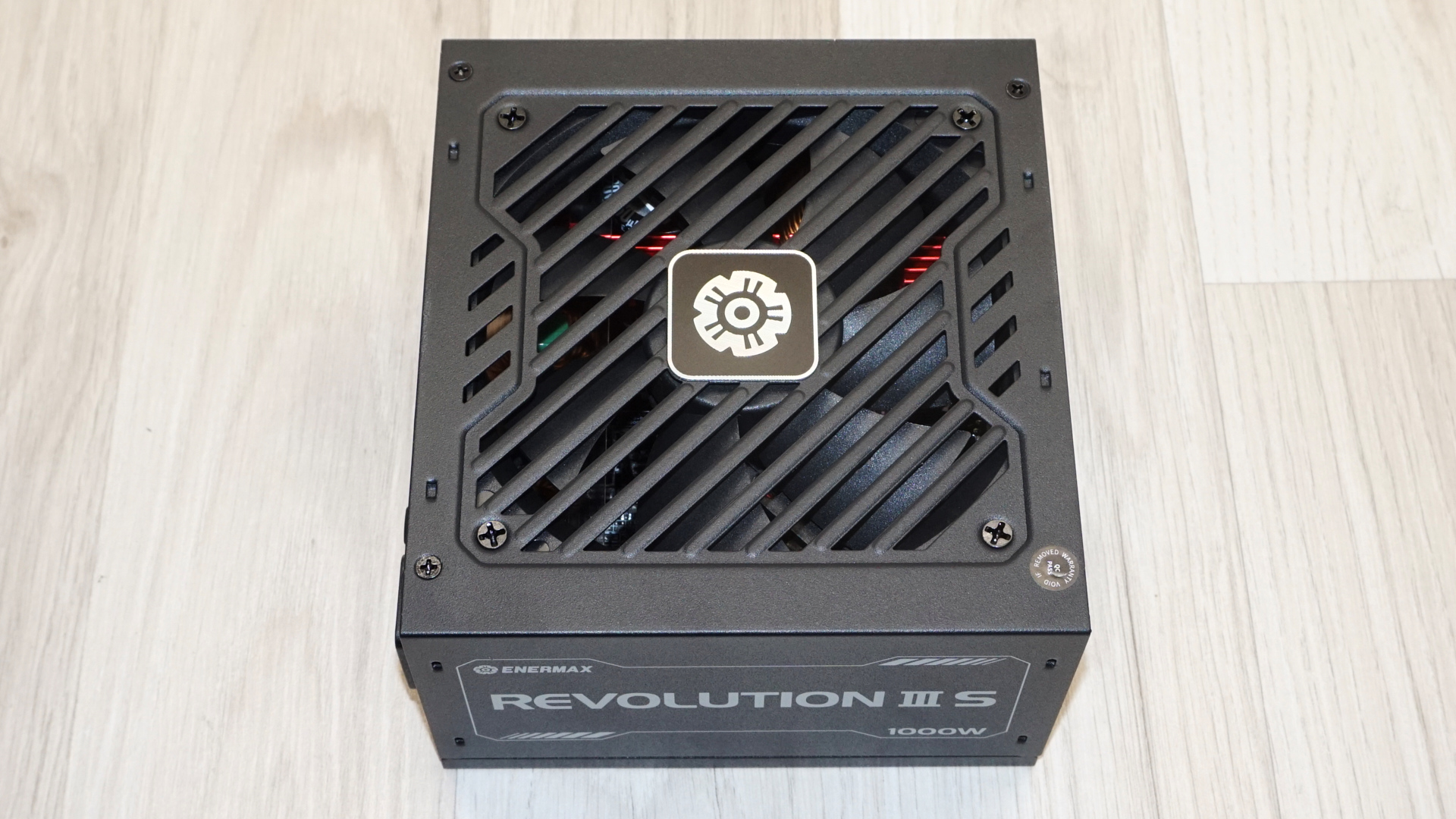
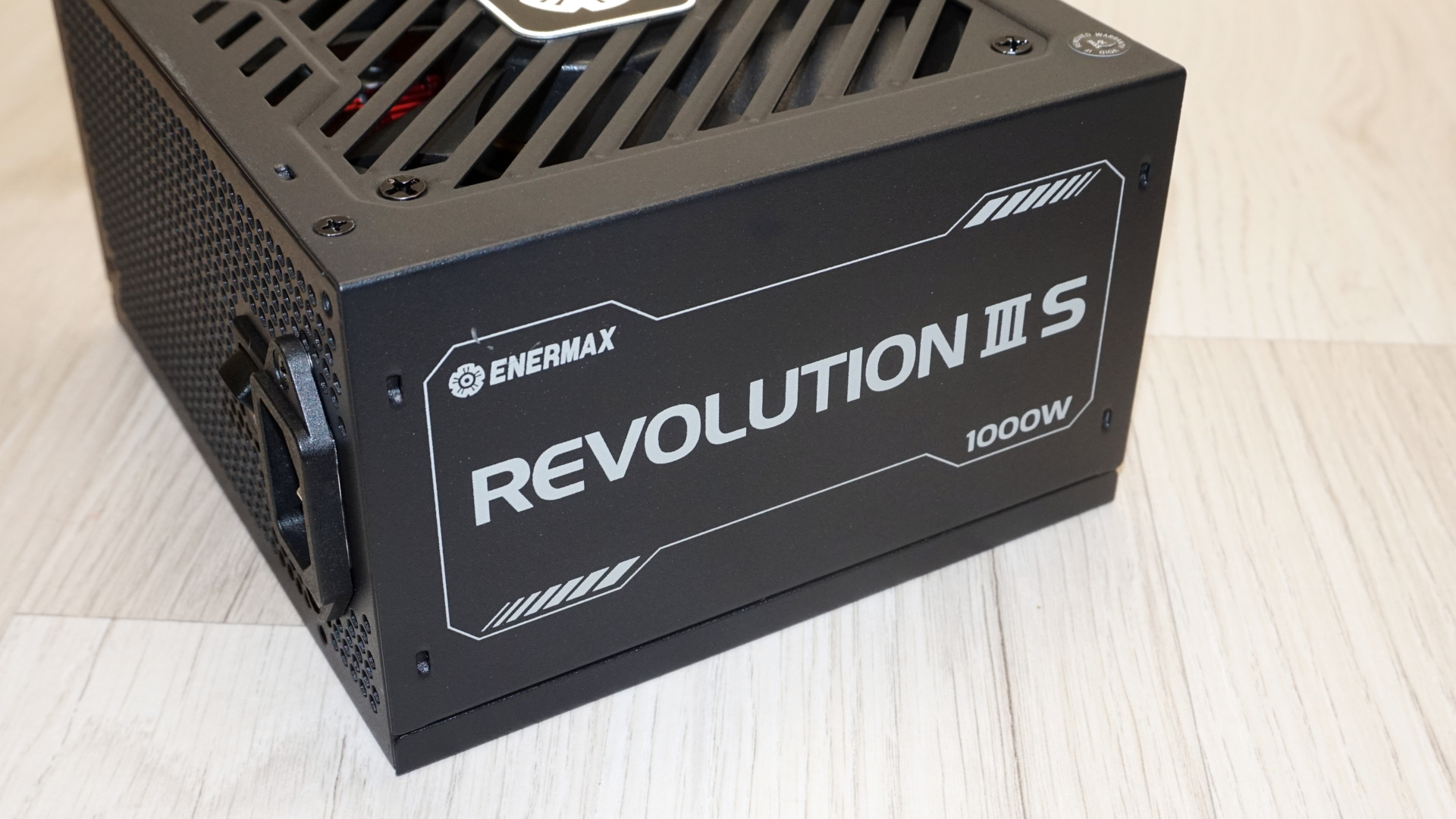
The chassis carries a lightly textured black paint finish, applied evenly and cleanly. The overall design is just a little bit extravagant. We have clean surfaces, white decorative etchings with the company logo and series name on the side panels, and a specification sticker on top. The diagonal cutout fan finger guard is integrated into the chassis rather than being a separate, removable component, and the Enermax logo sits directly above the fan motor. It is a slightly aggressive, premium-feeling exterior. A white version is also available for those building in lighter-themed systems.
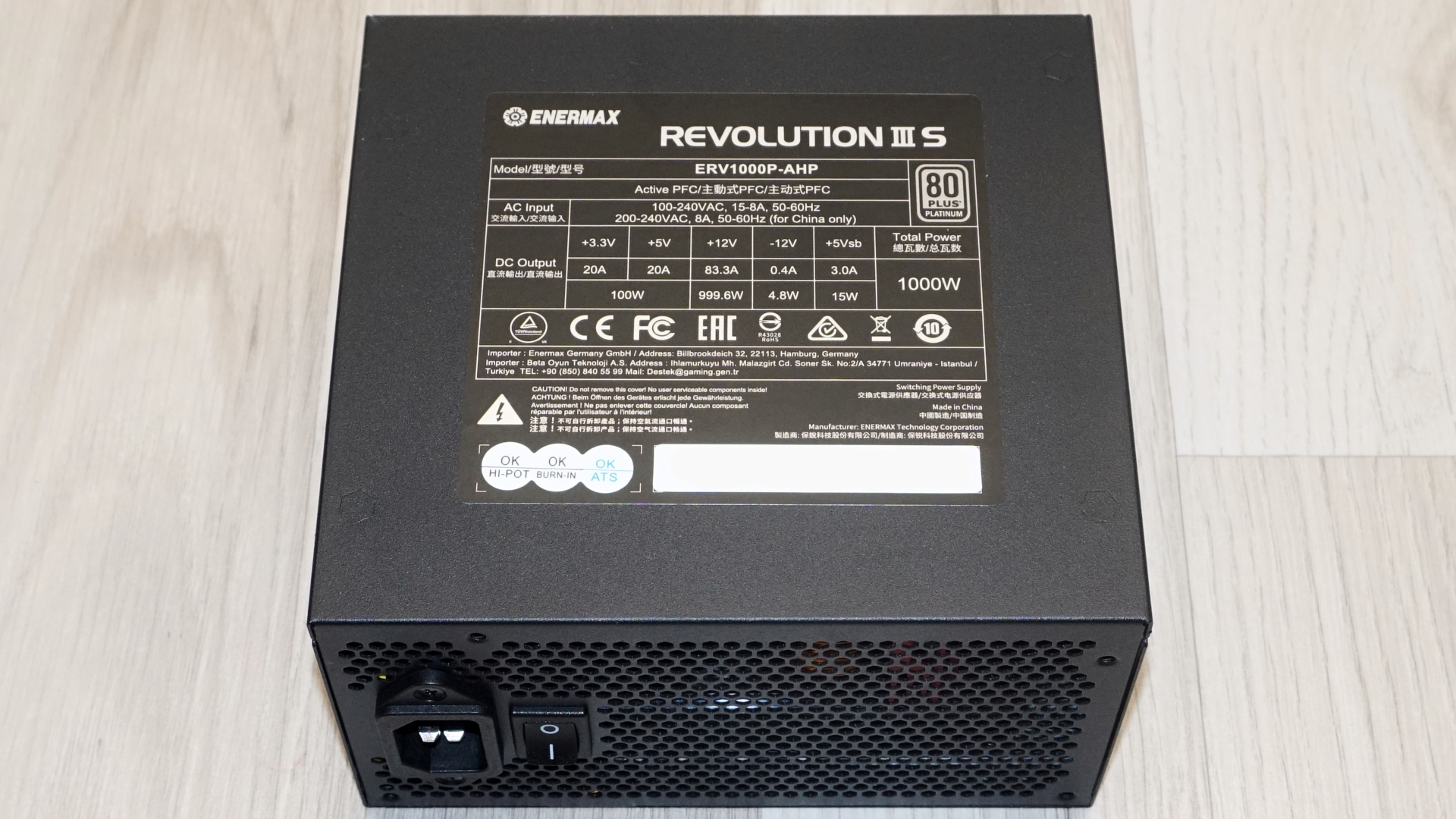
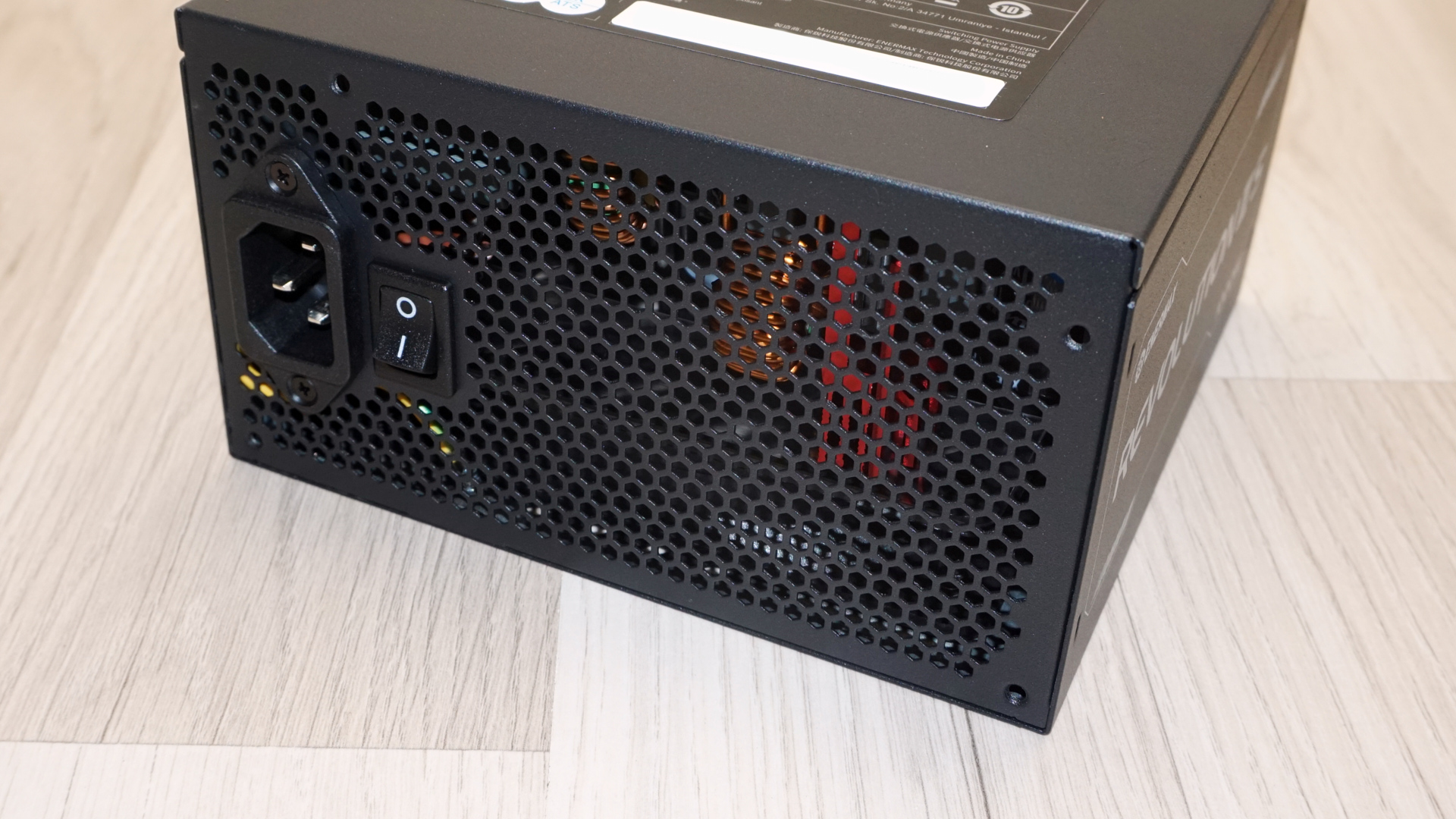
The front holds the power switch and AC receptacle without additions — no secondary switches, no mode selectors. The rear panel carries the modular connectors with a printed white legend alongside the company and series branding.
Internal Design
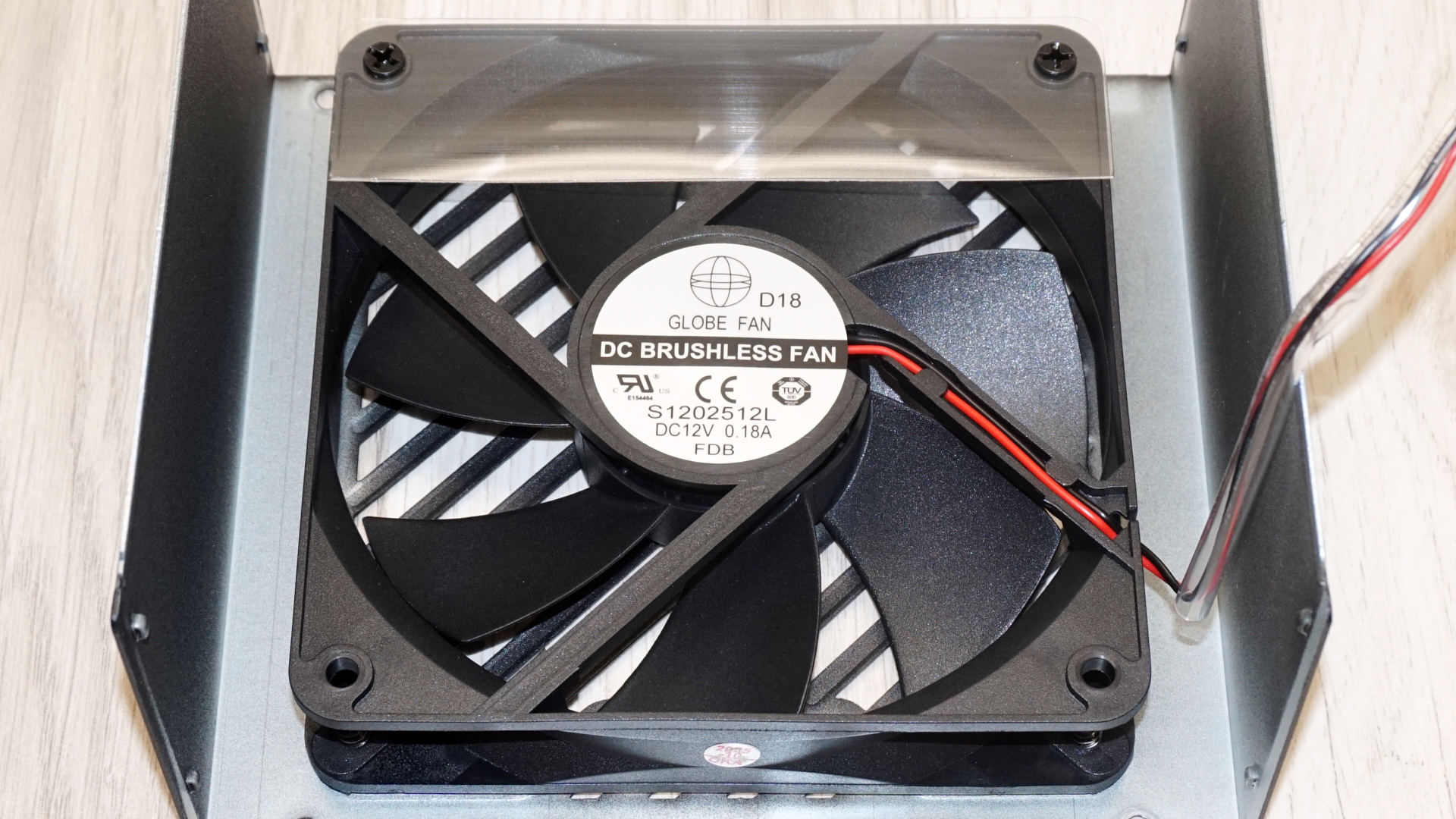
A Globe S1202512L 120mm fan with a fluid dynamic bearing engine handles the active cooling of this unit. FDB designs occupy a practical middle ground between the longevity of dual ball bearings and the quietness of sleeve bearings. The rated maximum is 1800 RPM, which is on the conservative side for a 1000W unit and intentionally so. It is the most significant functional departure from the Platimax II, which uses a larger 135mm fan with dual-ball bearings. The same 13-year warranty stands though.
The OEM is Shenzhen Ruishengyuan Technology (or RSY), which is a relatively new company, founded in 2014. The company is not a frequent name in PC PSU circles, but their assembly work has been appearing in mid-to-top-tier units across several established brands for several years now. The construction on this unit is tidy and the platform layout is logical.
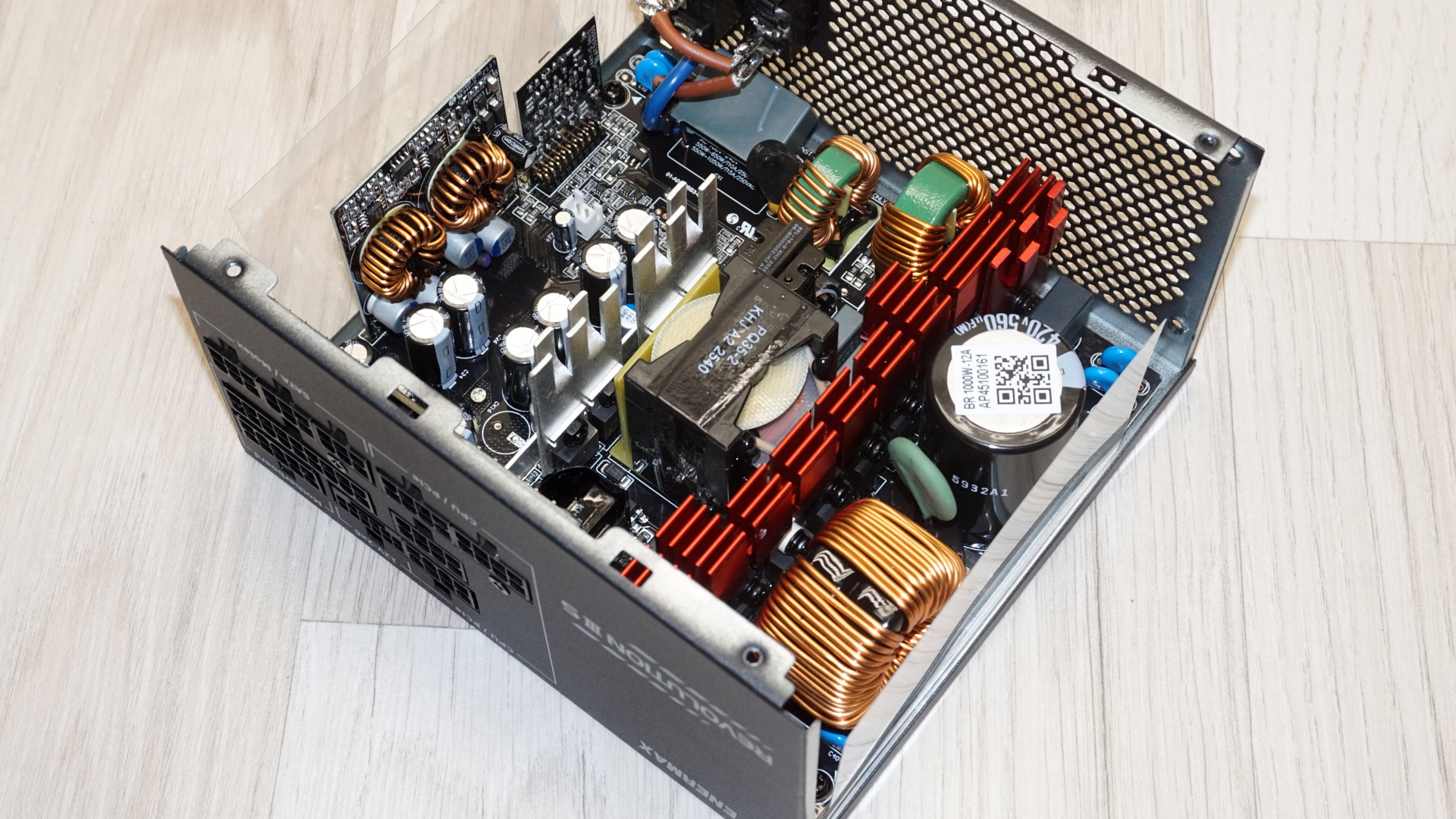
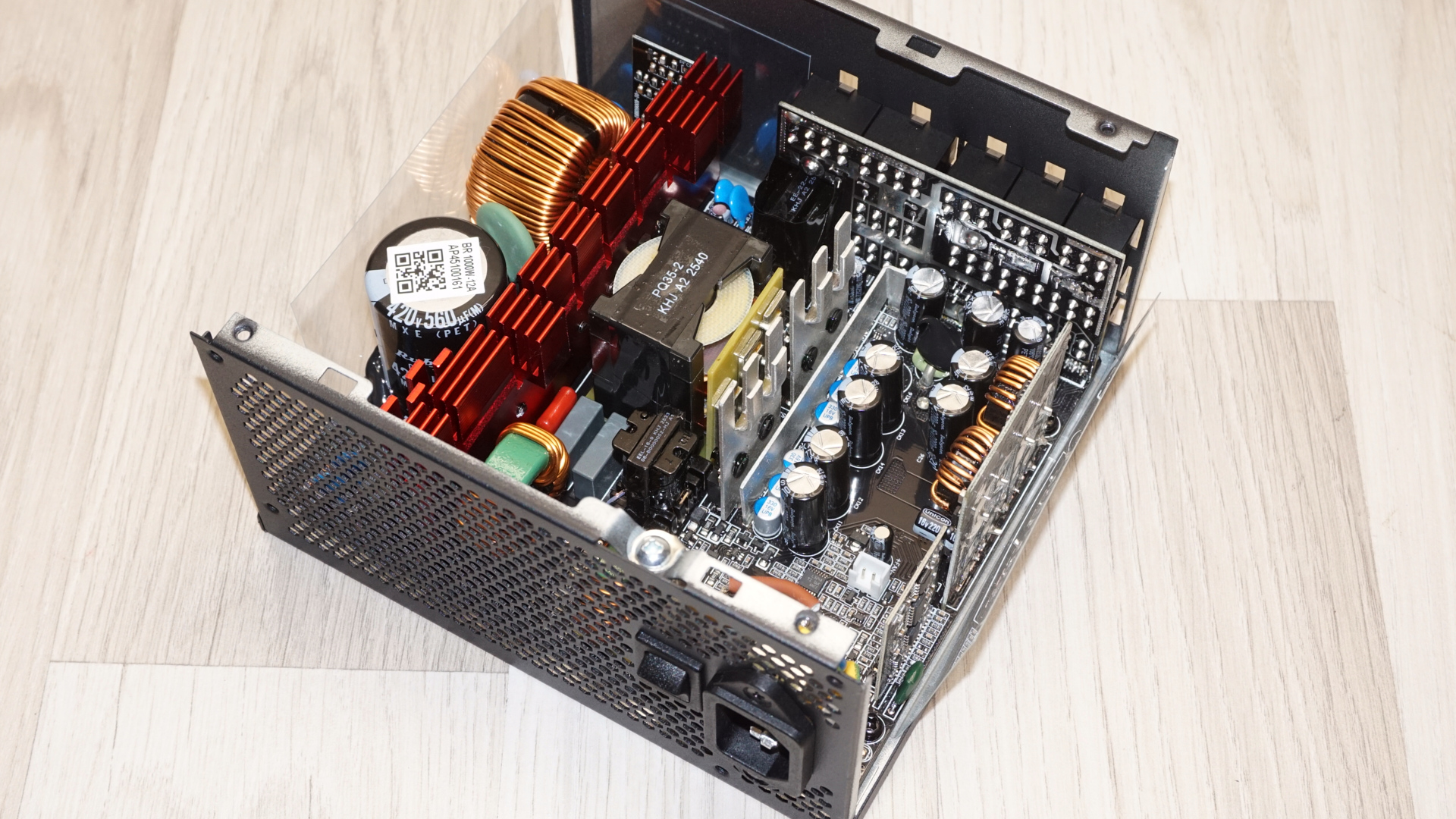
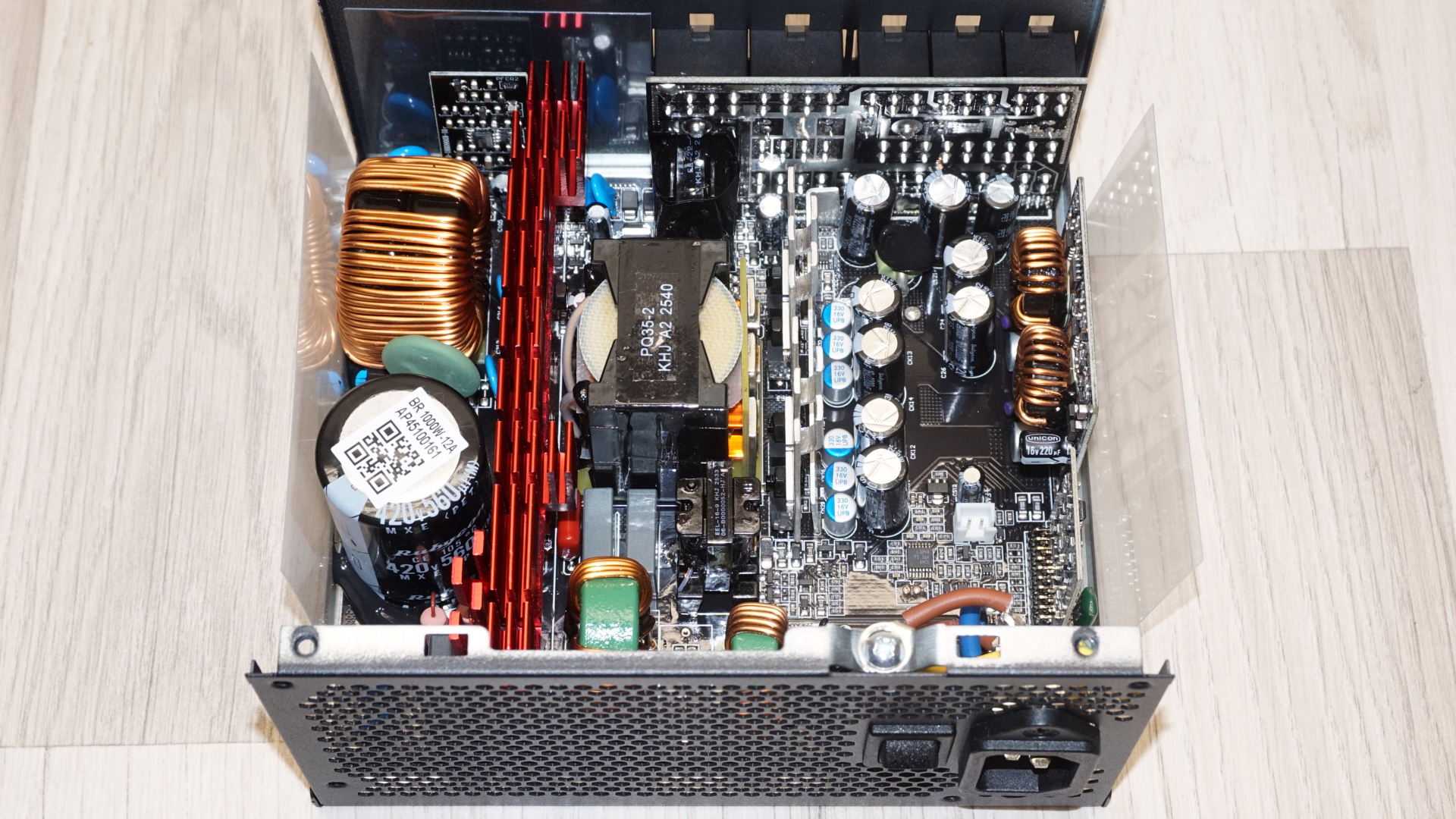
Input filtering is adequate, with four Y capacitors, two X capacitors, and two filtering inductors. A single rectifying bridge sits on a basic heatsink adjacent to the bulk capacitor. The APFC stage uses two Maple Semi SLF60R090E7 MOSFETs and a diode, with a large open inductor and a Rubycon 560μF capacitor handling the passive side.
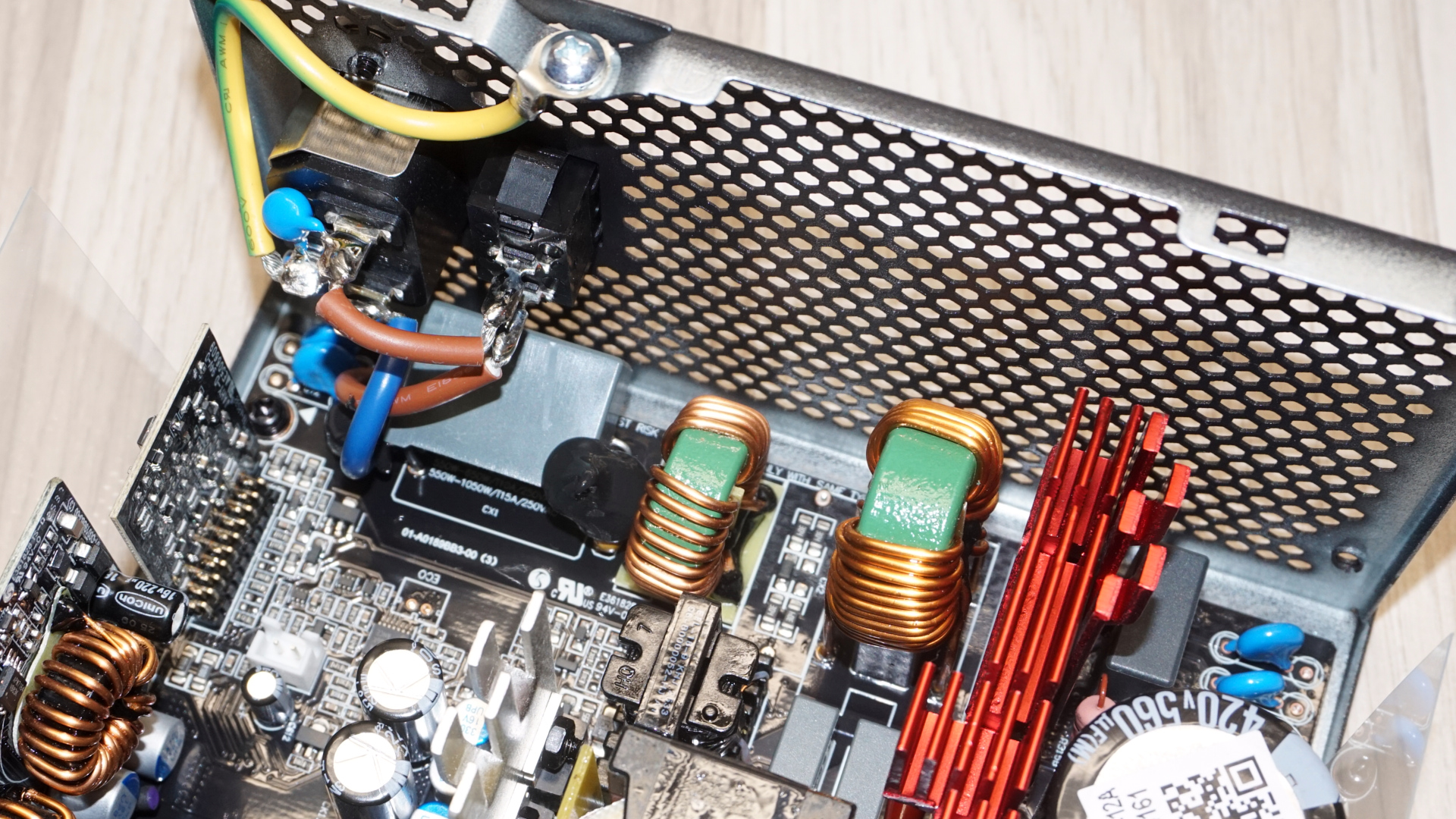
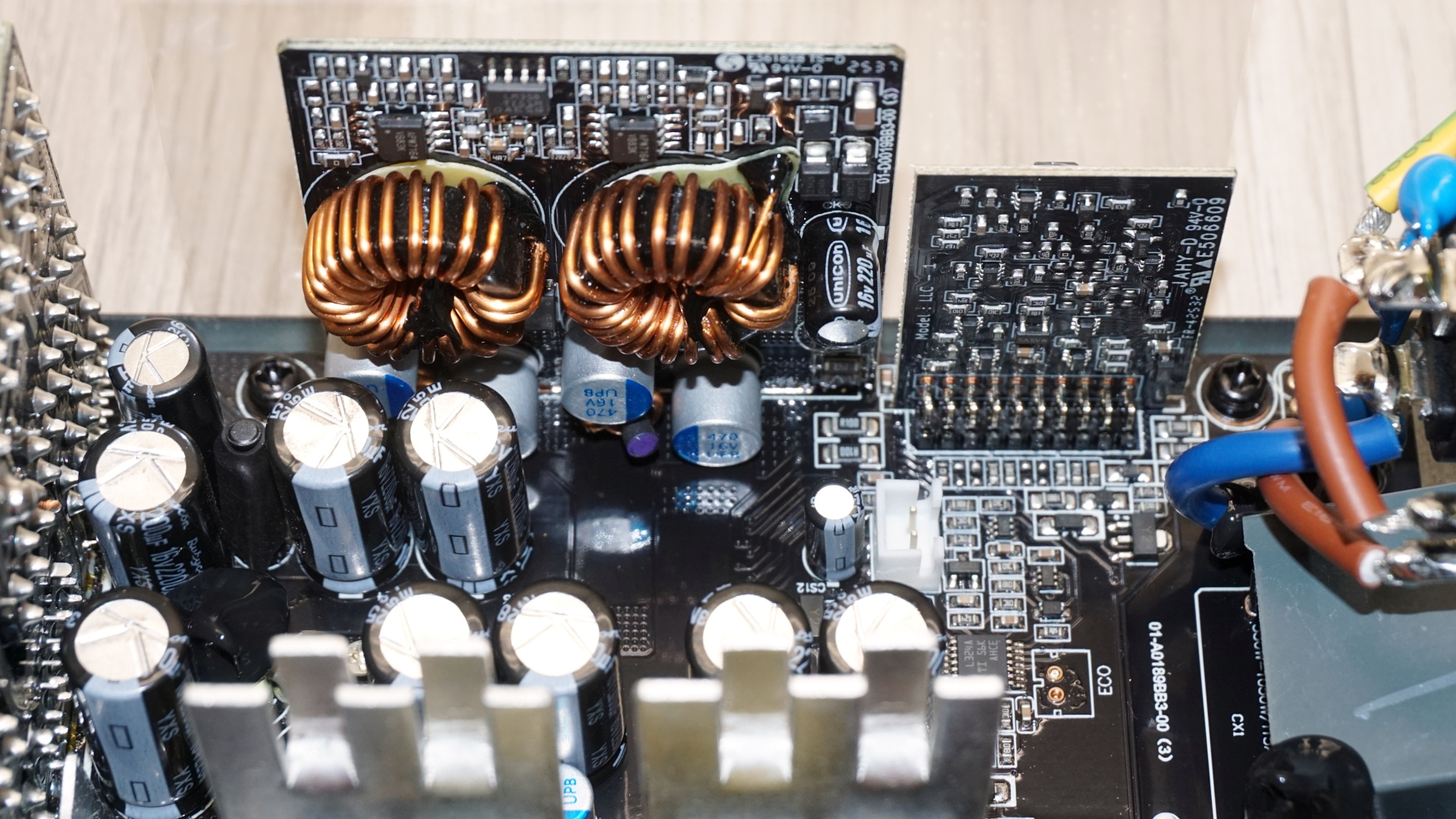
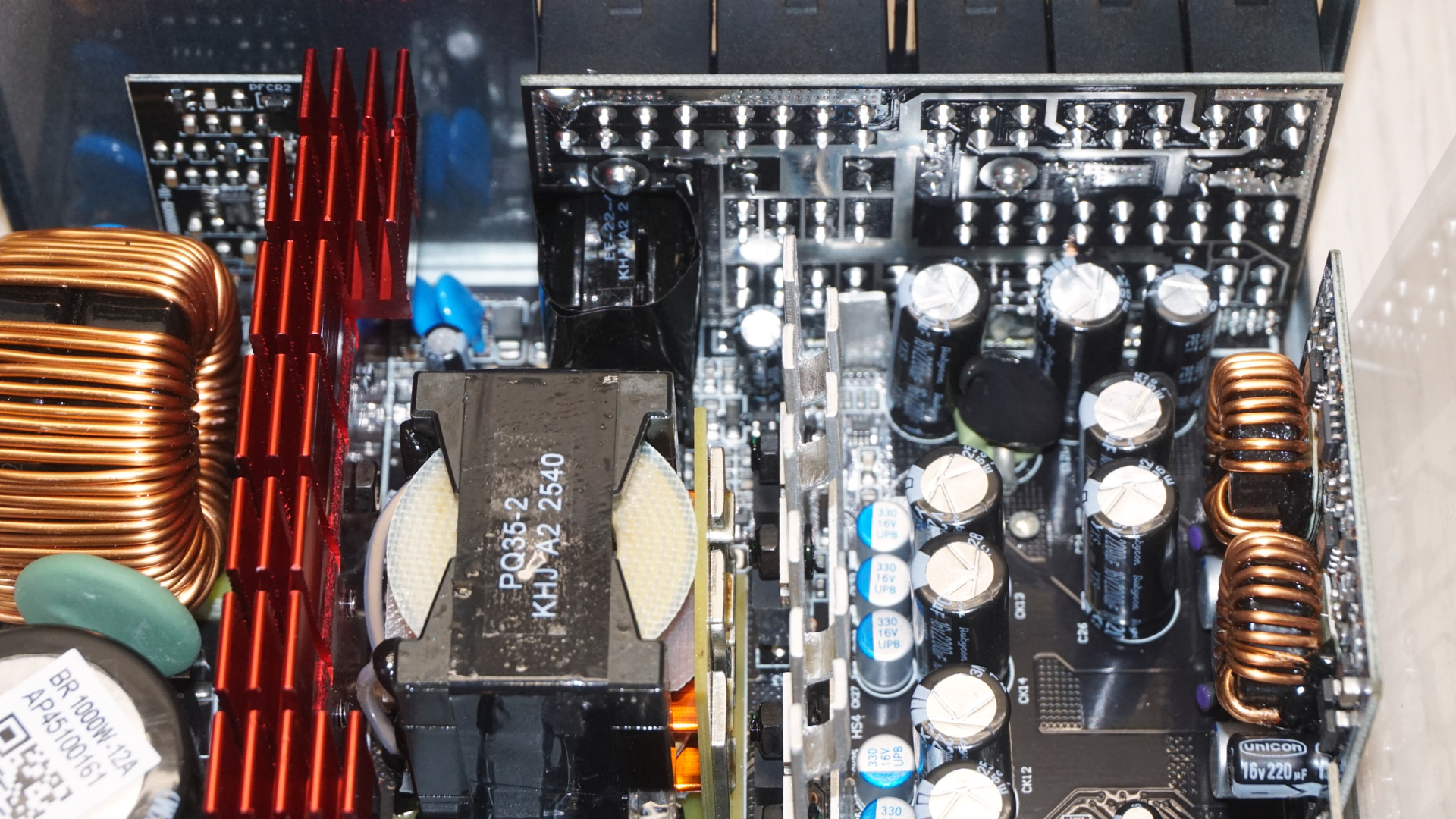
The primary inversion stage is a classic full bridge LLC topology using four Convert CS25N50FF MOSFETs, sharing a heatsink with the APFC active components. Four AGMSemi AGM4012C MOSFETs generate the 12V rail through synchronous rectification on the secondary side, mounted on simple silver heatsinks. The 3.3V and 5V rails are produced by DC-to-DC converters on a dedicated vertical daughterboard.
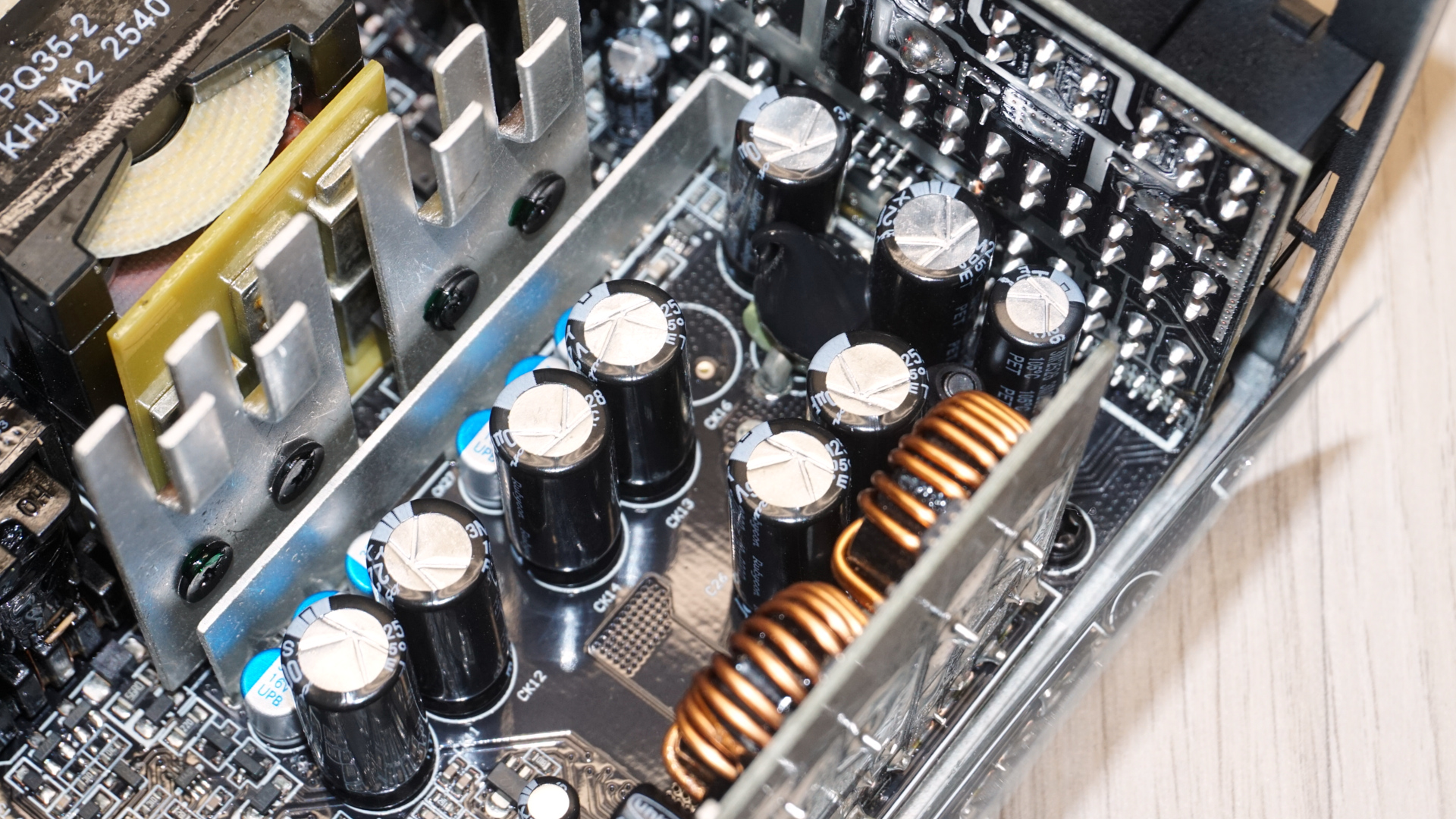
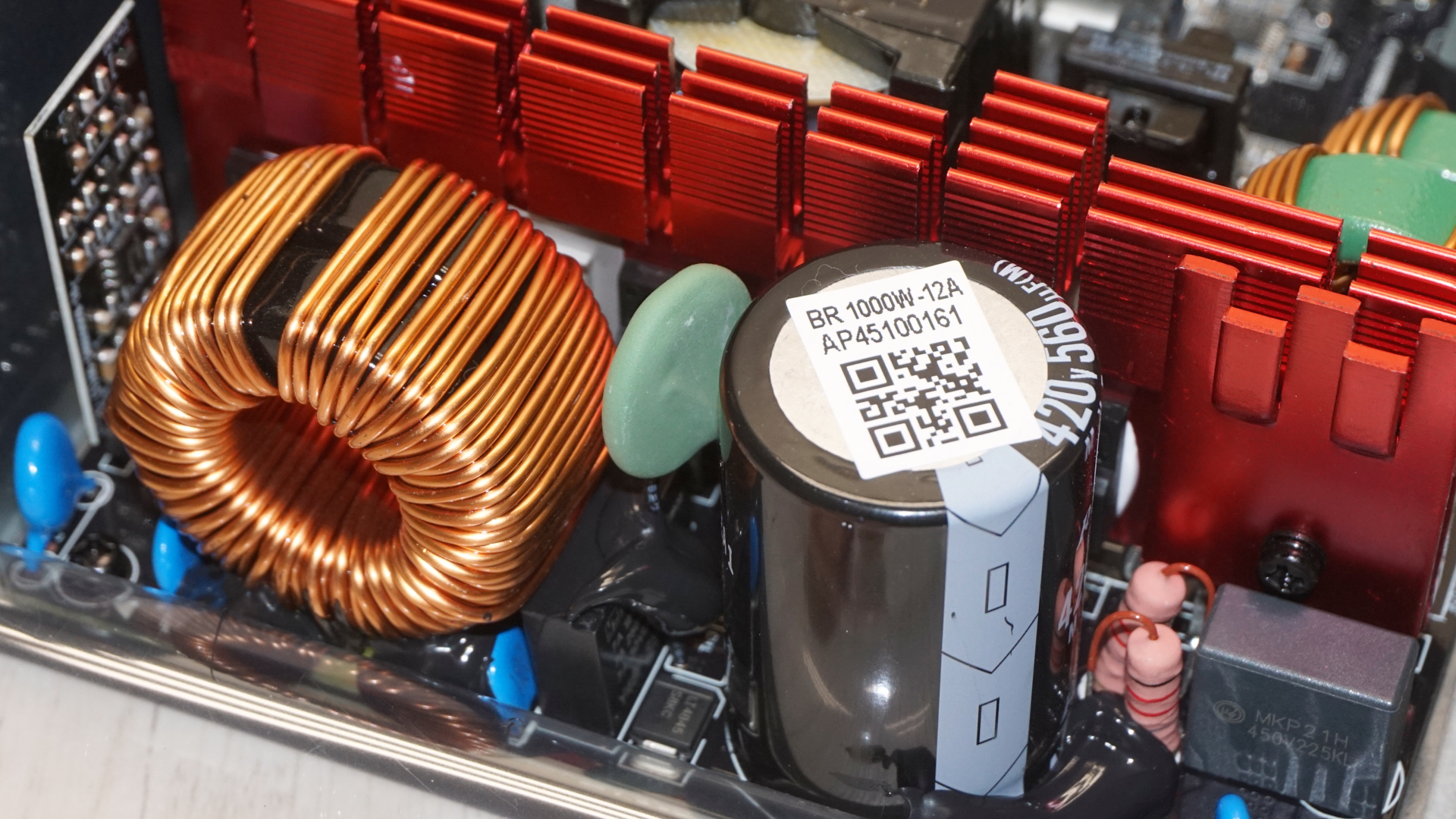
Secondary-side electrolytic capacitors come from Rubycon and Unicon, both Japanese and both well-regarded. Solid-state capacitors are sourced entirely from Unicon. The capacitor selection lives up to Enermax's marketing language.
Cold Test Results
Cold Test Results (25°C Ambient)
For the testing of PSUs, we are using high precision electronic loads with a maximum power draw of 2700 Watts, a Rigol DS5042M 40 MHz oscilloscope, an Extech 380803 power analyzer, two high precision UNI-T UT-325 digital thermometers, an Extech HD600 SPL meter, a self-designed hotbox and various other bits and parts.
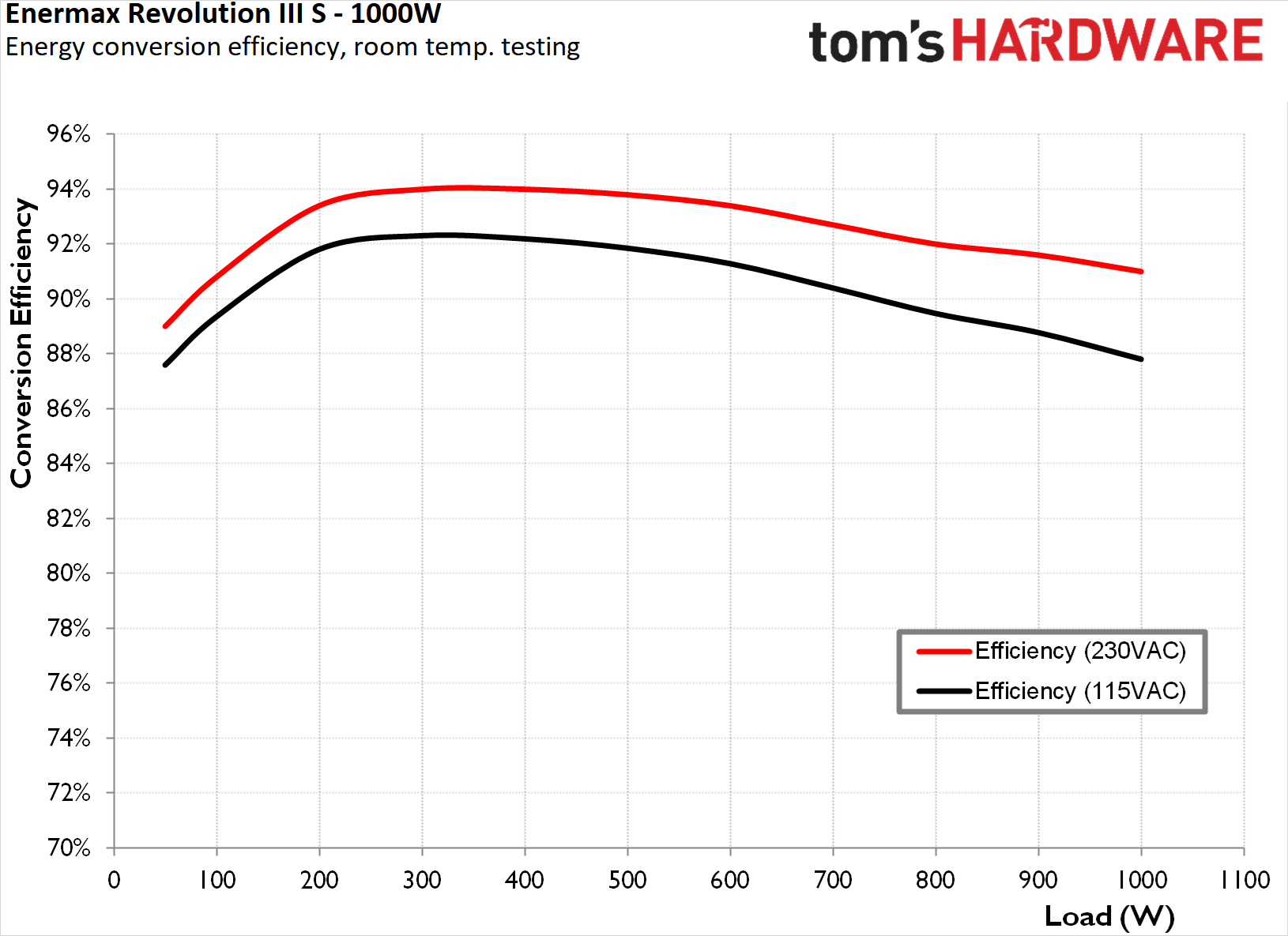
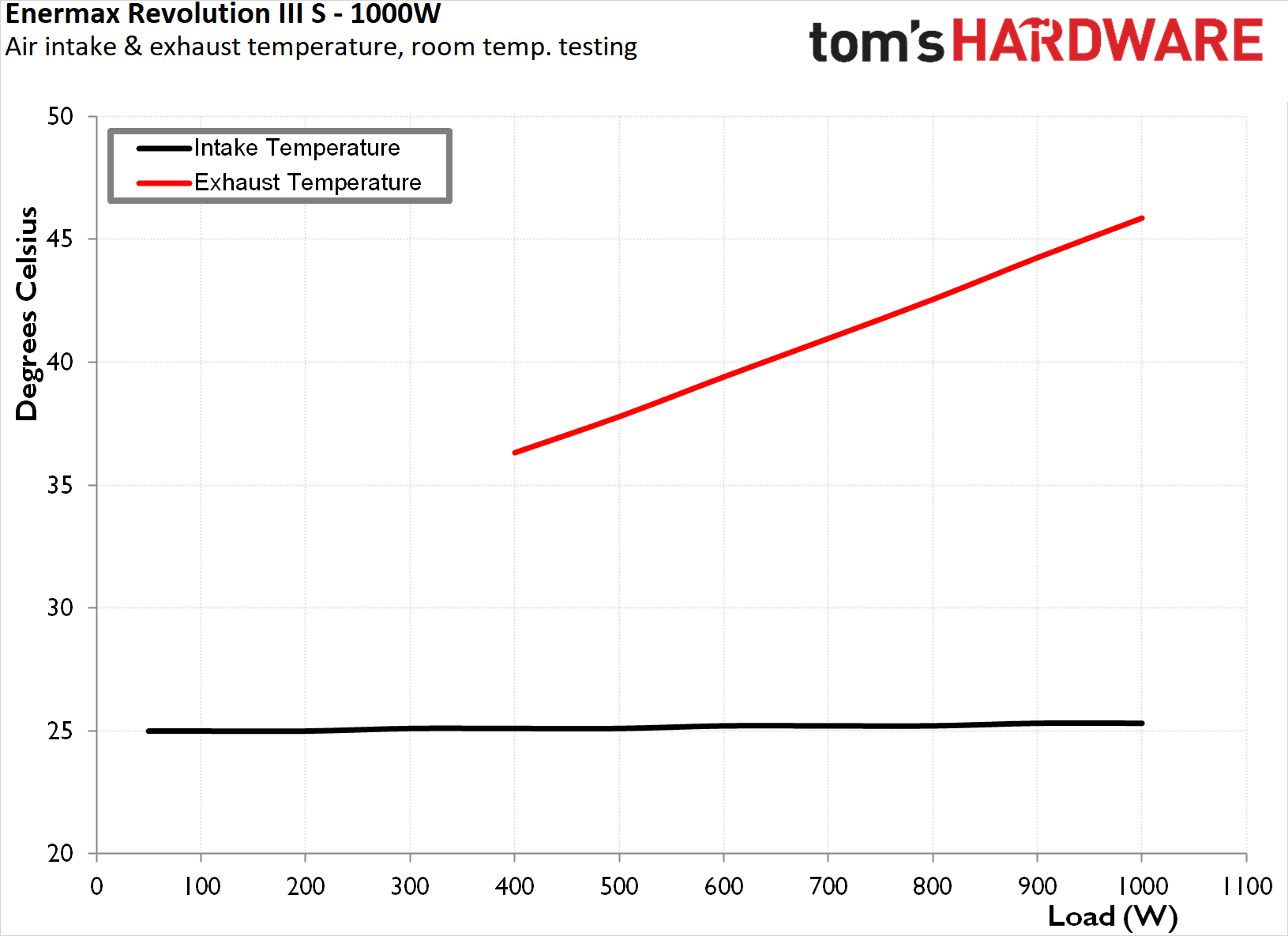
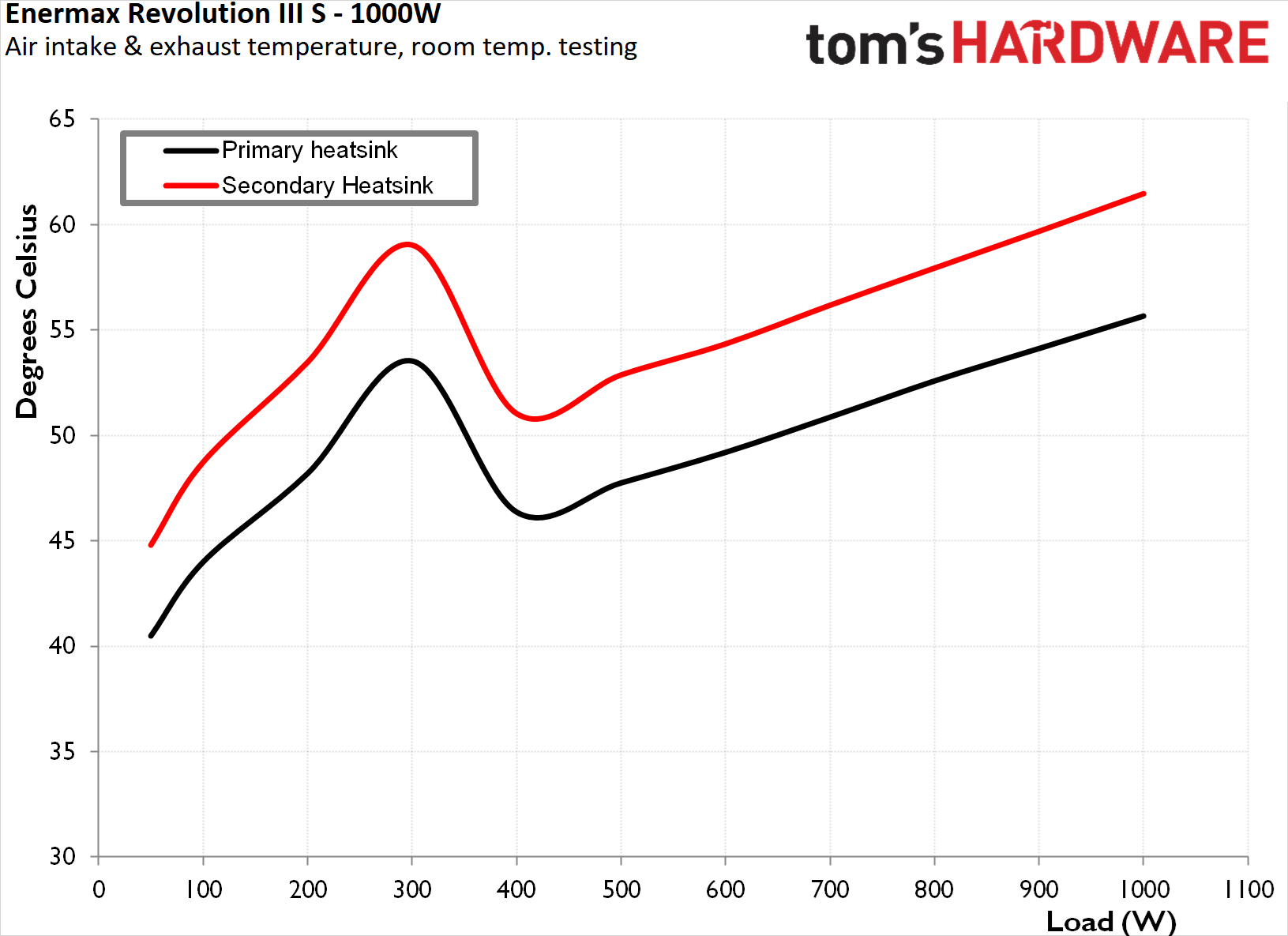
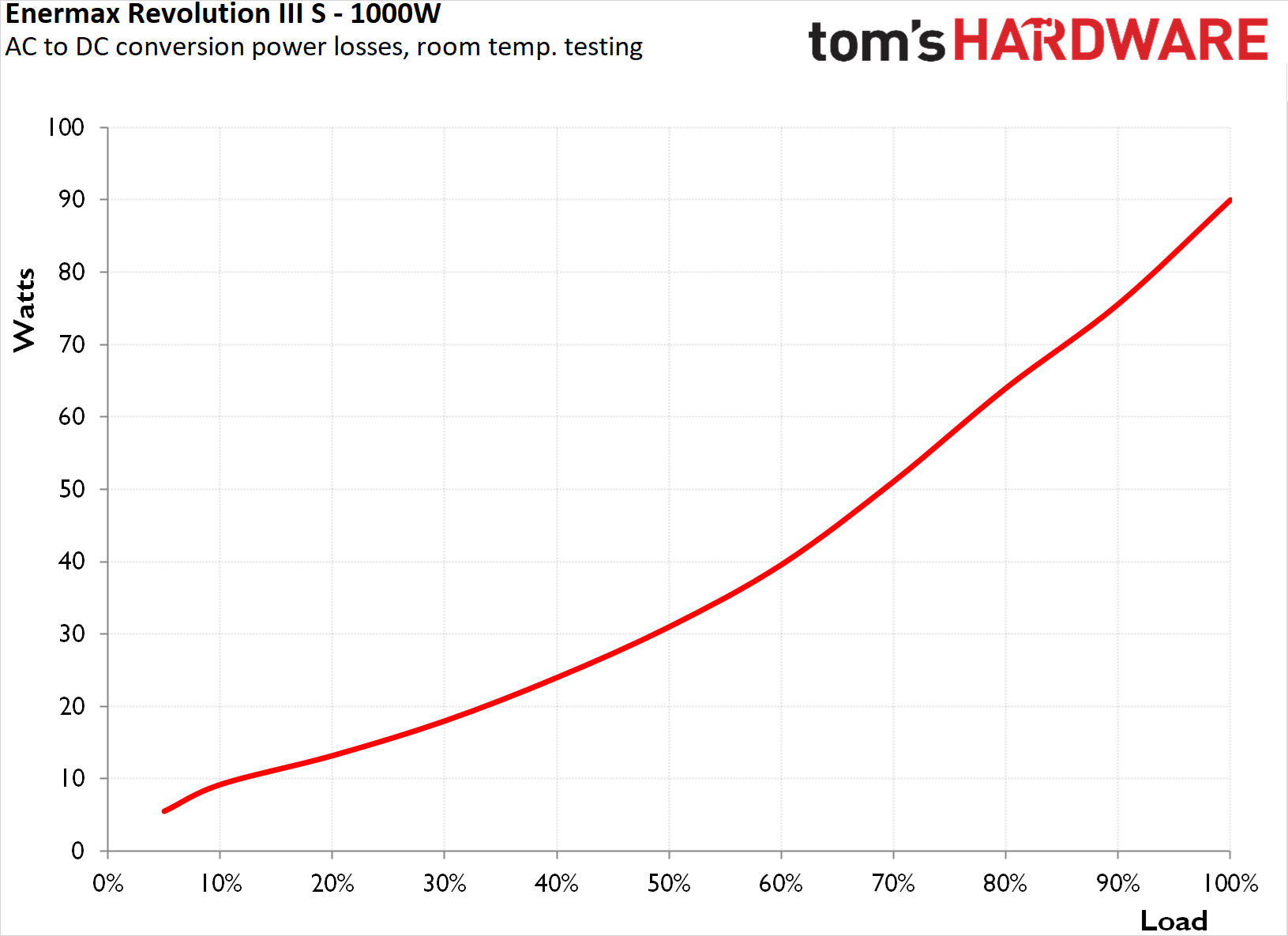
At 115 VAC, average efficiency across the nominal load range is 90.5%. At 230 VAC, it rises to 92.7%. Both figures satisfy the Platinum standard as certified by Clearesult (80Plus), Cybenetics, and PPLP.Info — triple certification that is not a routine achievement. Low-load efficiency is quite good, and the overall efficiency curve is stable across the full range. The peak lands around 40% load, which is typical of well-optimized platforms.
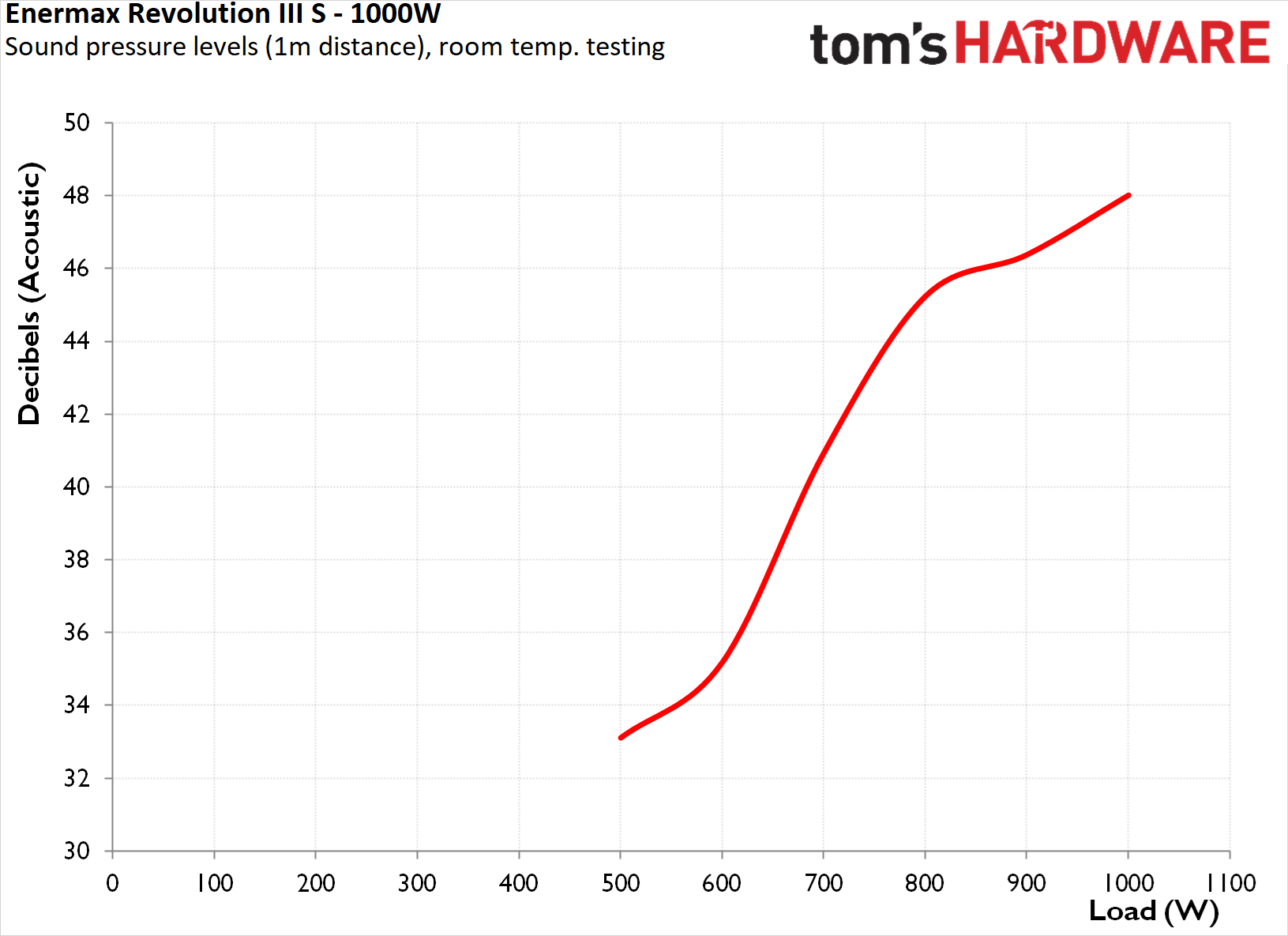
The fan remains stationary until load crosses approximately 400 Watts. Once the fan engages, speed rises inaudibly at first, but picks up meaningfully after 600 Watts. Thermal performance under these conditions is fair rather than exceptional, reflecting the constraint of the smaller fan.
Hot Test Results
Hot Test Results (~45°C Ambient)
Efficiency degradation under elevated ambient temperature is significant. At 115 VAC, average nominal efficiency drops to 87.5%. At 230 VAC, the figure falls to 89.6%. The 3.1% efficiency drop is massive and a rare sight in an advanced PC PSU. Signs of thermal stress become visible at full load, where the fan is unable to assist.
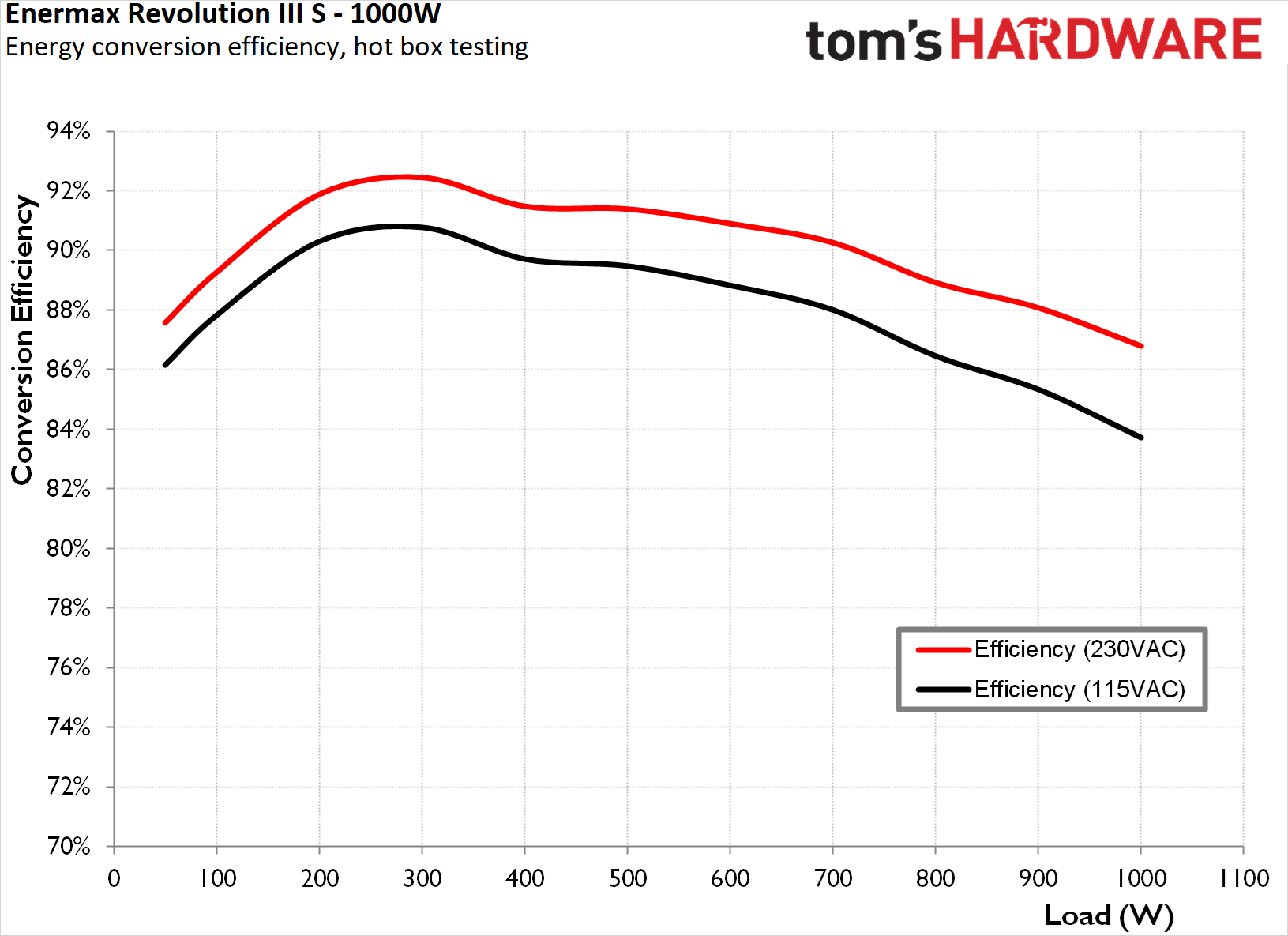
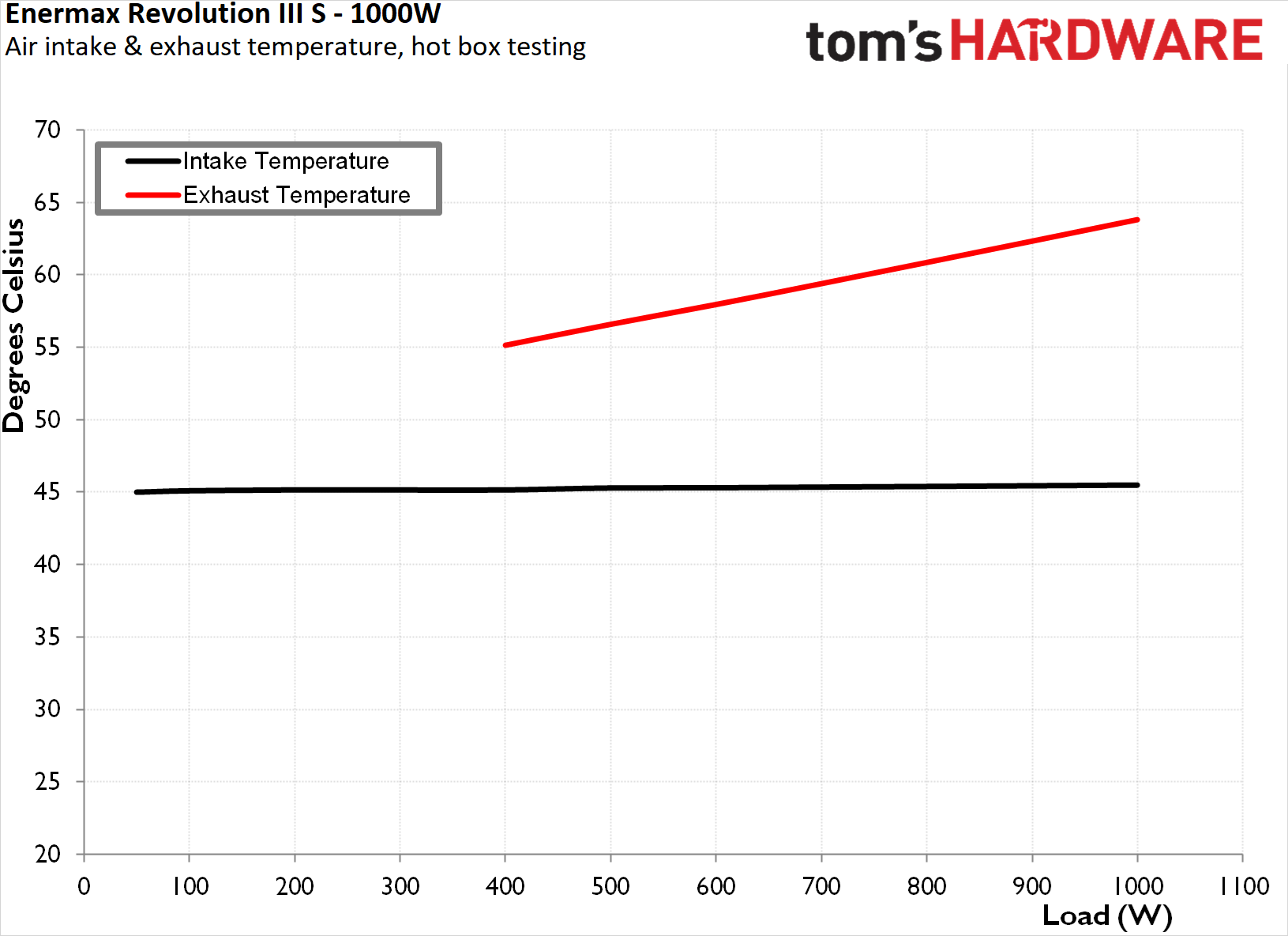
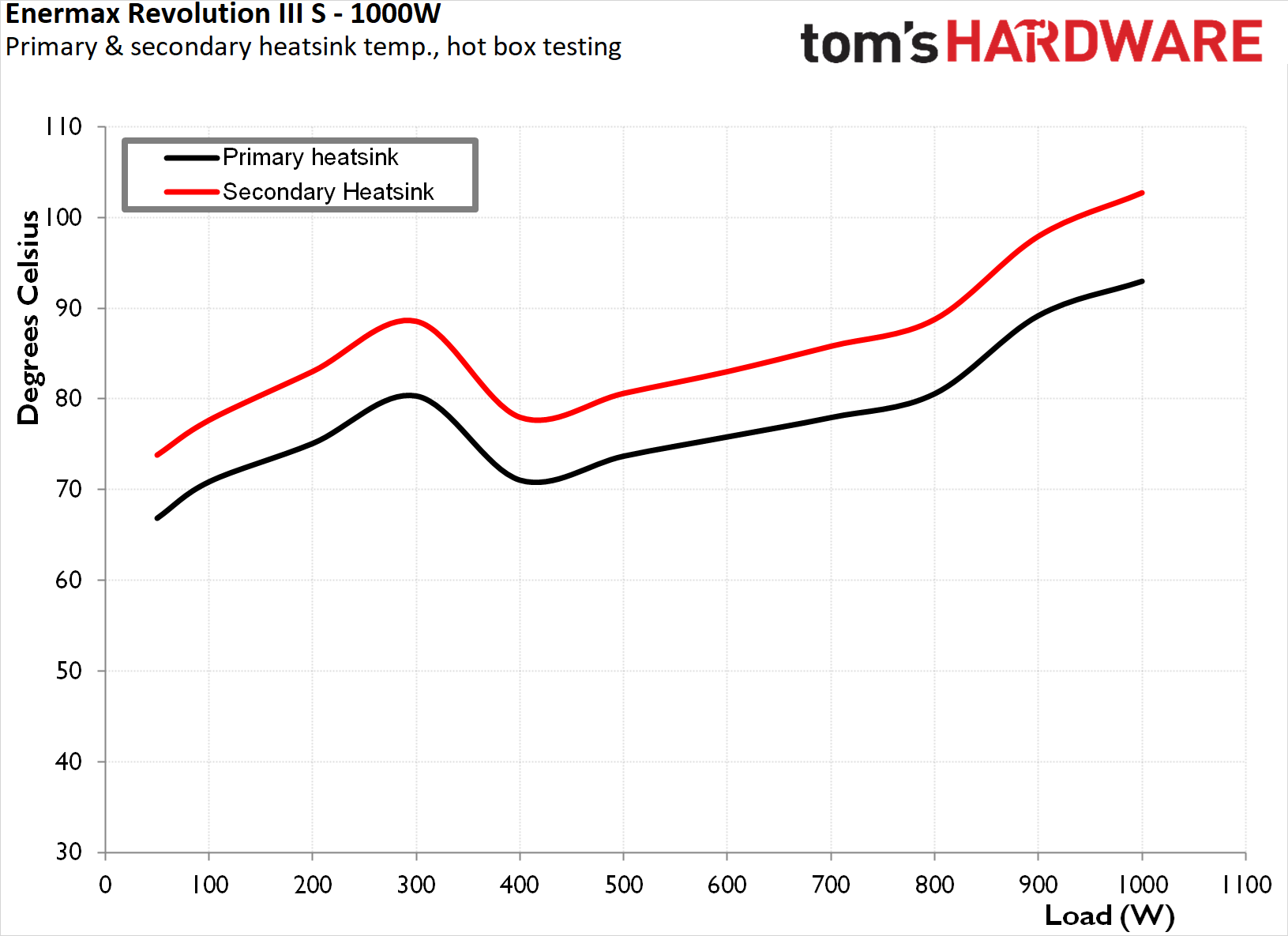
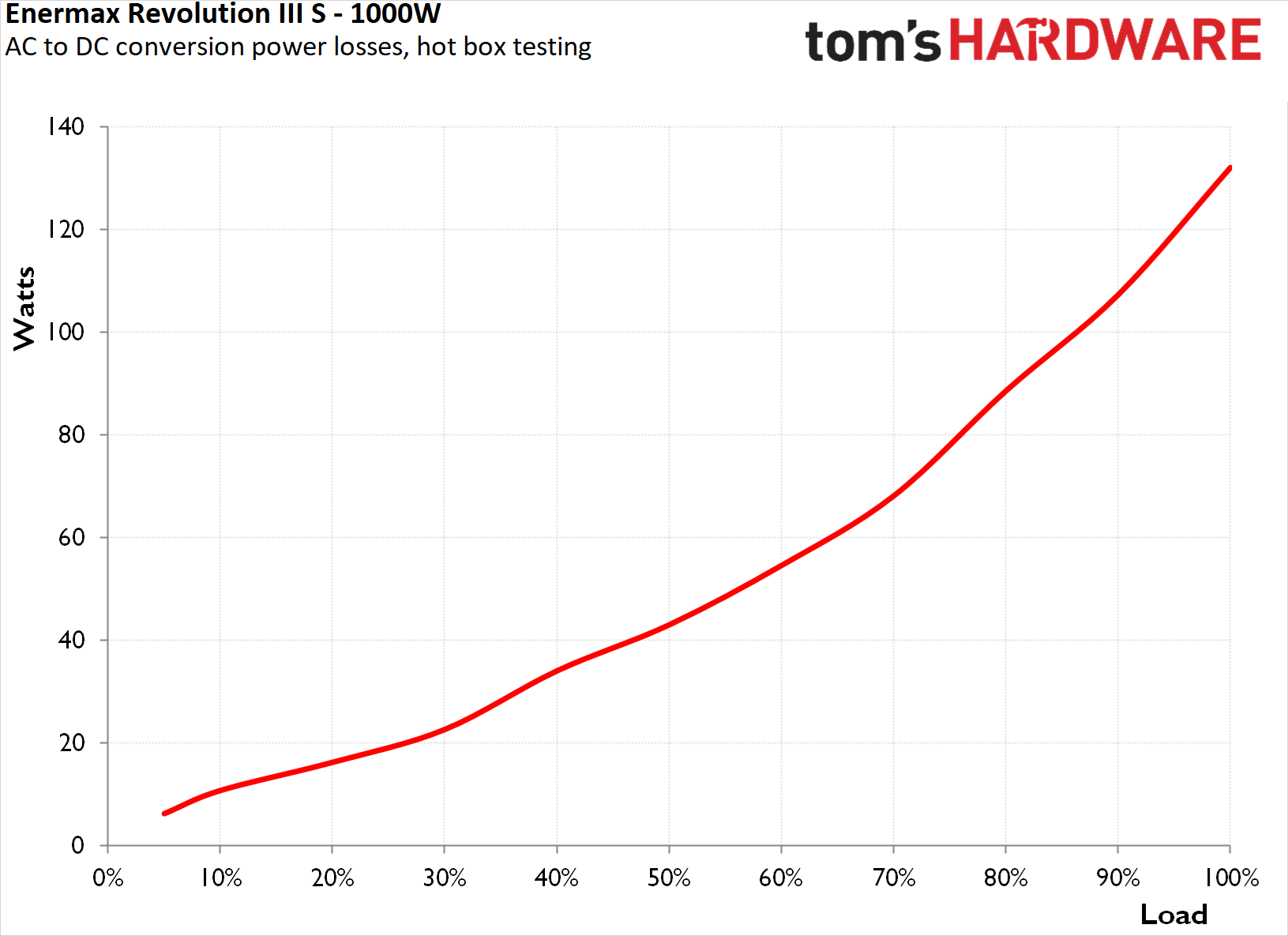
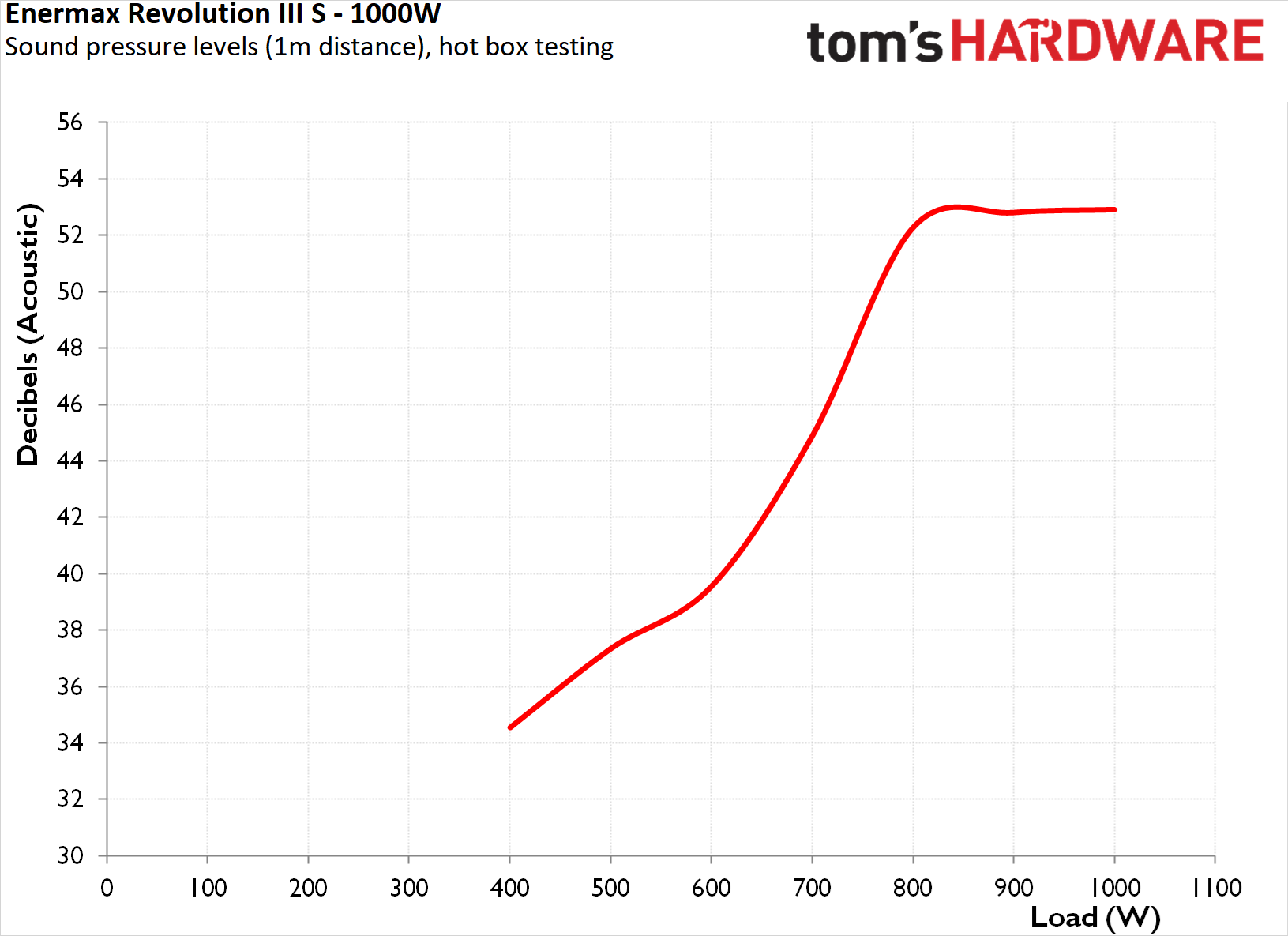
The fan engages at roughly the same 400W threshold as in cold testing, but speed increases much more rapidly. The unit reaches maximum fan speed at approximately 80% load rather than at full output. Due to this limitation, internal temperatures rise faster above that 80% point as the fan cannot do anything to help, though they stay within safe limits and no over-temperature protection event occurred during testing. Buyers intending to run this unit consistently at high load in a warm environment should factor that in.
PSU Quality and Bottom Line
Power Supply Quality
Voltage regulation is very good by current standards. The 12V rail holds to within 1.0% across the load range, the 5V rail to 1.5%, and the 3.3V rail to 1.4%. These are competitive figures for a unit of this class. Ripple suppression is more ordinary. The 12V rail peaks at 52 mV, the 5V rail at 26 mV, and the 3.3V rail at 26 mV. All figures sit comfortably within the ATX specification limits of 120 mV on the 12V rail and 50 mV on the minor rails, but this is not the class-leading suppression seen in the top-performing units at this price. It is acceptable but in no way impressive.
During our routine evaluation, we examine the fundamental protection features of all power supply units we review, including Over Current Protection (OCP), Over Voltage Protection (OVP), Over Power Protection (OPP), and Short Circuit Protection (SCP). Protection circuit behavior is broadly reasonable. The 3.3V and 5V rails trigger OCP at 140% of rated current, which is adequate. The 12V rail OCP activates at 116%, a relatively tight margin that may warrant attention in transient-heavy loads. OPP under hot conditions triggers at 120% of rated output, appropriately conservative given that this is a unit showing thermal stress at full load. The settings feel deliberate and responsible, protecting the unit quickly if something is wrong.
Swipe to scroll horizontally
Load (Watts) | 202.98 W | Row 0 - Cell 2 | 506 W | Row 0 - Cell 4 | 754.61 W | Row 0 - Cell 6 | 1004.34 W | |
Load (Percent) | 20.30% | Row 1 - Cell 2 | 50.60% | Row 1 - Cell 4 | 75.46% | Row 1 - Cell 6 | 100.43% | Row 1 - Cell 8 |
| Row 2 - Cell 0 | Amperes | Volts | Amperes | Volts | Amperes | Volts | Amperes | Volts |
3.3 V | 1.85 | 3.43 | 4.62 | 3.42 | 6.93 | 3.39 | 9.24 | 3.38 |
5 V | 1.85 | 5.13 | 4.62 | 5.1 | 6.93 | 5.07 | 9.24 | 5.06 |
12 V | 15.39 | 12.16 | 38.47 | 12.13 | 57.71 | 12.06 | 76.94 | 12.04 |
Swipe to scroll horizontally
Line | Regulation (20% to 100% load) | Voltage Ripple (mV) | Row 0 - Cell 3 | Row 0 - Cell 4 | Row 0 - Cell 5 | Row 0 - Cell 6 | Row 0 - Cell 7 |
| Row 1 - Cell 0 | Row 1 - Cell 1 | 20% Load | 50% Load | 75% Load | 100% Load | CL1 12V | CL2 3.3V + 5V |
3.3V | 1.40% | 16 | 20 | 24 | 26 | 18 | 26 |
5V | 1.50% | 18 | 20 | 22 | 26 | 18 | 26 |
12V | 1% | 22 | 32 | 38 | 52 | 48 | 24 |
Bottom Line
The Revolution III S 1000W is a well-built, electrically competent unit that earns its Platinum rating without compromises on quality. RSY's assembly work is clean, the topologies are established and reliable, and the active components (despite coming from names that will not be recognized by most buyers) deliver what the platform demands. The capacitor selection is genuinely supplied by Japanese companies.
The electrical output quality is capable throughout the load range. Voltage regulation is acceptable on all three rails, and while the ripple suppression falls short of what the very best units at this price deliver, it stays well within specification at all times. The efficiency figures are consistent and well-behaved across the full load range, peaking near 40% and holding steady rather than sagging toward the extremes. Triple Platinum certification across Clearesult's 80Plus, Cybenetics, and PPLP.Info is a meaningful distinction, not a marketing formality.
The cable architecture, with one 12V-2x6 and four PCIe connectors that cannot all be deployed simultaneously due to the shared 12V-2x6 port, will not trouble every builder, but it needs to be understood before purchase. It is an unusual design choice on a 1000W unit, and it limits the appeal for anyone planning a multi-GPU system or a future upgrade path that demands a large number of connectors. The absence of cable combs is a minor but noticeable omission given the premium aesthetic the cables otherwise project.
The 120mm fan is the single most consequential compromise relative to the Platimax II. Under cold conditions it is quiet, well-controlled, and largely unobtrusive. Under sustained heavy load or if placed in a hot ambient environment, it spins up fast and becomes audible quickly - simply because it has no other choice. The thermal performance remains within safe limits throughout, but the acoustic result in worst-case operating conditions is not what buyers spending their money on a premium PSU will want to hear.
The 13-year warranty remains the most compelling single argument in this unit's favor. It is an extraordinary commitment in a market where 8 to 10 years is considered generous, and it is not a gesture made lightly. It also serves as an implicit reliability statement that no amount of marketing copy can replicate. At $170, the Revolution III S 1000W is fairly priced for what it delivers. It competes well on efficiency, build quality, and long-term confidence. For a high-end gaming or workstation build that will spend most of its operating life at moderate loads, it is a sound choice. Those planning sustained operation at full output in warm enclosures, or who need maximum cable flexibility for demanding multi-GPU configurations, should consider stepping up. For everyone else, this is a serious unit from a manufacturer that clearly believes in what it has built and does not ask for an arm and a leg for it.
MORE: Best Power Supplies
MORE: How We Test Power Supplies
MORE: All Power Supply Content









 English (US) ·