
SPOILER ALERT: The following story contains plot details from “No One’s Normal. It Just Looks That Way from Across the Street,” the series finale of “DTF St. Louis,” now streaming on HBO Max.
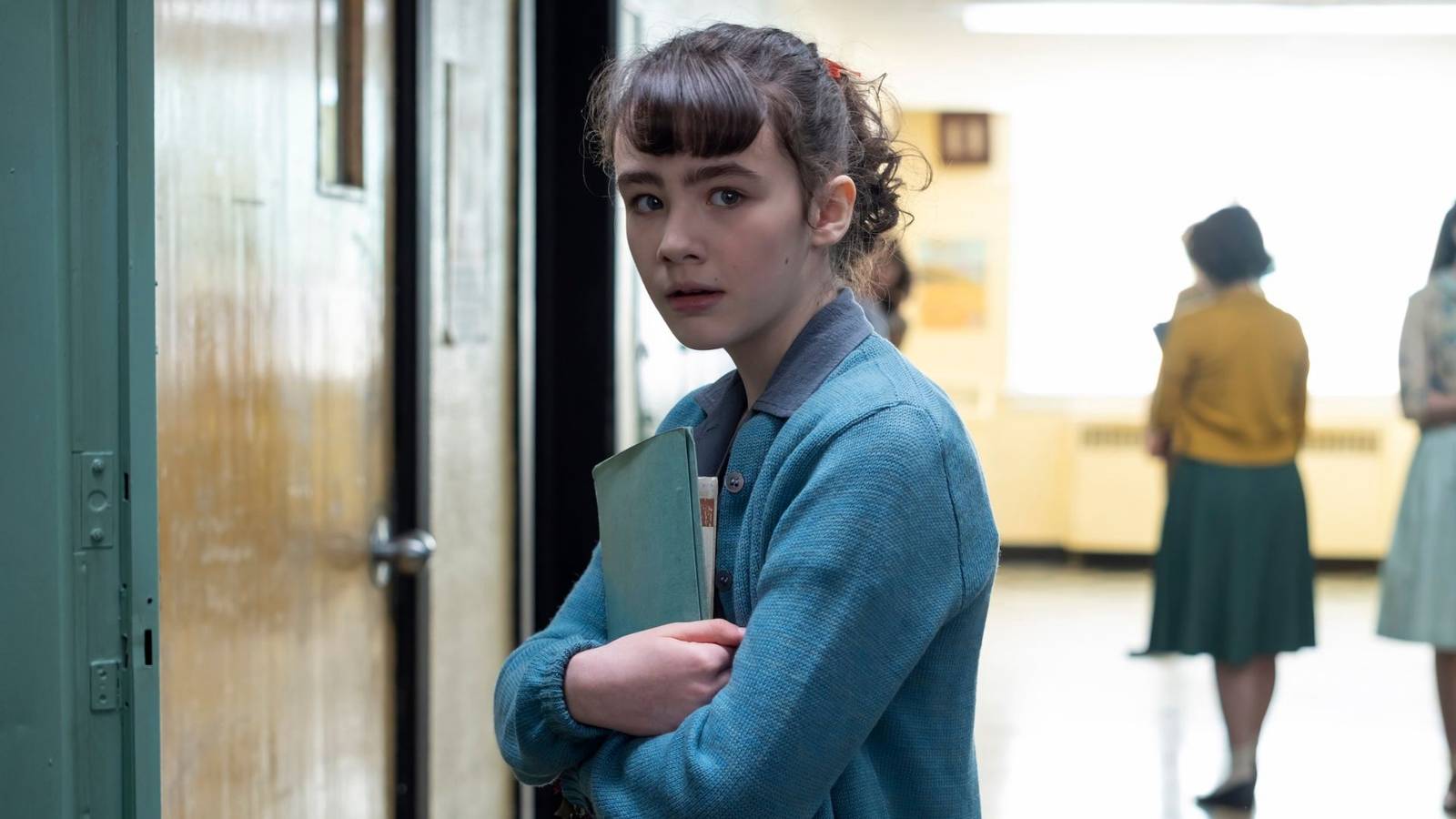
“DTF St. Louis” is not a conventional murder mystery, and its April 12 finale did not deliver a conventional conclusion. The HBO limited series spent seven episodes investigating the death of Missouri ASL interpreter Floyd Smernitch (David Harbour), who was found dead after drinking a poisoned Bloody Mary in the Kevin Kline Community Pool Center. (Fun fact: Kline is a St. Louis native!) Over seven episodes, detectives Donoghue Homer (Richard Jenkins) and Jodie Plumb (Joy Sunday) circled a few likely suspects: Floyd’s best friend, local weatherman Clark Forrest (Jason Bateman), who was having an affair with Floyd’s wife Carol (Linda Cardellini); Carol, who’d just taken out a seven-figure life insurance policy for Floyd — and even Floyd’s stepson Richard (Arlan Ruf), a socially awkward pre-teen with a history of violent outbursts.
Well before the finale itself, viewers of “DTF St. Louis” already knew its central love triangle defied easy categorization. In more ways than one, Clark and Carol weren’t alone in their infidelity. Clark and Floyd had initially bonded over the show’s namesake app, a means for married people to meet discreet new partners; Floyd, too, had met up with potential paramours like Modern Love (Peter Sarsgaard), the online pseudonym of a local roller rink owner. But Floyd was also aware of Clark and Carol’s connection. In fact, he encouraged it, recognizing the toll the couple’s chronic lack of intimacy had taken on them both. Sometimes, Floyd even watched.
To creator Steven Conrad, “DTF St. Louis” was about something more profound and less tawdry than romantic jealousy: the loneliness and disappointment of reaching midlife and not liking what you find. “You can’t tell anybody what is really hurting,” Conrad tells Variety. “You can only pretend like some trivial things might help.” There’s no one person to blame for this condition, except maybe oneself. And so it is with Floyd’s death, Joy and Donoghue come to realize: he dosed the Bloody Mary and drank it knowing what would happen, using his final moments to sign “I love you” to a horrified Richard, who’s come to the poolhouse, unknowingly, just as his stepfather has made his fateful choice.
Despite — or perhaps because of — this undercurrent of depression, “DTF St. Louis” also revels in off-kilter humor, from the slapstick of Cardellini in an umpire outfit (it’s Carol’s side hustle) to made-up slang like “voo,” a shorthand for “rendezvous.” The resolution of the show’s other primary mystery epitomized this blend of hilarious and sad. One contributing factor to Floyd and Carol’s dry spell was a penis deformity Floyd explained to Clark with a long, drawn-out story of a job interview in Chicago. But after several feints, including multiple traffic accidents, the injury’s origins were far more mundane: Richard, whose biological father was abusive, snapped after seeing Carol and Floyd argue. “DTF St. Louis” invokes the absurd, yet its characters’ actions are rooted in ordinary, universal emotions.
Conrad broke down the fitting end, singular tone and haunting final shot of “DTF St. Louis” in a wide-ranging interview. Read on for the rest of our conversation.

After building up the murder mystery over seven episodes, we ultimately learn there is no murder at all. How did you want the reveal of what happened to Floyd to add to the audience’s understanding of this character?
If you’ll recall, the first time we meet Floyd, it’s not the tornado where he meets Clark. It’s at the therapy session with Richard, where he’s struggling to make this connection. And he mentions to his stepson that he’s concerned that he’s going to grow up and have a life that amounts to the way he characterizes as getting “grown-up Cs.” What he means by that is that he’s afraid that Richard is going to suffer from profound loneliness. Over the course of trying to solve what seems to be a murder mystery, we watch them connect. Their relationship has become stabilized, and then becomes destabilized — catastrophically destabilized — by impulsive decisions that were made to try to soothe some pain on his part.
I guess I would hope that the audience has come to know him over the seven hours, and that this event feels sad, obviously, but foreseeable due to the conditions of this one summer where the only bright spot was this singular friendship that didn’t amount to ultimately be enough for him. To have a condition of an adult life where you can’t tell anybody what is really hurting; you can only pretend like some trivial things might help. And if he had only been able to maybe say more to Clark, who knows how they might have chosen to spend that last week. It would have been different, I’m sure.
In the finale, the relationship between Clark and Floyd comes right up to the edge of becoming physical, but ultimately, they don’t cross that line with each other. Was there a version of the show where that might have been consummated, or was that important to your understanding of this connection they’ve forged?
The extent of it in 7 was the extent of it in my imagination, and I wanted to be careful. I thought we could say more about loneliness if that was our destination. This isn’t news to anybody, but there are moments in your life where you have isolation and loneliness, where even just bumping into somebody or getting your hair shampooed before you get a haircut feels like a connection. It can feel like more than it is, because there’s so much less of it. I wanted the secret-keeping and the fun and the silliness to really just be fraternal, but to make sure that each of these men has a longing that might allow that to become confused.
I’ve never seen a step-parent and step-child relationship be depicted as tenderly as that between Floyd and Richard. How did you see that connection figuring into this project?
Well, Floyd has, if you assess him comprehensively, he’s got these wonderful attributes, but he has some deficiencies in terms of being a caretaker of a family. And I don’t think that he’s childlike. I think that he just happens to have a spirit that is more attuned to the sweetness of life, and is less inclined to get in the ring with anybody. This eventuality of his, where he could have gone to Chicago and worked in the Board of Trade — he couldn’t slug it out with other people that way. It’s not in his constitution. I knew that there would be this sweetness that could help Richard immensely, help his stepson immensely.
But I also knew that Floyd is challenged by not having another set of attributes that will allow him to work himself out of debt. He brought debt into Carol’s life. Carol didn’t have a household that had to suffer it. Floyd brought it to their marriage, and he hasn’t tended to it, and it’s become a weight that can’t be ignored any longer. That plight is decisive, and the bill’s coming due, and all the sweetness in the world can’t save Floyd. But you know, most of it could have saved Richard, except for the simple mistake of leaving his laptop out with the DTF invitation on it.
The other primary mystery in the season is what happened with Floyd’s injury, and after all these wonderful teases, we find out Richard had a role in it. Could you talk about having Floyd tell us that, instead of showing the actual injury?
I thought about it both ways. If you remember, the way he conveys it, it’s very offhand. He might as well have said “Richard cut the buttons off of my dress shirt.” He understands the blow that he delivered to his family that day, and what Richard was reacting to was watching Carol essentially break down after Floyd came home from deciding to divebomb that interview and to pursue his vocation. Richard didn’t know any of the details. He just saw his mom suffering. We allude to the fact that she was married to a bad person before, and I have a sense of what I think that meant. I think there was a lot of spontaneous violence in her household before, and that Richard was a very young person. His attack on Floyd was an effort to protect his mom, and Floyd sees it exactly like that. Probably would prefer that it hadn’t happened, but understands it.
Floyd’s capacity to understand it, it’s a blessing and a terrible curse for him, because when he has to make that assessment in the Kevin Kline poolhouse: Is there anything worth it tomorrow for him? And his answer being no, he lost. He dropped the thing you can’t drop, and it broke on the floor, and it can’t be fixed. Floyd understands Richard’s attack on him that morning, and he understands the degree to which he probably shattered Richard that early morning. So I hoped that they would connect in a way that would make the ending something that could be perceived, understood and then felt by the audience.
How did you decide on the final shot of the show — leaving us with Clark, who’s already confessed his loneliness and is left even more lonely and isolated and bereft of connection than he was before?
Well, there’s a set of themes that are obvious in the show. They’re not buried. We just come right out and say it: grown-up C’s, grown-up A’s, the idea that recess has been a thing for you and then is no longer a thing for you. The idea of adult life having a pressure on you that doesn’t really have completely dependable ways to relieve it that we can count on. All of our attempts to relieve the pressure we feel in adult life, they’re all shots in the dark for us now. It’s not recess. You don’t get to just go run around and blow off steam.
I think Clark failed disastrously to try and find a pressure valve, and the swing set was the very first. He just wanted to peek over the neighbor’s fence to see what he was missing. I felt like he obviously is no longer swinging to see what’s on the other side of the fence. He’s barely able to even move that thing anymore. But I wanted the audience to remember the aggregate of all of the decisions — some good, some bad. It was really the swing set where they plotted the idea of DTF to begin with.
On a practical level, do you personally believe that Carol got the insurance money?
She would not have, because she helps the detectives draw the conclusion that Floyd killed himself, in which case his life insurance would be worthless. She understands at the moment, the detectives understand that Floyd decided to take his own life. I think the most important thing for her then is just the truth, and imparting to Richard that someday he’s going to understand what Floyd did, and that he remembers the last communication Floyd ever made to him was to say, “I love you.” Carol wanted to make sure that that got imprinted on Richard, that that expression was all Floyd had to leave him and then left him with it. I think she would rather Richard know this than to have the reward of the insurance.
Something I love about this show is the language that the characters use. It’s this very simplistic, almost childlike way of speaking, even though the main subject of the show is something as adult as sexuality. How deliberately were you thinking about the word choice and the dialog as you were writing the show?
That is concurrent with that set of themes about how childhood had essentially consequenceless activity. Adult life has none of that, but you still have an appetite for consequenceless activity. I wanted to keep it on the table the whole time that there’s this need — and it might be childlike — this need to build things and break things and build things and break things. I didn’t want it to feel intellectually arrived at. I wanted it to feel like it was coming from an impulse, like something that hadn’t been evaluated enough for a grown-up to decide how to talk about it, or just to say the feeling, which is generally the way kids speak.
It’s really exclusive to this for me. I’ve written other things, and they don’t have that characteristic. It just felt like I could understand these people better if this was the way that they were choosing to talk to each other. If you think about it, there’s a lot that they’re trying to get away with that’s really pretty naughty. And if they were told by someone that what they were doing was naughty, I think they’d feel just fine. But if they were told by some authority, some voice, that what they’re doing is bad or cruel, poorly thought-out, consequential, they wouldn’t do it. So a lot of the choices for talking like they’re in a fort is, they’re trying to hold between them this idea that this is just naughty. Everything’s going to be OK. We’re having just a little fun in the fort this summer.
There’s a throwaway moment when Floyd and Clark are dancing in the poolhouse, where Floyd just yells out, “We’re having fun in the fort!” That’s as childish an expression as the show ever shares. But it came in a moment I felt like we needed to be reminded that for them, this is a need to simply have fun, right? As strangely as it might show up, this is fun for these men in this moment.
Similarly, I really admired how the show is funny and is about sex, but it never feels like it’s making a mockery of sex itself, or these characters’ sexual desires. How did you think about navigating the division between those two elements of the tone?
Well, I tried to always apprehend that this is a middle-aged version of that part of our lives. To me, that meant that the clock’s ticking in terms of, you have these passions and these, for lack of a better way to characterize it, these kinks that Clark has been living with. I remember talking to Jason about Clark’s set of kinks and arriving together at this idea that he is married to a person, but you’re sort of married to your kinks too, in the sense that they live with you. And what’s your obligation? They’re not going away. What’s your obligation to them, and making a decision to explore them with someone other than the person you’ve made your promises to.
I didn’t want that to feel erotic, exactly. I wanted it to feel kind of brave — not to be admired, but to be appreciated. That you sit across from another grown-up in a Jamba Juice and they say to you, “I want to know the things that you won’t tell anybody else that you would like to say and do behind a closed door, and you’re safe with me.” That felt very middle-aged to me: the clumsiness of it, trying to find each other with bodies that have changed their shapes on you, and also trying to maintain, with Carol and Floyd, a physical attraction to each other.
She mentions in 106 that she fell in love with Floyd because he was the sweetest man she’d ever met. He has a kindness that was extraordinary to her. And then immediately after that, Floyd shares with Clark that her husband, her first husband, was a real asshole. Twelve years ago, this gentle giant was sexually attractive to her and could make safety in her life. And 12 years later, there’s been an evolution that will not allow that to be true any longer, and Clark is attractive to Carol, and Carol is attractive to Clark. And 10 years from now, they’ll wonder what they ever saw in each other. But they weren’t wrong. It just was fleeting — real, but fleeting, and the fleeting thing feels like a thing a middle-aged person might make peace with. To recognize this is only a temporary solution. There is impermanence in this relationship, necessarily. It won’t fix anything. It’ll distract me, and possibly it could make everything much, much worse. So making sure that intimacy always had those complications just seemed like the right order of business and the right way to try to break down that really complex part of grown-up life.
The way the two investigators function, they don’t really act like conventional cops. They’re almost like emotional detectives, blowing up a text message the way other shows would a blood splatter. What role did you see these two outside observers playing in this narrative?
Well, you might start with their age gap. I think the audience recognizes that that’s their divide they have to traverse — they have to close whatever separation is in that age gap. In Homer’s case, his experience is not an asset. His experience has taught him that people will kill for revenge or money or sex, but he can’t picture the confusion of the shared intimacies as easily as this younger person can, just because polyamory is a feature of the young detective’s life. We didn’t explore it as much as could have been the case. But the way I talked to Richard about it is, and these are generalizations, but a man of Richard’s generation had intimacy with his wife, and they shared a life, and she died. That’s the end of it. And in Clark’s case, with his generation, you promise yourself to someone monogamously, and then you cheat on each other, but you’re not honest about it. That’s the difference between Homer and Clark.
Now the difference between Homer and Clark and Jody is that she’s ethically non-monogamous. She and her husband have other intimate relationships, and they’re honest about them. So they have a floor plan. Each of these generational partnerships have a different floor plan for how they regard intimacy, and it’s been the case that the youngest person can maybe illuminate some of the appetite of Clark to Homer. So you’re right to identify that as being purely emotional, and really not a feature of finding and discovering clues. But you know, the clues end up making sense because of the emotionality of their condition.
This interview has been edited and condensed.







 English (US) ·