
It’s not often that a game is created in part as a eulogy to a dear friend.
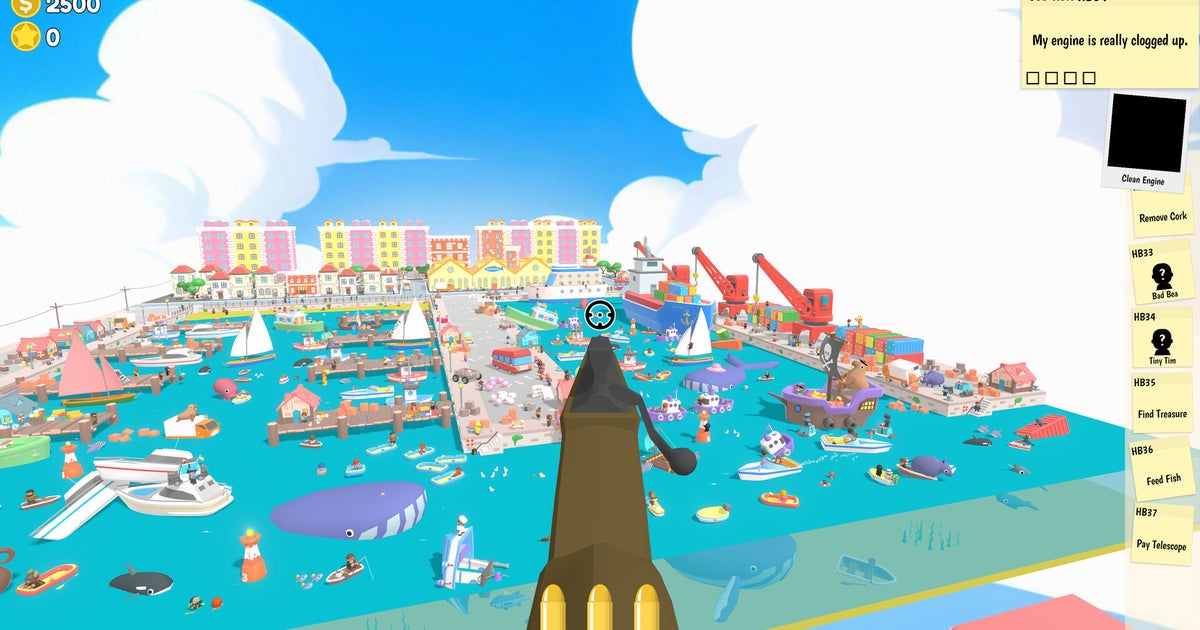
Aerial_Knight’s DropShot, a new stylized first-person indie shooter releasing on February 17, is one of those few. It was first conceived by game director Neil Jones and his long-time friend, Daniel Wilkins. Wilkins, who passed away in 2024, was a sound designer, composer on the games Never Yield and We Never Yield, and game developer.
Based out of Detroit, Jones (Aerial_Knight) explains that he has a book filled with game ideas, and DropShot was one of those concepts he spoke openly and excitedly about with Wilkins. He developed the new shooter within a year with the same excitement he’s maintained since his first title, Aerial_Knight’s Never Yield, which was released in 2021.
“I feel video games are the most expansive art form. You literally have to touch everything. From level design, interior design, you gotta create the outfits, the music, the sounds. You’re creating an entire world, so it’s a ton of work, but I just, you know, I’m at peace when I’m sitting in front of a computer just working on some stuff and just making my own games,” he explains.
Jones says that as an indie developer, he wants to keep making games for as long as he can. His personal story of how and why he makes games is similar to that of many other creators; he feels a drive to make things he cares about. Creating titles for underserved communities and establishing his own lane in the games industry also remain important to him.
Jones says, “There’s still not a lot of Black characters or Black-coded characters, you know, because Smoke Wallace (the lead character of DropShot), he’s purple, but everybody who looks at him [says] ‘Oh, he’s Black.’ “
 ©Aerial_Knight
Regarding Smoke being purple, the game originally didn’t have a story. However, for marketing purposes, it was made up on the fly and added in later on. The hero is bitten by a radioactive dragon, the creature eats his family, he can fire bullets from his fingers, and Smoke engages in aerial battles for revenge.
While DropShot is a single-player FPS, Jones admits he is not a fan of guns. He deliberately decided to have Smoke shoot with finger guns so he wouldn’t have to model guns for the hero; all the marketing prominently features the purple-skinned lead with fingers aimed at enemies. Meanwhile, the enemies you face are armed. These choices, Jones explains, are intended to subvert FPS titles. It’s also a reflection of his own desire to not have another piece of media with a Black leading man armed with a gun.
“Now this was gonna be my take on a shooter, how would I make a shooter, but I hate guns. There’s a lot of stuff that you can do outside of adding guns. We have this one power-up: you destroy a dragon egg and get power-ups, and he has 8 arms come out, turning into a Gatling gun of finger blasts. So, we’re just trying to be as creative as possible to kind of negate the violence of it all,” he explains.
“…I didn’t want to model a gun. I modeled it for the enemies and whatnot. So, it wasn’t against making guns. It was just the main character. I was [thinking] it’s so boring to just put a gun in his hand.”
 ©Aerial_Knight
Making a game is no easy feat. While Jones himself served as the main designer and director, he required a close-knit team to help him create DropShot. He enlisted the help of past collaborator Julie Huynh, and rounding out what would become Aerial_Knight Games were Tomas Abrams and Benjamin Campbell. With the team by his side, Jones found developing this fast-paced, 50-level shooter relatively easy.
“This is the third game,” Jones said. “So, I got a good workflow now, and this was the easiest of all the games we made. Because the environments are a lot simpler. You’re in the sky, so there are clouds and floating rocks, planes, stuff like that, and that’s it. So it was just me focusing mostly on mechanics and level design.”
“…The hardest part, I would say, would probably be the cutscenes. It’s because they’re all hand-animated. I did them all myself, and we have 150 cutscenes for each level. We have 50 levels, each level has a custom intro and a custom ending, and then some levels had these mini option cutscenes in between.”
The small nature of the development team also helped make the game’s development a smooth process. Jones notes that with a cohort this small, it’s easier to manage people, communicate, and iterate on ideas. If the group were larger, processes would become more complicated, so the game director prefers to keep teams small, much like the games he likes to create.
Unsurprisingly, the team of four also had a fun time generating additional ideas for the game. Jones points to a cow that’s featured in the game’s trailer.
“I had this old cow model. I put it in the trailer and made it say something, and everybody loved the cow so much,” he says.
The bovine creature became more prominent throughout the course of the game’s development.
 ©Aerial_Knight
The team said, “Hey, I want to make a cow level, special cow sunglasses, and a hidden cow event that happens.” I said all right, because I do this thing on my team, I give everybody one wish. Because I wanted [DropShot] to feel like everybody’s, you know, this is a group activity. My name is on it or whatever, but that’s because, you know, I’m putting all the risk out there, for branding, but everybody gets a wish.”
When it comes to sales performance, the game director is confident DropShot will do well. However, Jones admits that a title’s market success depends largely on luck, a factor that he says many game developers don’t appropriately acknowledge. Which is why he continues to bet on himself and the games he creates. This also included the decision to self-publish, which he says was an easy choice.
To fully explain his decision to eschew a publisher deal, he cited a quote from Lisa “Left Eye” Lopes of the popular girl group TLC. In a 1999 episode of VH1’s Behind the Music, Lopes explained how she and her bandmates were broke after selling 10 million records.
“That means that every time an album gets sold, TLC gets 0.56 cents. So, 10 million records, $5.6 million seems like a lot of money. Well, it’s not a lot of money when the record company spent $3 million to record your album. And in the record business, we pay all costs back to the record company. We paid recording costs and video costs, so now we have $2.6 million left. Well, guess what? When you have that much money, you’re in about the 47 percent tax bracket. So that immediately gets deducted to $1.3 million,” said Lopes.
– Launching on PlayStation, Xbox, & PC
-Made Without a Publisher
– 50+ levels
– Black-owned studio
– Dropping in during black history month
Don't let it get buried and forgotten https://t.co/3uf1BKbHN1
— Aerial_Knight DropShot Feb 17th (@aerial_knight) January 18, 2026
Jones admits the decision meant more work on the backend when self-publishing, but he says it was worth it. If the title sells 10,000 copies, that would be enough to fund the next slate of titles for Never Yield Games. Autonomy means a lot to him as a game developer, creatively and business-wise.
It’s why all his games are labeled Aerial_Knight, followed by their respective titles. As he explains, it’s for branding purposes, so people know it’s his work. He can even be found on social media saying no to commentators who suggest removing the label. Jones makes the point that people wouldn’t ask that of prominent figures in the games industry.




 English (US) ·