
 5 hours ago
5
5 hours ago
5
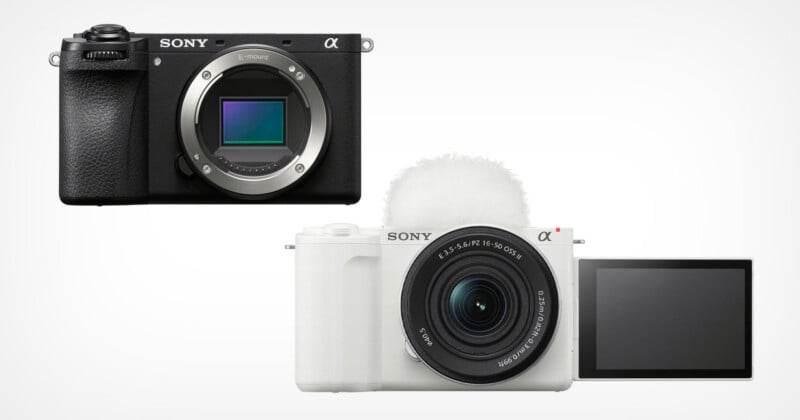
Sony’s full-frame Alpha cameras rightly get a lot of attention, especially among enthusiast and professional photographers and hybrid creators. However, the company tells PetaPixel it remains very committed to APS-C, and that demand for APS-C products has steadily increased over the years.
Sony’s APS-C Lineup Is Impressive Despite a Focus on Full-Frame
Among full-frame mirrorless camera manufacturers, Sony has a relatively healthy assortment of APS-C products. In Sony’s current lineup, it sells five interchangeable lens Alpha cameras with APS-C image sensors: the ZV-E10 II and ZV-E10 vlogging cameras, and the more traditional, generally photo-oriented Alpha 6100 (a6100), a6400, and a6700 models. Sony currently sells 15 APS-C E-mount lenses, including two converters. While Canon and Nikon both make APS-C mirrorless cameras and lenses, neither has the quantity or, arguably, the quality of Sony’s APS-C lineup.
Even still, Sony is consistently busier with full-frame releases. Since the company released the ZV-E10 II in July 2024, four new full-frame Alpha cameras have been released. Lenses are even more tilted toward full-frame FE models. Sony has launched seven FE lenses since the E-mount 16-50mm f/3.5-5.6 PZ OSS II arrived in 2024, and even that was just a slight refresh of an earlier model. Of Sony’s newest 15 lenses, the 16-50mm Mark II is the only APS-C model. Admittedly, Sony had something of an APS-C blowout back in June 2022 when it unveiled three new APS-C lenses, the 10-20mm f/4 PZ G, 15mm f/1.4 G, and 11mm f/1.8, all at once.
The point is that, from the outside looking in, it can seem like Sony is really only focused on full-frame cameras, but the company told PetaPixel at CP+ 2026 that this is not the case.
APS-C Is a Growing Segment
“APS-C is important. Looking at the market, we believe it’s growing,” said Yasufumi Machitani, General Manager, Camera Business Department, Sony Imaging Entertainment Business Unit.
“APS-C demand has been steadily growing, so we see it as important as well. We want to see the market trend and discuss future development.”
APS-C cameras are routinely popular with photographers. Although only one Sony camera made Japanese retailer Map Camera’s 10 best-selling digital cameras of 2025, the full-frame a7C II, five of the cameras on the list are APS-C models, while just three feature full-frame image sensors.
Japanese retail analyst BCN+R, which covers approximately 40 percent of Japan’s retail market, including general-purpose electronics stores, published a list of the 10 most popular cameras in Japan in 2025. The Sony ZV-E10 II was number two, while the ZV-E10 and a6400 landed in fourth and fifth place. The full-frame a7C II was eighth.
Clearly, while many hardcore photographers tend to focus relatively more on full-frame cameras and lenses, the broader market appreciates APS-C’s blend of more compact designs, lower prices, and strong photo and video features. As Fujifilm has shown with the success of its X System, APS-C cameras appeal to a wide range of photographers, from beginners to pros.
Sony told PetaPixel it does not see any difficulty marketing its APS-C products while also boasting the image quality and performance advantages of its full-frame products.
“Even if customers start with APS-C, some will upgrade to full-frame once they enjoy our products, ” Machitani explained. “We don’t limit the APS-C business.”
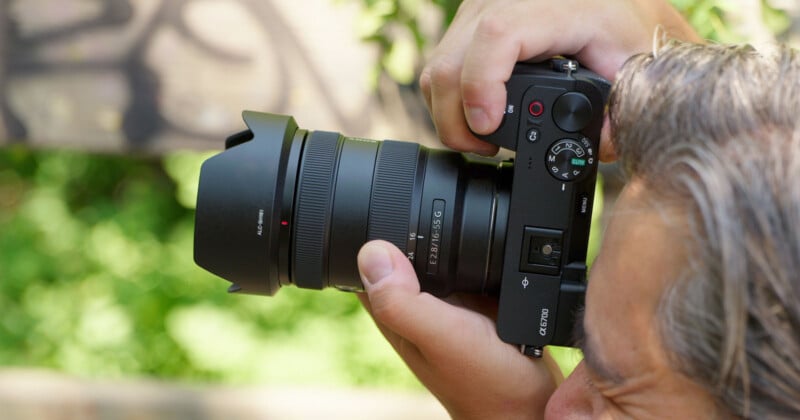 Sony a6700
PetaPixel’s Take
Looking at where Sony’s APS-C system seems to find the most success, the company’s vlogging-focused models are particularly popular. Although the a6400 and a6700 are good cameras, Sony’s emphasis on hybrid performance and video features in its APS-C product lineup has proved to be an area of relative success.
Canon has tried to grab a share of the same market with cameras like the PowerShot V1 and the EOS R50 V, but Sony was the first major manufacturer to seriously commit to the space, and it has paid dividends.
What remains to be seen is what’s next for Sony’s APS-C product lineup. Things have been pretty quiet there lately, and although the entry-level and mid-range market is not necessarily one that demands constant upgrades, it would be very interesting to see Sony give APS-C cameras higher-end photo features.
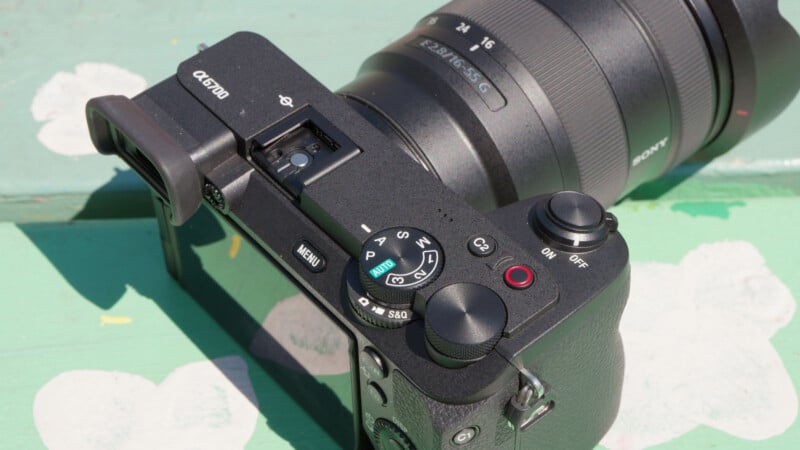
Sony, of course, won’t discuss future products, but there are plenty of photographers out there who might appreciate Sony’s take on an enthusiast-level APS-C camera with a compact but rugged a7-series body design and the company’s latest processor.
There’s always a delicate balance to strike with APS-C cameras and lenses in a predominantly full-frame product lineup. APS-C cameras and lenses are ideally smaller and lighter than their full-frame counterparts, so there is a built-in limit to how rugged and performant cameras can be and how fast lenses can be.
Another important factor in the appeal of APS-C for many customers is that cameras and lenses are relatively more affordable. It’s not feasible for any company, Sony included, to put all its latest and greatest technology in an APS-C camera targeting an aggressive price point.
However, there may be more room above the a6700’s $1,599 price point in the market. There is also a lot of space below the a7 V in Sony’s current lineup. An APS-C a7 “lite” would arguably deliver a more compelling blend of features and value than an older full-frame model, like the a7 III from 2018, which has an MSRP of $1,998.
 What if Sony made an APS-C camera built on the a7-series design, like the a7 V shown here? If it were just a little smaller and lighter, it could be a great, roughly $2,000 option in Sony’s lineup.
I would love to see Sony push its APS-C cameras further in terms of features, design, and performance. Sony has so many great lenses for wildlife and sports, two genres that benefit greatly from the 1.5 times crop factor of APS-C image sensors. Although it hasn’t been updated in a while, it’s hard not to look at the Canon EOS R7 and wonder if Sony could take some inspiration. The R7, especially at launch, embraced many of Canon’s highest-end features in a slightly smaller, reasonably affordable enthusiast-oriented body design. Sony has nearly all the pieces it needs to create something with a similar spirit, but Sony Alpha technology and soul, and I think it would be a great addition to the Alpha family.





 English (US) ·